Beware wearing ‘inside-out’ spectacles

A recurring theme, as felt by me as a ‘customer’ of many services, is that the front-line person (apparently) ‘helping me’ with my need(s) has treated me like an idiot.

I’d expect that this has been experienced by most of you.

The front-line ‘helper’ has (subconsciously) slipped into ‘you’re an idiot’ mode because it’s sooo obvious (to them) as to how to do the thing that I’m currently struggling to achieve.

Continue reading

On Consistency

I hear a recurring mantra from conventional operations management within relational service organisations. I’ve been hearing it for years.

That mantra is the (apparent) necessity for ‘consistency across the front line’.

It often starts with decrying that “we’ve got 1,0001 [front line workers] and 1,000 ways of doing things. We can’t have that, we need consistency!

So, to examine this presupposition, I’ve imagined a conversation between a senior operations person…and a coach:

Continue reading

“Our work this year”

I regularly notice many service organisations1 communicate to the public with a list of facts that apparently demonstrate that their services are a good thing. This usually occurs at their reporting year-end and is titled something like “Our work this year”2.

I call this the ‘didn’t we do well!’ comms.

Don’t get me wrong, I’m a big supporter of the concept of services that help people….and, yes, I’d like to know what these services are doing and how well this is going. Continue reading

The Golden Moment

Short post time to set out a concept that I frequently talk about…

When a client chooses to contact a service system (#inbound) there is a good chance that they have prepared themselves for this moment1, such that they have:

  • A degree of time to talk, and the mindset to want to explore/ resolve/ move things forward;
  • secured themselves a suitable/ conducive environment in which to do this (e.g. a room with privacy); and
  • gathered (what they believe are) the necessary supporting information/ documents…or may have ready access to them.

Conversely, when a service system attempts to contact a client (#outbound), it is highly likely that we may find it difficult to get hold of them…and, if we are lucky enough to achieve a connection, very few (if any2) of the above conditions may be in place! Continue reading

‘Bob the Builder’: Push vs. Pull analogy

Let’s suppose that I have the first world problem of having my home bathroom renovated. Lucky me.

I (the client) want others to do this work for me. I’m not competent/capable of doing it myself, so I contact a qualified builder.

Now, given this ‘scene setting’, I want to compare and contrast two vastly different ‘system designs’ in dealing with my need – I’ll label them as ‘Push’ and ‘Pull’…and I’ll then use my builder analogy against many a conventional service system.

Note: The Push and Pull concept can be used in several ways. In this scenario I am using:

  • ‘Push’ as the client being pushed around an inside-out focused design (as if they were merely a ‘widget’); and
  • ‘Pull’ as ‘value’ being pulled towards the client by their helper (builder), making for an outside-in flow.

Continue reading

Thou shalt care for thy customer!

I haven’t published a post for ages. However, I was part of a conversation last week in which I realised that I’d drafted a relevant post a couple of years ago. Here it is:

Show me a service organisation and I’ll likely be able to show you posters on their walls imploring (or perhaps commanding) their front-line employees to ‘care about their customers’ (or clients1).

I expect that we are all in agreement that we should care about our customers – who they are, what their situation is, what they really need, how they are thinking/feeling (because of the past, the present and their view of the future)…

…BUT whether our employees can and will ‘see the customer’, and whether they act accordingly, will depend.

The conventional way to ‘convince’ employees to care is to roll out some form of a ‘we must be customer-centric’ programme (which likely includes those posters on the wall). There might even be some framework rolled out to score how well each ‘service agent’ did within each customer interaction or (so called) ‘moment of truth’.

However…

‘Customer-first programmes’ are essentially an attitude/orientation exercise.

All too often we discover that people return highly motivated from an excellent training experience only to find an organisation with procedures, systems and other conditions which do not adequately support the values expressed in the programme.

People can’t delight the customer if their organisation won’t let them!

(John Seddon)

Seddon is clearly questioning the simple (simplistic) notion that ‘our people’ are the problem…and therefore where to aim a (supposed) solution to this.

But what about the ‘bad eggs’?

You might respond with “Yes Steve, but I’ve got clear, undeniable evidence of some of our people providing really poor service to our customers!” and, yep, I’d expect that you do. Perhaps even bucket loads of it.

The fact that poor service often happens isn’t in doubt.

The question that needs asking is “why is this happening?” And just to be super clear, NOT “who did we catch doing it?!”

If you know the why, then you will know what to act upon to achieve meaningful and sustained improvement.

Conversely, you can spend all day rooting out the ‘who’, and perhaps publicly ‘parade them around’ with the aim of shaming them for all to see…but I doubt you will achieve any meaningful improvement to your system and its performance. In fact, likely the reverse.

A self-fulfilling prophecy

So, we want our front-line employees to be ‘customer-centric’ and yet we regularly see instances where it can be said that they weren’t…and it is very easy to fall into a ‘blame game’.

However, a quote to ponder:

“When we take people merely as they are, we make them worse.

When we treat them as if they were what they ought to be, we help them become what they are capable of being.”

(Translation of Johann Wolfgang von Goethe, 1795)

I really like these words, and they have been repeated in various forms by many since they were first written. In fact, it’s almost a perfect fit with the work of Douglas McGregor (ref. Theory X and Theory Y).

To me, there are three points worth drawing out from von Goethe’s quote:

  • ‘As they are’: If we look to blame a person for the poor performance that occurred during an event that they were involved in, then we’ll be heading in the wrong direction!

  • ‘What they ought to be’: If, however, we start from a position of presuming that a person would want to do the right thing (and was likely born that way), then we change the game completely. Clarification: This isn’t denial of what has happened, just a better starting point to move forwards.

  • ‘What they are capable of being’: What I particularly like about the quote is that von Goethe wasn’t suggesting that all people can do/be anything and everything.  Rather, he recognised that people are individuals and that, if they are treated accordingly, they can achieve what they are capable of…which is likely to be far greater than what we can currently imagine.

Do you believe your own rhetoric?

If you are employed in a ‘leadership position’2 then I expect that you often find yourself talking with your team about how they should behave. In fact, if you stood back, this might be somewhat of a ‘broken record’.

However, I am reminded of the proverb “do as I say, not as I do”.

Turning this around – and therefore realising why this proverb is often stated…to little effect – is to make clear that people take note of what you do and use this as their guide…no matter what you say.

Those in leadership positions are responsible for the organisational system – its purpose and the working environment. You can say ‘wonderful things’, but the system you preside over is the key.

“People’s behaviour is a product of their system. It is only by changing the system that we can expect a change in behaviour.” (John Seddon)

Management is responsible for that system, and therefore the behaviours that it produces. No amount of ‘training’ or exhortation will undo this tie.

In short:

  • beware the dissonance between management talk and management behaviour

  • don’t spend (waste?) time exalting people to ‘care for thy customer’, provide them with an organisational system in which this is the obvious and natural thing to do

  • to do this requires much reflection as to why things are as they are, which can be discovered  from regular and respectful ‘eyes wide open’ time ‘at the Gemba’

Footnotes

1. Customer or client?: I was interested as to whether there is a meaningful difference between the use of these two words…and, after a bit of a trawl through definitions, I think that there is.

The Oxford dictionary sets out the origin of the word ‘client’ as a person who is under the protection of another i.e. dependent upon them.

The normal use of the word ‘client’ (as opposed to ‘customer’) is when it is associated with the services of a professional (examples: lawyers, accountants,….plumber) and so this now makes some sense…

I am a customer where I am clearly in control of what is happening and can make my own choices e.g. transactional situations.

I am a client where I am highly reliant on another and their care over me.

2. Leadership position…which is very different to ‘leading’. Ref. an earlier post on the notion of leadership

“Erm, I don’t know yet!”

I dont know yetThis short post is about receiving text messages from service organisations: Some are (or could be) useful, whilst many others are (ahem) ‘bullshit masquerading as customer care’.

I recently had to arrange an MRI scan. I’m getting old(er)…and so are my joints.

The initial mix up.

A medical consultant referred me for an MRI scan. She told me to expect an appointment within the next 4 – 6 weeks. Cool, that doesn’t sound too long.

I started to question things when I hadn’t heard anything after 10 weeks. I rang to chase it:

“Oh, sorry to hear that you haven’t heard from [the MRI service]. We sent the request through to them the very day that you saw your consultant. They must have ‘lost it’. I’ll send through a second request marked’ urgent’. Let me know again if you don’t hear from them.”

Making a booking

Thankfully, a member of the MRI service’s booking team rang me about a week later.

She asked me some clarifying questions, explained what would happen, gave me a few appointment slot options and I agreed to a day and time for next week. Excellent – an easy and friendly conversation. That was a good customer experience (though, please don’t ask me to give an NPS score!)

However, do you know that feeling when you put the phone down and think1:

“hmmm, I’ve hastily scribbled ‘Thursday at 9 a.m.’ down on my doodle pad next to me….I think that’s the slot that we agreed on….I hope I’ve got that right….I hope that’s what she put into her system.”

…and so what I really really really wanted was an immediate text (i.e. within minutes of ending the call) confirming the day, time and address for my scan. So simple, so easily done and so valuable.

They did send me a text. Here’s what it said:

“Hi Steve. If you need to move your appointment with [name of MRI service], please call [tel. number], thanks.”

Face palmAaaargh! That’s about as much use as a chocolate fire guard. It gives me no information of value. They have quite brilliantly engineered a near certain failure demand call from me – they’ve even given me the number to call!

So, I ring the number that they have so helpfully provided, and they confirm that, yes, I did have it right and, no, it wasn’t a problem me ringing to check – they get it all the time (operation face palm).

So that’s all well and good.

Two further texts

Time goes by and then, 24 hours before my appointment I get two (separate) text messages from the MRI service.

Here’s the first:

“Confirming your appointment with [name of MRI service] at [address] on [date], please arrive at [time]. Please phone [tel. number] if you have any queries.”

Brilliant. This is the exact text message that I wanted when I first booked. Now, don’t get me wrong – I like getting the above text the day before as a reminder…but AS WELL AS, not INSTEAD OF an initial confirmation text.

Now, I know that this blog post is totally about ‘first world problems’ and I’m really grateful for the access to the medical services that I have.  I mainly wrote this post because of the second text2 and to illustrate a point about it.

how did we doHere’s what the second text said:

“How was your recent experience with our booking team? Go to [URL].”

…and I thought “Erm, I don’t know yet…I haven’t had my scan!”

And why does this matter you might ask?

Well, I might turn up for my scan and:

  • they aren’t ready for me (perhaps there’s a huge queue); or
  • they might not have my information ‘in their system’ yet (e.g. because it hasn’t been passed on by another silo); or
  • they might have ‘double booked’; or
  • they might not have any record of my booking; or
  • they might not have informed me of something I needed to bring/wear/not wear or do/ not to do; or
  • …and on and on.

The text feedback request sent before I receive the service shows quite clearly that the organisation is trying to score a vertical silo (i.e. the booking team, and quite likely a specific person within) rather than caring about (let alone understanding) whether the horizontal service worked for the customer.

I care about ‘from my need through to its satisfaction’. I don’t care about the ‘booking team’ (sorry booking team, no offence meant).

The booking team can talk to me as friendly and efficiently as they want (which, no doubt, I would find agreeable) …but this makes up about 5% of the value of the interaction. I will only find out about the quality of my booking interaction when I come to have my scan.

Turning to the general point

I don’t mean to pick on the MRI service. It’s just the last example in a long line of service organisations sending out ‘surveys’ asking how well they did from a single interaction with me.

Whether it’s the bank, telecommunications, utility or insurance company…or even the local council.

The point is the same for ALL of them. I don’t really care about a contact, I care about whether you satisfied my need. These are totally different points of view.

In summary:

If you really want to improve your organisation, change your viewpoint from ‘inside out’ to ‘outside in’.

Addendum

Of course I had to go to the URL given to me in that last text to confirm my suspicions as to what I would find…and oh yes, regular blog readers have guessed it – they want me to give them a score from 1 through to 10 about whether I’d recommend them to my friends and family.

Ho hum.

Footnotes:

1. You might not be like this. However, I’m the sort of person where people (including my wife) deliberately ask me down the pub whether I locked the front door…just to see the doubt creeping across my face.

2. The rest is just the comedy side baggage that also occurred.

‘Chain’ beats ‘Triangle’

chain-beats-triangleFollowers of ‘Modern’ (?) management find themselves in essentially the same position: Trying to increase value1 to their investors. But, if this is their outlook, where to start?

Introducing the Triangle

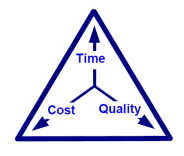
Perhaps the place where ‘the triangle’ is seen most visibly is within many a traditional project management book – you will likely see a lovely little diagram within its first few foundational pages, with the words ‘quality’, ‘cost’ and ‘time’ at its points.

triangleIt will go on to suggest that the Project Manager’s job is to juggle these three variables so as to deliver ‘on time, within budget and to an acceptable quality’.

The key thing to notice is the assumption that there is an equation in which these variable are somehow related….and received wisdom goes on to suggest that there is a trade off and ‘we can’t have it all’ e.g. if we want higher quality then this would sacrifice time and/or cost.

…and the thinking behind that triangle isn’t limited to projects…it goes right across the organisation, in everything it does – basically that faster and cheaper are the opposite of higher quality.

All makes sense doesn’t it – nothing to see here. Blog post over?

Well no, as you’ve probably guessed, I’m just revving up!

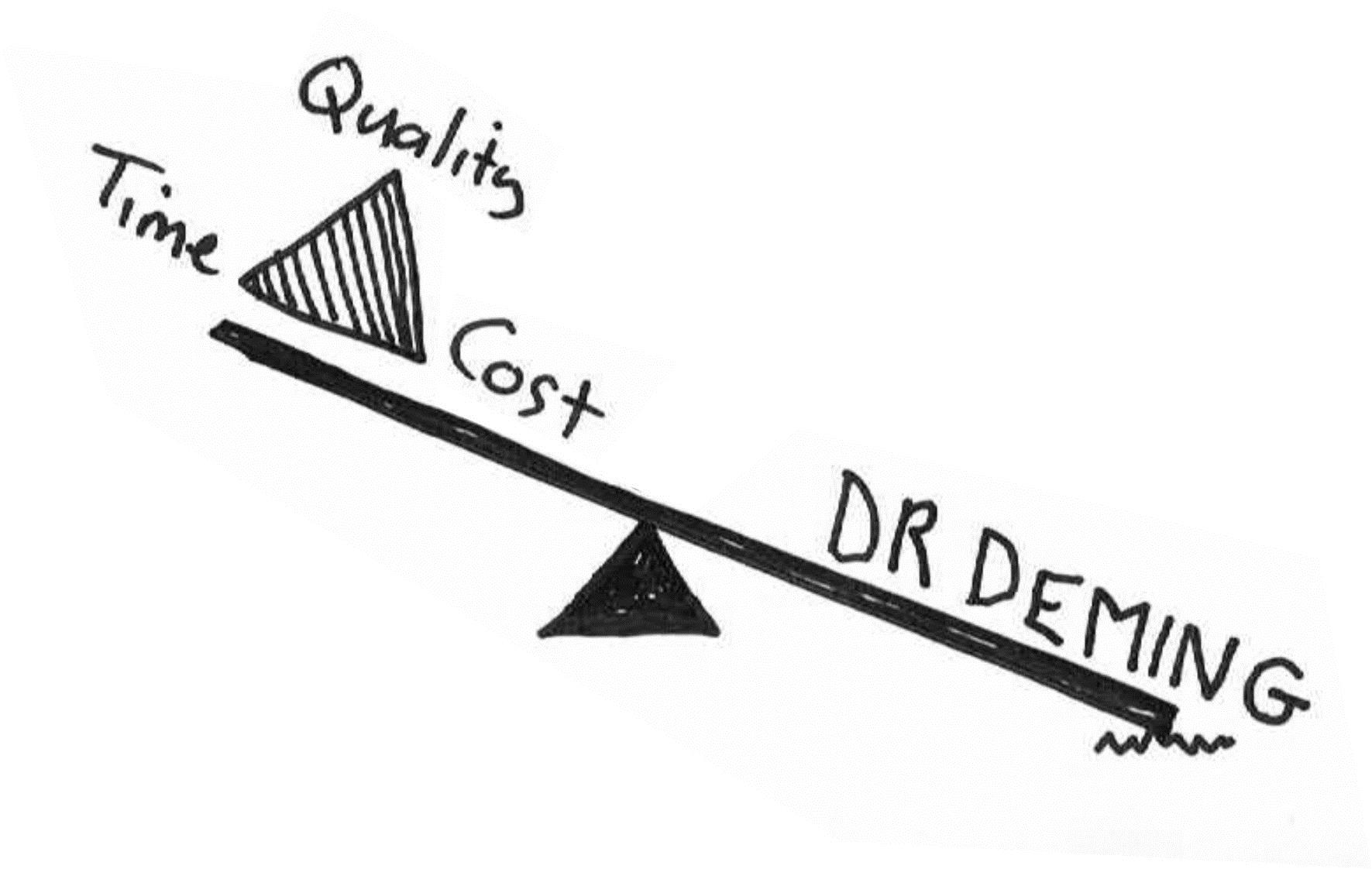
And so to Dr Deming:

In his book ‘Out of the Crisis’ (1982)Dr W. Edwards Deming wrote about the “folklore…that quality and productivity are incompatible: that you can’t have both. A manager will usually tell you that it is either or. In his experience, if he pushes quality, he falls behind in production. If he pushes production, his quality suffers. This will be his experience when he knows not what quality is nor how to achieve it.”

Deming’s last line suggests that there could be value in exploring:

  • What ‘quality’ means; and
  • His thinking on how to achieve it.

What is quality?

It’s obvious isn’t it? Surely, it’s simply “how good something is!” Well, yes…but that doesn’t get us very far. It poses the rather obvious question “good for who?”

There are two levels to drill into:


Level 1 (and perhaps you’ll all be yawning reading this much-stated point) is that quality is, and can only be, defined by ‘the customer’ (or citizen or patient or….).

It follows that you can’t tell your customers what quality is, or quietly determine this for them. Instead, if you really want to deliver ‘quality’, you’d better spend time constantly understanding2 your customers and what they want/ need from your product/ service/process.


Level 2 is that there is no such thing as the average customer – no two customers are the same – and, as such, quality is defined by each unique customer…and this point has profound implications (particularly for service organisations).

For example, it would be a mistake to create a ‘customer specification’ and think that you have solved the quality conundrum. We need to understand the particular customer before us and design a system that can effectively, and efficiently, absorb their variety. This would be the opposite of trying to force them into a straight jacket.

“You’ve ‘dissed’ the triangle…but what’s your ‘Chain’ got to do with it?”

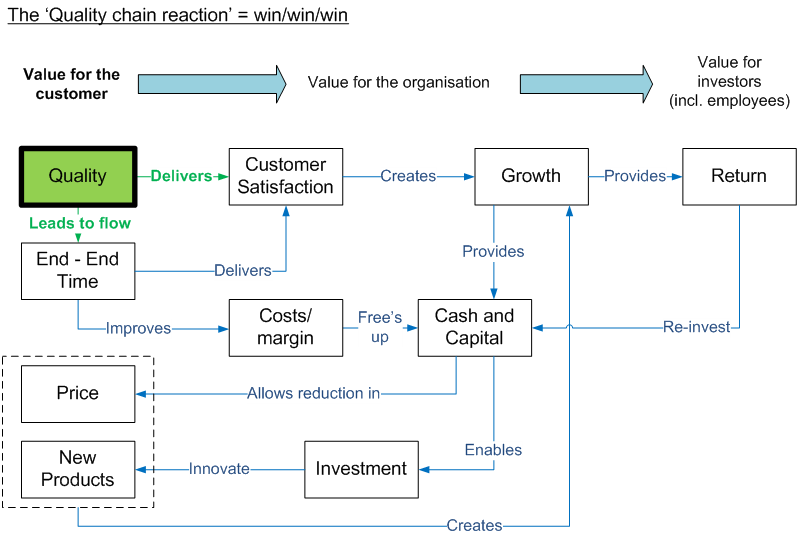
And so to Deming’s thinking on how to achieve quality. I’ll start by introducing his ‘quality chain reaction’:

Deming wrote that, in the post World War 2 period, some Japanese companies observed that “improvement of quality begets naturally and inevitably improvement of productivity.” i.e. that when quality goes up, costs actually come down. This would seem to be the opposite of our triangle!

How can this be so? Well, when the quality goes up, costs decrease due to fewer mistakes, less rework, fewer delays…reduced failure demand…and on and on. This leads to a continually improving flow.

Deming went on to write that the following “chain reaction was on the blackboard of every meeting within top management in Japan from July 1950 onwards:”

Improve quality – costs decrease – productivity improves – capture market (better quality, lower prices) – stay in business – provide jobs…and more jobs.

Notice where it ends – jobs. Contrast this with where most cost-cutting ‘initiatives’ start – jobs…but not to create them!

Deming calls out a difference in thinking3:

“Western Industry is satisfied to improve quality to a level where visible figures may shed doubt about the economic benefit of further improvement. As someone enquired, ‘how low may we go in quality without losing customers?’ This question packs a mountain of misunderstanding into a few choice words. It is typical of management’s misunderstanding in America.

In contrast, the Japanese go right ahead and improve the process without regard to figures. They thus improve productivity, decrease costs, and capture the market.” (Deming)

‘Triangle’ thinking requires a detailed business case, showing a healthy (yet imaginary) ‘return on investment’ (ROI) before anything can gain authorisation to proceed. This is, unhelpfully, labelled as ‘governance’.

‘Chain reaction’ thinking uses a clear vision, for the customer, and gets on with constantly experimenting towards it, whilst checking the results. This generates a purpose-seeking learning organisation.

Updating the Quality chain

Dan Jones, in one of his YouTube videos, expands Deming’s quality chain reaction to show its wider effect on the full organisational system4. I really liked what he had done on his slide…but I wanted to make it clearer still…and so I ‘tweaked it’ (see below5)…showing that, if you start at quality, the chain reaction is kicked off and then continues to flow around and around the system:

quality-chain-reaction

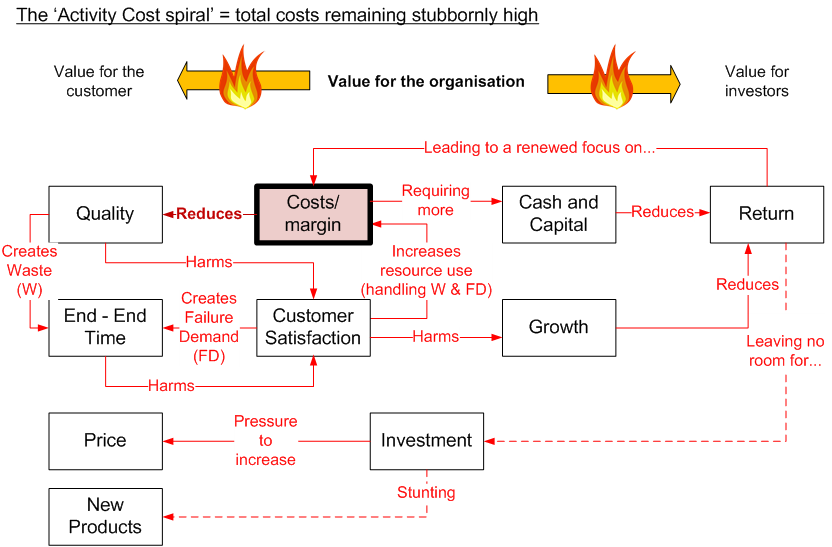
Now, many a command-and-control organisation would look at the above and shout out “that’s exactly what we are doing!”…and so, to counter this riposte, I thought I’d re-do the diagram but this time start at cost.

i.e. if your starting point is to reduce costs (usually by interrogating line items on the P&L, and focusing on activities) then you are NOT on the quality chain reaction. You would be on quite a different journey:

activity-cost-spiral

In a sentence:

Customer Purpose (which, by definition, means quality) comes first…which then delivers growth and profitability, and NOT the other way around!

…and, for all you executives/ senior managers out there, many (most!) of your people already know this6.

Footnotes

1. The definition of Value: I reflect on a rather nice quote from Jeffrey Liker: “The first question…is always: ‘What does the customer want from this process?’ This defines value.

Unfortunately, the modern corporate world has somewhat twisted this definition, and has come to believe that value is defined by the providers of ‘dead money’.

2. Understanding your customer: This requires much more than simply asking them what they want/ need. They often don’t know or, even if they do, can’t (or won’t) clearly articulate this. We need to listen to, and observe, the demands that they place on the system…and then we can truly understand how they behave.

3. Deming’s ‘Western/ American vs. Japanese’ comparison reflects the age, and focus, that he was operating within. Times have changed – not all Western/ American organisations can be tarred with the same brush…and not all Japanese organisations have stayed true to this thinking.

I suggest a modern interpretation would be to compare how organisations are run, by:

  • Command-and-Control ‘financial engineers’, attempting to use remote-control management; with
  • ‘Systems thinking’ value stream managers

4. Dan Jones presentation: See his slide with the heading ‘defining value’

5. Value for investors: I’ve added employees to the ‘value to investors’ column label within the diagram, to reiterate my recommendation that the system needs ’live moneyto enable this way of thinking.

6. A common aim: The production worker in Japan, as anywhere else in the world, always knew about this chain reaction; also that defects and faults that get into the hands of customers lose the market and cost him his job.

Once management in Japan adopted the chain reaction, everyone there from 1950 onward had one common aim, namely, quality.

With no lenders nor stockbrokers to press for dividends, this effort became an undivided bond between management and production workers.” (Deming)

I know that it’s a broken record but…this last sentence returns back to “Your Money or your Life!”

“You keep saying that…but what does it mean?!”

what-does-it-meanSo I recently had a most excellent conversation with a comrade.

I’d written some guff in the usual way and he wanted to push back on it…great! I need to be challenged on my thinking, particularly the more I verbalise (and therefore risk believing) it.

His push back:

I’d used the ‘absorb variety’ [in customer demand] phrase yet again…and he (quite rightly) said “but what does it mean?”

He went on to say that, whilst he understands and agrees with a great deal of what I write about, he doesn’t fully agree with this bit. He has reservations.

So we got into a discussion about his critique, which goes something like this:

“I agree that we should be customer focused, but…‘absorb their variety’???

You can’t do anything for everybody….they’d start asking for the world…you’d go out of business! There have to be rules as to what we will or won’t do.”

He gave an example:

“If a customer asked you to fax them their documents [e.g. invoice, contract, policy…], surely you’d say no because this is such old technology and it doesn’t make sense for people to use it anymore.”

Yep, a very fair view point to hold…and an example to play with.

So, in discussing his critique, I expanded on what I mean when using the ‘absorb variety’ phrase. Here’s the gist of that conversation:

First, be clear as to what business you are in

Taking the “you can’t do anything for everybody” concern: I agree…which is why any business (and value stream within) should be clear up-front on its (true) purpose.

However, such a purpose should be written in terms of the customer and their need. This is important – it liberates the system from the ‘how’, rather than dictating method. It allows flexibility and experimentation.

Clarification: ‘liberating’ doesn’t mean allowing anything – it means a clear and unconstrained focus on the purpose (the ‘why’ for the system in question). If you don’t have a clear aim then you don’t have a system!

Understanding the customer: who they are, what they need.

fredOkay, so the purpose is set, but each customer that comes before us is different (whether we like this or not). The generic purpose may be the same, but what works best for each unique customer and their specific situation will have nuances.

On ‘unique’: A service organisation (or value stream within) may serve many customers, but a customer only buys one service – their need. We need to see the world through their eyes.

“The customer comes in customer-shaped” (John Seddon)

Let’s take the scenario of an insurer handling a house burglary, with some contents stolen and property damage from the break-in.

The customer purpose of ‘help me recover from my loss’ is generic yet focused…it clearly narrows down what the value stream is about.

But, at the risk of stereotyping, here’s some potential customer nuances:

  • Fred1 is an old person that lives at home alone. He’s very upset and concerned about his security going forward;
  • Hilary is a really busy person and just wants the repair work done to a high quality, with little involvement required from her;
  • Manuel2 doesn’t speak English very well;
  • Theresa is currently away from the country (a neighbour notified the police);
  • ….and the variety goes on and on and on3

Each of these customers needs to recover from their loss…but the specifics of what matters differ and these can be VERY important to them.

If we (are ‘allowed’ by our management system4 to) make the effort up-front to (genuinely) understand the customer and their specific unit of demand, and then work out how best to meet their needs then they are going to be very happy…and so are we…AND we will handle their need efficiently.

If we don’t understand them and, instead, try to force them into a transaction orientated strait-jacket, we can expect:

…adding significant and un-necessary costs and damaging our reputation.  Not a great place to work either!

Do what is ‘reasonable’ for them

Right, so you may agree that we should understand a customer and their reality…but I still hear the critique that we can’t do anything and everything for them, even if it could be argued as fitting within the purpose of the value stream in question.

So let’s consider the ‘what’s reasonable?’ question. ‘Reasonable’ is judged by society, NOT by your current constraints. Just because your current system conditions5 mean that you can’t do it doesn’t make it unreasonable!
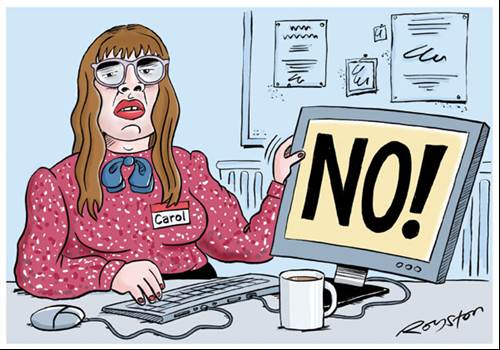
computer-says-noA test: if you (were allowed to actually) listen to the customer, understand the sense in their situation and the reasonableness of their need…but respond with “computer says no” (or such like) then your value stream isn’t designed to absorb variety.

And so we get to what it means to design a system that can absorb variety.

It doesn’t mean that we design a hugely complicated system that tries to predict every eventuality and respond to it. This would be impossible and a huge waste.

It means to design a system that is flexible and focuses on flow, not scale. This will be achieved by putting the power in the hands of the front-line worker, whilst providing them with, and allowing them to pull, what they need to satisfy each customer and their nominal value. This is the opposite of front-line ‘order takers’ coupled to back-office specialised transaction-oriented sweat shops.

How does that ‘fax request’ example sit with the above? Well, on its own, I don’t know…and that’s the point! I’d like to know why the customer wants it by fax.

  • perhaps they aren’t in their normal environment (e.g. they are on holiday in the middle of nowhere) and the only thing available to them is some old fax machine;
  • perhaps they didn’t know that we can now email them something;
  • perhaps they don’t (currently) trust other forms of communication…and we’d do well to understand why this is so;
  • perhaps, perhaps perhaps…

Each scenario is worthy of us understanding them, and trying to be reasonably flexible.

Forget all that!

take-a-lookOf course the above means virtually nothing.

You’d need to see the variety in your system for yourself to believe, and understand, it…and the way to do that would be to listen and see how your current system DOESN’T absorb variety.

How would you do that? Well, from listening to the customer:

  • in every unit of failure demand;
  • within each formal complaint made to you;
  • …and from every informal criticism made ‘about you’ (such as on social media)

I’ve got absolutely no idea what you would find! But do you?

 The funny thing is…

…if we allow front-line/ value-creating workers to truly care about, and serve each customer – as individuals – in the absence of ‘management controls’ that constrain this intent (e.g. activity targets) then:

  • the ‘work’ becomes truly inspiring for the workers, ‘we’ (the workers) gain a clear purpose with which we can personally agree with and passionately get behind;
  • we become engaged in wanting to work together to improve how we satisfy demand, for the good of current and future customers; and
  • the ‘management controls’ aren’t needed!

If I asked you, as a human being:

  • do you primarily care about, say, a ‘7 day turn-around target’? (other than to please management/ get a bonus)

vs.

  • do you really want to help Fred (or Hilary, Manuel, Theresa…) resolve their specific needs and get back on with their lives?

…how would you answer?

We need to move away from what makes sense to the attempted industrial production of service delivery to what makes sense in the real worlds of the likes of Fred.

Footnotes

1. Fred: The picture of Fred comes from a most excellent blog post written by Think Purpose some time ago. This post really nicely explains about the importance of understanding customer variety in a health care setting.

2. Manuel: A tribute to the late Andrew Sach (a.k.a Manuel from Fawlty Towers) who died recently. He wasn’t very good at English…
que

3. Variety in service demand: I’ve previously written about Professor Frances Frei’s classification of five types of variety in service demand and, taken together, they highlight the lottery within the units of demand that a service agent is asked to handle.

4. Allowed to: This is not a criticism of front-line workers. Most (if not all) start by wanting to truly help their customers. It is the design of the system that they work within that frustrates (and even prevents) them from doing so.

You show me a bunch of employees and I’ll show you the same bunch that could do awesome things. Whether they do so depends!

5. System Conditions may include structures, policies, procedures, measures, technology, competencies…

6. Bespoke vs. Commoditisation: It has been put to me that there are two types of service offerings. Implied within this is that there are two distinct customer segments: One that wants little or no involvement for a low cost and another that wants, and is willing and able to pay for, a bespoke service.

This is, for me, far too simplistic and misunderstands customer variety. Staying with the world of insurance…

A single customer might want low involvement when managing their risk (taking out a policy and paying for it, say, ‘online’) but to deal with a human if they need help recovering from a loss (i.e. at claim time).

That same customer may switch between wanting low involvement and the human touch even within a value stream – e.g. happy with low involvement car insurance but wants a human when it comes to their house insurance.

…and even within a given unit of demand, a customer may be happy with low involvement (say registering a claim)…but want the option of a human conversation if certain (unpredictable) scenarios develop.

The point is that we shouldn’t attempt to pigeon-hole customers. We should aim to provide what they need, when they need it…and they will love us for it!

7. Automation: On reading the above, some of you may retort with “Nice ideas…but you’re behind the times ‘Granddad’ – the world has moved to Artificial Intelligence and Robotics”. I wrote about that a bit back: Dilbert says… lets automate everything!

Dilbert says…let’s automate everything!

Dilbert portraitI absolutely love ‘Dilbert’ – it seems to me that Scott Adams, the cartoonist, has seen into our very souls when it comes to our working lives.
You may also love the Dilbert cartoons but what you might not know is that Scott wrote a couple of (let’s call them) ‘essays’ as the introduction to his first Dilbert book1…I read them many years ago and they made me cry with laughter.

I’ve not thought about these for a long time, but they popped into my head recently when I was considering where the world is heading in respect of invention, and specifically automation.

I’d like to reproduce the core parts of one of his comedy essays here, for use in this post (I hope Scott doesn’t mind… this is, after all, a plug for his books 🙂 ). Here goes:

“Theory of Evolution (Summary)

First, there were some amoebas. Deviant amoebas adapted better to the environment, thus becoming monkeys. Then came Total Quality Management. I’m leaving some of the details out…

Anyway, it took many years to get to this lofty level of evolution. That leisurely pace of change was okay because there wasn’t much to do except sit around and hope you didn’t get eaten by wild pigs. Then somebody fell on a sharp stick and the spear was invented. That’s when the trouble started…

I wasn’t there, but I’m willing to bet that some people said the spear would never replace fingernails as the fighting tool of choice…’diversity’ was not celebrated back then, and I expect the ‘Say No to Spear’ people got the ‘point’ if you catch my drift.

The good thing about the spear is that almost everybody could understand it. It had basically one feature: the pointy end. Our brains were fully equipped for this level of complexity. And not just the brains of the intelligentsia either – the common man could find his way around a spear too. Life was good…almost nobody complained about how confusing the spears were….

Suddenly (in evolutionary terms) some deviant went and built the printing press. It was a slippery slope after that. Two blinks later and we’re switching batteries in our laptop computers while streaking through the sky in shiny metal objects in which soft drinks and peanuts are served.

I blame sex and paper for most of our current problems. Here’s my logic:

Only one person in a million is smart enough to invent a printing press. So when society consisted of only a few hundred apelike people living in caves, the odds of one of them being a genius were fairly low. But people kept having sex, and with every moron added to the population, the odds of a deviant smarty-pants slipping through the genetic net got higher and higher, When you’ve got several million people running around having sex all willy-nilly the odds are fairly good that some pregnant ape-mom is going to squat in a field someday and pinch out a printing-press-making deviant.

Once we had printing presses, we were pretty much doomed. Because then, every time a new smart deviant came up with a good idea, it would get written down and shared. Every good idea could be built upon. Civilisation exploded. Technology was born. The complexity of life increased geometrically. Everything got bigger and better. Except our brains.

All the technologies that surround us, all the management theories, all the economic models that predict and guide our behaviours, the science that helps us live to eighty – it’s all created by a tiny percentage of deviant smart people. The rest of us are treading water as fast as we can. The world is too complex for us. Evolution didn’t keep up.

Thanks to the printing press, the deviant smart people managed to capture their genius and communicate it without having to pass it on genetically. Evolution was short circuited. We got knowledge and technology before we got intelligence.

We’re a planet of nearly six billion ninnies living in a civilisation that was designed by a few thousand amazingly smart deviants.”

Oh, there’s so much in there to work with! But, first…

What about you and me?

…I believe that I am reasonably intelligent (don’t we all!) but I’m absolutely certain that I’m not one of the “deviant smarty-pants”. I use a fair bit of technology in my daily life but don’t really know how it works. Sure, I can read Wikipedia like the next ape and spout out that it’s all about 0’s and 1’s…but that doesn’t mean that I really ‘get it’.

Now, I don’t mean to be rude, but the vast majority of you reading this aren’t likely to be geniuses either…and if you are, then please consider our predicament and look after us 🙂

…and so, to automation:

With reference to Scott Adam’s evolution theory, I often feel like we have become a bunch of idiots within our world, and each fresh automation added to our environment likely makes this more so.

There appears to be a large push for the likes of robotics and artificial intelligence at the moment, with lots of super positive articles being written by ‘interested parties’.

I reckon that we would be wise to ponder the automation thing and to have a healthy regard to what it implies. This isn’t to be a luddite2 and try to hold back the tide of change. It is suggesting that we fully think through what it means, across a broad context, and not be easily persuaded by some futuristic promise of bliss (which we should constantly reflect is mainly coming from those selling it).

(By way of context: this post was triggered by a recent article in respect of a fatal accident involving Tesla’s semi-autonomous car. and a discussion with work colleagues)

The calculator as one of the simplest of examples:

Many years ago I trained to be a Maths teacher, along with a good mate called Dave.

We used to have a laugh whenever we asked one of our students how they had arrived at a particular answer and they would simply reply that “I worked it out with my calculator Sir”.

We did the usual “back in my day” lament about kids not knowing how to do simple arithmetic on a piece of paper and becoming reliant on a calculator instead.

Now, you might respond with “yeah, but why do they need to learn all that stuff if they’ve got a calculator!”…and, mainly, I’d see your point.

The problem comes when they accidentally miss-key into their wonder machine, get a result and blindly rely on it.

If you don’t understand the basics of what’s going on, then you can’t be expected to spot an error (often in our inputs or usage). How could you?

To the world of work:

To take the calculator example, and turn it into a generalisation: You can’t truly cope with a defect (or failure demand), let alone improve the system that created it, if you don’t understand what’s actually going on.

If we are going to automate things, then I’d suggest a few automation design principles should be used…such as:

  • it must be very obvious to the people utilising the automation as to what is actually happening (i.e. this is not hidden or over-complicated);
  • it must be possible, and easy, to take back control and experience the task for ourselves; and
  • taking back control (i.e. ‘switching to manual’) is encouraged…and even required on a regular basis.

This may add initially to any automation endeavour, but should pay itself back handsomely when in operation, by our understanding of (and retention of control over) what is actually taking place.

(I note Toyota’s thinking in respect of automation: i.e. automation may prove useful, but it isn’t the objective and could be a hindrance.)

Humanity, and customers:

Going back to that ape thing: Given that we are basically a bunch of “ninnies”, we should design accordingly.

My criticism of many (most?) automation efforts is that they are aimed at efficiency.

Our true purpose should be effectiveness, and that requires us to fully appreciate our customers, and their* (wildly varying) ape-like humanity.

(* again, I don’t exclude myself from this)

Every attempt at efficiency, say through pushing the likes of contact centre IVRs, self-service portals and ‘chat-bots’3 onto customers, is hugely wasteful and counter-productive if they aren’t effective (which means valuable for the customer, for their needs)

We should be pulling innovative ideas on the basis of clear value for our customers.

So, I suggest that the first automation design principle should be that the customer (a human being) would want it!

 …and, as a bonus for reading this far:

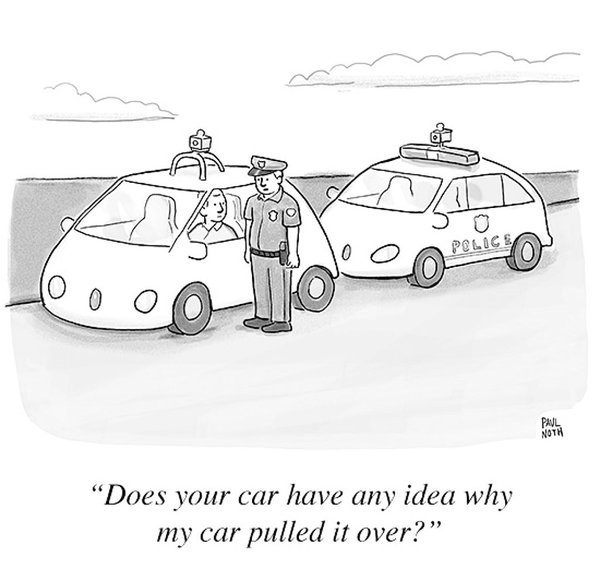
I share the following thought-provoking cartoon4 :

auto cars

Footnotes

1. Scott Adam’s book is called ‘The Dilbert Principle’ and was first published in 1996.

2. Being a Luddite: A clarification for all you early adopter ‘technologists’ out there. This post isn’t an attempt at denial. It is (hopefully) to provide some healthy self-reflection when putting forward the next hugely optimistic article on what’s coming to take over our worlds :);

3. Chat bots: I found this recent BBC article somewhat illuminating, particularly IKEA and ‘Anna’. “In the beginning, we tried to impersonate a person, and we found that there was no reason to do that”. This speaks volumes to me. By causing a confusion to the human as to ‘what’ they are interacting with, we create an unnecessary and yet fundamental problem.

4. Credit: This cartoon was found by a colleague. Thanks 🙂