The Emperors Clothes

emperors_new_clothes_550There are some funny conversations going on around me at work at the moment. I can hear sentences starting with:

“Now, I don’t agree with it either BUT…; or

“Let’s just muddle through and see what we can come up with…; or

“Let’s try and make this a painless as possible…; or even

“Let’s just pretend to play the game…

What’s this all about? Well, it’s ‘end of year’ time at work and the performance review show is just ramping up. I can feel it all around me. The words quoted above are what I can hear from managers (appraisers) when talking with their teams (appraisees).

These bizarre yet established conversations aren’t new to this year. I hear them every year.

The children’s story ‘The Emperors Clothes’ springs to mind. Everybody knows something important but can’t bring themselves to tell the Emperor….so they carry on with the charade.

I feel like the little boy in the story who dared to say something….and here it is: An Exercise in Futility.


Of note: All these managers do want to talk to their teams but not through an annual judgement exercise.

Falling into that trap!

BearTrap_01.jpga203455b-ef09-4c5a-be36-5fe7351fd23fLargeSo I cycle to work when I can. It’s approx. 22km from one side of the city of Christchurch to the other, right through the middle. I (usually) enjoy it immensely.

I upgraded my cycle computer a few months back to a fancy new GPS one. It’s got this cool screen that tells me lots of information. I can also download each cycle ride’s data onto my computer to analyse later – perfect for a geek!

I’d been using this computer for a few weeks and was starting to get an understanding of my average km/ hour for each trip. Sometimes I could get it into the 27 km/hour range, other times I could only manage 23 km/hour….and before all you MAMILs* out there guffaw thinking “how slow?!” the average speed takes into account stopping at lots of junctions (traffic lights, roundabouts, road works) and crossing busy traffic….not that I’m saying that I am fast.

(* MAMIL: middle-aged men in Lycra…and I must confess to being a member of)

Further, the computer tells me my average km/ hour at the bottom of the screen as I cycle. I can see it going up and down throughout the journey. If I stop at a junction I can see it plunge rapidly whilst I am sat idle and then if I cycle on a long flat straight I see it slowly rise back up again.

Now, I fell into the trap! I began to get distracted by the average km/ hour reading as I cycled. Without consciously thinking about it I set myself a target of completing each ride at an average of 25 km/hour or higher. The fact that I was doing this only dawned on me the other day after I performed a dodgy manoeuvre in my obsession to keep my average above the target… my sudden sense of mortality put me into a reflective mood.

Here’s what I reflected on:

What had I become?

  • I had started to look at the average km/ hour reading all the time and obsess about it dropping below the magical 25;
  • If I was stopped at traffic lights, I watched the average km/hour reading sink before my eyes. I was then in a mad hurry to get off so as to get that average back up again as quickly as possible:
    • which meant that I was trashing my legs and blowing them out too early in the ride…
    • which put me at huge risk of pulling a muscle/ injuring a joint whilst piling on the pressure to get back above that target…
    • which meant that I didn’t cycle the next day because I couldn’t!
  • If I was ‘on the cusp’ of the target and coming up to a junction then I was starting to do dangerous things in order to keep going, like running orange lights or crossing lanes in between cars;
  • Even more bizarrely, I had unconsciously started to cheat!
    • I had changed my behaviour to only turning on the computer after I had got going from my house because the few seconds getting up to speed from rest might count!
    • If my average was 25.0 as I got to work I would turn the computer off before I came to a rest…so that it couldn’t drop down to 24.9 as I slowed…because that would have meant failure!
  • Conversely, if I was well above the target (let’s say because I had a good tail wind or I had been really lucky with the light sequences), then I was pretty happy and relaxed…no need to push since I was ahead. I could have gone faster.

Reading the above, you may think me to be a bit of a nutter! Did I really do those things? Well, yes, I did…and I can honestly say that the 25 km/ hour target that I had set myself was to blame.

Now for those of you who have been on one of my courses or who have read the majority of posts on this blog, you will likely have a good laugh at me – “he bangs on about the evils of targets all the time!”

So, getting away from my target:

What is my actual purpose in cycling to work?

On reflection I came up with the following:

“To safely cycle to work so that I get fitter and I use the car less.”

Three things come out of this purpose:

  • Fitter: I wanted to get better at it
  • Use the car less: I needed to be able to cycle consistently, day after day
  • Safely: there’s no point in getting killed or badly injured cycling!

This clarity of purpose has helped me drastically change the way I cycle!

Thinking about variation within the system:

In this case, the system is the cycling to/from work and the conditions I encounter in doing so. One cycle ride is a single ‘unit of production’. I should be thinking about the capability of the system (about how all units go through it), not about a single unit.

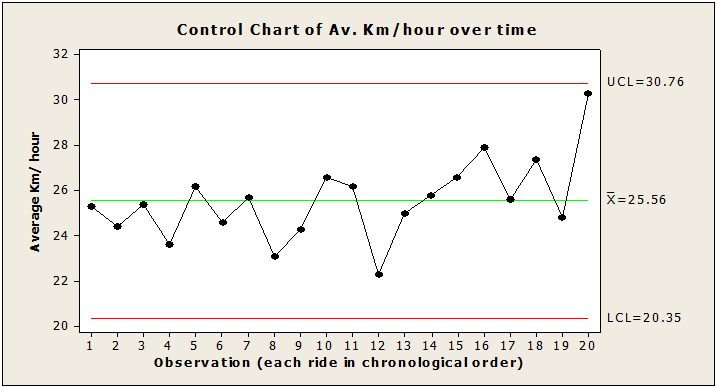
Here’s a control chart showing the variation in the last 20 of my rides:

bike control chart

The control chart enables you to visualise what a table of data can’t…that my riding is stable. It shows the meaninglessness of the target and variance analysis.

The following are the more obvious causes of variation:

  • Head wind or tail wind (makes a huge difference!);
  • Wet or dry weather;
  • Heavy or light traffic;
  • Whether the traffic light sequences are with me or not;
  • …and so on

Some special causes might be:

  • An accident;
  • Road works

…although if you live in Christchurch you will know that there’s nothing special about road works !!!

You can see that it would be bizarre for me to achieve the same average km/ hour every day. Going back to that target: Some days it will be impossible for me to hit the 25, other days it will be really easy…and that’s without me changing anything about my riding.

Note: Looking back at the control chart, you might think that you detect an improvement from around ride 15 onwards. In fact, it was at around ride 15 that I had my ‘I’ve fallen into the target trap’ epiphany….so, yes, there could be something in that. However, you should also know that whilst ride 20 looks fantastic (it was), I had a massive Nor’ Wester wind behind me literally pushing me along.

What can I experiment with to increase my capability?

The first thing I need to do is STOP LOOKING at the average km/hour as I cycle. Then I can consider what I can change about my cycling for every ride.

Since ride 15 I’ve begun to experiment with:

  • Junctions: looking well ahead and adjusting my pace to time myself through them so that I reduce the need to slow down/ stop
  • Pedalling: trying to pedal more smoothly and efficiently
  • Crossing lanes: improving my balance when looking behind me so that I can safely do this whilst retaining my speed with the traffic
  • ….and so on.

Each of these changes will lead to small improvements on every ride, no matter what the conditions are. It’s not about the current unit, it’s about every unit.

Results?

Well, it’s too early to draw valid conclusions (I need more data), and it’s a never ending journey of improvement BUT I can say that I am cycling more often (because I didn’t wreck my legs the day before) and I’m having far less ‘that car’s a bit too close for comfort’ moments.

So what’s the point?

Targets cause dysfunctional behaviour. As Simon Guilfoyle makes clear:

“As a ‘method’ [Setting a target] is rubbish because it disregards the capability of the system and natural variation. … It assumes that the system knows the target is there and will respond to it (it doesn’t and it won’t!) It ignores the fact that the greatest opportunity for improving performance lies in making systemic adjustments rather than berating, comparing, or otherwise trying to ‘motivate’ the workers to achieve the target.”

‘No targets’ doesn’t mean ‘no measurement’! In fact, it’s quite the reverse. It means actually studying meaningful measures (i.e. against purpose) over time (via a control chart), understanding the capability of the system and therefore truly understanding whether it is improving, staying the same or getting worse.

Do you have targets? So what dysfunctional behaviours do they cause, moving us away from purpose?

Chalk and Cheese

Chalk-and-CheeseLet’s compare two organisations (or departments within):

In one (let’s call it Cheese – I like cheese…it matures into a lovely outcome):

The senior manager is curious as to how to get the best out of the system, for the good of the customer. She has understood that, to achieve excellent results, the organisation must continually work on the causes of those results.

She questions her own learning’s to date, always looking to expand her knowledge and amend her ‘worldview’, seeks counsel from others* and (once suitably skilled) actively coaches the people that work within the system. She has the humility to realise that her role is to lead, not to know the answer.

* such counsel comes from meeting the process rather than a reliance on the  senior management team.

This mentality has become the way that all her managers now think and operate and, because of this, they have removed all ‘management instruments’ that get in the way of collaborative system-wide thinking.

They don’t believe that the ‘answers’ are out there, to be found and copied from other organisations or consultancies selling the ‘current best practise’.

Instead:

  • they identify measures that demonstrate the system’s capability at delivering value to their customers (making these transparent to all) and they monitor these measures over time to understand variation and any progress.
  • they constantly work to understand their current condition, set themselves challenges (target conditions) that, when achieved, would be good for their customers and then move towards these goals through experimentation and learning.

They accept that their path will be unclear…but they are clear on what they want to move towards, why and how they are truly doing.

And, because of the above:

  • everyone is engaged in a collaborative effort towards a clear purpose (for the customer);
  • there is transparency for all within the system;
  • there is mutual trust and respect across the system; and as result
  • there is a high degree of commitment and engagement….dare I say ‘a thriving culture’ in which people want to come to work

BUT: it’s not perfect, it’s often rather messy…but learning is like that.

In the other (Chalk – crumbly, disintegrates…not enjoyable to consume!)

The senior manager has come across some improvement methodologies and guru books and has issued a directive that these will be implemented across the organisation.

A corporate team is set up to drive each implementation. Energy is spent developing and deploying presentations, training, tools, templates and methods of working. There is an implementation plan with activities, milestones and metrics. Benefits are to be ‘realised’.

Tweaks are made to incorporate the programme into the existing management instruments: objectives, performance appraisals, rewards, awards.

‘Operations’ (the various teams within) are then expected to enthusiastically embrace and absorb the ‘shiny new thing’ (along with the other ones that are regularly handed down from the brains above) whilst continuing to deliver against silo’d targets.

The corporate team responsible for the initiative ‘lives and breathes it’ as if its implementation is the most important thing…no surprise since their rewards are based on this.

A regular reporting mechanism is put in place to demonstrate adoption. Operations do what they can to categorise their actions as ‘evidence’ of their successful compliance, thereby pleasing those above and ‘proving that it was a good idea’.

So what’s the point?

  1. It’s not about ‘implementing’ a methodology (or two), it’s about a complete change in thinking;
  1. It about changing your management system rather than manipulating it;
  1. You can’t separate Operations from those responsible for actually managing the improvement of the system. (You have to be very careful about setting up a separate corporate team i.e. why you are doing this and how this will actually be of value!);
  1. You don’t start with an answer, you don’t ‘implement’, you never complete…it is a never ending journey with a clear purpose and an open mind.
  1. If senior management don’t truly get this, then there’s work to do – they need to understand their system for what it really is.

If you want to understand the above at a deeper level, I would recommend reading (in increasing order of length and therefore time commitment):

  • the essay ‘Modern Management vs. Lean Management’ by Jim Womack in his book Gemba Walks;
  • the prologue to John Seddon’s book called ‘Freedom from Command and Control’;
  • the book called ‘Turn your ship around’ by David Marquet

The 8th, and greatest, waste

performance-potentialI expect many of you sometimes sit back from your desk, sigh, and think something along the lines of:

“Blimey (polite version 🙂 ), I’ve got so much more to offer this organisation…if only they knew!…if only they properly utilised my particular talents and motivations”.

Each of our talents and motivations will likely be very different to one another but they are incredibly valuable.

So, what might happen if you took this ‘my value is so wasted’ thought further, along the lines of:

“Hey, why don’t I actually say this the next time that I meet with my Manager!” (or is that Leader? We seem to be confused by these two words nowadays)

What do you think his/ her response would be?

This brings me to something which seems to be all pervasive within a hierarchical ‘command and control’ organisation…I expect that you would hear the following response:

“but you are responsible for your own development!”

I’ve heard this at a few organisations throughout my ‘career’ and it has always made me deeply uncomfortable…not because I don’t want to further myself (I absolutely do¸ always have and always will….but not necessarily in the ‘go up the greasy money-and-power pole’ way that might be implied).

It makes me deeply uncomfortable because this “it’s your responsibility” response:

  • is so lazy and convenient! It sidesteps the need for management to think about why the person feels this way and what is preventing the organisation (and its customers) from benefiting from their potential;
  • misunderstands, or worse, ignores the huge role of the management system in what an individual can achieve;
  • demonstrates an abdication of responsibility* by the management above as to their role in understanding and developing their people and in enabling them to thrive;

(* as in “Your development is not actually my problem! I might ‘throw you a few bones’ but take control of your own destiny…I did and look at me!”);

  • really means “impress me (the manager)”…where this is more about them than you.

Essentially, you have to do things that they want, rather than things that are in fact of value…and you certainly aren’t being encouraged to think for yourself, be bold, courageous and different.

The “it’s your responsibility” response completely bypasses the actual role of management – “to change the system rather than badgering individuals to do better” (Deming)

Curiously, the higher you succeed in climbing an organisation, I suspect the greater the risk of hubris and the belief that you got there almost 100% because of you! And therefore the most likely you are to want to deny the effects of the system on what you (as compared to others) were enabled to achieve.

Indeed, if you operate in a command-and-control organisation and are good at playing the necessary game, you may very well ‘go far’…but is this ‘game playing’ actually good for the organisation and, ultimately, towards its purpose? I think not.

The frustrating thing is that the command-and-control management system works very well for those at or near the top and any rational analysis of the waste caused by their management system is likely to be met with denial.

As a result, the only way that change is likely to occur is through those leaders studying the system, obtaining meaningful knowledge as to how it operates and working it out for themselves.

This doesn’t mean that it is hopeless for the rest of us: the more we help those same leaders look at the system and how it actually works then the more likely they are to ‘see’.

Note: The title of this post refers to Taiichi Ohno’s original ‘7 wastes’ and the fact that an 8th overarching waste has been added – that of the waste of untapped human potential.

This 8th waste will be huge within a command-and-control paradigm. 

About my giants…

giant-panda-clip-art-dTr4bjGT9When I started this blog I always intended to include a list of who I considered to be my giants, along with an introduction to each of them.

I have been writing such information over the last few months but I hadn’t got around to adding them to this blog site.

This post is to inform you that I have (finally) got off my backside and rectified this. If you look at the home page you will now see a page entitled ‘My Giants’. You can also see that I have added a page for each of the first six of these giants…which should be enough for anyone interested to be getting on with.

I hope you find the information interesting and of some use.

p.s. I’ve got other giants in mind to add to the list and I will do so as time allows.

Worse than useless

ChocTeapotI’ve recently got back from visiting family in the UK. Whilst there, I noticed things that had changed since I left 7 years ago. This post is about one particular change in service businesses that stood out to me.

During my visit I travelled the length and breadth of England, staying in hotels, eating in restaurants and buying items in shops – my credit card took a real hammering!

It struck me that many of these service businesses have put in place some very unhealthy practices around asking customers for feedback.

Let me explain with an example:

The hotel

We stayed a few nights in a (budget chain) hotel on the edge of London – nothing flash: A basic family room for four, breakfast included and parking for our hire car.

Overall the place was pretty good – well worth the price we had paid. However, during this stay there were the odd things that we noticed that could have been better. For instance:

  • The onsite parking was rather confusing: we had pre-paid on the internet but it wasn’t easy to show this. It took a few phone calls and some explaining to partially satisfy us that we weren’t going to get towed away for non-payment;
  • My boys complained to us that the sheets on the extra beds put into the room for them were cheap and scratchy…which they really didn’t like. I told them to ‘take a concrete pill’; and
  • The scrambled eggs at breakfast had clearly sat around at the buffet for far too long and had become a bit ‘plastic’, dare I say chewy.

At the end of our stay we went to reception to hand in our room key. A very nice chap behind reception thanked us for our stay and then told us that we would be receiving an email with a link to a survey asking us to rate our stay using scores from 1 – 10. He went on to quietly inform us (as if it was secretive information) that:

  • if we scored 9s or 10s then these counted as a positive for them;
  • if we scored 8s, these were neutral – no good to them; but
  • all scores of less than 8 would count against them. He gave us the clear impression that this would be in monetary terms (i.e. affecting their rating and therefore bonuses for this month)

Some very clever manager at head office (who had probably been to ‘management school’) had tied the collection of customer feedback with contingent rewards for the workers. Clearly a believer in the brilliance of extrinsic motivators.

Now, before I go any further, if you are a fan of contingent rewards you may cry out that the employee shouldn’t have told the customer about the scoring and its effects! But think about that for a minute – do you really expect your employees not to engage in the games that you are playing on them?

As Goldratt wrote: “Tell me how you will measure me, and I will [show] you how I will behave.”

Further, let’s just assume that the employee hadn’t told me about the scoring system: Management have shown no understanding of the variation in customer demand (one person’s 5 is another person’s 9) – meeting these targets is a lottery that the employee is, understandably, trying to influence in his favour by confiding in us.

So what do you think this scoring knowledge does to the customer, and for the company?

I can tell you three things it does to me:

  • First, given that I am a human being, it makes me feel a little bit sorry for the really nice chap behind reception who established a rapport with us and served us excellently. We understand that he probably has very little ability to improve our stay any further…and so we want to give him a good score, an 8 or 9 so that it doesn’t count against him*.

 But this isn’t what we really feel. I was thinking of a 6 or 7…along the lines of ‘it was all right but not mind-blowing’.

So the company collects distorted information telling it that it is doing better than it is…and will draw incorrect conclusions accordingly. 

  • Second, I also feel a bit used by the employee telling us about the scoring and the likely outcome. So I now think worse of the company for putting in place such a system which has ended up manipulating me. I almost feel dirty for being involved in this subterfuge!

 So I am now turned off this company for making me feel this way by their management practices. 

  • Third, I walk away without providing any verbal qualitative feedback on my stay.

So the people who need to know have gained no understanding of my three highly useful pieces of qualitative feedback (the parking, scratchy sheets and plastic eggs)

I can almost picture the confusion at the senior management team meeting where the CEO is asking his Executive team:

“But how can we be performing so poorly when our average customer feedback score at each of our hotels is 8.27?!”

In summary, the company:

  • has collected a score for my stay that is likely incorrect and misleading;
  • has annoyed me because I feel manipulated…which may lead me to look elsewhere next time (and tell my friends the same);

yet (most importantly)

  • the employees are totally blind as to what could have been better and hence cannot improve.

The customer feedback score is worse than useless!

The knowledge required to meaningfully improve is in each and every piece of qualitative customer feedback…it is not in a monthly average score.

* This behaviour has been reported in many other similar service situations. My hotel experience is but one example. Put in general terms: the employee quietly tells the customer that their feedback score will be ‘used on them’ by their company and pleads for the customer to be kind. As humans we can’t help but want to help them out yet also feel annoyed about this manipulation of us.

Just in case you hadn’t got the picture at the top: it is of a chocolate teapot…which is worse than useless…a bit like linking contingent rewards to customer feedback.

POSIWID

download (1)Professor Stafford Beer wrote that “the purpose of a system is what it does.” which is often stated by its acronym of POSIWID.

This is looking at systems via a kind of backwards logic. (See my earlier ‘harmony or cacophony’ post if you’d like to look at them going forward first!)

Another quote might help:

“Every system is perfectly designed to achieve the results it gets.” (Don Berwick)

Okay, so let’s see if these examples exercise your mind a bit:

 Example: Supposed purpose: (unintended?) Reality:
School (Teacher) Help our children grow into well rounded individuals capable of sustaining themselves in the world Train our children to pass tests on a specified curriculum and go up the ‘league tables’.
Parliament (Politician) Help deliver a better life for the electorate Get elected next time round/ get set up for a nice life ‘after’ politics.
Police Help keep us safe Meet targets for resolving reported crime and completing paperwork.
Call centre Satisfy the callers actual need (however long this takes) Deal with callers as ‘efficiently’ as possible (‘average handling times’).
…etc

In Stafford Beer’s words:

“The purpose of a system is what it does. This is a basic dictum. It stands for bald fact, which makes a better starting point in seeking understanding than the familiar attributions of good intention, prejudices about expectations, moral judgment, or sheer ignorance of circumstances.”

So, what’s the point? There’s a BIG difference in what we might like the purpose of our (organisational) system to be and what it actually is!

You can say that the purpose of the system is [XYZ] until you are blue in the face but, if this isn’t what it actually delivers, then by point of fact it ISN’T its (current) purpose.

How should we use POSIWID to assist us?

POSIWID is used to counter the belief that the purpose of the system can be understood purely from the intentions of those that design, operate or promote it. Complex systems (which organisations certainly are) are not controllable by simple notions of management. Interventions in complex systems can only be properly understood by observing their true effect on system behaviour.

This means:

  • listening to and observing demand*, particularly failure demand;
  • finding out:
    • what the system is currently capable of (using measures, NOT targets); and
    • how it actually works – get facts, don’t rely on opinions….which fits in perfectly with going to the Gemba; and
  • taking a scientific (open minded!) approach to interventions….which must avoid shonky experiments!

* a big part of the purpose of your system (at whatever level you define this) is to deal with the current demands coming into it….whatever they may be.

A final point on Management’s intent and Management controls

If we look above the value streams and observe an organisation’s management system, we are likely to see leaders saying wonderful things about respecting, empowering and supporting the process performers….yet people who work within a ‘command and control’ environment experience a set of management controls (cascaded personal objectives , numeric activity targets , contingent rewards , and performance appraisals ) that contradict and constrain these ideals.

“No matter what you say your values and beliefs are, the mechanisms of control define what your culture really believes about who can be trusted with what. [The desired management system] won’t work if you pay lip service to it.” (Mark Rosenthal)  

Note: Stafford Beer (1926 – 2002) was a theorist, consultant and professor and founder of the field of Management Cybernetics. He is another giant who, sadly, is no longer with us.

Blackmail

the-beatings-will-continueI’ve written about why cascaded personal objectives and contingent rewards aren’t a good idea.

Question: What’s the worst form of this practise?

Answer: A rigged game.

Now clearly, contingent rewards are set by those (hierarchically) above you so as to strongly encourage you to comply with their wishes. That’s the whole point. But we should be very clear that compliance should not be mistaken for motivation.

“Rewards and punishments induce compliance, and this they do very well…but if you want long term changes in behaviour…they are worse than useless – they are actually counter-productive.” (Alfie Kohn)

The rigged game explained:

Consider if the objectives being set and the carrots/ sticks on offer really mean the following:

Carrot: “We’ll pay you money for saying what we want you to say…which will then make us look good…and is effectively buying you.”

Or

Stick: “If you don’t act as we want, we will make sure that you will lose out and even be disciplined.”

If a politician did this, they would be hung out to dry!

There was an interesting article on Stuff recently regarding an Australian company (Cotton On) that could easily be accused of playing this rigged game. Here’s an extract of that article, referring to their HR department’s leaked* four page code:

Failure to portray “fun, entrepreneurial, keeping it real, family, ethical, engaged” behaviour was unacceptable, the Australian clothing chain said.

It could result in counselling, warnings or instant dismissal, according to the four-page code** which was leaked to Fairfax Australia newspaper The Age.

* you don’t have to be a brain surgeon to see why it was leaked…being told to have fun ‘or else’ is quite a message to stomach!

** the need for a four-page code speaks volumes about a lack of trust. (Does your organisation trust you?)

Surveys linked to rewards:

Another example of rigging would be if you ask people to fill in a survey and then link (some aspect of) their rewards to the results of that survey. You can’t say that the outcome of such a survey can be unbiased.

An organisation’s culture will not be understood from reviewing survey results that merely capture how people felt they were expected to answer. In fact, the reverse is the case – the results from such a survey will hide, distort and confuse… leading to ignorance of the true state of play and the wrong conclusions being drawn.

Attitudes:

I personally dislike the idea that an organisation thinks it needs to tell me what specific ‘attitudes’ I should be adopting at work. What is much worse (and moves towards the rigged game) is that I am then rated and rewarded according to their judgement as to how well I meet them! This is not far removed from the Cotton On example.

The only difference is that Cotton On were daft enough to spell out the ‘stick’ as opposed to concentrating on the ‘carrot’….but this misses the point that, in every carrot there is a hidden stick (that you can be denied the reward).

The crucial point:

Our behaviours are a result of the environment in which we find ourselves.

If you want me to be motivated, happy, collaborative, engaged, ‘real’ … [keep going with a long list of words in a dictionary that are blindingly obviously desirable!]…don’t tell me to BE these words…don’t blackmail me to SAY that I am these words….provide the environment such that I AM these words!

Oh, and the final crunch point: I (and most normal human beings) actually WANT to be motivated, happy, collaborative, engaged, ‘real’. I’d be weird if I didn’t. It’s down to the management system (which defines the environment that I work within) that determines whether I can be.

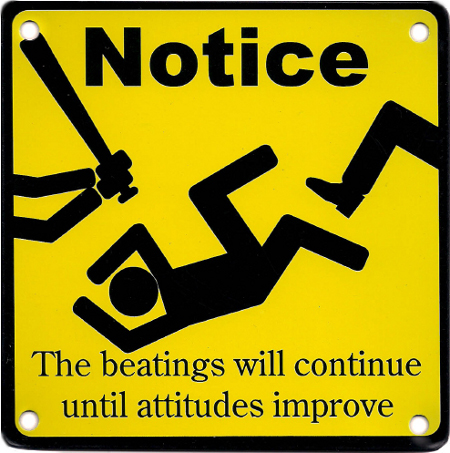
The above is perfectly reflected in the saying “the beatings will continue until morale improves”.

A clarification: I’m certainly not saying that attitude isn’t important. In fact, I think that ‘attitude’ is just about the most important thing there is for a human being!

Here’s one of my favourite quotes ever (I have it on my wall at home and at work):

“The longer I live, the more I realise the impact of attitude on life. Attitude to me is more important than facts. It is more important than the past, than education, than money, than circumstances, than failures, than success, than what other people think or say or do. It is more important than appearances, gift, or skill. It will make or break a company…a church…a home.

The remarkable thing is we have a choice every day regarding the attitude we will embrace for that day. We cannot change our past…we cannot change the fact that people will act in a certain way. We cannot change the inevitable. The only thing we can do is play on the string we have, and that is our attitude.

I am convinced that life is 10% what happens to me and 90% how I react to it. And so it is with you…we are in charge of our attitudes”. (Charles Swindoll).

It is this quote that often helps me write these (professionally provocative) posts. My attitude is that there’s not a lot of point in moaning about my environment. I choose to try to do something about it.

The Spice of Life

spices-442726_640Variety is the spice of life. If everything were the same it would be rather boring. Happily, there is natural variety in everything.

Let me use an example to explain:

I was thinking about this as I was walking the dog the other day. I use the same route, along the beach each day, and it takes me roughly the same time – about 30 minutes.

If I actually timed myself each and every day (and didn’t let this fact change my behaviour) then I would find that the walk might take me on average 30 minutes but it could range anywhere between, say, 26 and 37 minutes.

I think you would agree with me that it would be somewhat bizarre if it always took me, say, exactly 29 minutes and 41 seconds to walk the dog – that would just be weird!

You understand that there are all sorts of reasons as to why the time would vary slightly, such as:

  • how I am feeling (was it a late night last night?);
  • what the weather is doing, whether the tide is up or down, and even perhaps what season it is;
  • who I meet on the way and their desired level of interaction (i.e. they have some juicy gossip vs. they are in a hurry);
  • what the dog is interested in sniffing…which (I presume) depends on what other dogs have been passed recently;
  • if the dog needs to ‘down load’ or not and, if so, how long this will take today!
  • …and so on.

There are, likely, many thousands of little reasons that would cause variation. None of these have anything special about them – they are just the variables that exist within that process, the majority of which I have little or no control over.

Now, I might have timed myself as taking 30 mins. and 20 seconds yesterday, but taken only 29 mins. and 12 seconds today. Is this better? Have I improved? Against what purpose?

Here’s 3 weeks of imaginary dog walking data in a control chart:

Untitled

A few things to note:

  • You can now easily see the variation within and that it took between 26 and 37 minutes and, on average, 30 mins. Understanding of this variation is hidden until you visualise it;
  • The red lines refer to upper and lower control limits: they are mathematically worked out from the data…you don’t need to worry about how but they signify the range within the data. The important bit is that all of the times sit within these two red lines and this shows that my dog walking is ‘in control’ (stable) and therefore the time range that it will take tomorrow can be predicted with a high degree of confidence!*
  • If a particular walk had taken a time that sits outside of the two red lines, then I can say with a high degree of confidence that something ‘special’ happened – perhaps the dog had a limp, or I met up with a long lost friend or…..
  • Any movement within the two red lines is likely to just be noise and, as such, I shouldn’t be surprised about it at all. Anything outside of the red lines is what we would call a signal, in that it is likely that something quite different occurred.

* This is actually quite profound. It’s worth considering that I cannot predict if I just have a binary comparison (two pieces of data). Knowing that it took 30 mins 20 secs. yesterday and 29 mins 12 secs. today is what is referred to as driving by looking in the rear view mirror. It doesn’t help me look forward.

Back to the world of work

The above example can equally be applied to all our processes at work…yet we ignore this reality. In fact, worse than ignoring it, we act like this isn’t so! We seem to love making binary comparisons (e.g. this week vs. last week), deriving a supposed reason for the difference and then:

  • congratulating people for ‘improvements’; or
  • chastising people for ‘slipping backwards’ whilst coming up with supposed solutions to do something about it (which is in actual fact merely tampering)

So, hopefully you are happy with my walking the dog scenario….here’s a work-related example:

  • Bob, Jim and Jane have each been tasked with handling incoming calls*. They have each been given a daily target of handling 80 calls a day as a motivator!

(* you can substitute any sort of activity here instead of handling calls: such as sell something, make something, perform something….)

  • In reality there is so much about a call that the ‘call agent’ cannot control. Using Professor Frances Frei’s 5 types of service demand variation, we can see the following:
    • Arrival variability: when/ whether calls come in. If no calls are coming in at a point in time, the call agent can’t handle one!
    • Request variability: what the customer is asking for. This could be simple or complex to properly handle
    • Capability variability: how much the customer understands. Are they knowledgeable about their need or do they need a great deal explaining?
    • Effort variability: how much help the customer wants. Are they happy to do things for themselves, or do they want the call agent to do it all for them?
    • Subjective preference variability: different customers have different opinions on things e.g. are they happy just to accept the price or are they price sensitive and want the call agent to break it down into all its parts and explain the rationale for each?

Now, the above could cause a huge difference in call length and hence how many calls can be handled…but there’s not a great deal about the above that Bob, Jim and Jane can do much about – and nor should they try to!. It is pure chance (a lottery) as to which calls they are asked to handle.

As a result, we can expect natural variation as to the number of calls they can handle in a given day. If we were to plot it on a control chart we might see something very similar to the dog walking control chart….something like this:

Control chart 2

We can see that:

  • the process appears to be under control and that, assuming we don’t change the system, the predictable range of calls that a call agent can handle in a day is between 60 and 100;
  • it would be daft to congratulate, say, Bob one day for achieving 95 and then chastise him the next for ‘only’ achieving 77…yet this is what we usually do!

Targets are worse than useless

Let’s go back to that (motivational?!) target of 80 calls a day. From the diagram we can see that:

  • if I set the target at 60 or below then the call agents can almost guarantee that they will achieve it every day;
  • conversely, if I set the target at 100 or above, they will virtually never be able to achieve it;
  • finally, if I set the target anywhere between 60 or 100, it becomes a daily lottery as to whether they will achieve it or not.

….but, without this knowledge, we think that targets are doing important things.

What they actually do is cause our process performers to do things which go against the purpose of the system. I’ve written about the things people understandably do in an earlier post titled The trouble with targets.

What should we actually want?

We shouldn’t be pressuring our call agents (or any of our process performers) to achieve a target for each individual unit (or for an average of a group of units). We should be considering how we can change the system itself (e.g. the process) so that we shift and/or tighten the range of what it can achieve.

So, hopefully you now have an understanding of:

  • variation: that it is a natural occurrence…which we would do well to understand;
  • binary comparisons and that these can’t help us predict;
  • targets and why they are worse than useless; and
  • system, and why we should be trying to improve its capability (i.e. for all units going through it), rather than trying to force individual units through it quicker.

Once we understand the variation within our system we now have a useful measure (NOT target) to consider what our system is capable of, why this variation exists and whether any changes we make are in fact improvements.

Going back to Purpose

You might say to me “but Steve, you could set a target for your dog walks, say 30 mins, and you could do things to make it!”

I would say that, yes, I could and it would change my behaviours…but the crucial point is this: What is the purpose of the dog walk?

  • It isn’t to get it done in a certain time
  • It’s about me and the dog getting what we need out of it!

The same comparison can be said for a customer call: Our purpose should be to properly and fully assist that particular customer, not meet a target. We should expect much failure demand and rework to be created from behaviours caused by targets.

Do you understand the variation within your processes? Do you rely on binary comparisons and judge people accordingly? Do you understand the behaviours that your targets cause?

Appreciated

Toilet-engaged-sign-007So, here’s a short ‘thought for the day’ shared with me by Helen (thanks H):

“A person who feels appreciated will always do more than what is expected.” (Author unknown)

I think it’s a great quote that really sits with Systems Thinking and is worth pondering over.

…and before any managers think “wow, that’s cool, I had better run off and show lots of appreciation to people because then I’ll get better results…and hopefully instantly!”, let’s just put some qualifiers/ caveats around it:

  • There isn’t much that is more precious to a human being than feeling that we truly matter, that what we do is valuable and is valued;
  •  A worldwide study (cited in a 2012 HBR article) found that the single highest driver of engagement is whether workers feel that their managers are genuinely interested in their well-being. Less than 40% of workers felt this way;
  • Conversely, the feeling of being devalued* is incredibly toxic;

(* whether from negative comments/actions or, just as bad, neglect through presumption, inaction and a lack of care);

Appreciation has to be authentic! Any/all instruments used to extrinsically motive (e.g. contingent rewards) and judge people (performance appraisals) will seriously harm/ undermine management’s ability to show genuine appreciation.