 I recently wrote a measurement guide and a hugely important (and definitely too short) section within is titled ‘Beware the allure of measurement’.
Unfortunately, our working worlds seem to be obsessed with measurement, to the detriment of getting on with doing obvious things.
So I was very happy to read a LinkedIn post by a chap called Nuno Reis which really ‘laid into’ this measurement point.
Nuno starts by telling us that we’ve been lied to! And not only lied to…but sold the exact opposite of the truth.
And that lie…set out as a nice pithy quote?
“If you can’t measure it, you can’t manage it.”
And why such a problem with the quote? Well, it meets the triumvirate of: a false quote, a misquote and a misattribution!
- It’s a false quote – because it’s been re-worded to say the exact opposite of what many educators had been writing (see below)
- It’s a misquote – because it misses out the important ‘second bit’ that is necessary to understand the first bit (again, see below); and
- It’s a misattribution – because it normally gets credited to Peter Drucker (presumably to give it gravitas), who didn’t say it1.
I encourage you to read Nuno’s short LinkedIn post.
Nuno provides us with the following quote in contrast:
“What gets measured gets managed – even when it’s pointless to measure and manage it, and even if it harms the purpose of the organisation to do so.” (credited to V. F. Ridgway)
As you can see, this is the opposite meaning of the well-known ‘simplistic’ quote, with the second part illuminating why.
Deming wrote in a similar vein, but with numeric ‘targets’ in his sights (no pun intended?2):
“People with targets and jobs depending on meeting them will probably meet the targets – even if they have to destroy the enterprise to do it.” (Deming)
Now, after a while of searching, I didn’t find this exact measurement quote written by Ridgway3, but I did find his Sept. 1956 ‘Administrative Science Quarterly’ Journal article titled ‘Dysfunctional consequences of Performance Measurements’.
I’ll repeat the date, 1956!!! This isn’t bleeding edge stuff – it’s been known for sooo long.
In that paper, Ridgway writes:
“Judicious use of a tool requires awareness of possible side effects and reactions. Otherwise, indiscriminate use may result in side effects and reactions outweighing the benefits… the cure is sometimes worse than the disease.”
Back to Deming:
I’m reminded of the distinction that was drawn (back then) by Deming between Japanese organisations and the majority of their Western/ Anglo-American counterparts:
“…in contrast, the Japanese go right ahead and improve the process without regard to figures. They thus improve productivity, decrease costs, and capture the market.” (Deming)
i.e. They don’t spend huge amount of up-front time on ‘the perfect business case’ that attempts to demonstrate ‘what will happen’ and exactly what the benefits will be…because:
- this would be wasteful (and, in fact, unknowable);
- it would delay the sensible action (which we could be using to reflect upon);
and, the worst part:
- it would stop lots of good things from happening because it was too hard to persuade those in (ahem) ‘governance’ roles.
And what did Peter Drucker actually say? Nuno references the following:
“By the time it can be captured in numbers, it’s too late.” (Peter Drucker, The Effective Executive, p17)
i.e. he was saying virtually the opposite of the ‘simplistic’ quote; that Executives (and those in positions of organisational authority) should be using their nous (ref. brains, intelligence) – foresight- and getting on with things…and seeing how this then shows up in the numbers.
To close:
“Of course, visible figures are important but he that would run his company on visible figures alone will in time have neither company nor figures. The most important figures are unknown and unknowable but successful management must nevertheless take account of them…
…It is wrong to suppose that if you can’t measure it, you can’t manage it – a costly myth.” (Deming)6
Addendum: A side-journey into quotes
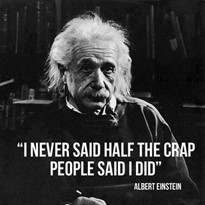 You’ll probably be aware that there are loads of quotes ‘out there’ that are attributed to the likes of Albert Einstein, Abraham Lincoln, Winston Churchill, Mark Twain, William Shakespeare2…and Budha!
Almost too many! That’s because there’s a hell of a lot of false quoting, misquoting and mis-attribution ‘out there’ on the inter-web thingy.
My intent when blogging is to mainly use quotes from things that I have actually read – i.e. words ‘on the page’ that I read in context and was moved to underline.
However, we can’t all read everything (setting aside the tricky tasks of finding it and affording to buy it)…and this shouldn’t preclude us from making use of what others have ‘found for us’.
And so, if I am making use of what others have found for me, I’m a big fan of ‘googling around’ to dig into quote sources – can I find a book or speech reference, can I see the text within its context? There’s some good ‘quote checking’ sites out there if you look.
Footnotes:
1. Re. Drucker: Here’s an article on the Drucker Institute refuting that he coined the quote.
Note: The physicist William Thompson (a.k.a. Lord Kelvin) was probably the originator of (what has turned into) the ‘simplistic’ quote, but – as with all things – there’s context: 1) he used a nuanced paragraph [not a 9 word ‘strap line’]; and 2) he was talking about scientific discovery, not management.
2. Bonus: A short (3 mins), but brilliant, James Acaster sketch re. ‘no pun intended’ 🙂
3. Ridgway? …but I did get back to this 2008 article by Simon Caulkin in The Guardian
4. However, with Shakespeare, it never ceases to amaze me how many ‘everyday’ words and phrases he made up! Mind blowing!
5. Quote attribution: Just to clarify, I’d lay a bet that there will be some incorrect quotes within this ‘Squire to the Giants’ blog! Whilst I want to check, this doesn’t mean that I haven’t fallen into the ‘misquote’ hole myself 🙂
Not all mistakes are the same: I think that, whilst mis-attribution is frustrating (and not good), it’s nothing like ‘as bad as’ misquoting and false quoting.
6. Re. the closing Deming quote: See my much earlier post titled ‘slaughtering the sacred cow’
7. For the header image for this post…I’ve gone with measuring something that must deal with our shit.
 Squire to the Giants
Our podcast team dives into this topic: https://notebooklm.google.com/notebook/42fa60c3-ca60-43a0-a603-523453eb30dd/audio
LikeLike
[…] Schefer delves into this a little deeper and finds that our working worlds seem to be obsessed with measurement, to the detriment of […]
LikeLike