 I regularly hear these title words around me – or words to that effect – and, depending on my mood, this makes me smile…or groan.
They are the recurring ‘message’ sung out from many senior figures in organisations and then ‘cascaded down’ …and then informally kicked ‘around and around’.
And my main reflection on hearing it?
“As if we don’t want to!!!!”
A little parable springs to mind1 which I’ll set out as follows:
‘Person in position of power’ (PPP): “How long is it going to take for me to change performance?!”
Coach: “Well, as and when the necessary conditions are in place, we might see meaningful changes in the performance of the system in, say, 3 – 4 months. You might notice some things much earlier, and for others, it may take a few reflective learning loops.”
PPP: “But ‘the wheels are falling off’ now. We must change right now!”
Coach: “Well, in that case [i.e. with that attitude], it’ll probably take 2 or more years.”
PPP: “What? That’s ridiculous, and not acceptable to me! I need the change right now. If you can’t make it happen, then I’ll get someone who can!”
Coach: “Oh, in which case, it may take 10 years.”
The point:
Yes, just about everyone would like to move fast towards a better systemic performance (for the good of the people that the system exists to serve).
But if you don’t understand what ‘makes it like it is’, and if you won’t meaningfully experiment on altering the critical structures (and underlying thinking*) that hold it this way, then the pace of valuable change will likely be glacial.
Conversely, if you really are ‘up for the ride’, then just wow – you could be amazed at how quickly seemingly intractable problems could change.
In short: things can move really fast, if the conditions2 allow….and if the conditions don’t, well, good luck with that!
* About that ‘underlying thinking’ thing:
I am reminded of a quote from Patrick Hoverstadt’s ‘The Grammar of Systems’ book:
“Most of us are not conscious of our thinking patterns. We think as we breathe…follow[ing] familiar trackways through the brain…without us being aware of why we think what we do…or how we got to the conclusions…we did.
For the most part, the patterns we follow when we say we are thinking are patterns that have been used repeatedly, patterns we have learned to use again and again…mostly these have come from people long dead…
…we are part of systems and whilst we do have free will, for the most part, what we see, think, feel and do is to some extent constrained and channelled by the systems we are part of. To paraphrase Churchill: we shape our systems, thereafter they shape us” (Patrick Hoverstadt)
And so, whilst we could talk with people about their (so called) current thinking, in many instances they don’t know what this is…because it isn’t really like that.
Rather, they (and we 🙂 ) may have become ‘captured by convention’ (i.e. without much, if any, conscious thought).
A few bullet points aimed at this pervasive problem…
- Be absolutely clear on purpose3 from an ‘outside – in’ perspective. i.e. why does your human-designed system exist? What would your customer/client/ patient/ [meaningful label] want it to achieve for them?
- Set out clear (method agnostic) principles that ought to steer the system towards doing valuable things (i.e. towards purpose);
- Rethink ‘performance’ using ‘how well did we do’ capability measures as distinct from ‘how many did we do’ and ‘how long did it take’ capacity measures;
- Experiment with how to meet purpose, whilst staying true to those principles;
- Look for, and reflect on, ‘anomalies’ [i.e. where and when you aren’t doing valuable things] and use these to ‘dig in’, to find those structures that are ‘hidden in plain view’.
…which, once you’ve truly seen these structures and ‘get it’, can make it a whole lot easier and quicker to meaningfully change them.
What about ‘low hanging fruit’?
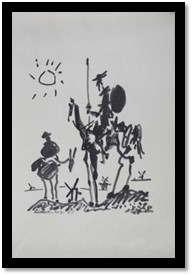 A very common stance from the ‘person in position of power’ is to declare that there must be lots of low hanging fruit that we could ‘tilt at’4 …and that would get us going fast…wouldn’t it!
I recall a wonderful comment on a post I wrote 8 years ago which said:
“It was only when I started to try and pick it, that I discovered the low hanging fruit was covered in piss.” (jaqueslecont)
That’s not to say that there won’t be some things that could be easy to work on/ sort out/ change…but a ‘cursory glance’ isn’t going to find them…and is highly likely to result in mere tampering, making for lots of very busy people (#projects), doing lots of things (#cost), creating lots of documents (#artefacts)…that ‘move the deck chairs’ slightly to the right whilst the ship lists5 ever further…closer to sinking.
To close:
A (related) saying:
“If you get on the wrong train, get off at the nearest station. The longer it takes you to get off, the more expensive the return trip will be.” (Anon.)
Footnotes:
1. Parable source: I can’t remember when/where I first encountered this, so sorry for a lack of attribution.
2. ‘Conditions’ clarification: where this doesn’t mean more money or more people – it won’t be about doing ‘more of the same’. It will be about curiosity – of why things are as they are…and what would change it.
And therefore, the fundamental ‘condition’ is for the ‘person in position of power’ to want to profoundly advance ‘the system’ (lead?!) – rather than merely ‘continue with the status quo’ – and realise/acknowledge that this will necessarily require examining and altering themselves.
3. ‘Purpose’ clarification: where this is ‘method agnostic’, and NOT an ordered goal (which would be an ‘inside-out’ perspective).
4. Tilting: the historical combat sport of a jousting knight with a lance. I have Don Quixote in mind here…titling at windmills (i.e. the mythical low hanging fruit).
5. Listing: I’m not a nautical person…so I was really interested (when ‘looking up a word’) that there is a difference between a ship listing and heeling.
‘Marine Insight’ tells me that:
- Listing = inclination of ship on one side due to internal factors (e.g. shift of cargo, ballast,…)
- Heeling = inclination of ship on one side due to external factors (e.g. wind, waves,…)
…which caused me to reflect on systemic vs. environmental factors.
6. Speed Image designed by Freepik (www.freepik.com)
 Squire to the Giants
a) Zen
b) De Bono
LikeLiked by 1 person
Love this post. You’re on fire at the moment
LikeLiked by 1 person
…might be something to do with the run in to Christmas – a bit of time for reflection.
LikeLike
Thanks for this one! It’s back to “the system is perfectly designed to get the results it gets” (Deming). People often think optimizing the process is going to be the place to go, but it is so much more often all the stuff that gets in the way of the process that is the bigger challenge. And that stuff is often hidden beneath “the way we do things.” And of course, the way we do things are the ones that are hardest to change.
LikeLiked by 1 person