Wear sunscreen

sunscreenI have an iPod with loads of 80s and 90s songs held within its memory and, through the magic of ‘shuffle’, they randomly make re-appearances in my world (or at least my ears).

There’s one song that I really like popping up when I’m ‘away with the fairies’ running on the hills (this is fertile ‘brain fart’ territory).

The song is ‘Everybody’s Free (To Wear Sunscreen)’, released in 1999 by Baz Luhrmann. If you’ve never heard it before then I’d describe it as a man eloquently talking through a series of life lessons, where his spoken word ‘rap’ is matched to an agreeable background beat. Groovy.

It’s pretty corny stuff…but that’s because there’s some level of truism in every line!

Now, there’s one short verse that I often think about whilst at work. Here it is:

“Live in New York City once, but leave before it makes you hard.

Live in Northern California once, but leave before it makes you soft.

Travel.”

Ok, I had better explain:

Why work?

I see a rather good analogy of:

  • working somewhere really great; and
  • working somewhere really not!
  • …and then, because you now ‘get it’, your work travels will become full of meaning.

If you’ve only ever worked somewhere really great: then you may not realise that it is great and, even if you do, you may not understand what makes it this way.

If you’ve only ever worked somewhere really terrible: then you may think that this is just what work is and, even if you wish for better things, you will likely be stuck as to what makes your work place terrible (I’m talking root causes)…and therefore whether it is changeable…and how to do so.

If you have worked at both ends of the spectrum: then you will likely have had some pretty important ‘aha’ moments and, even if you haven’t had these (yet), you are probably curious to explore the seemingly vast gulf between organisations.

Of course there’s nothing wrong with working for a figurative ‘Northern California’ all your life….but travel is a great thing – not for the destination, but for the journey 🙂

…and, whilst it might be great, I presume that even Northern California isn’t perfect.

How about me?

I realise that everything is relative, but yep, I reckon that I’ve spent years at both ends of the spectrum and I can confirm that I didn’t realise what good looked like whilst I was there! Looking back, I can say that it wasn’t perfect, but man it was GOOD!

Put at its simplest: it was about the people…and it was soooo about the customer…and it really was!

I can also confirm that, whilst I am a natural skeptic (where this is, I believe, a positive word), it was only on leaving my (unacknowledged) Paradise that my journey of discovery truly crystallised…and accelerated.

I might not work in Paradise now but, hey, I’m on an interesting journey.

Direction of travel?

Now, you’ll notice that the song lyric doesn’t give explicit advice on whether the order of habitation matters. Here’s my thinking on this:

  • if you prefer a smooth ride then I hope lady luck books you a ticket from New York to Northern California;
  • if you are a thrill seeker, and like a bumpy ride, then you should hope for the journey in reverse….you’ll probably learn a lot more.

…and for those of you struggling whilst on your travels, remember Charles Swindoll’s view that “…life is 10% what happens to me and 90% how I react to it.”


Oh yeah, and to conclude – here’s my favourite, favourite line from the song:

“The race is long, and in the end, it’s only with yourself.”

That’s it – there’s nothing more to add to that.


Footnotes

Author of the song lyrics: One of the nice things about blogging is that, through checking things out before I publish, I find out a whole lot more in the process. I looked up the ‘Wear Sunscreen’ song and Wikipedia (and its source links) tells me that the lyrics come from an “essay written as a hypothetical commencement speech” by a columnist Mary Schmich in 1997. Baz Lurhmann then used it as the basis for the 1999 song.

Where you currently work: So there’s a small chance that your current boss happens to read this post, points it in your direction and then asks you whether you work in New York or Northern California.

If you honestly answer ‘New York’ and they respond badly to this…then they kinda prove the point. However, if they genuinely want to understand why this is so, then perhaps you’ve just moved a small step towards Northern California.

Where’s the meat in your sandwich?!

sandwichI came across a LinkedIn ‘research’ report that had been shared on a social media platform the other day. It had a grand title:

The 2016 Workforce Purpose Index: ‘Purpose at work – the largest global study on the Role of Purpose in the Workforce.’

Mmmm, sounds interesting. And, wow, ‘largest global study’ – must be important – I’d better have a read…and so I did…and then I found myself doing a bit of frothing at the mouth. I do that when stuff winds me up…I’m okay, honest 🙂

Now I am absolutely NOT getting at the person who shared the ‘report’, or any persons liking or positively commenting on it. Just to clear up any potential confusion at the start: I totally agree that the premise of ‘purpose at work’ is to be ‘liked’….and in fact passionately argued for. An earlier post uses an Ackoff essay to explain why this so.

But here’s some other stuff that I thought as I read through the ‘report’:

Helpfulness?

The introductory pages deliver the usual ‘listen up people – purpose matters’ message. This is, for me, like the ‘Buy low, sell high’ advice – blindingly obvious…but not particularly useful.

Profit?

And so to the page on “Purpose brings profit”: Yes, I agree with this…but, at the risk of repeating my ‘blindingly obvious’ mantra, this shouldn’t really be surprising i.e. if you passionately understand and serve your customers with what they actually need (this is fundamentally different to ‘selling to them’), then you have a high chance of success. Simples.

What the report fails to tackle, let alone drive home, is that many organisations get their logic ‘in a twist’ i.e. their (subconscious?) thinking is that ‘If we craft, and then regularly, state a cool-sounding purpose, then we can focus on our real purpose of profit.’ This is NOT what ‘purpose brings profit’ means!

A focus on growth and profitability doesn’t unlock purpose – indeed it will likely do the exact opposite. This isn’t to say that you can’t grow and be profitable. Of course you can. It is to correctly state the cause-effect relationship between a fanatical focus on a meaningful purpose (cause) delivering sustainable and healthy growth and profitability (effect).

Again, I’ve written about the ‘what and why’ of this previously in a post titled ‘Oxygen isn’t what life is about’.

People?

To quote from the report:

Key Finding: Given the right role and environment, [people] are ready to tap into their purpose and reach a higher potential at work”.

Now, I absolutely agree with this statement but I get sick of, what I consider to be, the spectacularly obvious being dressed up as a ‘finding’. This is ‘McGregor 101’: How you treat me will determine a massive amount of how I behave.

And so to the next quote:

“this correlation of satisfaction at work and purpose orientation was consistent in virtually every country and industry studied.”

This is where I write “No sh1t Sherlock!” That would be because we are all humans – which is a nice segue to Dilbert, and the Theory of Evolution.

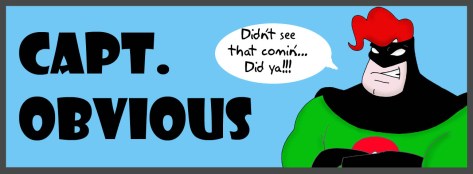
Capt obviousIt’s a bit like all those scientific research projects spending scarce grant money to confirm that ‘water quenches our thirst’ or ‘alcohol gets us drunk’ or [insert one from today’s supposed news].

The trouble, for me, with stating the obvious but missing out the important contextual piece is that organisations then run away shouting “oooh, quick, quick…we’ve got to find our purpose! Let’s gather round and play with some words.”

And they spectacularly miss the point.

Purpose driven?

So let’s get to the nub of my critique: The report implies that there are three different types of people*, these being those who are primarily:

  • Purpose-driven; or
  • Status-driven; or
  • Money-driven.

They then follow this line of reasoning with….have you guessed it?…the recommendation to search for and select purpose-oriented ‘talent’.  It even suggests adding the ‘what is your primary drive?’ dimension to an organisation’s talent selection criteria 😦

The hilarity of this is that they may recruit lots of (currently) purpose-driven people…and then kill it. It’s the same old talent message – don’t endlessly seek talent, recognise and tirelessly work to unleash the talent from within.

So, back to the ‘research report’: sure you can ask someone to respond to survey questions as to which category they currently associate themselves most with (i.e. purpose, status, money)…but where is the consideration as to WHY someone might answer as they did.

* are they ‘types’ of people….or are they outcomes that people have arrived at or been driven to?

Some examples:

  • how many of you started a new job with passion and purpose, but within 6 months – 1 year, had been beaten back to surviving on merely the money and seeking some status to get noticed?
  • how many of you started your ‘careers’ focused on getting on the ladder and earning enough money to gain a roof over your heads and have a family….and how many of you have reached a certain level of wealth and/or experience where your priorities have changed?1

To conclude:

Yep, purpose is important.

Yep, I can’t really disagree with the blindingly obvious littered throughout the ‘report’.

…but if the report were a sandwich, it is bland, limp and empty – where’s the important and insightful stuff that needed to be said?

In short, where’s the meat in the sandwich?!

Does this matter? Well, yes, it does. The problem with such reports is that they allow the top management of traditional (‘command and control’) organisations to gleefully wave them about, shouting “nothing to see here – we know all of this and, even better, we’ve got it totally covered!”

Total codswallop.  As I wrote in an earlier ‘Blackadder’ post, a report is only valuable if it covers what needs to be said, not what they want to hear.

The report spectacularly misses the huge point that:

“People’s behaviour is a product of their system. It is only by changing [the system] that we can expect a change in behaviour.” (John Seddon)

What sort of system environmental things am I talking about? If you read Deming’s 14 points for management you will get a good idea. At a high level, let’s compare two environments and then you tell me which would enable you to focus on your purpose and which would see you struggling to survive through status and money:

Traditional A better way!
Hierarchical (authority…superiority) ‘Social’ (responsibility, equality)
Fear/ blame Trust/ ‘safe to fail’
Rules and consequences Guidance and support
Growth and Profitability Customer, customer, customer
Budgets, financial measures, cost cutting ‘Purpose’ operational measures, variation
Implement ‘best practise’ on the people (plans) Problem solving by the people (experiments)
Cascaded personal (or team) targets Value stream capability measures
Judgement, through rating and ranking Coaching, through non-judgemental feedback
Carrot and stick compliance Intrinsically motivated
Incentives Profit sharing
Competitions, and hero (people) awards Collaboration, and achievement focus

 Whether a person can (will) be purpose-oriented is hugely down to the environment in which they work. Simples.

Footnotes

1. This is rather obvious: take your pick from ‘Herzberg’s Motivators & Hygiene factors’ or ‘Maslow’s hierarchy of needs’.

2. I ‘get’ that LinkedIn are merely trying to drum up business by suggesting we all need to find ‘talent’ but….grrrrrr.

….because I wanted to!

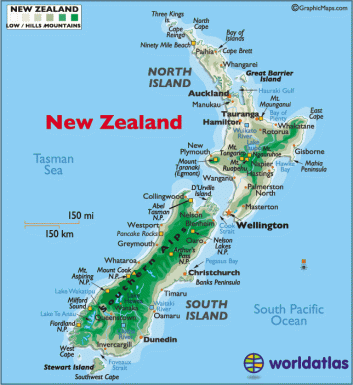
nz mapSo something really important happened to me yesterday evening – I became a Kiwi!

“What’s so good about that?” you might ask…

The Back-story:

I was born and raised in the UK which (for the avoidance of doubt) I still love.

However, I have happily been a permanent resident of New Zealand for 8 awesome years. There was no pressure on me to go further and apply for citizenship. Indeed, to do so would require a bit of effort on my part and some money to pay the Ministry of Internal Affair’s administration costs.

The Citizenship Ceremony:

There were about 180 candidates for citizenship, representing over 30 different countries.

The ceremony kicked off with an excellent performance from a Kapa Haka1 group.

The Mayor of our city, ably assisted by a linguistically impressive2 MC, presided over the ceremony and did a brilliant job of welcoming us, making us feel at ease, running a tight ship for oaths/ affirmations, certificates, photos (and trees!3) and finally congratulating us.

The National Anthem was sung.

But, just before the National Anthem, we watched a short video….

The insight:

…and within that video was a welcome from the Hon. Peter Dunne, Minister of Internal Affairs.

He nicely put into words that, as New Zealand residents, we are already entitled:

  • to stay indefinitely, to work and to study;
  • to healthcare, education and social security, as citizens are; and
  • to vote

and that this is not the case for all countries around the world4.

…and as such, we’re not becoming citizens in exchange for such rights – it isn’t for personal gain (in a ‘do this to get that’ kinda way), it is because we want to!

Indeed, some people will be choosing to surrender citizenship5 from their country of birth.

Now, I hadn’t formalised it as such…but, yes, Mr Dunne had ‘hit the nail on the head’. There was no need to become a citizen, but we feel part of this community and want to belong to it.

Now, for those of you reading the above thinking “that’s very nice and all that…but you usually write about organisations – what’s gone wrong this time?”…here goes:

The analogy:

Yep, you can see where this is going: Many an organisation uses the ‘do this to get that’ logic on its people throughout its management system:

  • meet these targets to get this reward;
  • put yourself forward to win this competition;
  • act in this way to win this quarterly/ annual award
  • search out, and apply for external awards to gain hierarchical kudos
  • ….etc.

In fact, they do so as if this is all rather obvious, and the only way to go about running an organisation.

But all of these things are extrinsic. They aren’t because you want to, they are because you want the prize available for complying with their wishes. This reminds me of a very early post I wrote titled ‘Don’t feed the animals’ which sets out and explains the point.

The reverse logic is to provide the people with what they need to thrive (with no strings attached)…and they will blossom…and they will want to belong. This is all about the environment:

…which will create:

People will come to love such an organisation, will want to belong, and will want to give of their all. How many organisations can honestly claim that?!

For you skeptics out there, such a transformation is:

  • possible, desirable, worthwhile and (as a side effect) profitable; and yet
  • impossible without a fundamental change in thinking.

Where would you choose to work (or live)?

Post script:

I texted a very good friend just after the ceremony: “All Blacks supporter now!”

ABs vs LionsHis response was:“All Blacks over the Lions?”

Damn, I hadn’t thought about next year’s Test series. This might take a little bit of time and emotional baggage to work through!

Footnotes:

1. Kapa haka is the term for Māori performing arts and literally means to form a line (kapa) and dance (haka).

2. 30+ different countries results in amazingly different names to be read out!

3. Every family grouping is presented with a native ‘baby tree’, to plant at home. We’ve got a spot in our garden already sorted.

4. Where this is a particular bone of contention for Kiwis living in Australia.

5. Some countries forbid multiple citizenships, and therefore require you to renounce your citizenship if you want to change to another.

6. You may not think they are random…but if they don’t take proper account of variation, then they are.

Dilbert says…let’s automate everything!

Dilbert portraitI absolutely love ‘Dilbert’ – it seems to me that Scott Adams, the cartoonist, has seen into our very souls when it comes to our working lives.

You may also love the Dilbert cartoons but what you might not know is that Scott wrote a couple of (let’s call them) ‘essays’ as the introduction to his first Dilbert book1…I read them many years ago and they made me cry with laughter.

I’ve not thought about these for a long time, but they popped into my head recently when I was considering where the world is heading in respect of invention, and specifically automation.

I’d like to reproduce the core parts of one of his comedy essays here, for use in this post (I hope Scott doesn’t mind… this is, after all, a plug for his books 🙂 ). Here goes:

“Theory of Evolution (Summary)

First, there were some amoebas. Deviant amoebas adapted better to the environment, thus becoming monkeys. Then came Total Quality Management. I’m leaving some of the details out…

Anyway, it took many years to get to this lofty level of evolution. That leisurely pace of change was okay because there wasn’t much to do except sit around and hope you didn’t get eaten by wild pigs. Then somebody fell on a sharp stick and the spear was invented. That’s when the trouble started…

I wasn’t there, but I’m willing to bet that some people said the spear would never replace fingernails as the fighting tool of choice…’diversity’ was not celebrated back then, and I expect the ‘Say No to Spear’ people got the ‘point’ if you catch my drift.

The good thing about the spear is that almost everybody could understand it. It had basically one feature: the pointy end. Our brains were fully equipped for this level of complexity. And not just the brains of the intelligentsia either – the common man could find his way around a spear too. Life was good…almost nobody complained about how confusing the spears were….

Suddenly (in evolutionary terms) some deviant went and built the printing press. It was a slippery slope after that. Two blinks later and we’re switching batteries in our laptop computers while streaking through the sky in shiny metal objects in which soft drinks and peanuts are served.

I blame sex and paper for most of our current problems. Here’s my logic:

Only one person in a million is smart enough to invent a printing press. So when society consisted of only a few hundred apelike people living in caves, the odds of one of them being a genius were fairly low. But people kept having sex, and with every moron added to the population, the odds of a deviant smarty-pants slipping through the genetic net got higher and higher, When you’ve got several million people running around having sex all willy-nilly the odds are fairly good that some pregnant ape-mom is going to squat in a field someday and pinch out a printing-press-making deviant.

Once we had printing presses, we were pretty much doomed. Because then, every time a new smart deviant came up with a good idea, it would get written down and shared. Every good idea could be built upon. Civilisation exploded. Technology was born. The complexity of life increased geometrically. Everything got bigger and better. Except our brains.

All the technologies that surround us, all the management theories, all the economic models that predict and guide our behaviours, the science that helps us live to eighty – it’s all created by a tiny percentage of deviant smart people. The rest of us are treading water as fast as we can. The world is too complex for us. Evolution didn’t keep up.

Thanks to the printing press, the deviant smart people managed to capture their genius and communicate it without having to pass it on genetically. Evolution was short circuited. We got knowledge and technology before we got intelligence.

We’re a planet of nearly six billion ninnies living in a civilisation that was designed by a few thousand amazingly smart deviants.”

Oh, there’s so much in there to work with! But, first…

What about you and me?

…I believe that I am reasonably intelligent (don’t we all!) but I’m absolutely certain that I’m not one of the “deviant smarty-pants”. I use a fair bit of technology in my daily life but don’t really know how it works. Sure, I can read Wikipedia like the next ape and spout out that it’s all about 0’s and 1’s…but that doesn’t mean that I really ‘get it’.

Now, I don’t mean to be rude, but the vast majority of you reading this aren’t likely to be geniuses either…and if you are, then please consider our predicament and look after us 🙂

…and so, to automation:

With reference to Scott Adam’s evolution theory, I often feel like we have become a bunch of idiots within our world, and each fresh automation added to our environment likely makes this more so.

There appears to be a large push for the likes of robotics and artificial intelligence at the moment, with lots of super positive articles being written by ‘interested parties’.

I reckon that we would be wise to ponder the automation thing and to have a healthy regard to what it implies. This isn’t to be a luddite2 and try to hold back the tide of change. It is suggesting that we fully think through what it means, across a broad context, and not be easily persuaded by some futuristic promise of bliss (which we should constantly reflect is mainly coming from those selling it).

(By way of context: this post was triggered by a recent article in respect of a fatal accident involving Tesla’s semi-autonomous car. and a discussion with work colleagues)

The calculator as one of the simplest of examples:

Many years ago I trained to be a Maths teacher, along with a good mate called Dave.

We used to have a laugh whenever we asked one of our students how they had arrived at a particular answer and they would simply reply that “I worked it out with my calculator Sir”.

We did the usual “back in my day” lament about kids not knowing how to do simple arithmetic on a piece of paper and becoming reliant on a calculator instead.

Now, you might respond with “yeah, but why do they need to learn all that stuff if they’ve got a calculator!”…and, mainly, I’d see your point.

The problem comes when they accidentally miss-key into their wonder machine, get a result and blindly rely on it.

If you don’t understand the basics of what’s going on, then you can’t be expected to spot an error (often in our inputs or usage). How could you?

To the world of work:

To take the calculator example, and turn it into a generalisation: You can’t truly cope with a defect (or failure demand), let alone improve the system that created it, if you don’t understand what’s actually going on.

If we are going to automate things, then I’d suggest a few automation design principles should be used…such as:

  • it must be very obvious to the people utilising the automation as to what is actually happening (i.e. this is not hidden or over-complicated);
  • it must be possible, and easy, to take back control and experience the task for ourselves; and
  • taking back control (i.e. ‘switching to manual’) is encouraged…and even required on a regular basis.

This may add initially to any automation endeavour, but should pay itself back handsomely when in operation, by our understanding of (and retention of control over) what is actually taking place.

(I note Toyota’s thinking in respect of automation: i.e. automation may prove useful, but it isn’t the objective and could be a hindrance.)

Humanity, and customers:

Going back to that ape thing: Given that we are basically a bunch of “ninnies”, we should design accordingly.

My criticism of many (most?) automation efforts is that they are aimed at efficiency.

Our true purpose should be effectiveness, and that requires us to fully appreciate our customers, and their* (wildly varying) ape-like humanity.

(* again, I don’t exclude myself from this)

Every attempt at efficiency, say through pushing the likes of contact centre IVRs, self-service portals and ‘chat-bots’3 onto customers, is hugely wasteful and counter-productive if they aren’t effective (which means valuable for the customer, for their needs)

We should be pulling innovative ideas on the basis of clear value for our customers.

So, I suggest that the first automation design principle should be that the customer (a human being) would want it!

 …and, as a bonus for reading this far:

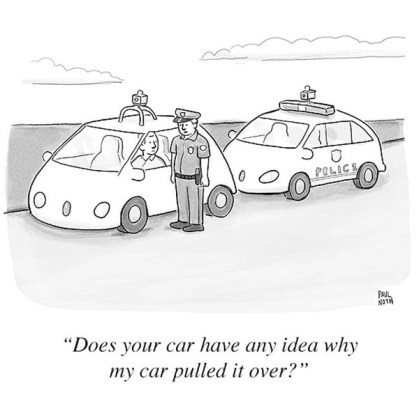
I share the following thought-provoking cartoon4 :

auto cars

Footnotes

1. Scott Adam’s book is called ‘The Dilbert Principle’ and was first published in 1996.

2. Being a Luddite: A clarification for all you early adopter ‘technologists’ out there. This post isn’t an attempt at denial. It is (hopefully) to provide some healthy self-reflection when putting forward the next hugely optimistic article on what’s coming to take over our worlds :);

3. Chat bots: I found this recent BBC article somewhat illuminating, particularly IKEA and ‘Anna’. “In the beginning, we tried to impersonate a person, and we found that there was no reason to do that”. This speaks volumes to me. By causing a confusion to the human as to ‘what’ they are interacting with, we create an unnecessary and yet fundamental problem.

4. Credit: This cartoon was found by a colleague. Thanks 🙂


There’s no such thing as…

internal customerThis post is a bit ‘tongue in cheek’ (so if you don’t agree 100% then please don’t take it too much to heart 🙂 ) but it expresses what I’ve thought for years now.

A business fashion started back in, oooh, probably the 1980s – talking about ‘internal customers’ within organisations. The idea being that you are the customer for the person upstream from you – they are producing for you – and, in turn, the person downstream from you is your customer…and on and on…in a long chain from the start to the finish of a value stream. Lots of lovely internal customers.

But here’s the thing: They aren’t your customer – they are a part of (i.e. colleagues within) your system!

Yes, yes, I know that you are reliant on them and then the next lot are in turn reliant on you…but that’s just because of the design of the (current) method.

And, yes, yes, I know that it would be jolly nice if you all worked together in really efficient and effective ways – but that doesn’t make for a customer relationship. Further, it can be harmful to think in this way.

What is a customer?

I’ll draw on a set of related quotes to assist me here:

“The purpose of a business is to create a customer.”1 (Peter Drucker)

“It is not the employer who pays the wages. Employers only handle the money. It is the customer who pays the wages.” (Henry Ford)

“There is only one boss. The customer. And he can fire everybody in the company from the chairman down simply by spending his money somewhere else.” (Sam Walton)

The point being that a customer is, by definition, external to the system. Everyone and everything within the system is (or should be) there for them.

Without the (true) customer, there is nothing.

Why does this ‘internal customer’ label bother me so?

Such ‘internal customer’ logic causes us to think that we must do what they ask, and not question them too much, along the lines of the ‘customer is always right’ and ‘give the customer what they want’ mantras.

It presents a suboptimal ‘them’ and ‘us’ situation rather than a collaborative horizontal (across the system) ‘we’.

Once you think in terms of internal customers, it’s only a short and painful step towards the dreaded ‘Service Level Agreement’ (SLA) game show. Grrrr.

A massive risk within the ‘internal customer’ logic is the creation of a static system, one in which the method (and targets) becomes defined in quick drying cement.

  • If I think of you as my customer, then there’s unlikely to be much challenge from me as to whether your role should change, or even exist…and you sure as hell aren’t going to appreciate any such line of reasoning from me – who the hell am I to suggest this – you are my customer, I am merely your supplier!
  • Further, as my customer, you may consider that you know best, that your wish should be my command and that I should be grateful to be of service to you. Indeed, you may even score me on how well I treat you. Ouch!

How many of you reading this post have been asked to do something by your ‘internal customer’ and thought that what they were asking for was nuts…and how many of you didn’t get the chance to meaningfully discuss this with them, and had to carry it out anyway?

Even worse, how many of you have switched off from even thinking about whether your internal customer’s request makes sense and have merely become ‘order takers’.

What a load of nonsense. Let’s just throw the ‘internal customer‘ language in the bin.

“But what about treating all our colleagues with respect?!”

I can almost hear some HR departments chiding my thinking as being disrespectful to my fellow employees. No, it’s not!

In fact, it’s the opposite. I think it’s disingenuous for me to pretend that my work colleagues are my customer. They are far far more than that – we are reliant on each other, to keep our jobs, to grow ourselves, to stimulate each other, to want to come to work…to spend our working lives delivering something meaningful to this world. This is soooo much more than being merely thought of as ‘internal customers’.

As colleagues, we need a robust relationship, not one of diffidence and servitude. We need to respectfully challenge each other, work hard to listen to and understand each other’s worldviews…and become better, closer and wiser for this.

We are not ‘internal customers’, we are colleagues.

Addendum:

I always pick a trusted colleague (from an ever widening group of ‘pioneers’) to have a read of my posts before I press publish. I was particularly nervous about this one as I felt that it could just be me ranting about an ‘issue I have with the world’ (again 🙂 ).

…but I got a great response back, with the following gem (thanks A):

“Are the All Blacks ‘customers’ to one another, or are they a team with a shared purpose? By using the term ‘customer’ where it doesn’t belong… it distracts us from understanding who our real customers are.”

This made me giggle. Turning to the wonderful game of rugby, I had visions of the ‘backs’ telling the ‘forwards’ that they are their customers…I don’t think that this would go down too well.

rugby positionsHow about the following, even dafter rugby situations:

  • the jumper in the line-out considering themselves as the customer of the hooker throwing the ball in;
  • the winger considering themselves as the customer of the no. 10, who is kicking the ball through for them to get on the end of; or, at its simplest
  • the potential receiver considering themselves as the customer of the possible passer of the ball.

What a load of guff! They’re a team that have to work together, as equals; that have to understand, and swiftly react, to what’s around them; that have to make the selfless pass or tackle; and that have to pick each other up and genuinely offer words of support when perhaps it doesn’t go quite as desired.

They are not ‘internal customers’, they are team mates.

And so, to complete the title of this post: There’s no such thing as ‘internal customers’

Footnote:

1. I’m not a massive fan of this particular Peter Drucker quote, but it fits for this post.

Why so? Unfortunately, businesses have become far too adept at creating customers and, as a result, we have rampant consumerism.

I reflect on Professor Tim Jackson (author of ‘Prosperity without Growth’) clearly calling out THE problem for humanity, and what we* might do about it (* requiring brilliant political leadership).

His take-away quote “The story about us – people being persuaded to spend money we don’t have on things we don’t need to create impressions that won’t last on people we don’t care about.” Prof. Tim Jackson TED talk.

The River Rouge – a divergent legacy

ford-model-t-1925-6I expect that you’ve heard of the industrialist Henry Ford (1863 – 1947), but what about his massive ‘River Rouge’ car plant?

If you had gone for a ‘factory visit’ in the late 1920s, what would you have noticed?

The Model T Production line1

Ford wanted to provide a car that the masses could afford to buy – to ‘democratise the automobile’. Enter the Ford Model T – a car designed to be easy to drive and easy to repair, with standard interchangeable parts.

…but it wasn’t just about the car’s design. It was about the design of how the car was made.

In 1906, Ford’s engineers did something different – they experimented with the physical layout of their manufacturing system. They arranged their manufacturing tools in the sequence of processing steps rather than the normal practise of by machine type. This seems ridiculously obvious now (hindsight is a wonderful thing!), and the result was considerably higher productivity. This innovation created a flow in the order of the work but, at this stage of the Ford story, each work step was still done on stationary tables and stands.

In 1913, they took the next breakthrough step: they experimented with the moving assembly line for a small section of the process and, after some fine-tuning, this increased productivity fourfold…..and so the engineers got to work spreading this method throughout the manufacturing value stream.

Ford was constantly reducing his costs, not by ‘cost-cutting’ but through a fanatical focus on creating flow. This was achieved by a combination of continuous (incremental) and breakthrough (step change) improvements…which enabled Ford to pass on these savings by consistently lowering the price of the Model T…which increased demand…which outstripped supply…which meant that ever further production innovations were required to keep up!

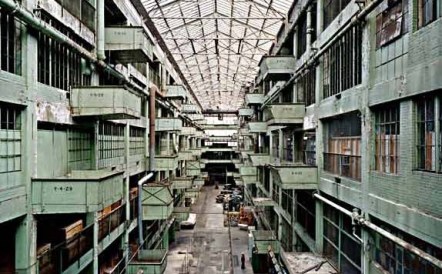
Highland ParkA great deal of the experimentation explained above was carried out at the purpose built Highland Park factory. It was six-stories high, with a railroad track running down a central atrium (pictured) and cranes lifting materials from the rail carriages up to balconies that opened to the appropriate floors on either side.

The basic pieces of the Model T started at the top floor and, through the use of chutes, conveyors and tubes between floors and the force of gravity, they made their way down through the various sub-assembly processes until they reached the ground floor final assembly conveyor….and then the completed car could ‘drive off the line’.

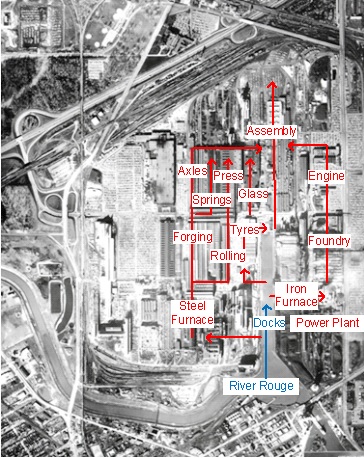
River RougeWhilst Highland Park was an amazing feat of engineering, it had its limitations – such as the central crane-way that was probably a huge bottleneck! Henry Ford went for one more innovative jump – he created an enormous horizontal factory complex called the River Rouge2. The site started with raw iron ore and materials and finished with completed automobiles. It had its own ship docks, power generation plant, blast furnaces and rolling mills – all arranged to achieve flow (I’ve added the basic flow over an aerial picture).

“The River Rouge Plant in 1925 produced about one vehicle per minute in a total lead time of about three days and nine hours from steel making to finished vehicle.” (Source: Henry Ford’s book ‘Today and Tomorrow’)

“…as long as it’s black”

You are probably familiar with the famous Henry Ford quote that ‘you can have any colour you like, as long as it’s black’. Today this sounds quaint, even humorous but there’s a seriously important point within: the manufacturing process was not designed to handle variety.

This hadn’t been a problem – people just wanted to be able to afford a car! – but rising standards of living and the birth of modern marketing gave rise to the ‘sophisticated consumer’. The new problem became offering ever wider variety (e.g. different colours, engine choices, trim levels, add-ons….) whilst retaining low-prices (and therefore mass-production costs).

And so to the crux of this post: Lots of organisations from all around America and the world went to the River Rouge to learn…but what did they see…and, therefore, what did they go away to do?

American Manufacturers post World War II.

So American organisations saw scale at the River Rouge.

Unfortunately, achieving the product variety now demanded by customers meant regularly stopping the production line to change tooling to be able to produce the different variants. Delivering variety was seriously hindering speed.

What to do? Here’s what they came up with:

  • Let’s interrupt the flow and decouple the stages within the production line, allowing the different processes to operate independently, and create buffer stocks between each process;
  • Let’s build each process to the largest scale feasible, and then run large batches per product variant through at the fastest rate possible and thus keep the number of changeovers required down to a minimum.
  • Let’s build warehouses to store all the resultant inventory (Work-in-process and finished goods)

This fundamentally changed production from workers producing for the next process step to workers merely producing for inventory. It became a case of ‘make lots and inspect later’. It was virtually a crime to stop the line3 – a disaster for quality!

Of course, once the main process steps were decoupled, their co-location didn’t matter so much. So rather than having a number of end-to-end manufacturing sites across America, the ‘logic’ could extend to…

  • Let’s centralise process steps into ‘centres of excellence’ so that we can increase scale even further! We might end up with, say, a massive steel works in one city, huge sub-assemblies in another city and a mega final assembly yet somewhere else.

…and the above ‘solution’ to variety introduced massive wastes in the forms of transportation across sites; inventory and its motion as it is constantly transferred in and out of the warehouse; over-production and obsolescence; defects through poor quality and rework…and on and on and on.

You could conclude that they ‘unlearned’ (even destroyed) what Henry Ford had achieved before variety had been introduced.

The above led American manufacturers to the hell of:

  • centralised planning, culminating in mega algorithms calculated by Manufacturing Resource Planning (MRP ii) computer applications, producing theoretical answers far from reality; and
  • ‘management by results’ using managerial accounting data (unit costs, rates of return, targets, budgets,…) to command and control the work.

This approach, even though it was hugely wasteful, proved profitable until the 1970s…until domestic demand became satiated and globalisation opened up the market to other manufacturers. Things suddenly became rather competitive….

Over in Japan

The Japanese, and Toyota in particular, saw flow at the River Rouge.

Taiichi Ohno (Toyota) realised that flow was the important bit: “ [they] observed that Ford’s plant conserved resources, by having processes linked in a continuous chain and by running slowly enough so that people could stop and fix errors when they occurred.”  (Johnson4)

Japan, unlike America, did not have the luxury of abundant resources after World War II. They couldn’t afford to create huge factories or tie up money in inventory…so they had to find a different way – to do a lot with a little.

Taiichi Ohno came to the conclusion that variety and flow had to go together i.e. “a system where material and work flowed continuously, one order at a time” (Johnson).

This created some clear challenges to work on:

  • rather than simply accepting that machine changeovers took time, Ohno set his workers the challenge of continuously reducing set up and change-over times; and
  • rather than running high-volume batches per variant, Ohno empowered each worker to design and control the steps they performed so that they could perform different steps on each unit that passed through them

In short, he set his people a huge visionary challenge, of working together as a system to think about the incremental, and sometimes giant, steps they could take to handle variety ‘in the line’.

Rather than centralised planning with standardised work dictated to them, the workers were empowered, and encouraged, to think for themselves, to deal with what was in front of them, to experiment and to innovate….and to share what they had learned.

And, wow, they came up with some fabulous techniques such as ‘Single-Minute Exchange of Dies’ (SMED), ‘pull’ using kanban, product supermarkets, ‘stop the line’ using andon cords, visual management, machine ‘right sizing’…and on and on.

I could write about each of these…but I’m not going to (at least not now). The point is not the brilliant innovations themselves. It is the clear and permanent challenges that were set and the constant progress towards them.

You may copy ALL of Toyota’s techniques but they (and other like-minded organisations) will still leave you far behind. Why? Because, whilst you are attempting to copy them they are racing yet further ahead. Indeed, what you copy (even if you ‘get’ the why) may be an out-dated technique before you go live! (This is to compare a static vs. dynamic environment)

What about service?

The Western (?) ‘solution’ for service organisations has, sadly, been virtually the same – scale: to standardise, specialise, centralise and ‘crank up the volume’.

Yet the challenge of handling customer variety is so much bigger: variety for service organisations is virtually infinite – it’s different per customer and, even for a given customer, it differs as their circumstances change.

So should we just pick up the ‘Toyota tool kit’ and get implementing? No. The techniques to meet the challenge will differ. Service is NOT manufacturing.

But can we learn from Toyota? Most certainly – but this must be at the deepest ‘beliefs and behaviours’ level.

The core message from the above is that service organisations should design their system such that the front line are allowed, and enabled, to absorb variety in customer demand.

If you run a service organisation and you have set up:

  • a front office ‘order taking’ function to categorise demand (which can only be based on the limited information available to them), and break it down into standard ‘work objects’ from an allowable catalogue of variants;
  • a ‘workforce management’ function to: prioritise and allocate (i.e. push) these work objects into ‘work queues’, usually by temporal batches (e.g. by day/ shift or weekly);
  • multiple specialised back office silos to churn through their allocated work, ‘motivated’ by activity targets (and incentives) regarding volumes of work performed; and, as a result
  • a complete confusion as to who is taking responsibility for resolving the customer need

…then you have seen scale, through commanding and controlling the work, as the ‘solution’.

If, however, you are on a journey towards:

  • equipping the people at the point of contact with the necessary expertise and freedom to respond to what most customers will predictably want (i.e. the bulk of demand); and
  • where more unusual demand hits the system, allowing and enabling these same ‘front of service’ people to ‘pull’ expertise to assist, yet retaining ownership of the service provision (thereby speeding up their rate of learning and widening their skills and knowledge)

…then you are on a similar track to Ohno: Pursuing flow for each unique customer demand, through revealing and harvesting the passion and pride within your workers.

Update: Here’s the link to an addendum to this post, which came about from a comment below.

Footnotes:

1. Sources: Much of the above comes from early chapters within three books:

  • ‘Relevance Regained’ by H. Thomas Johnson
  • ‘Profit Beyond Measure’ by H. Thomas Johnson
  • ‘Toyota Kata’ by Mike Rother

Other details (including pictures) come from searching around the ‘interweb’ thing.

…and of course the service ending is inspired by the work of John Seddon.

2. Historical point of detail: “The River Rouge was built to produce Model T Fords for decades to come, [but] by the time it was capable of full production later in the [1920s], a factory a tenth its size could have handled the demand for Model Ts.” (Wiley)

i.e. Henry Ford had built this huge production machine but his product had gone out of fashion because its competitor, General Motors, was providing the variety that customers now wanted, albeit using scale to do so. Ford was now in a dash to recover.

3. ‘Stop the line’ crime: Workers knew that managers wanted them to make as many as possible, with no ‘down time’. I understand that this is where the phrase to ‘throw a spanner in the works’ comes from…which refers to a disgruntled worker ‘accidentally’ dropping a tool into the assembly line mechanism so that the line stopped and they all got a break whilst the cause was found and rectified.

4. A fresh giant: Johnson is a giant for me, and I’ve been meaning to add his ‘giant bio’ to this blog for ages now…I have finally done so 🙂

The gift that keeps on giving

A good laughI’m a big fan of the Think Purpose blog. It gives me a good hearty laugh, and long may it continue.

Some time ago the author promoted the blog’s most viewed post to a ‘page of its own’ status under the heading ‘It’s not all cream cakes and beer in systems thinking’. Go on, have a read.

I enjoy this post immensely (it has so many truths within) and, as such, I have it on my wall in an attempt to keep me sane.

I was pondering it the other day as yet more madness happened around me and something struck me: I wanted to add something of an optimistic/ positive nature to the list (‘item no. 8’ if you will)….and here it is:

Once you begin to understand the basics of systems thinking and intervention theory then much of what you observe around you becomes ‘the gift that keeps on giving’.

There isn’t a day that goes by in which I don’t read an email or intranet communication or become involved in (or overhear) a conversation in which I start to chuckle (even ending up crying with laughter) at what is happening before and around me.

So, yep, I’d add to the list that systems thinking is the gift that keeps on giving. Just think – all that comedy was occurring around you beforehand…and you never knew! How could you?

…and to follow up this positivity, ‘item no. 9’ is that ‘systems thinking’ conversations are hugely stimulating.

Since starting my journey, and in particular from when I began to write this blog, I have never had such fabulous, important, liberating, energising, therapeutic, cathartic etc. etc. conversations with some truly inspirational, humble, genuine, passionate and well-meaning people, searching for a ‘better way’ for them, for society and for our planet.

Sure, much of the command and control cr@p still remains around them but it’s a great feeling to be able to talk to a fellow human and ‘you know that they know’ and ‘they know that you know’! It’s a bit like having a magical secret.

Obviously it gets better the more of you there are1…but even just two of you can hugely enjoy a daily exchange about another “you couldn’t write this stuff” instance of ‘item 8’ comedy (see above).

Conversations beforehand were just so bland, boring and irrelevant to the world.

Ho hum, roll on tomorrow’s fun 🙂

Footnote:

1. I see these stimulating conversations as the pioneers of a ‘new way’ connecting and nourishing themselves along the lines of the Berkana Institute system change model. (Thanks to Charles Beauregard for sharing this video in the comments section of a much earlier Think Purpose post.)

Lost in translation

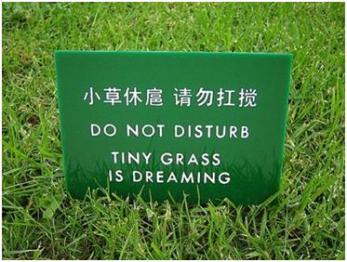
keep off the grassSo I came across a PowerPoint slide recently that was headed something like ‘Deming’s 14 points for management translated for our organisation today’ (emphasis added).

It then contained 14 very brief (i.e. 2 or 3 word) phrases of unclear meaning.

I am familiar with Deming’s 14 points for management, having them on my wall, and many (most?) of the phrases on the PowerPoint slide were alien to me.

Now, the reasons for this apparent mismatch could be one, or many, of the following. The author of the slide:

  • doesn’t understand Deming’s principles; or
  • doesn’t agree with Deming; or
  • doesn’t think that they apply to his/her organisation or to the world as it stands today1; or
  • does understand, does agree with them and does think they are applicable BUT doesn’t want to ‘upset the applecart’ with the inconvenient truth that some (many?) of Deming’s principles might go completely against how his/her organisation currently operates2

…and so considers it necessary and acceptable to, let’s say, ‘adjust’ them.

Now, the point of this post is not to dwell on my translation concerns on what I read on a PowerPoint slide (I mean no disrespect or malice to the writer). The point is to faithfully set out Deming’s 14 points as he wrote them and to pull out some pertinent comments…and, in so doing, to point out where many organisations have a way to go.

“Hang on a minute Steve…

…erm, you seem to be suggesting that Deming’s points are akin to a holy book! What’s so important about what Deming had to say?!”

If you are wondering who on earth Dr W. Edwards Deming was then please have a read of my earlier ‘about the giants’ post on Deming.

In short, he may be considered a (the?) father figure for post war Japan/ Toyota/ Lean Thinking/ Vanguard Method/ Operational Excellence…and on and on. If you believe you are on a ‘Lean Thinking’ journey, then Deming is a hugely important figure and I’d humbly suggest that anyone/everyone study and understand his thinking.

So, here they are!

Deming’s 14 points for management, as summarised3 by Deming (the blue italics), with additional comment from me4:

“The 14 points are the basis for transformation. It will not suffice merely to solve problems, big or little. Adoption and action on the 14 points are a signal that management intend to stay in business and aim to protect investors and jobs

…the 14 points apply anywhere, to small organisations as well as to large ones, to the service industry as well as to manufacturing.


1. Create constancy of purpose towards improvement of product and service, with the aim to become competitive and to stay in business, and to provide jobs.

Purpose is about improvement for the customer, not growth and profitability per se. If we constantly pursue our customer purpose, then success (through growth and profitability) will result …NOT the other way around. You have to act as you say, the stated purpose cannot be a smokescreen.


2. Adopt the new philosophy. We are in a new economic age. Western management must awaken to the challenge, must learn their responsibilities, and take on leadership for change.

Deming’s reference to Western management might now be referred to as ‘Command and control’ management and ‘management by the numbers’. Not all of western management today is command and control (there are many great organisations that have escaped its grip using Deming’s wise words) and, conversely, command and control is not limited to the west – it has sadly spread far and wide.

It’s a philosophy: Deming isn’t putting forward an action plan. He’s putting forward an aspirational way of being. The distinction is important.


3. Cease dependence on inspection to achieve quality. Eliminate the need for inspection on a mass basis by building quality into the product in the first place.

“Quality cannot be inspected into a product or service; it must be built into it” (Harold S Dodge). If you have lots of ‘controls’, then you need to consider root cause – why do you deem these necessary?

Controls cannot improve anything; they can only identify a problem after it has occurred. What to do instead? The answer lies (in part) at point 12 below.


4. End the practise of awarding business on the basis of price tag. Instead minimise total cost. Move towards a single supplier for any one item, on a long-term relationship of loyalty and trust.

How many suppliers (such as outsourcing and IT implementations) are selected on the basis of a highly attractive competitive tender and are then paid much much more once they have jammed their foot in the door, and the true costs emerge once we have become reliant on them?

True strategic partnerships beat a focus on unit prices.


5. Improve constantly and forever the system of production and service, to improve quality and productivity, and thus constantly decrease costs.

The starting point and never-ending journey is quality, in the eyes of the customer. The outcome (result) will be decreasing costs. Cause and effect.

To start at costs is to misunderstand the quality chain reaction. Focussing on cost-cutting paradoxically adds costs and harms value.


6. Institute training on the job.

 Management (of ALL levels) need constant education at the gemba and, when there, need to understand capability measurement and handle (not frustrate) variation.


7. Institute leadership. The aim of supervision should be to help people and machines and gadgets to do a better job. Supervision of management is in need of overhaul, as well as supervision of production workers.

Management should be farmers, not heroes.


8. Drive out fear, so that everyone may work effectively for the company.

The fixed performance contract (incorporating targets and rewards) is management by fear. Replace with trust.


9. Break down barriers between departments. People in research, design, sales and production must work as a team, to foresee problems of production and in use that may be encountered with the product or service.

This doesn’t mean turn everything on its head! Many an organisation misunderstands and attempts a grand re-organisation from vertical silos to horizontal streams. This is not the point. There is a need for (appropriate) expertise – the problem are the barriers that prevent collaboration across such teams….such as cascaded objectives, targets, rewards, competitive awards…and on.


10. Eliminate slogans, exhortations, and targets for the workforce asking for zero defects and new levels of productivity. Such exhortations only create adversarial relationships, as the bulk of the causes of low quality and low productivity belong to the system and thus lie beyond the power of the work force.

The role of management is to improve the environment that people work within, rather than constantly badger and bribe people to do better.


11.

a) Eliminate work standards (quotas) on the factory floor. Substitute leadership.

b) Eliminate management by objective. Eliminate management by numbers, numerical goals. Substitute leadership.

Numeric targets and straight jacket rules do not improve processes. On the contrary – they create dysfunctional behaviour that clashes with ‘serve customer’ as people struggle to survive.


12.

a) Remove barriers that rob the…worker of his right to pride of workmanship. The responsibility of supervisors must be changed from sheer numbers to quality.

b) Remove barriers that rob people in management and in engineering of their right to pride of workmanship. This means, inter alia, abolishment of the annual or merit rating and of management by objective

This means removal of the performance review process!

 To improve, the value-adding workers need to be given the responsibility to measure, study and change their own work. This fits with the front-line control (devolution) lever.


13. Institute a vigorous program of education and self-improvement

i.e. learn about Deming, about all the other giants …but through education, not merely training; through educators, not gurus….and then experiment.


14. Put everybody in the company to work to accomplish the transformation. The transformation is everybody’s job.”

…but don’t fall into the ’empowerment’ trap! Empowerment cannot be ‘given’ to teams, or people within…it can only be ‘taken’…and they will only take it if their environment motivates them to want to, for themselves.

 True collective accountability (i.e. where everyone can and wants to work together towards the same common purpose) comes from profit sharing within an ideal-seeking system.

Beware ‘making a message palatable’

Going back to that translation: Some of you may argue back at me that the person that carefully ‘translated’ Deming’s 14 points into something more palatable is ‘working with management’ and ‘within the system’ and that this is the best thing to do.

I don’t subscribe to this way of thinking (and neither did/do the giant system thinkers such as Ohno, Ackoff, Scholtes, Seddon etc.)

To borrow a John Seddon quote:

“Fads and fashions usually erupt with a fanfare, enjoy a period of prominence, and then fade away to be supplanted by another. They are typically simple to understand, prescriptive, and falsely encouraging – promising more than they can deliver. Most importantly fads and fashions are always based on a plausible idea that fits with politicians and management’s current theories and narratives – otherwise they wouldn’t take off.”

Beware the trap of ‘adjusting’ an unpalatable message (to the current status quo) in an attempt to progress. In making it ‘fit’ with management’s current thinking you will likely have bleached the power from within it.

For example: to translate Deming’s point 12 and (conveniently) omit his words around abolishing management by objectives and the performance rating system is to (deliberately) strip it of its meaning. Sure, it’s been made ‘agreeable’ but also worthless.

Deming’s philosophy is no fad or fashion! As such, it is important that it shouldn’t be treated that way. Managers should be exposed to what he said and why…and those that are true leaders will pause for self-reflection and curiosity to study their system, to get knowledge as to what lies within.

Footnotes:

1. Deming wrote about the 14 points in his 1982 book ‘Out of the Crisis’

2. If this is the reason then it strongly suggests that the organisation fails on Deming’s point 8: Management by fear.

3. Whilst this is only Deming’s summary, he wrote in detail on each point i.e. if you want a deep understanding of one (or all) of them then you can.

4. There’s far too much to pull out of the above to do justice to Deming within this one post – I’ve merely scratched the surface!…and, if you have been a reader of this blog for a while, you will likely have read enough that supports most (all?) of his points.

Oh…so that’s why ‘Command and Control’ doesn’t work very well!

social systemWarning (or advert for some): Sometimes I write long(er) ‘foundational’ type posts – this is one of them 🙂

Russ Ackoff researched and wrote a great deal about systems.

It is within his writings1 that I find an excellent explanation about why many organisations adopted the command and control management model, why there is a major problem with this and, most importantly, why there is a better way.

First, A recap:

Before looking at types of systems, I should allow Ackoff to remind us what is meant by ‘a system’ and why this matters:


“A system is a network of inter-dependant components that work together to try to accomplish the aim of the system…

The two key pieces here are that:

  • there is an aim; and
  • it is made up of parts that need to work together (either directly or indirectly) to achieve that aim

If you have parts but no aim then you don’t have a system…you simply have a ‘collection’.

If you have a part that (truly) isn’t required to achieve the aim then it isn’t actually part of the system…which is why your ‘appendix’ body part got its name.


…If each part of a system, considered separately, is made to operate as efficiently as possible, the system as a whole will not operate as effectively as possible…

The heart and lungs are parts of the body but if they function according to what’s best ‘for themselves’ then they won’t function as required for the overall good of the whole. It’s no good if the brain is telling the heart and lungs to ‘work flat out’ to run like hell from a chasing pack of lions and these organs both respond with a “no thanks, this doesn’t suit  us!” The same is true for parts of (e.g. functions within) organisations.


…The performance of a system depends more on how its components interact than on how they act independently of each other…

You can buy a ‘light as a feather’ carbon frame, an awesome set of aero wheels and a precision engineered 11-speed group set but you can’t ride them as a bike if they don’t fit together. Further, someone with a basic ‘sit up and beg’ bike frame with cheap wheels and components that do fit will easily beat you in a bike race.


…When a system is taken apart it loses its essential properties.”

If you take apart an alarm clock, you will have all of the parts necessary for the system but the disassembled collection of parts isn’t sufficient to tell you the time.

The above has huge implications.

So, on to Ackoff’s system types:

Ackoff defined a number of types of systems2 and the problems that occur when an organisation adopts a management model that does not match the correct system type.

Here goes….

Type 1: Deterministic (e.g. mechanisms)

alarm clockA deterministic system is one which has no purpose and neither do its component parts. This might seem rather strange…”Erm, I thought you said a system had to have an aim?!” – the point is that a deterministic system normally serves a purpose of an entity external to it, such as its creator. Its function, and that of its parts, is simply to provide that service when required.

Mechanisms are the most obvious examples of deterministic systems: An alarm clock is such a system. Its purpose (to tell the time) has been provided to it by its creator (the clock maker)….and that is what it is for, nothing more and nothing less. It can’t decide to do something else!

Even a computer, whilst incredibly more complicated than an alarm clock, is such a system – it is reliant on the inputs and programs provided to it by its external sources.

Type 2: Animated (e.g. most organisms)

monkeyAn animated system is one which does have a purpose of its own but its parts don’t.

Animals (and therefore humans) are the most obvious example. They have a purpose of their own – where this might be argued as (at a minimum) survival, and (more optimistically) to enjoy doing so, in the manner of their own choosing.

The animal is made up of parts (e.g. organs) and whilst these parts have a necessary function for the good of the whole, they do not have a purpose of their own.

In this way we can compare a computer to a person and see that they are fundamentally different. The computer’s purpose is provided to it whilst the person provides their own.

Type 3: Social (e.g. organisations, societies)

flagsA social system is one which has a purpose of its own and so do its parts (the people within).

Indeed each social system is usually part of a larger social system (e.g. a family is part of a community, which is part of a nation, which is part of ….)

And even more complex, a person belongs to multiple social systems – which have different, sometimes conflicting, purposes3.

So, bringing these three types together, we have:

System Type4: The whole is: The Parts are:
Deterministic (e.g. a mechanism) Not purposeful Not purposeful
Animated (e.g. a human) Purposeful Not purposeful
Social (e.g. an organisation) Purposeful Purposeful

These three system types form a sort of hierarchy: The deterministic alarm clock is given purpose by the animated (clock making) person who also lives within their social group. The linkages don’t go the other way….or at least they shouldn’t…which leads on to…

Okay, interesting stuff but what’s the point?

Well, now that we have an understanding of three different types of systems, we can see the consequences of the misunderstanding of an organisation as a system:

A ‘deterministic’ model applied to an organisation:

Adam Smith (often referred to as the father of economics and of capitalism) wrote a famous book called ‘The wealth of nations’ (1776). In it, he used the example of a pin factory to explain the concept of ‘the division of labour’. He explained that one person performing all the steps necessary to making a pin could perhaps make only 20 pins a day but if the pin-making process were broken up into a series of limited operations, with separate people performing them in a joined-up line, productivity could rise to thousands of pins per day per worker.

Now that sounds fantastic doesn’t it! But for who?

Smith’s thinking was taken on board by industrialists who went on to employ vast factories of ‘unskilled labour’ in the new concept of ‘manufacturing’ (and who likely still do in the sweat shops of 3rd world countries).

Standing back, we can see that this is using people as replaceable machine parts i.e. we have a defined mechanism (the manufacturing process) which is given its purpose externally by its creator (e.g. make pins)…and wow, this mechanism sure can make pins!

Henry Ford’s phenomenal success worked in the same way. He designed a mechanism to make Model T Fords (his mass production factory) and installed workers as the mechanism’s parts. He (and other ‘owners’ at this time) could use workers in this mechanistic way because:

  • unskilled workers, whilst poorly educated, were adequate for the simple tasks required of them;
  • such workers were willing to tolerate being treated as a machine part since there was high unemployment and virtually no social security safety net…giving them little option (i.e. work as required or starve);
  • there was a large pool of available labour – the human parts of the machine were easily replaceable; and
  • such business owners were subject to very little societal controls (such as governmental interventions and constraints) limiting their treatment of their worker ‘parts’4.

It’s worth noting that, even though worker conditions were massively in his favour, Ford’s ‘mechanism’ had an astounding 370% turnover of workers in 1913, with new hires staying an average of only 3 months. Many workers simply ‘walked off the job’ without notifying anyone…which is what happens if you ask humans to perform monotonous (demoralising) work without having to use their brains.

An ‘animated’ model applied to an organisation

So times moved on. We had two world wars that caused/ enabled major societal changes – a major shakeup of the class system, the birth and rise of the Labour movement and worker unions, massive improvements in education, social security and welfare, and great advances in technology.

The other significant change was the raising of capital (necessary for post war growth and development) from the public and the consequent birth/ rise of publically owned corporations. This separated the ownership and management of these new organisations.

A big difference from before was that:

  • the workers were now far more educated and empowered; and
  • the required work had become far more skilled (utilising new technologies).

Managers were no longer able to treat workers as merely replaceable cogs in a machine – it took time to train them, and they now had worker rights and choice.

Now, rather than seeing an organisation as a deterministic system with the all-powerful owner dictating its purpose (as the likes of Ford had done), they operated as an animated system would6: with a ‘brain’ (senior management) and a ‘body’ (the various operating functions performing the work).

Such a model works by senior management providing the instructions (the what: commands) and procedures (the how: controls) and then the operating units carrying them out accordingly.

“Command and control represents the division of labour between decision-making and doing the work.” (Seddon)

We all know that the ‘operator’ parts within the organisations ‘body’ are actually human beings but the ‘command and control’ management instruments don’t really recognise this fact:

  • the organisational ‘brain’ (often annually) decides the strategy and breaks this down into a set of objectives for the parts of the ‘body’ and locks these into a cascaded grand plan;
  • the organisational ‘brain’ provides incentives for the ‘body’ to act as it requires: thus assuming that it is simply a matter of extrinsically motivating each part to comply as required;
  • the organisational ‘brain’ considers the performance of each part of the ‘body’, scores it and delivers this judgement back: thus assuming that each part can and will accept such feedback for the good of the whole;
  • the organisational ‘brain’ performs (frequent) reorganisations on the ‘body’ parts, as if shifting pawns around a game board. The brain does this by dictating such redesigns to the body rather than asking the body if (and how) it could better rearrange itself;
  • The organisational ‘brain’ thinks that the answer to an increasingly complex environment is simply to increase the quantity and regularity of communication with the ‘body’ parts. This fails to realise that communication is not the underlying problem.

But the reality for every organisation is that they have purposeful parts – you and I – whether they like it or not…and so to treat these parts as merely having a function for the whole is to inevitably generate conflict.

A social model applied to an organisation

…and so we reach the point at which we conclude the obvious that:

  • the organisation (hopefully) has a purpose;

AND

  • the humans working within it have separate purposes.

…and therefore any management model that doesn’t understand and work within such a social system will be very limiting – causing loss of immeasurable value to the organisation AND to the people within.

Now you might say “okay, interesting stuff, but treating an organisation as an animated system and using command and control methods has worked fine so far…why do we need to change?”

The rate of change in our world has been massively accelerating. It used to be that change was seen as generational and this made it relatively easy for people to adapt but this no longer holds true.

Organisations are operating in more complex and less predictable environments with the result that:

“Over the last 50 years, the average lifespan of S&P 500 companies has shrunk from around 60 years to closer to 18 years.” (Source: The art of corporate endurance )

Here’s a classic Deming quote: “It is not necessary to change. Survival is not mandatory.”

But if survival is desired, then the best chance that an organisation has is to operate a management model that actually fits with the correct type of system! In so doing, it can get the best out of everyone within.

What might this model look like? Studying ‘Deming’s 14 points for Management’ would be a great start. A post to follow next.

Who’s been successfully operating a social model for decades? Two brilliant examples are Toyota and Handelsbanken.


Footnotes:

1. Credit: The core of this post comes from learnings derived from a classic Ackoff essay entitled ‘Reflections on systems and their models’ which can be found in the book ‘Ackoff’s Best: His classic writings on management’.

2. I’m aware that other system thinkers have created other, more sophisticated, classification schemes (e.g. Boulding, Beer). Ackoff’s system types nicely serve the purpose of this post.

3. This fact is probably relevant to the need for, and creation of ‘soft systems thinking’…which is where Peter Checkland’s work fits in (A ‘giant bio’ currently in draft)

4. For those ‘system’ geeks out there: Ackoff explained a 4th system type, that of an ecological system – where the parts are purposeful but the whole is not. Ecological systems contain interacting mechanistic, organismic and social systems, but do not have a purpose of their own. However, their function(s) serve the purpose of the systems that are their parts.

Example: the purposeful use of fluorocarbons as propellants by humans (a purposeful part of the ecological system) affects the ozone layer in a way that is determined, and not a matter of choice for our planet (the whole)…the planet cannot decide that it is harmful to it and decide to ‘do something about it’– the outcome (even though we may not understand it) is determined.

5. Henry Ford realised the problem and, in an attempt to compensate for their conditions, paid his workers well as compared to what they could earn elsewhere.

6. Stafford Beer wrote a famous book called ‘The brain of the firm’ (1972) that explored in detail the analogy of an organisation working as the human body does.

Don’t be an Ostrich

OstrichHere’s something that I’ve noticed over the years: ‘Command and control’ managers really don’t like being referred to as….well…’command and control’ managers.

In fact, they don’t like this apparently grubby ‘command and control’ phrase being used to describe anything around them – it seems to irritate them….a lot!

So it got me pondering about why this might be:

  • Perhaps they see it as disrespectful, as in “how dare you, don’t you know who I am?!”
  • Perhaps they are somewhat embarrassed, as in “shhh – keep your voice down! I’m not very comfortable with you bandying that term about.”
  • Probably there’s an element of both.

If you are that ‘irritated manager’

…and this is the point of this very short post, putting your fingers in your ears and humming “lalalala” doesn’t make it go away.

Fingers in ears

If someone uses the dreaded ‘command and control’ phrase ‘at’ or about you (or your management team) then, rather than being an ostrich, how about asking for, and respectfully drilling into, their perspective as to why they feel this way?

You might learn quite a bit (but that would depend upon you).

…and even if you aren’t able to bring yourself to accept (some of) what they say, remember that perception is reality.

And before you are tempted by the “well that may be your opinion Bob, but you are the only one saying it!” riposte…stand back and have a think about that.

One of THE attributes of a ‘command and control’ environment is fear…and so there should be no surprise that there is only one foolish/ brave/ wise/ disengaged/ about to retire/ got another job* ‘Bob’ prepared to tell you. (* select as appropriate)

Perhaps you would have accepted Bob’s critique, say, last year but you have been doing your best to progress towards a better way. However, don’t be offended if the ‘command and control’ label doesn’t melt away overnight – it won’t because it can’t.

Turn Bob’s challenge on its head as a good thing – every time someone uses the ‘command and control’ label you have an opportunity to better, and more deeply, understand your current condition and its root cause and then further improve.

…though, if it’s not getting better after a while, you are probably doing it wrong!

…and finally

If you are the employee using the ‘command and control’ label to describe what you see and feel, then please carry on with using this label when it is appropriate to do so…but carefully look out for any ostrich discomfort from management (whether verbal or body language) and, rather than withdrawing or defusing your comment, how about asking them “so why the discomfort?”

–  You may create an opportunity to inform and educate 🙂

Note: My next post will use an Ackoff essay to explain why ‘command and control’ is the wrong model to apply.