Oh…so that’s why ‘Command and Control’ doesn’t work very well!

social systemWarning (or advert for some): Sometimes I write long(er) ‘foundational’ type posts – this is one of them 🙂

Russ Ackoff researched and wrote a great deal about systems.

It is within his writings1 that I find an excellent explanation about why many organisations adopted the command and control management model, why there is a major problem with this and, most importantly, why there is a better way.

First, A recap:

Before looking at types of systems, I should allow Ackoff to remind us what is meant by ‘a system’ and why this matters:


“A system is a network of inter-dependant components that work together to try to accomplish the aim of the system…

The two key pieces here are that:

  • there is an aim; and
  • it is made up of parts that need to work together (either directly or indirectly) to achieve that aim

If you have parts but no aim then you don’t have a system…you simply have a ‘collection’.

If you have a part that (truly) isn’t required to achieve the aim then it isn’t actually part of the system…which is why your ‘appendix’ body part got its name.


…If each part of a system, considered separately, is made to operate as efficiently as possible, the system as a whole will not operate as effectively as possible…

The heart and lungs are parts of the body but if they function according to what’s best ‘for themselves’ then they won’t function as required for the overall good of the whole. It’s no good if the brain is telling the heart and lungs to ‘work flat out’ to run like hell from a chasing pack of lions and these organs both respond with a “no thanks, this doesn’t suit  us!” The same is true for parts of (e.g. functions within) organisations.


…The performance of a system depends more on how its components interact than on how they act independently of each other…

You can buy a ‘light as a feather’ carbon frame, an awesome set of aero wheels and a precision engineered 11-speed group set but you can’t ride them as a bike if they don’t fit together. Further, someone with a basic ‘sit up and beg’ bike frame with cheap wheels and components that do fit will easily beat you in a bike race.


…When a system is taken apart it loses its essential properties.”

If you take apart an alarm clock, you will have all of the parts necessary for the system but the disassembled collection of parts isn’t sufficient to tell you the time.

The above has huge implications.

So, on to Ackoff’s system types:

Ackoff defined a number of types of systems2 and the problems that occur when an organisation adopts a management model that does not match the correct system type.

Here goes….

Type 1: Deterministic (e.g. mechanisms)

alarm clockA deterministic system is one which has no purpose and neither do its component parts. This might seem rather strange…”Erm, I thought you said a system had to have an aim?!” – the point is that a deterministic system normally serves a purpose of an entity external to it, such as its creator. Its function, and that of its parts, is simply to provide that service when required.

Mechanisms are the most obvious examples of deterministic systems: An alarm clock is such a system. Its purpose (to tell the time) has been provided to it by its creator (the clock maker)….and that is what it is for, nothing more and nothing less. It can’t decide to do something else!

Even a computer, whilst incredibly more complicated than an alarm clock, is such a system – it is reliant on the inputs and programs provided to it by its external sources.

Type 2: Animated (e.g. most organisms)

monkeyAn animated system is one which does have a purpose of its own but its parts don’t.

Animals (and therefore humans) are the most obvious example. They have a purpose of their own – where this might be argued as (at a minimum) survival, and (more optimistically) to enjoy doing so, in the manner of their own choosing.

The animal is made up of parts (e.g. organs) and whilst these parts have a necessary function for the good of the whole, they do not have a purpose of their own.

In this way we can compare a computer to a person and see that they are fundamentally different. The computer’s purpose is provided to it whilst the person provides their own.

Type 3: Social (e.g. organisations, societies)

flagsA social system is one which has a purpose of its own and so do its parts (the people within).

Indeed each social system is usually part of a larger social system (e.g. a family is part of a community, which is part of a nation, which is part of ….)

And even more complex, a person belongs to multiple social systems – which have different, sometimes conflicting, purposes3.

So, bringing these three types together, we have:

System Type4: The whole is: The Parts are:
Deterministic (e.g. a mechanism) Not purposeful Not purposeful
Animated (e.g. a human) Purposeful Not purposeful
Social (e.g. an organisation) Purposeful Purposeful

These three system types form a sort of hierarchy: The deterministic alarm clock is given purpose by the animated (clock making) person who also lives within their social group. The linkages don’t go the other way….or at least they shouldn’t…which leads on to…

Okay, interesting stuff but what’s the point?

Well, now that we have an understanding of three different types of systems, we can see the consequences of the misunderstanding of an organisation as a system:

A ‘deterministic’ model applied to an organisation:

Adam Smith (often referred to as the father of economics and of capitalism) wrote a famous book called ‘The wealth of nations’ (1776). In it, he used the example of a pin factory to explain the concept of ‘the division of labour’. He explained that one person performing all the steps necessary to making a pin could perhaps make only 20 pins a day but if the pin-making process were broken up into a series of limited operations, with separate people performing them in a joined-up line, productivity could rise to thousands of pins per day per worker.

Now that sounds fantastic doesn’t it! But for who?

Smith’s thinking was taken on board by industrialists who went on to employ vast factories of ‘unskilled labour’ in the new concept of ‘manufacturing’ (and who likely still do in the sweat shops of 3rd world countries).

Standing back, we can see that this is using people as replaceable machine parts i.e. we have a defined mechanism (the manufacturing process) which is given its purpose externally by its creator (e.g. make pins)…and wow, this mechanism sure can make pins!

Henry Ford’s phenomenal success worked in the same way. He designed a mechanism to make Model T Fords (his mass production factory) and installed workers as the mechanism’s parts. He (and other ‘owners’ at this time) could use workers in this mechanistic way because:

  • unskilled workers, whilst poorly educated, were adequate for the simple tasks required of them;
  • such workers were willing to tolerate being treated as a machine part since there was high unemployment and virtually no social security safety net…giving them little option (i.e. work as required or starve);
  • there was a large pool of available labour – the human parts of the machine were easily replaceable; and
  • such business owners were subject to very little societal controls (such as governmental interventions and constraints) limiting their treatment of their worker ‘parts’4.

It’s worth noting that, even though worker conditions were massively in his favour, Ford’s ‘mechanism’ had an astounding 370% turnover of workers in 1913, with new hires staying an average of only 3 months. Many workers simply ‘walked off the job’ without notifying anyone…which is what happens if you ask humans to perform monotonous (demoralising) work without having to use their brains.

An ‘animated’ model applied to an organisation

So times moved on. We had two world wars that caused/ enabled major societal changes – a major shakeup of the class system, the birth and rise of the Labour movement and worker unions, massive improvements in education, social security and welfare, and great advances in technology.

The other significant change was the raising of capital (necessary for post war growth and development) from the public and the consequent birth/ rise of publically owned corporations. This separated the ownership and management of these new organisations.

A big difference from before was that:

  • the workers were now far more educated and empowered; and
  • the required work had become far more skilled (utilising new technologies).

Managers were no longer able to treat workers as merely replaceable cogs in a machine – it took time to train them, and they now had worker rights and choice.

Now, rather than seeing an organisation as a deterministic system with the all-powerful owner dictating its purpose (as the likes of Ford had done), they operated as an animated system would6: with a ‘brain’ (senior management) and a ‘body’ (the various operating functions performing the work).

Such a model works by senior management providing the instructions (the what: commands) and procedures (the how: controls) and then the operating units carrying them out accordingly.

“Command and control represents the division of labour between decision-making and doing the work.” (Seddon)

We all know that the ‘operator’ parts within the organisations ‘body’ are actually human beings but the ‘command and control’ management instruments don’t really recognise this fact:

  • the organisational ‘brain’ (often annually) decides the strategy and breaks this down into a set of objectives for the parts of the ‘body’ and locks these into a cascaded grand plan;
  • the organisational ‘brain’ provides incentives for the ‘body’ to act as it requires: thus assuming that it is simply a matter of extrinsically motivating each part to comply as required;
  • the organisational ‘brain’ considers the performance of each part of the ‘body’, scores it and delivers this judgement back: thus assuming that each part can and will accept such feedback for the good of the whole;
  • the organisational ‘brain’ performs (frequent) reorganisations on the ‘body’ parts, as if shifting pawns around a game board. The brain does this by dictating such redesigns to the body rather than asking the body if (and how) it could better rearrange itself;
  • The organisational ‘brain’ thinks that the answer to an increasingly complex environment is simply to increase the quantity and regularity of communication with the ‘body’ parts. This fails to realise that communication is not the underlying problem.

But the reality for every organisation is that they have purposeful parts – you and I – whether they like it or not…and so to treat these parts as merely having a function for the whole is to inevitably generate conflict.

A social model applied to an organisation

…and so we reach the point at which we conclude the obvious that:

  • the organisation (hopefully) has a purpose;

AND

  • the humans working within it have separate purposes.

…and therefore any management model that doesn’t understand and work within such a social system will be very limiting – causing loss of immeasurable value to the organisation AND to the people within.

Now you might say “okay, interesting stuff, but treating an organisation as an animated system and using command and control methods has worked fine so far…why do we need to change?”

The rate of change in our world has been massively accelerating. It used to be that change was seen as generational and this made it relatively easy for people to adapt but this no longer holds true.

Organisations are operating in more complex and less predictable environments with the result that:

“Over the last 50 years, the average lifespan of S&P 500 companies has shrunk from around 60 years to closer to 18 years.” (Source: The art of corporate endurance )

Here’s a classic Deming quote: “It is not necessary to change. Survival is not mandatory.”

But if survival is desired, then the best chance that an organisation has is to operate a management model that actually fits with the correct type of system! In so doing, it can get the best out of everyone within.

What might this model look like? Studying ‘Deming’s 14 points for Management’ would be a great start. A post to follow next.

Who’s been successfully operating a social model for decades? Two brilliant examples are Toyota and Handelsbanken.


Footnotes:

1. Credit: The core of this post comes from learnings derived from a classic Ackoff essay entitled ‘Reflections on systems and their models’ which can be found in the book ‘Ackoff’s Best: His classic writings on management’.

2. I’m aware that other system thinkers have created other, more sophisticated, classification schemes (e.g. Boulding, Beer). Ackoff’s system types nicely serve the purpose of this post.

3. This fact is probably relevant to the need for, and creation of ‘soft systems thinking’…which is where Peter Checkland’s work fits in (A ‘giant bio’ currently in draft)

4. For those ‘system’ geeks out there: Ackoff explained a 4th system type, that of an ecological system – where the parts are purposeful but the whole is not. Ecological systems contain interacting mechanistic, organismic and social systems, but do not have a purpose of their own. However, their function(s) serve the purpose of the systems that are their parts.

Example: the purposeful use of fluorocarbons as propellants by humans (a purposeful part of the ecological system) affects the ozone layer in a way that is determined, and not a matter of choice for our planet (the whole)…the planet cannot decide that it is harmful to it and decide to ‘do something about it’– the outcome (even though we may not understand it) is determined.

5. Henry Ford realised the problem and, in an attempt to compensate for their conditions, paid his workers well as compared to what they could earn elsewhere.

6. Stafford Beer wrote a famous book called ‘The brain of the firm’ (1972) that explored in detail the analogy of an organisation working as the human body does.

Don’t be an Ostrich

OstrichHere’s something that I’ve noticed over the years: ‘Command and control’ managers really don’t like being referred to as….well…’command and control’ managers.

In fact, they don’t like this apparently grubby ‘command and control’ phrase being used to describe anything around them – it seems to irritate them….a lot!

So it got me pondering about why this might be:

  • Perhaps they see it as disrespectful, as in “how dare you, don’t you know who I am?!”
  • Perhaps they are somewhat embarrassed, as in “shhh – keep your voice down! I’m not very comfortable with you bandying that term about.”
  • Probably there’s an element of both.

If you are that ‘irritated manager’

…and this is the point of this very short post, putting your fingers in your ears and humming “lalalala” doesn’t make it go away.

Fingers in ears

If someone uses the dreaded ‘command and control’ phrase ‘at’ or about you (or your management team) then, rather than being an ostrich, how about asking for, and respectfully drilling into, their perspective as to why they feel this way?

You might learn quite a bit (but that would depend upon you).

…and even if you aren’t able to bring yourself to accept (some of) what they say, remember that perception is reality.

And before you are tempted by the “well that may be your opinion Bob, but you are the only one saying it!” riposte…stand back and have a think about that.

One of THE attributes of a ‘command and control’ environment is fear…and so there should be no surprise that there is only one foolish/ brave/ wise/ disengaged/ about to retire/ got another job* ‘Bob’ prepared to tell you. (* select as appropriate)

Perhaps you would have accepted Bob’s critique, say, last year but you have been doing your best to progress towards a better way. However, don’t be offended if the ‘command and control’ label doesn’t melt away overnight – it won’t because it can’t.

Turn Bob’s challenge on its head as a good thing – every time someone uses the ‘command and control’ label you have an opportunity to better, and more deeply, understand your current condition and its root cause and then further improve.

…though, if it’s not getting better after a while, you are probably doing it wrong!

…and finally

If you are the employee using the ‘command and control’ label to describe what you see and feel, then please carry on with using this label when it is appropriate to do so…but carefully look out for any ostrich discomfort from management (whether verbal or body language) and, rather than withdrawing or defusing your comment, how about asking them “so why the discomfort?”

–  You may create an opportunity to inform and educate 🙂

Note: My next post will use an Ackoff essay to explain why ‘command and control’ is the wrong model to apply.

“What I think is…”

InformedI’d suggest that every day in our working (and home) lives we are asked for our opinion on something. In fact, such a situation probably occurs dozens of times every single day.


Let’s drill down into a single instance and consider the basic pattern of dialogue: we listen to someone state, and maybe explain, their thinking with regards to what they deem to be a problematic situation (explained below)  and then we start an immediate response with words like “I think that…”.  Worse, we may state our ‘thinking’ (perspective) as fact and we may mistake our feelings as rational logic.

I have a constant battle with myself to avoid, pull back from, or recognise my fall into this vast pit.

A sideways look at ‘everyday life’:

Peter Checkland, in his ‘Soft Systems Methodology’ (SSM), came up with a rather nice device that assists – the idea of ‘problematic situations’.

“As a member of the human tribe we experience everyday life as being quite exceptionally complex. We feel ourselves to be carried along in an onrushing turbulent stream, a flux of happenings, ideas, emotions, actions, all mediated through the slippery agency of language, all continually changing.

Our response to our immersion in this stream is not simply to experience it. Beyond that, we have an innate desire to try to see it, if we can, as meaningful. We attribute meaning to it – the ability to do this being one of the characteristics which marks us out as human.

Part of this meaning attribution is to see chunks of the ongoing flux as ‘situations’. Nothing is intrinsically ‘a situation’; it is our perceptions which create them as such, and in doing that we know that they are not static; their boundaries and their contents will change over time.

Some of the situations we perceive, because they affect us in some way, cause us to feel a need to tackle them, to do something about them, to improve them.” Thus we perceive such situations as ‘problematic’ i.e. something to intervene in.

This neatly dovetails with my last post in respect of Ackoff and messes vs. abstract problems. Just as Ackoff didn’t like the simplistic word ‘problem’, neither does Checkland. …and for the same reason: ‘problem’ implies ‘solution’ but, as he puts it, “real life is more complex than that!”

Back to that opinion we have been asked for

How do we arrive at our thinking? Do we have enough knowledge to justify a response?

Here’s another useful passage from Checkland:

“In human conversation, each of the persons involved influences others and is also influenced by them. Out of this two-way process comes what the participants are creating as their notion of changing ‘reality’. These acts of creating reality are never complete, and so have to be examined as only a part of a never-ending process.”

i.e. Any response we provide isn’t, and cannot be, ‘concrete’*. We have, and will always have, much to learn. Of course, it’s absolutely the case that our mindset (and where it sits on the ‘fixed – growth’ spectrum) will determine in which direction(s) and how far our thinking will travel during, and following human interactions.

(*yet, in many situations, we are easily satisfied with superficial response(s) and make key decisions based upon them)

I’d like to propose a few ‘alterations’ to our language to more accurately express the reality whenever we offer our opinion. How about we start our replies with:

“what I currently think is…”; or even better

 “what’s just popped into my head as a response is…”

Because, let’s be honest – we weren’t thinking about it 5 minutes before we were asked and we have press-ganged our brain into providing a timely reply. Further, our ‘answer’ isn’t exactly complete. It’s just an initial train of thought based on what we have been exposed to, and heavily weighted by its recency.

Even thinking about adjusting our replies to being less certain is likely to help us contemplate what we actually know to respond.

I could be flippant here and say that, if you ask me what I think, I should reply that I don’t know yet – ask me on my death bed…because that’s when I will have finished* assimilating all the information available to me. (* though likely, I presume, not by my choice)

Rather than taking this unhelpful line of reasoning…let’s look at what lies within:

Knowledge, not opinions

i.e. the idea that I need to take my time, gain (and therefore seek out) experience, understand the facts and expose differing perspectives before I provide a hypothetically useful reply.

So, even better than the “what I currently think is…” response would be to clearly explain the basis, extent (and therefore limitations) of our experiences in respect of the topic in play…so that we and the listener can appreciate why we currently think as we do…and our listener is encouraged to  reflect in the same manner. Gosh, we might end up educating each other!

“Real knowledge is to know the extent of one’s ignorance” (Confucius)

In a work scenario our response should often simply be:

“I don’t have the facts to make a valuable response…but I can do something about that…I’ll get straight to the gemba!”

…and if we do this, we will collect the facts, appreciate the environment in which they arise, and understand other perspectives…leading to meaningful change, towards purpose.

…which is an excellent link to three previous posts:

…and I’ve also set myself up for a follow-up post on the ‘soft systems thinking’ topic of ‘Worldviews’. Here’s a teaser to end with:

“The systems approach begins when first you see the world through the eyes of another. [It] goes on to discover that every world-view is terribly restricted. There are no experts in the systems approach.” (C. West Churchman)

So, you think you’ve got a problem!

Mr MessyI wrote in my bio of Russell Ackoff that he was a favourite giant of mine…but I haven’t covered much of his work in my writings to date. I recently re-read a couple of chapters from his wonderful ‘Ackoff’s Best’ collection of essays on management (and education) and this post is the result.

Ackoff wrote that:

“There are four ways of treating problems: absolution, resolution, solution and dissolution.

1. To absolve a problem is to ignore it and hope it will go away or solve itself; 

…and how much of what occurs around us (in whatever organisation) fits into this category?!


2.  To resolve a problem is to do something that yields an outcome that is good enough, that satisfies. Problem resolvers…try to identify the cause of a problem, remove or suppress it (relying on ‘experience’ and ‘common sense’), and thereby return to a previous state;

 …this fits with a ‘copying’ what you or others have already done, and an ‘implementation’ mentality. Nothing’s really been solved, just hidden or worked around;

…to my mind ’outsourcing’ fits here: i.e. the hope that ‘giving the problem to someone else’ to sort out for you is a good idea. (There’s a post ‘shouting to get out’ here)


3. To solve a problem is to do something that yields the best possible outcome, that optimises. Problem solvers…rely heavily on experimentation and analysis;

 …we may therefore move forward in a continuous and incremental manner

…but, whilst ‘solution’1 is a word that we all seem to be devoted to:

– no problem ever stays ‘solved’ due to the dynamic nature of reality; and

– every solution creates new problems. If you doubt this then reflect on the phrase that ‘Systems bite back’!


4. To dissolve a problem is to eliminate it by redesigning the system that has it [such that the problem no longer exists]. Problem dissolvers try to idealise – to approximate an ideal system – and thereby do better in the future than the best that can be done now.

 …this is to look at the ‘problem’ within its context – the bigger system that it sits within; to go ‘above’ the problem and look to understand how and why it exists in its wider environment;

…and, by redesign, achieve breakthrough improvement (or in Ackoff’s words a “discontinuity”).

Some ‘command and control’ organisational examples

…to ponder in respect of problems and their (re)solutions:

  • Why do we try to continually draft, and redraft cascaded personal objectives in the hope that we can make them SMART and good for the stated purpose of the system?
  • Why do we continue to fiddle with the incentives system so as to ‘motivate’ our people to ‘do what we want’, whilst increasing ‘controls’ to stamp out the resultant undesirable dysfunctional behaviour?
  • Why do we constantly strive to ‘give’ people empowerment (which is an oxymoron) and ‘make them’ engaged with their work, and yet continue to command and control what they do?

…why don’t we look at the management system (which reflects management’s beliefs and behaviours) that currently requires cascaded personal objectives, targets, the rating of people and the dangling of contingent rewards…and redesign it …and thereby dissolve these recurring ‘problems’?!

(Clarification: A reorganisation does NOT qualify as redesign!)

So how do we redesign?

You study your system, get knowledge and then, and only then, intervene for the good of your employees and customers….which sustains a long-term result for your investors.

But you don’t simply ‘intervene’: The manner of your intervention is vital to the outcome.

In a recent post, ‘Think Purpose’ brilliantly explained a somewhat profound point – that “change doesn’t happen AFTER finding the solution, it IS the solution.”  His post (along with the simple yet insightful diagrams within) is worth taking the time to read.

Looking at what is written above, I see a strong correlation between dissolving problems and people understanding and improving their system for themselves.

Okay, so we’ve looked at different ways to treat a problem but…

What’s a problem anyway?

Ackoff went on to explain that:

“There’s no such thing as ‘a problem’. They don’t exist – they are a concept. A problem is an abstraction, extracted from reality by analysis. It’s isolated from reality.

A problem is to reality what an atom is to a table: You experience tables not atoms – you experience the whole, not the parts that you have reduced it to by conceptual reduction.

What we experience (i.e. reality) are dynamic situations that consist of complex systems of problems, not individual or isolated problems. I call such systems messes.

When a mess, which is a system of problems, is taken apart, it loses its essential properties, and so does each of its parts. The behaviour of a mess depends more on how the treatments of its parts interact than on how they act independently of each other.”

“Erm, right…I think – got any examples to illustrate?”

Okay, I’ll go with two topical examples in the news.

Let’s start with Donald Drumpf3:

  • DrumpfProblem: (supposed hoards of) illegal Mexicans

  • Resolution: Build a wall! Obvious really :).
  • So how will that help? If you want a hugely funny take-down of Donald’s overly simplified problem-resolution thinking, watch John Oliver’s hilarious 18 min. piece about how determined ‘aliens’ will easily get around the wall. The bit where Donald answers his own question by suggesting they might just use a rope to lower themselves down is hilarious.

I could have written all day about other absurdly simplistic Drumpf-isms to everything and anything but, frankly, he’s too easy a target. What comes out of his mouth are supposed ‘resolutions’ to problems without thinking about the mess from which they come….and the many many new problems that they will spawn.

Without wanting to be political, I would note that Bernie Sanders appears to look underneath the problems at the systemic root causes, with a huge desire for redesign.

And so on to ‘BREXIT’:

BrexitOn 23rd June 2016 Britain votes on whether to remain in or leave the EU.

The ‘problem’ that the leaders of the ‘Leave’ campaign appear fixated on is the control of (supposedly unmanageable) immigration…mmm, there’s a similarity with Drumpf here.

Now, I’m not saying that leaving the EU is impossible – of course it’s not…but I believe that the suggested miracle ‘cure’ of leaving the EU is many magnitudes worse than the abstract ‘problem’ of resolving immigration.

An attempt at ‘dissolving’ the problem might look at why they want to leave their homes. Bombs could have something to do with it.

(If you don’t mind the swearing – I warned you – then I love this 3 min. Jonathan Pie ‘BREXIT’ video)

So what about an organisational example to end on?

Resolving the problem of high costs by ‘cost-cutting’ fits here!

We should remember that “Costs aren’t causes. Costs come from causes.” (Deming).

We can’t look at a line item in the management accounts, say it is too high and command that it be cut…and then not expect this to harm the system. The abstract ‘problem’ of a (seemingly) high cost cannot be separated from the system that causes it.

Ackoff’s ‘mess’ thinking now makes so clear the underlying reasons behind Seddon’s message:

“Managing value [i.e. the purpose of the system] drives out cost.

Cost cutting [i.e. an abstract ‘problem’] paradoxically adds costs, and harms value.”

To conclude

Here’s the hugely important point in a final Ackoff quote:

“A partial solution to a whole system of problems is better than whole solutions of each of its parts taken separately.”

  • A partial solution for the whole is good for the system’s purpose, and can be improved yet further as we study and learn more;
  • ‘Whole solutions’ to each part will likely harm, and can ultimately destroy, the system and its purpose.

Or, in American-speak:

  • A small step towards gun control is better than arming everyone4;
  • A small step towards cultural, racial and religious tolerance/integration is better than building a wall and throwing people out of the country.

Neither of these small steps eradicates the mess, but both start to untangle it.

Notes:

  1. Many ‘Lean (Systems) Thinkers’ prefer to use the word ‘countermeasure’ rather than ‘solution’ because they understand the reality of a complex and dynamic system;
  2. If you are new to this blog and don’t appreciate what the word ‘system’ means then please take the time to enlighten yourself  – this is foundational to everything;
  3. If you don’t know why I’m calling Trump ‘Drumpf’…John Oliver provides the answer 🙂
  4. Here’s Donald Drumpf’s simplistic rationale on arming the ‘good guys’ (who ever they may be!): “[the recent massacre in Paris] would have played out differently with the bullets flying in the other direction.”
  5. I’ve always intensely disliked the rather conventional ‘go after the low hanging fruit’ business improvement phrase, which refers to taking a cursory glance at something, coming to some quick judgements and ‘wading in’ with solutions. The phrase “Don’t think about it, just do it” springs to mind! Ackoff’s brilliant systems thinking work firmly puts the ‘low hanging fruit’ mentality in its place (at least for me anyway).

“Sir, Sir, Sir…have you marked it yet?!”

class with hands upSo my son had some school exams and this post was triggered from a conversation I had with him just afterwards:

I expect all of you can cast your minds back to school and if you’ve got teenagers then, like me, you will also be sharing their experiences.

Picture the following scenario:

  • You’ve studied for, let’s say, a maths exam1;
  • You’ve spent 2 long hours sat on an uncomfortable school chair, whilst being watched by the beady eyes of the maths teacher (who was actually asleep), and have just emerged from the exam hall;
  • You and your mates fall straight into discussing the trauma that you’ve just been through:

“What did you put for question 4?”

“Oh [beep], I hadn’t realised it was about that! I wrote about [something else that was completely irrelevant to the question]”

“Could you work out the pattern in that sequence of numbers?…’Fibonacci’ who?”

“What do you mean there were more questions over the page?!!!”

…and so on.

What you will notice is that they are all ‘switched on’ in the moment, whether they ‘enjoyed’ the exam or not. They really want to know what the answers were and how they did against them!

The after’math’ 🙂

So, next day, they have double-maths…whoopee!

The Students all plead together: “Sir, Sir, Sir…have you marked our exam yet?”

Teacher: “Whoa, hold your horses, I’ve barely sat down! I’ll do it as soon as I can.”

…and the students engage in yet more chatter about the exam but their memory of the exam is beginning to fade.

At the end of the week, they have maths again:

The majority of Students: “Sir, Sir, Sir…have you marked our exam yet?”

Teacher: “No, not yet, I’ll do it over the weekend.”

…much less chatter now. They have forgotten most of it.

So, now it’s the following week and maths:

A few keen Students: “Sir, have you marked our exam yet?”

Teacher: “Sorry, no, I’ve been writing reports so I haven’t got around to it yet. I’ll definitely do it by the end of this week.”

…the mood has changed. The content of the exam has been forgotten and so, instead, they fall back to merely wanting to know a score.

End of week 2 maths lesson:

One diligent Student: “Sir, have you marked our exam yet?”

Teacher: “Yes I have! I’ll read out the marks” and the marks are duly read out to the class, which brings out the whole spectrum of emotions (from feelings of elation to tears of despair, with a healthy dose of indifference in between).

That diligent Student again: “…but Sir, can I have my marked exam paper back?”

Teacher: “Erm, yes…I haven’t got them with me now…I’ll bring them in next week.”

What do we think about this?

We all know that by far the best thing to do for effective learning to take place is to mark this exam, get the marked papers back to the students and then go through the paper to explain and then discuss it question-by-question…and to do all of this As Soon As Possible.

(… and I know that this is what all good teachers will try to do)

We can see that:

  • There is a human desire for immediate and meaningful feedback, which quickly dissipates over time;
  • An overall score (the result), whilst potentially providing some useful indicative data, cannot help with learning – you can feel emotions from receiving a score but you can’t improve. Instead, you need to know about the method (or, in this exam scenario, each question);

“We don’t learn from our mistakes, we learn from thinking about our mistakes” (Ralph Tyler, Educator)

  • There is little point in just the teacher knowing the current capability of each of their students. Each student should be very clear on this for themselves.

So, to organisations:

The above might seem blindingly obvious and a world away from work but every day we all carry out actions and interactions within value-streams for the good of our customers…and the usual buzz phrase uttered at regular intervals is ‘we want to continuously improve!‘…but do we provide ourselves with what we need to do so?

Think of the richly varied units of customer demand that we* strive to satisfy as analogous to the maths exam:

  • (how) do we all know how we (really) did?
  • (how) do we find this out quickly?
  • (how) do we know what specifically went well and what didn’t?
  • …and thus, (how) can we learn where to experiment and how this went?!

(* where ‘we’ refers to the complete team along the horizontal value stream)

There’s not much point in senior managers receiving a report at the end of the month that provides them with activity measures against targets and some misleading up/down arrows or traffic light colouring. Very little learning is going to occur from this…and, worse, perhaps quite a bit of damage!

…and when I say learning, I hope you understand that I am referring to meaningful changes being made that improve the effectiveness of the value stream at the gemba.

The value-creating people ‘at the gemba’:

The people who need the (relevant) measures are the people who manage and perform the work with, and for, the customer.

If the people who do the work don’t know how they are truly doing from the customer’s point of view then they are no different from the students who don’t have their marked exam papers back.

hamster wheelThere should be no surprise if the workers are merely clocking in, turning the wheel, collecting their pay and going home again. It’s what people end up doing when they are kept in the dark….though they likely didn’t start out like this!

Senior Management may respond with “but we regularly hold meetings/ send out communications to share our financial results with them, and how they are doing against budget!”

  • This gives people the wrong message! If you lead with, and constantly point at, the financials, you are telling people that the purpose of the system is profit, and NOT your stated ‘customer centric’ purpose;
  • You can’t manage by financial results. This is an outcome – ‘read only’. You have to look at the causes of the results – the operational measures;

To repeat a hugely important John Seddon quote:

“Use operational measures to manage, and financial measures to keep the score”

I am championing what may be termed as ‘visual management’: being able to easily see and understand what is happening, in customer terms, where the work is done.

A whopping big caution

caution signHowever, ‘visual management’ should have a whopping big warning message plastered all over its box, that people would have to read before undoing the clasps and pushing back the lid…because visual management works for whatever you put up on the wall!

If you put up a visual display of how many calls are waiting or how long your current call has taken or a league table of how many sales each member of your team has made or….etc. etc. etc. people WILL see it and WILL react….and you won’t like the dysfunctional behaviours that they feel compelled to engage in!

So, rather than posting activity measures and people’s performance comparisons, what do the value creating people need to know? Well, put simply, they need to know how their system is operating over time, towards its purpose.

Here’s what John Seddon says about the operational measures that should be “integrated with the work: In other words they must be in the hands of the people who do the work. This is a prerequisite for the development of knowledge and, hence, improvement.

  • Flow: what is the capability of the system to handle demands in one-stop transactions? Where a customer demand needs to go through a flow, what is the capability of that flow, measured in customer terms? 

…in both cases we need to know the extent of variation – by revealing variation we invite questioning of its causes. By acting on2 the causes, we improve performance.”

A final thought: This blog has often said “don’t copy manufacturing because Service is different!“ But gemba walks through a well run ‘Lean thinking’ factory floor may very well assist your understanding of what is meant by good visual management. No, I’m not saying ‘copy what you see’…I’m suggesting that you might understand how a well run value stream has a physical place alongside the gemba where its participants gather and collaborate against a background of what they are currently achieving (their current condition) and what experiments they are working on to improve towards some future target condition.

To close – A shameless segue:

So I’ve been writing this blog for nearly 2 years…and I know many people read it…but I don’t get much feedback3.

If you have read, and accept the thinking within this post, you will understand that this limited feedback ensures that I am somewhat ‘in the dark’ as to how useful my writings are for you.

I do know that people see/ open my posts…but I don’t know too much more:

  • you might read the title or first few lines of a post, yawn, and go and do something else;
  • you might get half way through and not understand what on earth I am rambling on about;
  • you might read to the end and violently disagree with some or all of what I’ve written;

but…and here’s the punch line, how would I know? 🙂

Notes:

  1. It’s clearly a totally separate, and MUCH bigger question as to whether taking exams is good for learning – I’m aware that many educators think otherwise. The genesis of this post merely comes from my son’s exam reality. Just for clarity: I’m not a fan of the ‘top-down standards and constant testing’ movement.  
  2. Seddon writes ‘acting on’, NOT ‘removing’ the causes of variation. The aim is not to standardise demand in a service offering…because you will fail: the customer comes in ‘customer shaped’. The aim is to understand each customer’s nominal value and absorb it within your system as best you can…and continue to experiment with, and improve how you can do this.
  3. A big thanks to those of you that do provide me with feedback!….and I’m most definitely not criticising those that don’t comment – I’m just saying that I have a very limited view on how I am performing against my purpose…just like many (most?) people within their daily work lives.


‘Catch ball’

catch ballCatch ball: Participative approach to decision-making in which information and ideas are thrown and caught back and forth, up and down throughout the organization”
(www.Businessdictionary.com)

Jeffrey Liker clarifies further:

“A two-way conversation, not a one-way mandate…[where this is] a real conversation based on facts, not just lip service.”

‘Consultation’

Many a ‘command and control’ organisation will point to (what is known as) their ‘consultation process’ as evidence of their ‘best practise’ in engaging with their employees.

But what is actually happening here?

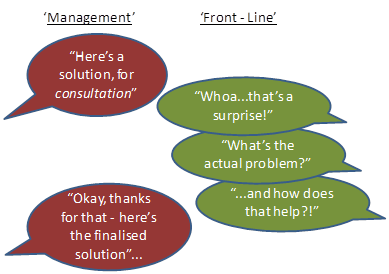
  • consultaitonA solution to a hypothetical/ ideological/ management perceived problem is proposed and released ‘for consultation’;
  • Those who notice it then scramble around to alert those that they see as being affected: “hey people, have you seen what’s just gone up on our intranet?!…you’ve got x days to say something about it!”;
  • There is much confusion about what the actual problem is, why the solution is proposing such radical ‘silver bullet’ change…and why the people at the coal face weren’t properly asked about it first;
  • Some people respond (many ‘choose‘ not to), FAQs are crafted, the consultation period ends, and a ‘finalised’ solution is issued (i.e. it becomes ‘organisational law’) and everyone is thanked for their contributions that brilliantly demonstrated [insert ‘corporate attitudes’ here]
  • …and if required, the sponsor of the ‘solution’ then employs some ‘change manager’ to force it through and, hey presto, all sorted!

If the first (real) step in supposed consultation is for an organisation’s management to issue a solution to a problem, and if that solution is then ‘finalised’ after the consultation period is closed then this is a one-way mandate masquerading as meaningful collaboration.

‘We need each other’

The above is not saying that there isn’t a role for management when making improvements. Indeed there is, but a radical different one than has become the norm.

Management’s job is to be very clear on customer purpose, on the value streams required to deliver against this, and how each value stream is performing against its purpose (i.e. its capability) and then to facilitate the front-line (value creating) workers through constant improvement.

The front line worker’s job is to constantly increase their competency in delivering value to their customers, and through this, know where in the process needs improvement.

…and, together, management and front line worker can pull improvements to where they are most needed ‘at the gemba’ and work through a logical 2-way problem solving method.

Implicit in the above is management’s number 1 task: to create, and sustain, a positive, collaborative environment in which each and every person is intrinsically motivated to fully engage and grow, towards a mutually agreeable purpose.

Consensus through ‘Catch ball’

The word ‘Consensus’ means agreement reached by a group. However, Liker expands this meaning within a Toyota context:

collaboration“Consensus does not mean that everyone agrees – that would be impossible.

Consensus at Toyota means that each person feels that he/she has been respectfully heard, and that his/her ideas have been seriously considered.

A leader tests, modifies, and improves a proposal at all levels of the organisation before it gets [put forward].”

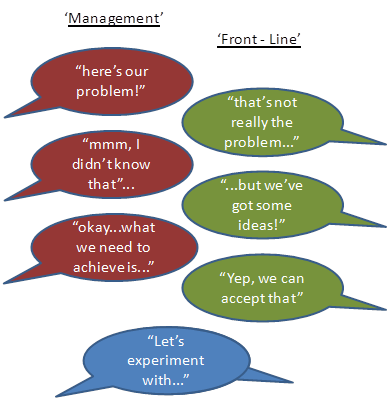
This means that it starts with clarity on the problem, through understanding of the facts…it proceeds through 2-way conversations, engaging in real discussions, experiments and innovation…and it culminates in consensus.

But won’t this take ages?!

Well, yes and no. This is to ‘go slow to go fast’.

Imagine if every change made was supported from the moment it is put in place! Think of all the cr@p that would be avoided. Think of how everyone would feel, and therefore how energised they would be to get involved, to come up with ideas, to listen to and consider alternatives to the status quo.

Use knowledge not opinions!

So, on looking at the above method, here’s a concern from management: “We have to accept that this is a really large organisation. We’d love to listen to all our people but every time we ask for their opinions we get hundreds of different, and contradictory, ideas! We simply can’t satisfy everyone all of the time.”

No, you can’t….so, to clarify: Don’t solicit opinions (like talk back radio). Start with and always come back to the facts!

…and if you’re not sure about something, don’t guess – go back and look deeper.

Start with a clear and meaningful challenge

Now, the ‘consensus’ bubble conversation above is better than the ‘consultation’ one…but it still starts with management suggesting the problem to the front line.

Let’s go one step further – Management should start with a very clear challenge (where this is a meaningful step towards the customer purpose) and then, through facilitation, help the workers identify the problems.

“But why would the workers do this?” I might hear you ask…well, yes, they will only do this if their environment is such that they are intrinsically motivated to do so. Remember that Turkeys don’t vote for Christmas.

Management should:

  • Be absolutely clear on purpose (of the system in focus);
  • Study the system at the gemba so as to truly understand its current condition (collect the facts, get knowledge);
  • Set the next challenge (the target condition – the end state to be achieved);
  • Facilitate the value-creating workers through experimentation towards the challenge;
  • ….and when achieved, set the next challenge – and repeat.

Rather than waiting for problems to arise, it is far better to “get your butt to the gemba and anticipate them” (Bicheno).

truthThe truth – can you handle it?

To end on a related point:

Many an organisation attempts to craft corporate communications and manage their people’s voices such that everything appears to be ‘on message’. Displays of ‘incorrect’ attitudes are frowned upon (and guarded against).

This means that, through the behaviours that this then creates, management cannot know the truth.

Contrast this with Toyota leaders who go out of their way to see and feel dissonant data. They want to know reality and most certainly don’t want to succumb to believing in a dream world!

A favourite quote of mine:

“If you cannot argue with your boss, then he [she] is not worth working for.” (Deming quoting Lt General Leslie E. Simon)

This is not championing anarchy. This is simply pointing out that if you are ‘in management’ and:

  • your people do not regularly and passionately challenge you; or if they do
  • you firmly argue with them ‘towards your way of thinking’

…then you are commanding and controlling your way to a soul-less wilderness.

Obedience to authority

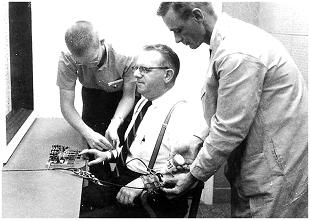
LearnerWhat if we set up an experiment to test how human subjects (and therefore we) respond to ‘authority’ ordering them to break their moral code?

What if this experiment went so far as to order the (effective) killing of another human?!

…and, of immense importance, what do we learn from this?

Some of you may be guessing where this is going: This post is about Professor Stanley Milgram’s infamous1 experiments at Yale University (1960 – 63) in which he wanted to test our obedience in the face of orders from an accepted authority that defy our conscience.

My intent in this post is to clearly set out a hugely significant point such that this can be subsequently built upon (by you in pondering what it means in application to your world, and by me in likely future posts).

The grounds for Milgram’s research were the Nuremburg trials, and the consistent defence from those ‘in the dock’ that they were “following orders” which, to most of us, invokes judgement of amoral and/or cowardly people offering excuses, and fills us with disgust.

But this begs the hugely uncomfortable question: ‘So, given the same orders, would you be any different?’ The answer might ‘shock’ you.

I came across Milgram’s psychology experiments many years ago and was fascinated by them…but it was only recently that I read his book (first published in 1974) that vividly chronicles exactly how the experiment (and its various permutations) was created, carried out, de-briefed and concluded upon…and it is one of the most thought provoking books I’ve ever read.

(Note: The experiment has been reproduced many times – across cultures, genders and in modern times – with comparable results)

The Experiment explained

Now, for those of you who don’t know (much) about the experiment, here are the basics

  • An advertisement was placed in the local newspaper asking for people from all walks of life to take part in a study of memory and learning by the psychology department at Yale University. Volunteers would be paid $4 for one hour of participation. It made clear that no special experience was needed, and there would be no further obligations once the study had been performed.

  • Many people came forward. The researchers considered ages, educational levels and occupations to balance participation across all the permutations of the experiment that they would carry out. Over 600 volunteers were used. Each was sent an exclusive allotted time to attend.

  • The experiments were conducted in a laboratory of Yale University so as to make it appear legitimate. As in many psychology experiments on humans, it required confederates* to act certain roles and thus make the volunteer (the person who is unwittingly the subject of the experiment) to believe that they are part of what appears to be something else all together.

* Confederate: An actor who participates in a psychological experiment pretending to be a subject but in actuality working for the researcher.

Here’s how the experiment works:

  • Two people turn up for the experiment at the laboratory as per their invite and are greeted by an experimenter. He is dressed in a grey technician’s coat and will ‘run’ the memory and learning experiment, explaining what is taking place, setting it up and controlling it.

  • The experimenter explains that the study is concerned with better understanding the effect of punishment on learning and, in particular, whether people learn things correctly by being punished for making a mistake (such as smacking a child).

  • TeacherUp-front explanation: The experimenter (E) explains that there are two roles: learner (L) and teacher (T).
    • The teacher will read a set of four word pairs to the learner, and then ask the learner to remember a correct pairing;
    • The learner is to indicate the correct answer by pressing one of four switches;
    • Whenever the learning makes an error, the teacher will administer an electric shock, starting at 15 volts.

  • Role selection: The experimenter asks the two people for any preferences as to which role they take and then suggests they draw for it. In fact, one of the men is an actor (i.e. working with the experimenter) and the draw is rigged so that he is always the learner. Thus, we have set up our one true volunteer (the subject of the study) into the role of teacher.

  • Taking up positions: the learner (our actor – and soon to be ‘victim’) is taken into a side room, strapped into a chair and an electrode is attached to his wrist. The strapping is explained as “to prevent excessive movement whilst being shocked”. The experimenter makes sure that the teacher is present and assists (i.e. knows exactly what is happening).

The experimenter and teacher return to sit in designated seats in the main laboratory next door, ready to begin.


  • shock generatorShock generator: On the teacher’s desk is a large piece of apparatus. It has a line of thirty switches, labelled as ranging from 15 to 450 volts, in 15 volt increments. There is also a written scale underneath the switches starting at the left with ‘slight shock’, through ‘moderate’, ‘strong’, ‘very strong’, ‘intense’, ‘extreme intensity’, ‘danger – severe’, and finishing at the 450 volts end simply with ‘XXX’. The experimenter provides the teacher with a sample shock using the 3rd switch (45 volts), making the volunteer strongly believe in the authenticity of the generator through an “owch”!

  • Instructions: The teacher is provided with the memory exercise questions to read out and told to administer a shock to the learner each time he gives a wrong response. The key bit – the teacher is instructed to move one switch higher on the shock generator each time the learner gives a wrong answer and to announce the voltage level to the learner just before applying it.

  • Victim feedback: So, firstly, you’ve probably guessed it by now – our victim isn’t actually going to receive the electric shocks but the teacher (our subject) most definitely believes that he is! Instead, a tape recording has been made of our victim acting out highly believable responses to being shocked, and this is played to the teacher at the appropriate moments.
    • The victim’s responses start with little grunts, rising to shouts of pain.
    • At the 150 volt level, the victim cries out that he doesn’t want to be a part of the experiment anymore.
    • His responses escalate, repetitively asking to be let out such that, by 270 volts, it is an agonising scream.
    • At 300 volts, he refuses to provide any more answers (see below for how this is dealt with).
    • His screams and protests reach a peak and then, from 330 volts, no further noise is heard – utter silence.

  • Experimenter feedback: As you would expect, our subject (the teacher), on hearing the victim’s worsening feedback, is going to increasingly turn to the experimenter for guidance…and, as for our victim, the experimenter’s responses to the teacher are scripted.

They start simply with “please go on” through an increasing sequence of “the experiment requires that you continue”, then “it is absolutely essential that you continue” and then “you have no other choice, you must go on”.

  • Three other specific pieces of feedback are scripted:
    • whenever the teacher asks or protests about the victim being hurt then the experimenter is to respond “Although the shocks may be painful, there is no permanent tissue damage so please go on”;
    • whenever the teacher asks about what to do when the learner doesn’t want to go on, then the experimenter’s response is “Whether the learner likes it or not, you must go on until he has learned all the word pairs correctly”;
    • and, finally, if the teacher asks about what to do when the learner doesn’t reply, then the experimenter’s response is to advise the teacher to allow the learner 5 to 10 seconds and take no response as a wrong answer (i.e. carry on up the shock scale) and continue on to the next question.

Of note: The experimenter uses no force, or threat of force, or threat of any form of retribution for disobedience. He merely uses his position of authority.


What was expected?

So, the true question that the researchers wanted to study: At what point (i.e. level of volts) will the teacher disobey the experimenter and refuse to continue delivering electric shocks?

Milgram did a rather cool thing – he staged a lecture on the topic of ‘obedience to authority’ and invited three different groups of people to attend: middle-class2 adults, college students and psychiatrists. He explained the experiment in detail to his audience without disclosing the results in any way.

shock control panelHe provided each person in his audience with a diagram of the shock generator and asked them to reflect on the experiment as just explained to them, and privately record how they believed they would personally perform if they had been the ‘teacher’ subject i.e. mark at what point on the scale they would disobey the experimenter. He then gathered in their responses.

I guess it’s no surprise that not one single audience member (whether middle-class adult, college student or psychiatrist) said that they would administer the 450 volt shock i.e. they all predicted defiance on their part.

Some indicated that they wouldn’t deliver any shocks at all, and a very few indicated that they would disobey at the 300 volt level, with the rest of the audience falling somewhere in between. The mean predicted ‘point of disobeying’ for the middle-class adults, college students and psychiatrists in the audience was 120 volts, 135 volts and 135 volts respectively i.e. no real difference in their thinking.

Further, Milgram realised that people like to see themselves in a favourable light and therefore the above predictions from the audience could have a vanity bias. He therefore asked the psychiatrists a different question: how do you predict other people would perform? They predicted that most subjects would not go beyond 150 volts and that about one in a thousand (i.e. someone with a psychological disorder) would administer the full 450 volt shock level.

Milgram explains that if the actual results were statistically different to these predictions then there is something very important going on that we should want to study and understand.

So, what actually happened?

Well, the results of the experiment were nothing like people’s predictions, and surprised the researchers!

For the basic version of the experiment (as explained above), 65% of subjects (the teachers) delivered the maximum (i.e. lethal) 450 volt shock to the victim and, of the minority that disobeyed, it took until the 300 volt level before the first one did so. Now that’s troubling! It’s important to note that there was a great deal of stress feedback exhibited by the teachers (i.e. it wasn’t a scene of happy compliance)…but, significantly, this didn’t prevent them from continuing.

If you’d like to get a really good feel for what all of that actually looks like, and understand some of the emotions involved, then here’s a very good ten minute YouTube showing the British “mentalist and illusionist’ Derren Brown accurately re-performing the experiment with unsuspecting people for one of his TV programs4. If you’ve read this far (!) then it really is worth watching.

What’s going on?

Milgram went on to create 17 variations to the experiment, to find out more and his analysis is highly significant. I hope to write some further posts that explore the reasoning, and its application to our world at work.

A basic conclusion for now:

“The social psychology of this century reveals a major lesson: Often it is not so much the kind of person a man is as the kind of situation in which he finds himself that determines how he will act.” (Stanley Milgram)

Notes

  1. The experiment was infamous because it was criticised at the time as being unethical. You should know that every volunteer was thoroughly debriefed afterwards and was followed up later by way of interviews and the sharing of the outcomes.
  1. It seems a bit weird writing ‘middle-class’ but this was Milgram’s categorisation back in the 60’s. Perhaps wording from another age? (or perhaps not?)
  1. Recommendation: So I’ve gone into a fair bit of detail in the above so that you appreciate the experiment…but I’d still thoroughly recommend the book ‘Obedience to Authority’ by Stanley Milgram.
  1. The final comment from the last subject on the YouTube clip (about making ‘more notches on the machine’) is quite amazing!

Laugh…or scream!!!

screamerSo I was passed a ‘McKinsey Quarterly’* article today by a good colleague of mine. It was titled ‘Ahead of the curve: the future of performance management’.

(*For those of you who haven’t heard of them, McKinsey is a large, well established global firm of Management Consultants)

Reading it made me want to laugh and scream in equal measure!

The glossy journal starts by referring to the “worst kept secrets” in respect of the traditional performance management process i.e. the well known issues with the process that virtually all organisations grapple with.

It then goes on to suggest a number of ‘aha’ insights and then ideas as to what to do about it.

Humble pie please…even a small slice?

humble pieI find it ironic when any consultancy writes such a piece in a style that (in my view):
  • suggests that it is bringing the ‘world of management’ something new and amazing (in a “listen to us, we know what we are talking about!” way);
  • …and yet completely side-steps* that it has likely made huge $$$ out of decades of pushing and propping up the exact thing that they now seemingly criticise;
  • …dressing up what it sets out as ‘key insights’ as apparently new findings, whilst ignoring that these have been championed by ‘giant’ voices all along (McGregor, Herzberg, Deming, Kohn, Scholtes, Seddon, …and on and on); [I seem to be repeating myself! – perhaps this McKinsey article is just late to the ‘performance management is dead’ party?]
  • …and even then, the narrative misses the ‘fundamental point’. It isn’t the people that we should be rating – it is the capability of the systems that they work within (see below).

* Big consultancies have ridden the ‘cascaded objectives – performance management – incentives’ band-wagon for years. We should be suitably cautious when considering what they now have to say.

I’m all for learning and growth, but I’d like some modest acknowledgment when the supposed teacher is attempting to lecture on something that appears to go against their previous decades of ‘wise counsel’.

“Answers are emerging”

The McKinsey authors declare in their article that “answers are emerging” in respect of how to change the performance management process, and then go on to talk about what some organisations are experimenting with (including the likes of GE, Microsoft, Neflix).

Now, I’m fine with exploring what others are doing, why and what their outcomes are, but why are these labelled as ‘answers’? Just because someone is doing something doesn’t make it an ‘answer’. There will be other organisations doing the opposite.

The basic problem (for me) with the McKinsey article is that it isn’t built around any fundamental consideration of:

  • What a system is, and why this matters;
  • What effects system conditions will have on people (and their supposed performance within that system);
    • in particular the effects of ‘command and control’ management
  • Why the system is far more than the sum of the parts and so it isn’t about individuals, but about the amazing and often unexpected outcomes that arise when unique individuals collaborate across value streams.

Looking at what other supposedly good and successful organisations have done doesn’t provide ‘answers’ (though it might provide ideas to experiment with for yourselves)

Beware the narrative fallacy: “Turning a sequence of events into a story in an attempt to explain the outcome…this is arguably how methodologies are born.” (‘The Lean Enterprise’ referring to Nasim Taleb’s definition).

Correlation does not equal causation. After all, if we looked at successful organisations a decade ago, we might easily construct an ‘answer’ based around performance management and incentives i.e. the exact opposite.

Things that I agree with

It’s not that I dislike what Google, Microsoft and many others are doing. I like a lot of what I hear about. However, I often don’t like how IT organisations, consultancies and what I perceive as their ‘industry bodies’ (e.g. Gartner, Forrester) write about it.

The McKinsey article includes references to the following highly agreeable points:

  • Severing the link between evaluation and compensation, though it doesn’t really explain the clear logic as to why;
  • Moving to frequent informal ‘on the job’ feedback discussions and a coaching style of management, though:
    • it doesn’t consider that those currently in the management hierarchy likely got there using ‘hero management’ and require the necessary skills to coach; and
    • it implies that coaching is about the manager providing feedback and focus (i.e. knowing the answer and imparting this knowledge to the worker). This is NOT coaching – coaching is helping the worker through their own problem solving ‘at the gemba’, not (as Mike Rother often jokes) getting them to successfully “guess what’s in your head”.
  • ‘Finding meaning in your work’ is what people want most* without making any comment of the Management Consulting industry’s role since the 1950’s in moving organisations towards ‘management by the numbers’ and economies of scale specialisation, centralisation, outsourcing, automation…in short: destroying the meaning of work!

(* I must admit to muttering a loud “no sh1t Sherlock!” when I read the bit in the McKinsey article that draws on ‘recent research’ that comes to this unsurprising conclusion)

‘Collecting data on people’

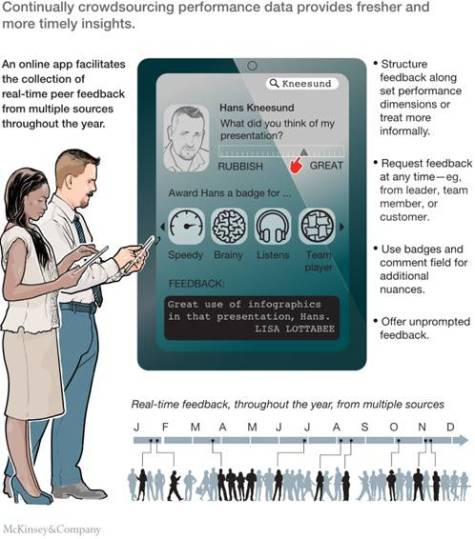
The article turns to “getting data that matters”, where this refers to collecting data about individuals and their ‘performance’. And so it turns to using technology to assist. It puts forward tools that people can use to automate the collection of real-time data on their colleagues, suggesting that this will “free up time” and make the information “more credible”.

Aaaargh!

McKinsey app piccieI hope McKinsey won’t mind me reproducing here the‘exhibit’ within their article (McKinsey: if you do then please let me know – I’ll remove it and let the readers know this)
I have a picture in my head of the attendees at every presentation, project meeting, workshop etc. with their heads down, teenager-like, constantly using an ‘app’ to rate aspects of the facilitator’s performance as they arise.

Further, I can almost feel the dysfunctional behaviours occurring: People becoming incredibly careful about what they do and say, so as to get a ‘good score’…and avoid a bad one. It will turn us into performing monkeys, all trying to ‘play it safe’!

Facilitators need to retain the ability to professionally say things that make people uncomfortable, to question the status quo, to challenge conventional thinking…and not fear being immediately marked down for it.

Sod the facilitator’s supposed ‘performance’…I’d rather attendees looked up and collaboratively engaged with what he or she is saying!

“But they are engaging with you Steve, they’re busy rating you and providing valuable feedback 🙂” It’s not the facilitator that needs rating, it’s the system that ‘we’ (the facilitator and audience) are trying to improve!

Now, before anyone thinks otherwise, of course I want valid feedback so that I can improve…but I want to work in an environment in which everyone is relaxed and comfortable with each other, and therefore such feedback is naturally volunteered, in a 2-way conversation. I find it funny that we, as society, often lament ‘the youth of today’ seemingly not able to interact with each other…and yet here’s the wider IT industry (the hungry Great White shark) trying to sell us down the same path.

If you want an example of what technology has done to us, look at email…we used to pick up the phone, even walk to people’s desks!!!

Of course technology may assist…but let’s not set this up as ‘the answer’. Let’s ONLY pull it towards us once we understand the underlying problem(s) and work out what we need to do about it.

“Ahead of the curve”

Near the end of the article, the authors eulogise that: “Companies in high-performing sectors, such as technology, finance and media, are ahead of the curve in adapting to the future…it’s no surprise that organisations in these sectors are pioneering the transformation of performance management. More companies will need to follow – quickly. They need to shed old models…and liberate large parts of the workforce…”

This made me belly laugh!

  • What about all those Japanese organisations (from Toyota onwards)?
  • What about all those American and European manufacturers that learned from Deming and Toyota?
  • What about all the Scandinavian organisations (like Handelsbanken) that have been thinking this way for decades?
  • What about the ‘Beyond Budgeting’ round table?
  • What about all those public-sector and health organisations that are embracing Lean Thinking and/ or the Vanguard Method?
  • …and likely many many more groups you could name.

Hardly “ahead of the curve”…more like laggards! It is arguably the likes of GE and Microsoft (often in the service sector and/or often American-centric) playing catch-up in spite of what those big consultancies (and many an MBA programme) have been peddling towards them for all these years.

…and how does the ‘article’ end?

The McKinsey article states that “It’s time to explore tools to crowd source a rich fact base of performance observations.”

Yep, that’s right folks, it would appear to be simply another case of an ‘expert’ consultancy dressing something up to create their next implementation revenue stream.

Let’s not ‘explore tools’. Let’s get rid of ideologies and, instead, get to the theory underneath…and then experiment with a new management system.

Let’s move:

  • from management attempting to control, judge and bribe their people (with whatever the current cool methods and ‘tools’ happen to be);
  • to management working with their people to study, understand, and change the system that (together) they work within and then sharing the results.

To quote Deming:

“95% of the reasons for failure to meet customer expectations are related to deficiencies in the system…rather than the employee…

…the role of management is to change the system rather than badgering individuals to do better.”

…now you understand why I didn’t know whether to laugh or scream. You’ve probably guessed that, on balance, I’m screaming.

To McKinsey: In the seemingly unlikely event that you are reading this:

  • I know that you are no different to all the others (I’m not singling you out); and
  • I recognise that you are a business trying to earn money (and that you aim to do this ethically)

…but I hope that you have the good grace to ponder on my thoughts.


“Dad…what do you do at work?”

what do you doSo I had a fabulous conversation with one of my (excellent) colleagues. Let’s call him (or her 🙂 ) ‘Bob’.

His 10 year old son keeps on asking him what he does at work…and Bob keeps on trying to explain!

Just as an aside: For those of you that work in the ‘improvement’ arena (sorry, I know that’s a crap phrase), here’s an excellent comedy sketch showing a father/ son ‘what do you do?’ interaction on the rather painful subject of Six Sigma:

The ‘what does your dad do’ assignment (It’s 6 mins. long)

Now, Bob and I work in the role of ‘Business Consultant’ within a large organisation….or at least that’s what it says on our email signatures.

…and, given that we are trying to educate the organisation away from an ‘implementing tools and techniques’ mentality and towards a ‘change management’s thinking and behaviours’ world, the “what do you do?” question is perhaps even harder!

Here’s Bob’s first attempt at explaining what he does to his son:

Son: “So, Dad, what do you buy/ make/ solve/ ….[insert list of value-adding words that any citizen would recognise]?”

Bob: “Well son, I don’t do any of those things. I try to help people do those things better.”

Son: “So you tell them what to do!”

Bob: “Well, no, I try to help people work out for themselves how they could do things better.”

Son: “Nope, you’ve lost me there – still don’t understand what you do….”

Okay, so he didn’t buy that one, so here’s the following weeks’ conversation:

Son: “…so back to that question”

Bob: “Well, I am called in to help people solve what they perceive to be their problems but I try to get them to see root causes…but they don’t really like this because the root causes are usually outside their control and my advice won’t help them to meet their short term targets around silo’d business objectives.”

Son: “Erm, so they ask for your help…but they don’t like what you say?”

Hmmm, perhaps there’s an element of truth in that. Here’s the 3rd (and final) round between Bob and his son:

Son: “…so then what happens?”

Bob: “…so I try to get them to explore what is behind what I have explained/opened up to them…I try to get them to see (for themselves) the system conditions that are causing them to behave in the ways that they are.”

Son: “…Oh, so you just confuse and frustrate people?!”

And so where did that leave his son? Well, next time Bob heard his son verbalise his work role, here’s what came out:

My dad’s a ‘Business Insultant’

Brilliant!

Now, what’s even better is that I entered ‘Business Insultant’ into Google and, without expecting anything back, came up with an article explaining it as a specific term …which sort of fits with the above…and loosely fits with what I attempt to do/ be.

Who knew! (except Bob’s son of course).

‘Beyond Budgeting’: There is a better way!

BudgetSo this post is part 2 of a two-part piece in respect of budgeting.

Part 1 (The Great Budget God in the Sky) introduced the ideas that:

  • creating a detailed budget for the next year and then holding people to it is a very poor way to manage;
  • the budget is part of a wider ‘fixed performance contract’ that understandably causes budget holders and their teams to engage in a set of games that are hugely harmful to the system and its purpose;
  • but there is a better way…which will be discussed in (this) part 2.

If you can’t remember, or haven’t yet read, why part 1 came to these conclusions then please (re)read it…otherwise read on:

So what do you do instead of a budget?

So there’s a short, simple (and insufficient) answer, and then there’s the rest of what needs to be said.

In simple financial process terms, those organisations that no longer use budgets work with rolling forecasts instead. Here are a few explanatory quotes from successful practitioners:

“Rolling forecasts are updated quarterly and look five quarters ahead…and because [they] are separated from any form of performance evaluation and control*, we get far more accurate forecasts than was ever the case with the budgeting system.”

(* a necessary discussion point covered later in this post)

“…this approach has reduced dramatically the amount of time managers now spend in forecasting compared with the previous budgeting process.”

“Forecasts are used in conjunction with actual results to show trends for high level KPIs such as return on capital, profitability, volumes and so forth. These typically show the last eight quarter’s actual results and the next five quarters forecasts.” (i.e. they see, and understand variation rather than making binary comparisons)

“Rolling forecasts…place the CEO in a much stronger position to anticipate financial results.”

Right, so you’ve got the basic idea about rolling forecasts…but I started by stating that this was insufficient:

Necessary…but not sufficient!

Here’s a rather nice animation of a seven-levered lock:

lock mechanism animationI find it mesmerising! And it’s pretty cool seeing how it actually works 🙂

Using the lock as an analogy:

  • The lock is a system. Each of the seven levers (along with the key and accompanying barrel) is a component part;
  • You can uncover the existence of one lever, work out what position it needs to be in, and get this sorted (e.g. moving from budgets to rolling forecasts)…and yet the lock won’t open;
  • Further, the moving of this one lever into the ‘right’ position will very likely upset the positioning of all the other levers;
  • It is only when all of the necessary components work together that the lock opens;
  • Each component is necessary, but not sufficient.

…and so it is the same for any organisation’s stated desire for (what is often termed) ‘Operational Excellence’.

Clarification: The lock system as an analogy is obviously limited because it is a simple ‘digital’ system – it is either locked or unlocked, on or off, black or white, 0 or 1. This doesn’t represent the real world but it is still useful.

The ‘locked – unlocked’ states in my analogy are the difference between:

  • a command and control management system (that will likely be playing with a few levers in the hope of change but which hasn’t unlocked the underlying issues with its ideology); and
  • a truly devolved, adaptive and purpose-seeking system.

The lock is only truly open when all the necessary levers are working together.

What levers?!

Here’s a brief touch on them (with links to further discussions):

Levers1. System-level Clarity:

  • Of purpose: a meaningful ‘why’ for the organisation, and each of its value streams, from the perspective of the customer and society…where profit is an ongoing result, not an excuse;
  • Of philosophy: i.e. how to get there (which incorporates the other four levers)

…where this clarity is instead of, not as well as, a ‘management has the answer for you’ plan.

2. Transparency:

  • Fast, frequent, unadulterated, open-to-all and useful information feedback on what your value streams are achieving over time and if/ how this is changing, NOT activity measures, targets, binary comparisons and management reports
  • Actual trends and rolling forecasts NOT budgets and variance analysis (as explained at the top of this post)

…meaning that the people who do the work gain constant feedback on the capability of their value stream(s) against customer purpose.

3. Front-line Control (Devolution):

  • Ownership of decisions and customers by the value creators: that’s the people working at the front line with the customer and their needs;
  • Freedom to explore, experiment, learn and act:

“Self-managed teams are far more productive than any other form of organising. There is a clear correlation between participation and productivity.” (Margaret Wheatley)

4. Management as Support (NOT control):

  • Provision of enabling technologies and expertise, NOT dictating what these shall be and how they shall be used;
  • Guidance, NOT rules;
  • Farmers, NOT heroes

…in short, value enablers instead of, not as well as, commanders and controllers.

5. Collective Accountability:

You may have noticed that I’ve put this in the centre of my fancy bubbles diagram. That’s because it will be a catalyst for everything else yet, without it, nothing great is likely to be achieved because individualism and extrinsic rewards will act as a highly effective brake.

…can you imagine if you and everyone around you were all truly harnessed together towards the same aim, and how this would change/ enhance your behaviour?!

With these five levers working together then you will get a ‘whole organisation’ that is very clear on what it is trying to achieve, that is laser-focused on their customers, that will constantly innovate and adapt, that is never satisfied with where it’s at, that wants to know who’s doing well (and why) and who’s not (and, importantly, how to help them).

It will also avoid the huge waste inherent within the fixed performance contract (with all the ‘budget setting, target tracking, performance appraising and contingent reward’ paraphernalia dismantled and replaced).

Revisiting those 10 games

In part 1 of this post I set out, and explained, a series of recognisable games that budget holders and their teams play.

However, if you are working on the set of levers explained above, you can expect to create a management system that reverses those games into highly desirable outcomes (for employees, customers and investors). Here are those opposites:

“Always aim to improve upon and beat the competition”

“Never let the team down and be the one that drains the profit-sharing pool”

“Always aim to know and care for customers”

“Always share knowledge and resources with other teams – they are our partners!”

“Never acquire more resources than you need”

“Always aim to challenge (and reduce) costs”

“Always have the ability to understand root causes”

“Always ‘tell it like it is’ and share bad news”

“Always do your best, never fudge the numbers”

“Always challenge conventional wisdom”

Wow, that would be a cool place to work!

‘Beyond Budgeting’: The movement

So, I might well hear you asking “who’s actually doing this mad-as-a-hatter stuff eh Steve?!!” and I would answer that there are loads and loads of organisations (large and small) all around the world who are somewhere along their journey.

If you want to read case studies then there are plenty of places to go to: There’s the Beyond Budgeting Organisation…but there’s also The Lean Enterprise Institute, Theory of Constraints Institute, Kaizen Institute, Vanguard Method …and on and on. Let’s not forget Toyota itself! It’s not about a methodology – the systemic thinking advocated by these different organisations isn’t contradictory.

And, whilst obviously they don’t all agree on exactly everything, they all point towards what has been called by some ‘Management 2.0’ – the realisation that the command and control management system is ‘the problem’ and advocating evolving to a new one (by humbly studying, experimenting and learning).

It’s not a recipe – it’s a philosophy

A recipe has a set of ingredients and related instructions as to how to combine them – it is something that is implemented (being repeatable and reproducible).

A (scientific) philosophy is a theory, based on sound evidence, that acts as a guiding principle for behaviour. It is a direction to follow, where the path is found through experimentation and learning.

This (or any other) post is not meant to prescribe what needs doing. Instead, this whole blog advocates a move away from command-and-control, and towards systemic thinking and adaptive progress towards a meaningful purpose through empowered (which must imply engaged) people.

Caveat: setting out a ‘philosophy’ is absolute twaddle if it isn’t actually believed in, understood and expertly, humbly and continuously practiced by those in leadership.

‘Lipstick on a pig’

lipstickWhat a great phrase! Putting lipstick, some earrings and a blonde wig on a pig doesn’t change what it is…even if you are doing so with good intentions! (Ewe, that’s a weird thought).

There are many organisations out there attempting to command-and-control their way to ‘Operational Excellence’ but this is an oxymoron.

There is a subtle, yet gargantuan, difference between an organisation fumbling (with best intent) with a few of the levers and one that understands the lock.

Note: All quotes, unless specifically stated, come from Hope and Fraser’s book ‘Beyond Budgeting’ (2003) and their associated case studies.