Farmers and Facilitation

FarmerI’ve been meaning to write a post about promotion (into, and through the hierarchy of management) for a while now…it’s taken me a bit to frame it. Here’s ‘part 1’:

Before considering promotion we should ask ourselves…

What is the work of management?

A great deal has been written on this question. Womack’s essay ‘The work of management’ gives us an all too familiar view as to what management actually means in practice:

“Most managers I observe spend most of their time with incidental work – box ticking, meetings that reach no actionable conclusions, report writing, personnel reviews that don’t develop personnel, etc. And in the time left over they do rework. By the latter I mean the fire fighting to get things back on course as processes malfunction. Most managers seem to believe that this is their ‘real’ work and their highest value to their organisation.”

Is this what we actually want our managers to be doing? Does this create value or is it just about survival?

Who do we hire/ promote into management?

In another of his essays, ‘Fewer Heroes, More Farmers’, Womack explains that when he asked a Command & Control CEO at a very large American Corporation about his management hiring/ promotion logic he got the following in reply: “I search for heroic leaders to galvanize my business units. I give them metrics to meet quickly. When they meet them they are richly rewarded. When they don’t, I find new leaders.”

Womack went on to ask this CEO, given the very high level of turnover of his business unit heads, “why does your company need so many heroes? Why don’t your businesses consistently perform at a high level so that no new leaders are needed? And why do even your apparently successful leaders keep moving on?”

He got the usual answers in reply: “business is tough, leadership is the critical scarce resource, and that a lot of turnover indicates a dynamic management culture.”

…and yet such businesses preside over:

  • A confusion as to its purpose (a mismatch between what is stated and reality);
  • The constant rolling out of the latest ‘revitalising’ programme from the top;
  • Poorly performing processes, that tend to get worse instead of better;
  • Dispirited people operating these broken processes at every level of the organisation; with
  • Mini-heroes everywhere devising workarounds.

Rather than heroes, Womack suggests that we need farmers whose role is to steadily tend every important process, continually asking three simple questions:

  1. Is the business purpose of the process [in the eyes of the customer] correctly defined? [and Seddon would add ‘is its capability measured?’]
  2. Is action steadily being taken to create value, flow and pull in every step of the process while taking out waste?
  3. Are all of the people touching the process actively engaged in making it better?

“This is the gemba mentality of the farmer who, year after year, plows a straight furrow, mends the fence and obsesses about the weather, even as the heroic pioneer or hunter who originally cleared the land moves on.

Why do we have so many heroes and so few farmers, and such poor results in most of our organisations? Because we’re blind to the simple fact that business heroes usually fail to transform businesses. They create short-term improvement, at least on the official metrics. But these gains either aren’t real or they can’t be sustained because no farmers are put in place to tend the fields. Wisely, these heroes move on before this becomes apparent.

Meanwhile, we are equally blind to the critical contribution of the farmers who should be our heroes. These are the folks who provide the steady-paced continuity at the core of every lean enterprise”.

Now, after reading the above back to myself, I can feel a back lash from the current cool management buzz of ‘everything today is about innovation!’…as in “but the world is ever changing Steve! We can’t just rely on Continuous Improvement – we’ve got to constantly reinvent ourselves or else we will get left behind!”

I agree! What is written above isn’t confined to making small step changes and doesn’t constrain discontinuous (breakthrough) improvements. Womack’s 3 questions equally apply for the seeds of innovation to blossom within a healthy working environment.

Conversely, hero management with financial targets and contingent rewards can seriously damage the chances of true and meaningful innovation from happening. (Both Alfie Kohn and Dan Pink explain the research showing the harm that incentives do to innovation).

If your purpose is clear and everyone is working together towards it (not towards individual targets) then you will likely alternate between many small steps and infrequent leaps as new ideas and technologies come along and existing ones are steadily improved.

Who should we want as our managers?

“The greatness in people comes out only when they are led by great leaders” (Akio Toyoda)

Liker, in his excellent book ‘The Toyota Way to Lean Leadership’, explains Toyota’s leadership development model. He explains it in four building blocks:

(Note: whilst I am mixing the words ‘leader’ and ‘manager’, there is a big difference between them. Please reflect on Confusion over two words)

First, to be considered for leadership, a person has to be committed to self-development i.e. to constantly seek to improve themselves and their skills. This is enabled and assessed by those ahead1 of them providing suitable challenges, space and coaching to allow self-development to occur.

Clarification: You may have years of experience and/or rolls of qualifications…but this doesn’t demonstrate that you have, or can, self-develop:

“What is often mistaken for 20 years’ experience is just 1 year’s experience repeated 20 times” (Source unknown)

Not everyone will be up for self-development2. Clearly, Toyota are looking for those who can and want to grow. This is in stark contrast to organisations that want merely to bring in people from outside to ‘implement here what they have done to people elsewhere’ (but now appear to be running away from this!)

Second: Once a person has suitably demonstrated their ability and desire to self develop, then they need to show the development of others. To be clear: this does not mean merely coaching (supposedly) star performers or favourites (the ‘chosen few’)…it means developing everyone. In fact, your ability to develop someone where this appears challenging* is a sure sign of your development capabilities. Liker uses the Toyota quote that “the best measure of a leader’s success is what is accomplished by those they trained3.” It’s not about what you can do; it’s about what they can now do because of you (even though they may not comprehend this link).

(*The greatest case study I know of this is what Toyota achieved at NUMMI with ex-GM employees who were considered the worst of the worst. They re-hired them and turned them into the best. The problem wasn’t a shortage of talent, as we are so often led to believe, but an inability to engage and develop the talents lying dormant within people).

Third: So you are a self-developer and can develop others. It now becomes about your ability to enable daily improvement – facilitating groups of people through constant improvement: being a farmer as described above.

The focus is not on attempting to force improvement (top down) but in enabling, encouraging and coaching improvement from the bottom up.

Clarification: This is NOT about that ’empowerment’ word!

…and, finally, Fourth: It is now about ensuring that the right big-picture challenges are set, pursued and accomplished by the people and, in so doing, that this causes much experimentation, reflection and learning.

None of this leadership development logic is about being promoted because you are the best at performing your current job or that you are a hardened ‘go get ’em’ management hero. All of it is about your ability to facilitate improvement through others.

Managers instead of Consultants

…this leads me to observe that many a ‘command and control’ manager brings in consultants (or ‘Black Belts’) to facilitate his/her team through the likes of a Kaizen/ Rapid Improvement Event.

  • Worse still, such facilitators often prefer that the manager isn’t involved in these improvement events (except as ‘statesman’ at the beginning and ‘rubber stamper’ at the end) because their presence would seriously hinder what the people can achieve.
  • To add insult to injury, such an absent manager has attempted to delegate their improvement responsibilities and thus finds themselves even further from the work (the gemba) and with new/ higher barriers between themselves and their people.

…owch! If this is the case (and, sadly, it often is) then this is a very poor state to be in.

At Toyota, facilitation of improvement is what their managers are for! And, rather than a week-long ‘point improvement’ event performed every (say) 6 months, this facilitation should be ongoing.

You might respond that “Nice idea Steve…but our managers don’t have very good facilitation skills. We need expert practitioners to come in”. And that is precisely why Toyota looks for those people within its ranks that have the potential as facilitators of improvement…and then develops them into leaders.

Rother makes clear that The primary task of Toyota’s managers and leaders does not revolve around improvement per se, but around increasing the improvement capability of people. That capability is what, in Toyota’s view, strengthens the company. Toyota’s managers and leaders develop people who in turn improve processes through the improvement kata [pattern].

Developing the improvement capability of people at Toyota is not relegated to the human resources or the training and development departments. It is part of every day’s work in every area…”

Sense-check: It may be that your current managers are (or could be) great facilitators. However, if they have to use a ‘command and control’ management system on their people then it is unlikely that such fantastic skills will get a chance to blossom and deliver the potential value within. Worse, their efforts will likely clash with all that commanding and controlling going on.

Next time you feel the need to bring in facilitators, reflect on why. Is it because your managers:

  • don’t have the capability? or
  • do have the potential, but are constrained by the management system that they are required to operate within?

If your answer is a), then develop them. If it’s b), you have far bigger fish to fry…but don’t let this stop you from doing anything – remember the Two Parallel Tracks.

______________________________________________________________________

To close:

  • this post (Part 1) considers who we should be promoting, and why;
  • Part 2 will turn this all on its head and question the promotion career ladder logic. In short: we can’t all ‘get to the top’ and neither should we all want to.

Notes:

  1. Ahead: I use the word ‘ahead’ rather than ‘above because I’d like the reader to get out of a ‘superiors in the hierarchy’ mindset and, instead, think about people who happen to have been promoted to more senior positions because they are more advanced on this leadership development journey. This is merely a matter of timing, rather than importance.
  2. Fixed vs. Growth mindset: Professor Carol Dweck’s research suggests that we can judge how good people will be at learning new skills – our capacity to learn is determined by our beliefs as to whether our abilities are innate or can be learned. Dweck suggests a continuum with two extremes: A Fixed mindset and a Growth mindset. Don’t despair of those already in leadership positions that appear to have ‘fixed’ mindsets. This may very well be down to the environment in which they work (and have always worked) within. The important bit is to assess them once their environment is changed to encourage self-development and growth.
  3. Trained: the use of the ‘trained’ word in this quote applies to its meaning as is used in sport. Rother notes that “The concept of training in sports is quite different from what ‘training’ has come to mean in our companies. In sport it means repeatedly practicing an actual activity under the guidance of a coach. That kind of training, if applied as part of an overall strategy to develop new behaviour patterns is effective for changing behaviours.”

What have the Romans ever done for us!!

Biggus DicusFor those of you Python fans out there, I suspect the title of this post draws a smile of recollection from you. It draws out a big hearty grin from me.

For those of you who don’t know what I am writing about (and for those who do…but would like to relive the moment – go on, you know you want to!), here’s the famous clip from the Monty Python film ‘The Life of Brian’:

What have the Romans… (1 min. 25 secs)

This clip was triggered in my mind the other day when pondering how people collect and use data in reports (I had just seen one that offended my sensibilities!). I get frustrated when I point out a serious fault within a report and the response I get is “yes, but apart from that….”

Here’s my attempt at a Python-like response:

Leader (John Cleese): Look at what this report is telling us!”

Minion 1: “…but we don’t have enough data to know what’s actually happening.”

John Cleese: What?”

Minion 1: “We are only using a couple of data points to compare. This tells us virtually nothing and is likely to be highly misleading.”

John Cleese: “Oh. Yeah, yeah. We have only got this month vs. last month. Uh, that’s true. Yeah.”

Minion 2: “…and we’re using averages – we’ve got no idea as to the variation in what is happening.”

Side kick 1 (Eric Idle): “Oh, yeah, averages, John. Remember some of the mad decisions we’ve made in hindsight because of averages?”

John Cleese: “Yeah. All right. I’ll grant you that our lack of data over time and the use of averages makes our report a bit suspect.”

Minion 3: “…and, even if we did have enough data points and could see the variation, we don’t understand the difference between noise and a signal (common and special cause variation)”

John Cleese: “Well, yeah. Obviously we don’t want to be caught tampering. I mean, understanding the difference between common and special cause goes without saying doesn’t it? But apart from a lack of data, (miss)using averages and tampering – ”

Minion 4: “We often compare ‘apples with pears’: Lots of the things we ‘hold people to account for’, they have virtually no ability to influence.”

Minion 5: “Much of the data we use is unrepresentative and/or coerced out of people, which makes any data biased.”

Minions: “Huh? Heh? Huh… “

Minion 6: “And we are focusing on one KPI and not seeing the side effects that this is causing to other parts of the system.”

Minions: “Ohh…”

John Cleese: Yeah, yeah. All right. Fair enough.

Minion 7: “and we are using targets, which are arbitrary measures that have nothing to do with the system and cause dysfunctional ‘survival’ behaviours from our people.”

Minions: “Oh, yes. Yeah… “

Side Kick 2 (Michael Palin): “Yeah. Yeah, our targets cause some pretty mad behaviours, John, and it’s really hard to spot/ find this out because our people don’t like doing ‘bad stuff’ and, as such, don’t like to tell us about it. Huh.”

Minion 8: “Our reports are focused on people (and making judgements about them), rather than on the process that they have to work within.”

Eric Idle: “And our people are ‘in the dark’ about how the horizontal value stream they work within is actually performing, John.”

Michael Palin: “Yeah, they only know about their silo. Let’s face it. If our people knew how the horizontal flow was actually doing, they’d be far more engaged in their work, more collaborative (if we removed some of the management instruments that hinder this) and therefore far more able and willing to continually improve the overall value stream.”

Minions: “Heh, heh. Heh heh heh heh heh heh heh.”

John Cleese: All right, but apart from a lack of data, (miss)use of averages, tampering, comparing apples with pears, biased data, focusing on one KPI, the use of arbitrary targets, reports focused on judging people, and our value workers being ‘in the dark’….Look at what this report is telling us!”

Minion 9: We’re using activity measures (about outputs), rather than seeing the system and its capability for our customers (about outcomes).

John Cleese: Oh. Seeing the capability of the system from the customers’ point of view? SHUT UP!

  • THE END –

In short, many (most?) organisations are terrible when it comes to measurement. They are stuck in a weird ‘conventional reporting’ world. Perhaps this is a blind spot in our human brains?

‘Statistics’ is a word that strikes fear into the hearts and minds of many of us. I’m happy to admit that I’m no expert. But I think we should have a healthy respect for data and how it should and should not be used. I’ve heard many a manager raise their voice to say that they have the data and so can ‘prove it!’…and then go on to make inferences that cannot (and should not) be justified.

(Personal view: I think that it is better to be mindful (and therefore cautious) of our level of competence rather than blissfully ignorant of our incompetence, charging on like a ‘Bull in a china shop.’)

Where to from here?:

I’ve previously written a few posts in respect of measurement. I’ve linked a number of them in the skit above or in the notes below. Perhaps have a (re)read if you’d like to further explore a point I’m attempting to make.

…and here’s a reminder of the brilliant Inspector Guilfoyle blog that is dedicated to measurement. He writes nice ‘stick child’ stories about the mad things we do, why they are mad…and what a better way looks like.

Some closing notes on some of the ‘reporting madness’ points made above:

Binary Comparisons: Here’s a really great explanation of the reasons why we shouldn’t use a couple of data points: Message from the skies

Averages: If you don’t understand the point about averages, then have a think about the following quote: “Beware of drowning in a river of average depth 1 metre.” (Quoted by John Bicheno in ‘The Lean Toolbox’)

Variation: Deming’s red bead experiment is an excellent way to understand and explore the point about variation that is inherent in everything. I’ve written about variation in (what happens to be my most read post to date): The Spice of Life

Tampering: This comes about from people not understanding the difference between common and special cause variation. I wrote a specific post about the effects of tampering on a process: Tampering

Biased data: There are loads of reasons why data collected might be biased. The use of extrinsic motivators (as in contingent monetary incentives) is a BIG one to consider and understand.

Targets: John Seddon  is the place to go if you want a deeper understanding of the huge point being made. His book ‘Freedom from Command and Control’ is superb. Also, see my post The trouble with targets.

Capability measures: I believe that this point can take a bit to understand BUT it is a huge point. I wrote Capability what? In an attempt to assist.

School boy debating society

donald-trump…so I was in a room with a few Executives who had ‘spared me some of their time’ to allow a discussion about how I could help them move their organisation towards its stated purpose.

I said something and almost immediately one of the Executives leapt back with a seemingly clever (or was that merely ‘conventional’) and forceful counter. He then looked at me in such a way as to imply that:

  • what I had said was clearly very stupid; and
  • my lack of immediate and razor-sharp response to his challenge proved that he was right.

The implication was that I didn’t know ‘as much’ as him (as in “Silly boy, you are wasting my time…best go away until you can justify being before me”). There was no consideration that I (might) know different things to him.

I took a moment, I pondered what he had said, I thought about what I had said and I provided a reasoned response.

…and he leapt back with another counter, getting more animated and looking around the room at his fellow executives for emotional support. They (quite naturally) returned some smirks to him, translated as clear and obvious agreement with what he was saying.

I quickly realised that this had (unexpectedly) escalated, that my original comment had not fitted into his current world view and that there was no way that I would alter his thinking by attempting a short verbal rational explanation…so I politely said words to this effect and attempted to move on.

..and so he and the Executives sat back with smiles on their faces, looking smug that they had ‘won the argument’ – and that they were clever, and clearly more so than this upstart before them.

Hang on a minute! ‘Won the argument’? Who said there was an argument? It certainly wasn’t supposed to be (Cue Monty Python ‘argument’ sketch).

I suspect that such meetings with ‘command and control’ executives are all too common.

I compare them back to what I imagine to be the format of public school boy debating societies:

  • you have a position which must be pushed, and defended, at all costs;
  • you’ve got a fixed time to put your point across;
  • there will be a vote at the end to determine a result;
  • there is glory to be seen as the winner;
  • there is mirth to be shown to the loser, who will be considered ‘weak’; and
  • once the debate is over, it is ‘case closed’.

Note: None of the above was actually a surprise to me. I know about different worldviews, about rational vs. normative change and about the boomerang effect*.

(* the unintended consequences of an attempt to persuade resulting in the adoption of an opposing position instead).

The reasons for writing this post are merely to share:

  • the similarity between exchanges with ‘command and control’ executives and school boy debating; and
  • how easy it is for such a well meaning ‘rational’ conversation to descend into a head-to-head ‘win or lose’ argument.

…oh yes, and as some form of therapy for me 🙂


To all those executives out there:

If you are an executive and people put forward ideas that differ to your own, I’d humbly suggest you see this as a (free, yet valuable) opportunity to self-develop and improve (rather than protect) your world view.

As a point of fact: If the person in front of you believes differently to you then there must be reasons for this…and it could be very useful for you to consider and understand why…and thus mature and/or expand (rather than defend) your thinking.

False Economies

chasing moneySo I expect we have all heard the phrase ‘Economies of Scale’ and have a view on what is meant.

The phrase is probably covered within the first pages of ‘Economics 101’ and every ‘Beginner’s book of management’. I think the idea has even leaked out of these domains and is used in every-day parlance. It is seen merely as ‘common sense’*.

(* please read and reflect upon a hugely important quote on ‘common sense’ when you get to the end of this post)

So what is the thinking behind ‘Economies of Scale’?

Let’s start at the beginning: Why is it said that we benefit from ‘economies’ as an organisation grows larger?

The idea in a nutshell: To run a business you need resources. As you grow, you don’t necessarily need a linear increase in those resources.

Basic example: A 1-man business premises needs a toilet (if he needs to go, well he needs to go). But when the next person joins the growing company he doesn’t get his own personal toilet written into his ‘remuneration package’. No, he has to share the existing toilet with his fellow employee. You can see this logic for lots of different things (one building, one IT system, one HR manager….), but I reckon a toilet is about as basic as it gets.

The theory goes that as the volume of output goes up* then unit costs come down (where unit cost = total cost/ units of output).

(* I’m writing generally now…I’ve moved on from toilet humour 🙂 )

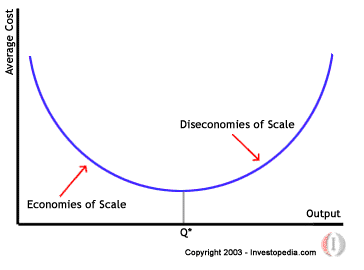
It should be noted that the classical economists that came up with the theory did accept the idea of ‘diseconomies of scale’: that of costs rising as growing organisations become more complex, more bureaucratic…basically harder to manage.

You’ll likely see all this expressed in economics text books with a very simple diagram (below) and, voila, it is surely so!

economies of scale

Getting into more specifics about the phenomenon, three distinct reasons are given for those scale economies:

  • Indivisibility: Some resources aren’t divisible – you can’t (easily) have half a toilet, a quarter of a receptionist, 1/8th of a manager and so on.
  • Specialisation along with Standardisation: this reason goes way back to the writings of Adam Smith and his famous book called ‘The Wealth of Nations’ (1776). In it, he used the example of a pin factory to explain the concept of ‘the division of labour’. He explained that one person performing all the steps necessary to making a pin could perhaps make only 20 pins a day but if the pin-making process were broken up into a series of limited and standardised operations, with separate people performing them in a joined-up line, productivity could rise to thousands of pins per day per worker.
  • Machinery: Investing in ever larger machines mean that they can turn out more and at a faster rate…and our beloved unit costs come down. In service organisations the equivalent could be a ‘bigger, better’ telephone system, IT system,…etc.

Sounds like a water tight case to me – ‘Economies of scale’ proven, case dismissed!

Not so fast…a few dissenting voices:

“All the above seems to be about managing our costs? We are concerned about where this might lead – shouldn’t we be first and foremost focused on delivering value to our customers?”

“We’ve got really low unit costs at lots of our activities…and we keep on making ‘economies of scale’ changes to get them even lower…but this doesn’t seem to be reducing our total costs (they remain annoyingly high)…are we missing something?”

“Gosh, that ‘economies of scale’ average cost curve looks so simple…so all we need to know is when we are at the optimum size (Q) and stop growing. Easy! Can someone tell us when we reach that point? How about a nice warning signal when we are getting close? What do you mean it’s just ‘theoretical’ and no-one actually knows?!”

“I’ve heard that ‘behavioural economics’ is debunking a central assumption within Adam Smith’s classical economic ideas. Apparently we are all human beings (with our own unique purposes), not rational robots!” (Nice link: Who cooked Adam Smith’s dinner?)

“We don’t make pins. We are a service organisation. We have much variety in demand and our customers are ‘co-producers’ within our process…specialisation and standardisation can do much harm to them, and therefore us!”

Meanwhile, on another planet…

Taiichi Ohno developed the Toyota Production System (TPS). In so doing, he used totally different thinking, with profound results.

(Note: Historians have identified a core reason for this difference in thinking as the heavily resource-constrained context that Japan found itself in after the 2nd world war. This was in complete contrast to 1950s America that had an abundance of resources and booming customer demand. In short, Ohno had to think differently to succeed.)

The big difference – Flow, not scale, as the objective: Ohno concentrated on total cost, not unit costs. He realised that, first and foremost, what matters is how smoothly and economically a unit of demand is satisfied, from initial need through to its completion (in the eyes of the customer).

The flow is everything that happens between these points and, as well as all the value-adding steps, this includes:

  • all the time that nothing is happening (a huge proportion of a traditional process)
  • all the steps that occur but shouldn’t really need to (i.e. they are non-value adding);
  • all the repeat and/or additional steps needed because something wasn’t done right; and (the worst of all)
  • everything needed to be done when the customer returns with the good or service as not being acceptable (where this could be days, weeks or even months later)

There’s no point in a particular activity being made ‘efficient’ if this is detrimental to the flow.

‘Economies of scale’ thinkers (and their management accountants) are obsessed with how much each activity costs and then targeting reductions. Their belief is that, by reducing the costs of each activity, these aggregated savings will come off the bottom line. Such thinking has led to:

  • ‘large machine thinking’ (which also relates to centralisation/ shared services);
  • ‘batch thinking’ to make these resources work (allegedly) more efficiently;
  • ‘push thinking’ to keep these resources always working – high utilisation rates are king; and
  • inflexibility due to highly specified roles and tasks

…which cause a huge amount of waste and failure demand.

Ackoff made incredibly clear in his systems TED talk (using the automobile as his example) that trying to optimise the components of a system will not optimise the system as a whole. In fact, the reverse will be true and we can expect total costs to rise.

Rather than trying to get the cost of a specific activity down, Toyota (and other system thinkers) focus on the end-to-end horizontal flow (what the customer feels). This is a different (systemic) way of thinking and delivers far better outcomes.

It is no coincidence that Ohno is also credited with much of the thinking around waste. It is only by thinking in terms of flow that waste becomes visible, its sources understandable, and therefore its reduction and removal possible.

In short, Cost is in flow, not activity.

Flow thinking has led the design of systems to:

  • ‘right-size thinking’ and ‘close to customer thinking’;
  • ‘single-piece flow thinking’;
  • ‘pull thinking’; and
  • handling variety ‘in the line’ thinking (Note to self: a future post to be written)

These all seem counter-intuitive to an ‘economies of scale’ mindset, yet deliver far better outcomes.

(How) does this apply to service?

Okay, so Ohno made cars. You might therefore question whether the above is relevant to service organisations. Here are examples of what the ‘Economies of scale’ mantra has given us in service, broken down into comments on each of specialisation, standardisation, centralisation and automation:

Specialised resources: Splitting roles into front, (middle) and back offices; into demand takers (and ‘failure’ placators), transactional processors, back room expert support teams and senior ‘authorisers’…meaning that:

  • we don’t deal with the customer when/ where they want;
    • causing delay, creating frustration – which needs handling;
    • incorrect setting of customer expectations;
    • unclear ownership, leading to the customer having to look out for themselves
  • we have multiple hand-offs;
    • causing batching, transportation, misunderstandings, re-work (re-reading, re-entering, repeating, revising);
    • we break a unit of value demand into separate ‘work objects’ which we (hope to) assign out, track separately, synchronise and bring back together again (…requiring technology);
  • we collect information to ‘pass on’ (…requiring technology)
    • often passing on incomplete and/or incorrect information (or in Seddon’s words “dirty data”), which escalates to the waste of dealing with the defects as the unit progresses down the wrong path;
  • we categorise, prioritise, allocate and schedule work around all these roles (…requiring technology)
  • …all of the above lengthens the time to deliver a service and compromises the quality of the outcome, thus generating much failure demand (which we then have to deal with)

Standardised activities: Trying to achieve a standard time (such as Average Handling Times) to perform a standard task (using standard templates/ scripts) that appears to best fit with the category that ‘we’ (the organisation) jammed the customer into

  • rather than listening to the customer’s need and attempting to deliver against it (i.e. understanding and absorbing customer variety);

Centralisation: Seeing ‘shared services’ as the answer using the “there must be one good way to do everything” mantra.

  • creating competition for shared service resource between business units and the need for SLAs and performance reporting;
  • requiring some ‘super’ IT application that can do it all (“well, that’s what the software vendor said!”);
  • ‘dumbing down’ the differences between services (and thus losing the so-called ‘value proposition’)
  • loosening the link between the customer and the (now distant) service.

Automation: Continually throwing Technology at ‘the problem’ (usually trying to standardise with an ‘out of the box’ configuration because that will be so much more efficient won’t it) and, in so doing, creating an ever-increasing and costly IT footprint.

Whilst technology is amazing (and can be very useful), computers are brilliant at performing algorithms (e.g. calculations and repetition) but they are rubbish at absorbing variety, and our attempts at making them do so will continually create failure demand and waste.

In summary: ‘Economies of scale’ thinking is more damaging in service because of the greater variety in demand and the nature of the required outcomes.

To close:

This post isn’t saying that scale is wrong. It is arguing that this isn’t the objective. Much harm is, and has been, done by blindly following an activity focused logic (and the resultant ‘specialise, standardise, centralise, automate’ mantra)

Further, I get that some of you might say “you’ve misunderstood Steve…we aren’t all running around saying we must be big(ger)!”…but I’d counter that the ‘economies of scale’ conventional wisdom is implied in a relentless activity cost focus.

Put simply, “Economy comes from flow, NOT scale” (Seddon)

End notes

Beware ‘Common sense’:

“There is a time to admire the grace and persuasive power of an influential idea, and there is a time to fear its hold over us.

The time to worry is when the idea is so widely shared that we no longer even notice it, when it is so deeply rooted that it feels to us like plain common sense.

At the point when objections are not answered anymore because they are no longer even raised, we are not in control: we do not have the idea; it has us.” (Alfie Kohn)

Credit: The ‘Economies of scale’ explanation comes from reading a John Seddon paper.

Being fair to Adam Smith: He understood that the specialisation of tasks can lead to “the almost entire corruption and degeneracy of the great body of the people [the workers]. … unless government takes some pains to prevent it.” i.e. it might be great for the factory owners…but their workers are people, not machines.

Social workers, Sociopaths and Politicians

silence of lambsI have written a few posts to date about money and one thing that constantly comes up in the mainstream media is pay. I break these ‘news’ stories into three categories:

  • Pay for social workers;
  • Pay for sociopaths; and
  • Pay for politicians

Warning: This post is a bit political…sorry about that. Normal service will resume once I’ve got this one out of my system.

Social workers:

I am using the ‘social worker’ label in a very broad way and deliberately so. I am referring to those workers who provide incredible value to our society yet do not get paid mega bucks for doing so.

You know who they (and perhaps ‘you’) are – just look for the perennial ‘offenders’ in the eyes of the establishment1 for complaining about their meagre pay. Yes, these are the health workers, teachers, emergency services (police, fire and ambulance) and so on.

Here’s the thing I find interesting about these social workers – we all recognise that:

  • we want ‘the best’ people in these roles: we have a vested interest since they nurture, develop and care for us!
  • (virtually2) all of them ‘bust a gut’ in their roles, doing far more than most of us should expect of them (or might do ourselves); and yet
  • for the value they provide to our society, the effort they put in and sacrifices they make, they aren’t paid well.

Classical economic doctrine would hold that, if you want the best, you have to pay for it. Further, if you don’t, then they will swap to complimentary careers that pay better.

But here’s the interesting thing: the vast majority of these social workers stay and soldier on in spite of the pay and conditions (i.e. the ideological policies handed down to them by politicians who have little real knowledge about what they are commanding).

This got me thinking: There is clearly an error in this supply/demand economic model. If I’m a social worker (using my wider definition), poorly paid, working long hours, and could get, say, an admin. job on similar money and far less stress…why do I stay and put up with this sh1t?!

Here’s my answer: Because they are paid in more than money – they are doing something that meets with their purpose (i.e. gives them great personal satisfaction). This, to them, is worth more than the monetary alternatives on offer.

And here’s the catch-22:

  • We want people like this to be doing social worker jobs! We don’t want people doing it ‘for the money’, we want people to be doing it because of the good that they do;
  • However, it would be very easy for society at large to take advantage of such people (in fact we do!), paying them poorly knowing that they can’t easily leave a job that they love.

I think society has to be thankful for, be respectful of, and do all it can to protect and support such people. This means:

  • providing them with a decent standard of living so that they can do as much good as possible, and not have to worry about the roof over their heads, the food in their bellies, the clothes on their backs and the bringing up of their families; and
  • listening to them, to use their undoubted passion and expertise to make our world a better place.

Sociopaths:

So, clearly, I put this group forward as a sort of opposite to the social worker. As usual, I want to get my terms right so here’s a definition:

“Sociopath: a person with a psychopathic personality whose behaviour is antisocial, often criminal, and who lacks a sense of moral responsibility or social conscience.“ (Dictionary.com)

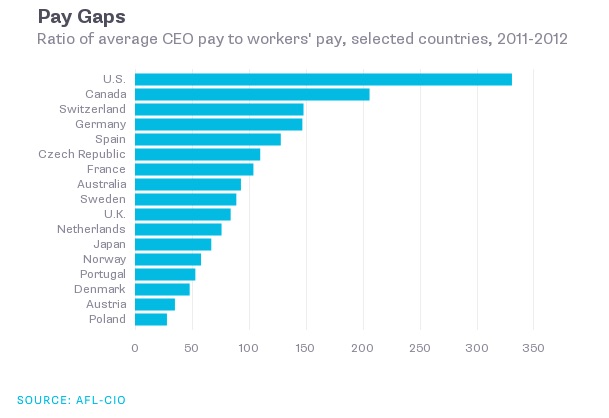
I then turn my attention to executives and their pay. Here’s an illuminating graph:

PayGap

Bizarrely, rather than being ashamed of this graph, many an executive uses it as justification to lobby for more pay from their boards!

“Look at what he/she gets in comparison to me…it’s not fair – I need a pay rise!”

This is merely a never ending race-to-the-top argument.

Indeed, I know of one (Antipodean based) executive using it to argue that their high pay isn’t an issue because “look at the Americans!”. Yes, you poor thing – it’s all soooo unfair.

We are fed the line that they (the executives) are brilliant, that only they could do the job and as a result, their pay is totally rational and justifiable.

Even more weirdly, if a good candidate for leading an organisation told its board that they would do the job for far less pay than what the market was demanding, the board would likely think that they surely can’t be up to it!

Here’s a test for any board:

Test: Advertise the top jobs to people in the company for, say, 10 – 20x workers pay, see who applies and find the best one.

Likely outcome: The person selected may very well be someone with great passion, leadership and humility…where money wasn’t the driver…you know, where they truly believed in the organisation’s purpose and are willing to bust a gut to strive towards it.

Executives have conned us into believing that, unless they are being paid mega-bucks, then they clearly aren’t competent to hold the job…what a topsy-turvy way of thinking.

Worse still – the majority of executives preside over command-and-control management regimes as if this were a good thing. It is, for them…but not for their employees, customers and (as a result) their shareholders3.

Some daring thoughts:

  • if a job is so big that it really is so hard and complex that it is worth millions of dollars in pay…then the job is too big and needs breaking down into many roles.
  • just because a person happens to be brilliant at something doesn’t mean that we need to shower them with riches.
    • Who believes that the best teacher4 in this country (who shapes hundreds of lives daily over a dependably long and loyal career) should be paid many millions per year? Anyone?
  • the person who says that they need to be paid millions or else they won’t do it is likely not the best fit for an organisation – they aren’t really in it for the organisation’s true purpose, they are in it for themselves.
    • It’s no surprise that founders live and breathe their company – it is most likely about their passion rather than the money.

Cor, that’s all a bit controversial….I’ll be accused of being a socialist next….and then it’s not too far down the spiral to be branded a communist…I’ll get my coat!

Here’s a theory: If you are paid, say, 100+ times the amount of your workers and you think this is justified then you are a sociopath.

(Corollary: If you get paid this much and don’t think it’s justified then you are likely unhappy in yourself, with feelings of guilt, which isn’t very healthy for you)

Why do I put this theory forward?

  • you think that you are better than everyone else (with your sense of extreme entitlement); and/or
  • you have an unhealthy relationship with money (and are excellent at rationalising why you need it).

And, just to head you off from the ‘communist’ label you may be lovingly making for me right now, here’s where I turn sideways, go all Zen and pull out one of my favourite quotes:

“The meaning of life is just to be alive. It is so plain and so obvious and so simple.

And yet, everybody rushes around in a great panic as if it were necessary to achieve something beyond themselves.” (Alan Watts)

Or, put into this context: sure we need enough to cover our basic needs but, after that, money cannot buy happiness. I’m pretty sure there’s been a song or two written about that?

Politicians:

And finally, I’ve saved the best till last!

This post wasn’t really about sociopaths, and it doesn’t matter whether you agree with my logic above or not (my views, whilst reflecting what I currently think, are just a red herring)…but it was necessary to set executives up for comparison purposes because this is what is done for and by politicians.

Back in February of this year, we had the all too common comedy of MP’s being awarded a hefty pay rise by an ‘independent’ body and then the leaders of political parties desperately trying to distance themselves from said pay rise.

Setting the scene: MPs in democracies around the world realised a while back that they were on a sticky wicket when it comes to their pay…so they create an ‘independent pay authority’ to take pay rises out of their hands…and then they can say “erm, I’m not asking for it but they think I deserve it – what can I do?”

Then some MPs aim to look pious by being seen to be ‘turning down’ a portion of their pay rise.

The MPs independent pay authority becomes the scape goat but, with some justification, argues in reply that:

”it’s fulfilling its obligations, set by Parliament, that include relativity with comparable positions, recruiting and retaining competent individuals and any prevailing adverse economic conditions.”

The underlying scam: The ‘independent’ part of the pay authority sounds good in practise but what are its terms of reference? What is the job that it has been given to do? It has been set up on the same basis as boards considering executive pay.

  • To use money to ‘get the best’ (as in “if we don’t pay them well, they won’t come”); and
  • To compare, which includes against the corporate world (as in “look what a private sector CEO gets – MPs are at least as important as them!”);

The comedy:

“I think there are two sorts of MP: those who see being an MP as a public service and know what they are there to stand up for, and those who see it as a conveyor belt to a private-sector job after two terms and a spell in government. There seem to be many more of the latter these days” (Quote from a backbench British MP, Source: Owen Jones’ book ‘The Establishment’)

Sure, have pay set independently, but with what objectives? …which points directly to THE question to be answered:

Who do we want our Politicians to be compared with? Social workers or sociopaths?

…and whatever your answer is, will be what you will get.

Good luck to all of us with that!

 Footnotes:

1. Regarding complaining: as in “their Unions are being unreasonable again and are threatening to strike!”

2. Regarding ‘busting a gut’ for us: sure, you’ll find the odd incompetent or bad egg but this is surely so in every walk of life. This can be an issue of selection but, more likely, of what ‘the system’ has done to them/ turned them into.

3. If you want to know why this is so then this is the subject of virtually all the other posts on this blog. In particular, please read “Your money or your life!”

4. The best teacher: If (as unlikely as it seems) you are a politician reading this, I’m only theorising – PLEASE don’t think you should now rush off and hire some consultants to supposedly come up with a measure for this!!!

5. Addendum (written in 2015!!): As I look ‘in’ at the current wonder that is the American electoral process, I see the following candidates for President: a gaggle of smooth politicians, 1 social worker and 1 sociopath. It sure is an interesting one – Go America, see what you can do…but (for the sake of the rest of the world) please consider what I write above. No pressure! Thanks in advance 🙂

Being an All Black

hakaSo a few people have sent me the link to the recent Steve Hansen interview* (20 mins. long) – thanks for that, it’s very good and worth writing this post about.

* For those of you who live on a different planet – Hansen is the current coach of the All Blacks (that’s a rugby team!) and is currently at the 2015 World Cup in England.

Listening to the interview shows how truly special the All Blacks environment is. I pick out below what I think are key things said that are applicable to any/ every organisation that wants to continually strive towards its true purpose:

(Quotes are in blue text with my thoughts following in black)


Interviewer’s Question: “…What defines Steve Hansen’s All Blacks?”

Steve Hansen’s Response: “It’s not Steve Hansen’s team…it’s about a collective group who are trying to do something [purposeful]….we have to set ourselves some lofty goals, and some people may say that’s arrogant, but I think if you want to achieve something in life, you’ve got to set big goals…”

This links to the setting of a clear challenge* such that everyone involved understands and wants to drive towards it, not for the leader but for themselves.

As such, this challenge has to be:

  • Meaningful: about making the world a better place in some way;
  • Tangible: easily relevant to everyone who is to be involved, not distant and abstract; and
  • Real: not a fake side-act for something else (see POSIWID).

*The challenge is not about a solution – you should know where you want to go but not impose how you believe you are going to get there (See How to have a successful journey).


Interviewer’s Question: “Is that one of the defining factors – the fact that it is a collective?”

SH Response: “…for this team to really play well, we need to be as one and the team has to be greater than the individual…”

This fits perfectly with the idea of systems thinking. The All blacks are a system made up of component parts – 15 individuals on the pitch, 7 on the bench, more in reserve, coaches and back room staff.

They want, and need, to optimise the system, not its component parts.

Every player will want to be picked in the 1st 15…but will work together even if they are not. If Dan Carter isn’t picked for a game, you’d still expect him to use all his 100+ caps of experience to help his replacement…and he most certainly will – and if you doubt it, look for the water boy!


Interviewer’s Question: “You’ve talked about humility and..devolving leadership…as the coach…you have to give up some control. Is that right?”

SH Response: “Well, it might seem like you have to give up control, but, really, it’s not about control. It’s about everybody going in the same direction, trying to achieve the same thing, so you’re not having to control anyone to do that. They want to be alongside you. And in some cases, you want them to be in front of you because they’re the people that are out there playing, and they’ve got to make the big decisions in the moment in the contest. And all we [the coaches] are is here to facilitate an environment…that is conducive to them being able to play.

This echoes everything posted on this blog about the important thing being the environment. We need to move away from a ‘command and control’ logic (and all its management instruments of torture) and replace it with a realisation that Purpose + Environment = the starting point!

Then, and only then, will the whole team truly work together for the good of all.

Purpose is necessary. Environment is necessary. Neither, on its own, is sufficient.

The other point is that it is about the people ‘at the Gemba’ making decisions. The coach’s job is just to provide the direction and support to enable this.


Interviewer’s Question: “How do you, Steve Hansen, see…get the feel for what a player needs?”

SH Response: “Well, once we’ve talked about the team coming first, the team’s made up of a whole lot of individuals, so you try and do your best to get to understand the individuals and what makes him or her tick…You’re really looking at them, ‘how am I going to get the best out of that person?’ along with the other guys that are helping you do that. It’s about watching them every day…you just know after a while when you’re rubbing shoulders with them all the time what individuals need and what they don’t, and I guess that’s the art of coaching.”

This echoes what was written in People are people so why should it be. We are all different, we have different strengths and weaknesses – the task is to develop each and every one of us, not judge and compare us!


Interviewer’s Question: “…you spend a lot of the time motivating the team…”

SH Response: “Interestingly enough I don’t think my job is to motivate the team. My job is to create an environment where motivated athletes can perform…”

I think Hansen might have read a bit of McGregor and Herzberg

He understands that I can’t motive you…but I can strive to provide an environment that has the best chance of you getting the best out of yourself for the good of you and your team.

I very much doubt that Hansen uses the management tools of cascaded personal objectives, individual targets, judgement and extrinsic rewards. Can you imagine him taking, say, SBW (that’s one of the players) to one side and saying “Right Sonny, your target this game is 6 offloads, 4 crunching tackles and 2 tries and if you do it, I’ll give you a sports car”. This would destroy the collaboration that he wants from his collective. It would make it about the individual rather than the team. It would make it about hitting the target and then doing no more.

Who’s had a son or daughter playing sport and seen what happens when a parent tries to motivate their child with, say, money for scoring a try (or goal or…). It is a coach’s worst nightmare! How on earth can they persuade this individual to get that ‘dangling carrot’ out of their mind to pass that ball?!


Interviewer’s Question: “Everyone wants to get better. I mean, how do you actually do it?”

SH Response: “I think it’s about living it every day. You create an environment where you’re living every day trying to get better and you’re not accepting that what you’re doing today’s good enough. And I think if you keep pushing that and everyone’s bought in to it first and foremost and then you keep pushing it and driving it, it’s achievable. But the minute you decide that ‘Okay, we’ve arrived’ someone’s just going to draw [go] straight past you…”

He understands that it is a never-ending journey and the moment you think ‘aren’t we just great!’ then you are in trouble.

It’s also about looking at yourselves and what you are doing rather than trying to be like somebody else (see Benchmarking – worse than cheating)


…and finally:

Whether they achieve their lofty goal (retaining the world cup) or not, I think you’d agree that they appear to be going about it in a fantastic way.

When I look back at Steve Hansen’s interview I think ‘he really gets it’. I also believe him – I don’t think he is just saying it…and, as such, I would follow him (I just need to get good at rugby now!!!).

If you didn’t know differently, you could easily think that Hansen was a student of Deming and Ohno …and who knows, he might be!

Turkeys don’t vote for Christmas!

turkeySo your leaders want to ‘improve’ your organisation! (or is that reduce its cost base – “aren’t these the same thing?!”).

Put yourself in the shoes of those leaders:

You have two choices:

a) You think you know ‘the answers’ and so can quickly move to ‘obvious solutions’: a dollop of specialisation here, a heap of centralisation there, perhaps with the ‘synergies’ word thrown in for good measure…and then, hey presto, let’s standardise and ‘automate it‘ whilst also doing that ‘customer-centric’ thing in parallel!; or

b) You understand that you don’t perform the daily processes at the front line and so you are necessarily reliant on the value-creating workers (with their middle and lower management) to:

  • Identify and work through where improvements might actually lie; and then
  • partner with you in successfully (and continually) changing the current system.

You can see (from the hyperlinks) that I have written a number posts that relate to option a) and I hope you agree that one of THE foundations of real and sustainable improvement is to meaningfully involve the process performers….so let’s take a look at option b).

Involving the workers

Okay, sounds great. Nice idea…so let’s start by asking the workers what they’d change.

Mmm, they don’t seem to be coming up with much, and what they are contributing seems rather insignificant and poorly thought through, dare we say feeble. They aren’t very competent are they! Perhaps our problem is with our workers – do we need to get rid of them and get a better bunch? After all, isn’t it one big ‘war for talent’ out there!

But, whoa, stop, back up the horse: What if your process performers aren’t (meaningfully) engaging in your much hyped ‘improvement programme’? …and why might that be? What might they be thinking about? How about the following:

“Do I have the time (and motivation) to properly engage in improvement thinking for fear of this counting against me elsewhere? (such as my business-as-usual workload, targets and incentives)

“Do I trust them to properly listen to what I am saying, in full and not jump to overly simplistic and seemingly easy ‘quick wins’?”

“What would any changes mean to me and my environment?”

“Will I be better or worse off?”

“Will they look after me (or those colleagues that my ideas would affect)?”

In short, turkeys don’t vote for Christmas. (Nice Roast dinner picture though eh – looks very tasty)

If leaders haven’t established (and don’t continue to nurture) an environment of trust then they should expect very little in return.

Trust

A critical part of achieving (what is often termed) ‘Operational Excellence’ is trust. (The opposite of fear)

“To drive the kind of no-holds-barred commitment to operational excellence that is required, everyone in [the organisation] has to believe in the process and that she won’t be ‘rewarded’ for driving progress towards [improvement] by having her job cut!

Without trust, [improvement] projects quickly devolve from finding and fixing critical problems to battles to shift blame and accountability to others….” (Liker)

Put simply, we need to treat people as assets, not as costs to be slashed. Deming went further:

“I used to say that people are assets, not commodities. But they are not just assets: they are jewels.”

Now, leaders might respond with “we don’t do that here!”…and, yes, maybe not blatantly…but what about how it looks; how a leader’s words are translated and what actually eventuates?

  • do you require business cases with ROI’s and financial benefits to be calculated and ‘realised’? Are these benefits often about head-count (perhaps masked with that 3 letter ‘FTE’ acronym)?
  • do you have structures in place* that make it very hard for someone in the system to suggest horizontal changes from their vertical silo’d world? (*such as cascaded personal objectives linked by judgement and rewards)
  • do you hold competitions between teams that should be collaborating? Do you often talk/write in such competing language?
  • do you preach empowerment of the people but then provide little time and support for their ideas?
  • do you continually re-organise such that people are continually finding their feet (and voice) within yet another management structure?
  • do you employ lots of change managers and external resources, distorting and hindering natural team dynamics?

To establish trust, improvement must not get confused with head-count reduction.

Management need to provide an environment whereby people are comfortable ‘changing their jobs’ because they know that they will go on to even more interesting work (preferably inside, but also outside, the organisation).

And here’s the wonderful chain reaction:

  • If you gain people’s trust (which will be hard at first and will take real leadership)
  • …by providing a safe, secure and stimulating environment for your people
  • …then they will develop themselves (some will amaze you!)
  • …and look for opportunities to continue on this journey
  • …which will mean that your organisation becomes self-sufficient in the ‘brains department’
  • …with a very healthy side effect that you can save an awful lot of money (and often pain) by avoiding the ‘bring in the outside consultants’ option
  • …meaning that you will align organisational purpose with those of your people
  • ….causing exceptional, and sustainable, results
  • …allowing the organisation to organically grow (rather than by constant acquisition)
  • …which enables you to invest in your people and we are off, full circle, around the chain reaction 🙂
  • BUT this chain is unstable and can be ever so easily broken by the words and deeds of leaders.

“Trust takes time to build, seconds to lose and twice as long to regain as it did to build in the first place.” (Unknown)

Deja Vu

How often does your function experience people coming in to ‘map processes’? And when this happens, how often are they referred to a similar exercise, usually performed for a specific project, carried out a year or so ago?

When your function digs out (what they can find of) these earlier process mapping ‘artefacts’ (as they are, in my view, unhelpfully labelled) for the new mappers to look at, how often do they say “excellent, we’ll use these as a starting point” and then adopt a slightly different mapping approach/ method/ tool and do it all over again.

….and the people ‘mapping’ and those ‘being mapped’ experience a certain déjà vu.

deja-vu

Even worse, do the ‘mappers’ take process performers away from the process to do the mapping in workshops?! Do you think this enables them to map reality or a set of opinions? Do you think they end up with a highly crafted and nice looking ‘logical diagram’ or the complex and messy truth?

If processes have been mapped before and this is being done (yet) again, then some hard questions need to be asked.

  • why did they get mapped last time?
  • who (if anyone) agreed/ agrees with what they produced?
  • who used/ uses them to perform the work?
  • what happened to them? (are they likely to be complete, current and meaningful?)
  • …and therefore, why does it need doing all over again?

Projects vs. Processes:

If the purpose of mapping is ‘for a project’ then there is already a problem.

A process exists all the time, no matter what projects are being done on (or, more likely, to) it.

A process should have a purpose and a clear customer. It will have demands that are placed upon it (both value and failure) and a capability for handling that demand (which includes variation). It will have a desired flow (how it should be performed), a current flow (how it is performed) and a set of system conditions (constraints) that make this so.

Whilst a project might affect a process, you shouldn’t need a project to understand a process and you don’t always need a project to improve a process. If you do, then you aren’t properly managing your processes!

Conversely, if you’ve got a project that is going to have a major impact on your processes….you had better be managing your processes well for this project impact to go smoothly. Otherwise you can expect the proverbial car crash.

Purpose

Let’s get to the real point: Every process performer wants to do a good job and, to do this they desperately* want:

  • really good process knowledge that they can easily use to do their job to the current standard;
  • this process knowledge to be able to cope with (absorb) the variety that they experience in customer demands, not force them into an unhelpful straight jacket;
  • to be able to use their actual experiences (as opposed to what is supposed to happen) and make sure that these learnings are captured, understood and properly used so that the process knowledge is continuously improved for them and for the benefit of their colleagues;
  • to know when the standard has changed, why and to what such that they can easily and consistently adopt it…and this means there is NO confusion as to what the new standard is and from when it is to be adopted.

What you will notice from the above is that it is the process performers who most want and need excellent and current process knowledge and, standing back, this is actually rather obvious!

* I use the word ‘desperately’ because this is what I always hear when I talk to the process performers at the Gemba (the place where the work is done). They cry out for the above!

But is this what our usual process ‘mapping’ focus is? I would say not.

Reality:

So what actually happens?

Projects come along, pull process performers into workshops, ask them what they do, document what they say, (sometimes) ask the process performers to ‘sign off’ on these ‘artefacts’ (grrr) who, in turn, typically think “it doesn’t tell the whole picture but, yeah, that’s about right” or “it’s not how I would have explained it, but I can see what you’ve done there”…and then the project goes away allowing the process performers to get back to their reality….until, wham, the project change is sprung on them.

In parallel to this, process performers are getting on with their day jobs and, desperate to make it easy for themselves to know what to do, they create (or augment) the necessary process knowledge to perform the work. They do this in whatever medium they have available to them, in what little spare time they have and then store it wherever is convenient for them. All of which is totally understandable.

Over the top of all this, those who determine the policies to be adhered to when carrying out a process (let’s call them the process owners) issue ‘memos’ (in increasingly modern formats) informing all of what is changing and how it should be done from now on. Similarly, these process owners also issue ‘rebukes’ as to what people are doing wrong (along the lines of “didn’t you read my memo dated xyz!”) and warning them to “do it right from now on!“.

dogs dinnerThe above usually creates what I would refer to as a ‘dog’s dinner’

Here are some thoughts on what’s needed for our processes to continually deliver customer value:

  • Clarity as to what the organisation’s set of value streams (and processes within) are and who is responsible for what;
  • A horizontal focus on these value streams, rather than a vertical silo focus…so that:
    • a process is seen from the customer’s point of view
    • there is meaningful collaboration by process performers across the flow
  • The process performers and process owners jointly owning their own process knowledge….they need to:
    • determine what they need to know and how it is best provided/ presented for their ongoing consumption;
    • like using this process knowledge; and, even better
    • like improving it (meaning this has got to be easy and obvious to do)
  • A focus on the wider subject of process knowledge, not (just) process maps:
    • i.e. any/ all knowledge necessary to perform the work
    • this includes the business rules (policies) to be applied when performing a process, and any necessary supporting materials
  • A true understanding of Service organisations such that the process knowledge helps the performers to absorb the variety within customer demand, not frustrate it
    • we shouldn’t attempt to create a ‘process encyclopaedia’ that clinically answers everything since no such thing can truly be created. Instead, it needs to allow the absorption of variety
  • An experimentation mentality (trial and error) from which to continually improve how process knowledge is created, provided and improved
  • Expert help on what tools are available to enable the above BUT this help is not to ‘do it’ to them or for them….but to advise and support them

Some good tests for process knowledge are:

  1. how comfortable (or conversely, anxious) a new starter is when beginning their work; and
  2. if/ how well a seasoned operator picks up a change in process without reverting to the old way.

And finally….it’s not about tools!

It doesn’t matter how good the ‘process management’ tool is that you have found if you don’t understand and properly live the above. Your investment in such a tool (and the resources to populate it) is likely to become one huge costly, dare I say ‘dog turd’ of a, mistake. You can create amazing (looking) process knowledge in an awesome tool but if no one uses it to perform (and continually improve) their processes then, wow, what a waste!

“A fool with a tool is still a fool” (Grady Booch).

Conversely, we seem to have the idea that there is only one tool ‘out there’ that will work for us. Rubbish. Many tools will help you, though no doubt some will help more than others. The process performers can successfully start with using, say, MS Word if they want…and then continuously improve through their experimentation and learning…where this may take them in many directions as opposed to finding ‘the one tool to rule them all’.

There is no ‘right answer’ when it comes to tools, only a never ending journey to continually improve the efficiency and effectiveness of how process performers know how to carry out their work in the best way currently known for the good of the customer.

Are you currently involved in ‘process mapping’? Is this Déjà vu for you?

Rolling, rolling, rolling…

cheese-rolling1So let’s suppose that we (‘Management’) have come up with (what we think) is a great idea to improve a process. We’ve tried it out in one place (such as a branch/ outlet or a team/ shift or a channel/ brand) and we now want everyone else to change to our new brilliant way.

i.e. let’s do a roll out!

Excellent, so let’s ‘grease those wheels’ by bringing in a ‘change manager’1 who can work out sensible things to make this roll out happen:

  • Let’s ‘big it up’: We’ll prepare fancy presentations (and perhaps some posters for around the office) that explain the change in an up-beat and positive way that makes it sound just great!
  • Let’s deal with the worries: We’ll have a period of consultation, prepare a set of FAQ’s in response, and make small changes to show that we have taken these worries on board;
  • Let’s ‘motivate them’ to want it: We’ll adjust everyone’s balanced scorecard and related objectives, targets and incentives so as to make it ‘front and centre of stage’;
  • Let’s create a launch: We’ll design a competition2 where ‘demonstrated compliance’ with the new way wins prizes for an initial period of time.

…does any (all!) of the above look familiar?

Now to reverse this logic:

Imagine that every team:

  • Understands its capability (against a system’s purpose) and works in an environment that wants to continually improve;
  • …so wants to experiment (for themselves) with new ways of working;
  • …so, as well as coming up with their own ideas (which their environment encourages), is really interested in going to see what other teams are doing;
  • …so brings back new ideas to adjust, try, consider and conclude upon (using the Plan-Do-Study-Act cycle);
  • …so is intrinsically motivated to rolling in new ways of working that they believe in.

John Seddon came up with the label ‘Roll in’ to explain this point. Here are his definitions:

Roll-out: Method that involves developing an improved process, standardising it and applying it to other areas*. This tends to create two problems:

  1. The solution is not optimised for each specific context so it is not a good fit;
  2. The staff in the other units have not been through the same learning and therefore feel little sense of ownership. They may also feel a loss of control and resist change.

(*I note that the much used ‘achieving buy-in’ phrase is synonymous with the ‘rolling out’ phrase i.e. it is actually about someone trying to sell something)

Roll-in: A method to scale up a change to the whole organisation that was successful in one unit. Change is not imposed. Instead each area needs to learn how to do the analysis of waste for themselves and devise their own solutions. This approach engages the workforce and produces better, more sustainable solutions.”

…meanwhile back at Toyota:

You might have heard that a big part of the hugely successful Toyota Production System (TPS) is standardisation3. and you might then make the mental leap to assume that every shift in every comparative production line in every Toyota plant across the world conform to the one ‘standard’ (i.e. the exact same methods). Yet such an assumption would be incorrect.

Liker’s decades of Toyota research makes clear that change is most definitely NOT imposed on the people and their processes. Instead, each unit (at all levels) is set a clear challenge (a target condition ) that aligns with purpose and is then coached through experiments to achieve it. And, once achieved, the cycle starts again.

So a given team on a given line in a given plant will want a standard way of working so that they are very clear on how to (currently) perform a task but this standard may be quite different to another team/ line/ plant.

Key points in this Toyota way of thinking:

  • The challenge that is set isn’t about rolling out some pre-defined solution. The solution is not known. It is up to each team to work out how to get there for themselves (see ‘how to have a successful journey’);
  • Each challenge is specific to each team, taking account of their current condition;
    • A mature plant in Japan would have very different challenges set to a much newer plant in, say, America, even though they might be making the same car model;
  • It is perfectly acceptable for one plant (say) to arrive at a different method of working to another. This is in fact considered a good thing because it keeps people thinking, broadens ideas and sets off yet deeper studying and understanding…fuelling yet more improvements;
  • It creates a desire for collaboration between plants: they are very interested in what others are doing (going to each others ‘Gemba’* ). This is the total opposite to the competitive (and myopic) mentality of ‘Our team’s way is the best way…it must be – we won a prize!‘;
    • In fact, a mature Japanese plant wants to go and see what a newer American plant has come up with because they understand that the ‘newbies’ may have come up with completely different (and potentially step-change) ways of thinking.
  • If a team from plant B do a Gemba walk at sister plant A and sees something of interest, they don’t just go home and implement it! They can’t – because that would just be the ‘plant visit’ team dictating to their colleagues back home. No, instead, they will explain what they saw, experiment, decide whether it is of use to them and, if so, adapt so that it fits for their needs;
    • The original plant A is highly likely to do a ‘reverse’ Gemba walk to see what plant B has done with their ideas…and then rush back home to experiment again….and, hey presto, what a healthy innovation cycle we have!

(* Reminder: Gemba roughly translates as ‘the place where the work happens’)

In short: Seddon didn’t invent the ‘roll in’ idea (Toyota, as an excellent example, have worked this way for decades) but he is very good at putting it into words, giving it a name and passionately championing it.

Looking back, it seems pretty obvious that if people find out about and learn things for themselves then this will be fulfilling and lead to real and sustained successes….which will create a virtuous circle. No such worthy circle exists from ‘stuff being done to you’.

But what about that Iceberg?

Many of you will have been introduced to, and likely read, John Kotter’s well written business story book called ‘My Iceberg is melting’. If you haven’t then it’s about a colony of penguins having to deal with a change being imposed upon them (the clue to that change is in the name of the book!).

Now, if you are having a change imposed upon you, then Kotter’s logic might be very useful to you….but, wow, wouldn’t it be sooo much better if you decided on your own changes!

I think one quote sums much of this post up nicely:

“People don’t resist change, they resist being changed.” (Scholtes)

Be realistic!

“Oh come on Steve, sometimes change is imposed and you’ve just got to deal with this!”

Yes, this is most definitely so. But here’s some counters to this critique:

  • Such a change should be coming externally (such as a legislative, societal or environmental change)…not from within the organisation;
  • Even if such change occurs, it is still better for the organisation to deal with it by setting its people suitable challenges (rather than dictated solutions) and leading them through rolling in changes for themselves;
  • If your people are used to the ‘roll in’ change paradigm then you will have a whole bunch of people who are skilled, creative and motivated problem solvers …just imagine how fantastic that capability would be for an organisation every time the challenge of an external change has to be handled!

…and finally:

Here’s an Ackoff ‘f-Law’ that might resonate with you as a true-ism:

“The only thing more difficult than starting something new in an organization is stopping something old.”

I think we all recognise that the ‘roll out’ problem doesn’t stop with merely getting someone to do something new…

Consider that, in contrast, by using ‘roll in’ the people are choosing for themselves to stop doing the old (whatever that is for them).

______________________________________________________________________

Addendum: I always ask someone (relevant to the subject) to act as editor before I publish. My editors always add great value Here are a few improvements:

  • Whilst Toyota may not enforce the same standard way of working across everywhere, it could be argued that they do have a cross-organisational standard way of thinking and acting (i.e. their management system, which has been termed ‘The Toyota Way’)…but, just like rolling in, this wasn’t copied from elsewhere and dictated to them – it came about through years of humility and experimentation;
  • If you want everyone rolling in the same direction then you still need a very clear (and meaningful) purpose, and systems thinking, such that all challenges being set lead to the same point on the horizon;
  • The ‘corporate form’ (e.g. a public body, private enterprise, large publicly quoted company,…) will likely have a huge impact on where you are now, and where you can get to;
  • You might like the idea of rolling in (as compared to rolling out) and say “yeah, great…how do we get there from here?” This is a BIG question, and just happens to relate to a future post which the ink is drying on….so, with that segue, please tune in again then.

Notes:

  1. Change management within command and control organisations is usually about senior leaders getting people to do what they want them to. Their employment of a skilled ‘change manager’ (of which there are many) may substantially improve the roll out outcomes…but it is still a roll out, with all its associated limitations.
  2. Competitions: Please don’t run ‘change’ competitions like this…or, if you do, know the harm that they cause. Research* shows that: Providing a reward for doing something seriously devalues that thing; and people think even worse of that thing once the reward period has finished, thus likely slipping back to how it was before and then making it that much harder to ‘get them to change’ (* see Alfie Kohn’s book ‘Punished by Rewards’).
  3. Standardisation: Don’t make the assumption that this standardisation principle is exactly the same for service organisations – it isn’t. I use it in this post merely to explain and demonstrate the roll-in principle.

Pulling Power

Beer pumpThere are two very different productivity ideas:

  1. Make as much as you can! …meaning that:
  • you are always busy (it is a ‘corporate crime’ to be idle!);
  • it is irrelevant whether the next activity down the track is already snowed-under with work or even if it is available….you just keep pumping it out! They aren’t your problem;
  • the ‘performance police’ are likely measuring the cost of the activity being performed, and judging you accordingly.

…this reflects a Push system, which fits with an ‘economies of scale’ efficiency mindset (“how many did you make!”).

  1. Make only what is needed when it is needed…meaning that:
  • each person is highly connected to the next activity down the track (because they need visibility of how the next step is going);
  • it becomes immediately obvious if there is a blockage and where it is;
  • the process performers can:
    • collaborate on making improvements at the (now visible) bottlenecks; and
    • see and measure the overall flow, from customer demand through to its satisfaction.

…this reflects a Pull system, which fits with a ‘flow’ effectiveness mindset (“how did we all do together for the customer?”)

Now, you might think that push will cost a lot less than pull because everyone is always working flat out, not waiting to do something….but you’d probably be wrong, and by a profound margin.

What’s so good about pull?

Here’s a simple ‘push’ diagram from the Lean Enterprise Institute to assist:

overproduction-e1351860597383

Stick man ‘A’ is happily making stuff, much to the despair of ‘B’ and, given that a real life process will have far more steps than A and B, you can imagine what this looks and feels like on a bigger scale – organised(?) chaos:

  • work will pile up throughout the process, meaning that there will be loads of ‘work in process’;
  • process steps might be working flat out, but it takes a really long (and usually increasing) time for a unit of work to get from start to (proper) completion. It spends a massive amount of its overall cycle time simply waiting;
  • defects are hidden within this mess, so it takes a long time for them to surface….with the time and cost to rectify the defect rising alarmingly as more work is performed on the defective unit of work;
  • changes in specifications or customer needs whilst units are (a long time) in process mean a huge amount of rework, and even scrapping of work done to date (Customer: “In the time you’ve taken, things have changed….I don’t want that anymore!”);
  • the long cycle times will create a huge amount of failure demand (blue marbles) from customers asking where their unit of value demand has got to and how long it will be.

Is this relevant to Service?

Absolutely! But, like most things, it can be a bit different to manufacturing.

THE big difference in service is that the trigger to start work is pull by default i.e. you can’t make a service in advance ‘and put it into stock’…you need to wait for demand to trigger the work. But, just because we have a customer pulling the demand lever doesn’t mean we should then be pushing their unit along a value stream before the downstream activities are ready for them.

For a really obvious example, let’s take a natural catastrophe (flood, earthquake, etc.), which results in an insurer getting a huge spike of claims demand. The insurer wants to help everyone as soon as they can but they a) are still getting the necessary processes defined ‘on the ground’ and b) have limited resources to do the work.

Now, this is a challenge: Insurers want to be seen to be pro-active and ‘getting on with it’ for their customers. But beware of creating a seemingly good short-term impression at the expense of a huge longer-term mess.

If you push claims through a process that isn’t yet defined and resourced then you can expect to:

  • only partially perform the necessary work, but not realise this;
  • set expectations that turn out to be incorrect (e.g. what you thought looked clearly a house rebuild turns out later to only be a repair…and vice versa);
  • go back and perform a great deal of re-work (ending up in multiple site visits, ‘reconciliations’ with previous findings, defensive explanations and compensatory actions);
  • throw away old work and virtually start again to cope with changing customer circumstances (“I was okay with you doing that 6 months ago…but not anymore”); and
  • lose the trust of the customer (your unintended mistakes are seen by them as malice and trickery)…which creates much failure demand, to be cautiously tip-toed through.

If you hear management say “right, let’s get all the claims through ‘assessment’ by [date x] and then we’ll focus on the next stage”, you know you’ve got push and all its associated problems.

This doesn’t mean that you don’t do all you can to make sure your customer is okay whilst you work things out (e.g. temporary repairs, emergency accommodation) and explain to them what is happening (including what you haven’t got in place yet)…but it is saying pull work through your flow when, and only when, you (& they) are ready for it.

This means that you focus your attention on defining and refining the flow, rather than wasting it firefighting each and every ‘undoing what’s already been done’ disaster.

A specific example for the catastrophe claims scenario: If a builder has a number of house builds on the go, don’t push any more on them (they may very well tell you they can take them!). Instead, allow them to pull the next one only as and when each build is satisfactorily complete. This will mean that the builder is focused on making their build processes effective, rather than trying to stockpile work for the next few years.

Moving on to ‘workflow management’:

Okay, so thankfully catastrophe management doesn’t happen all the time…so what about ‘day to day’ pull in service?

Who works in an area that has a ‘workflow management’ role (or even team) that sorts out work as it comes in the door by briefly looking at what it is, categorising it and then assigning it to people as fairly as they can? This is pushing.

What does this cause?

  • Incorrect classification: As explained in ‘The Spice of Life’, there is huge variation in service demand. It is impossible to properly appreciate the necessary work content until you do the work; which means that…
  • Feelings of unfairness: …it is impossible to fairly divide up the work. This wouldn’t be such a problem if judgement and rewards weren’t hanging on it…but they usually are! This creates a constant tension between the work assigner and the workers; leading to…
  • Dysfunctional behaviour: …people will do what they can to protect themselves. You can read ‘The trouble with targets’ to see the general techniques that people understandably use to survive;
  • Re-working the workflow: So the work has been carefully assigned for the week ahead but Jack’s work is turning out to be slower than expected (Bob’s is easier than expected but he isn’t going to tell you!), and Jill is off sick…this only comes to light mid-way through the week so customers in Jack and Jill’s trays have been waiting in vain. Push requires a constant need to review and re-sort allocations between queues as circumstances (always) change…which is pure waste.

What’s wrong with people pulling work from a central and highly visible ‘pile’?

‘Command & Control’ Manager: “Well, people can’t be trusted to do this can they!”

Counsel: “Eh? Why ever not?!”

Manager: “Well, they will slow down and look for the easy ones.”

Counsel: “and why would they do that?

Manager: “Erm, because of their personal metrics…needed because their performance is being judged…which will affect their linked rewards/awards.”

I hope you can see that this is a classic case of looking past a logical tool/technique (in this case ‘pulling work’) and seeing the root causes within the ‘command and control’ management thinking.

If the team:

  • had a capability measure as to how they are all doing (so that they could see the system, rather than being blinded by personal targets);
  • were being coached, not judged (so that they wanted to improve, not protect, themselves;) and
  • were sharing in their success (so that they wanted to collaborate, not compete)

…then a) designing an initial* pull system could deliver great results and b) the workers would likely look for, and make, continual improvements to it…so that it worked better and better and better.

* don’t try to implement the perfect pull system: let the workers move towards pull through experimentation….but management must remove the constraints that are in their way.

Examples of service moving from push to pull:

In fact we have all felt moves from push to pull. One obvious area has been customers (that’s us) being able to book appointments (pull) rather than being assigned a slot (push). This has happened from medical appointments, through school parent evenings, to home deliveries.

Note that ‘pull’ is actually an ideal, not a tool. You need to think widely (and differently) about achieving it. It isn’t an easy journey…but it’s well worth the effort.

How about this one from John Seddon: When a contact centre agent gets a customer demand that they are unfamiliar with, they should ‘pull’ in the necessary expertise to handle it, instead of ‘pushing it’ to the expert to perform. In this way, the agent is developing on the job and the customer feels that one person is caring for/ owning their need…developing great trust: a win/win.

Pulling is linked with continuous improvement, like an umbilical cord.

Notes:

  • Pull is a key part of the Toyota Production System (TPS), and is the 4th of the 5 ‘Lean Thinking’ principles;  
  • Kanban is a Japanese word and refers to a visual signal (often a card) used to trigger an action. The downstream process provides the kanban (signal) to the upstream process (i.e. it pulls the work along the value stream).
  • You can substitute the catastrophe example used above with any service process where a) the process isn’t yet properly defined and/ or b) a spike in demand has to be handled (i.e. exceeds capacity)