Capability what?

tape_measureReaders of this blog will have likely come across a phrase that I often use but which you might not be too clear on what is meant – this phrase is Capability Measure.

(Note: I first came across the use of this specific phrase from reading the mind opening work of John Seddon).

I thought it worthwhile to devote a post to expand upon these two words and, hopefully, make them very clear.

Now, there are loads of words bandied around when it comes to the use of numbers: measures, metrics, KPIs, targets. Are they all the same or are they in fact different?

Let’s use the good old Oxford dictionary to gain some insights that might assist:

Measure:     “An indication of the degree, extent, or quality of something”

Metric:     “A system or standard of measurement”

KPI (Key performance indicator): “A quantifiable measure used to evaluate the success of an organization, employee, etc. in meeting objectives for performance.

Target:     “An objective or result towards which efforts are directed

So putting these together:

A measure quantifies something…but this of itself doesn’t make it useful. It depends on what you are measuring! In fact, there is a huge risk that something that is easily measureable unduly influences us:

“We tend to overvalue the things we can measure and undervalue the things we cannot.” (John Hayes)

A metric is the way that a measurement is performed – it’s operational definition. There’s not much point in taking two measurements of something if the method of doing so differs so much as to materially affect the results obtained.

KPIs are an attempt to get away from using lots of different measures and, instead, boil them down into a handful of (supposedly) ‘important ones’ because then that will make it sooo much easier to manage won’t it?…I hope your ‘Systems thinking’ alarm bells are ringing – if we want to understand what is really happening, we need to study the system. Any attempts at short-cutting this understanding, combined with the use of targets and extrinsic motivators is likely to lead to some highly dysfunctional behaviour, causing much damage and resulting in sub-optimal outcomes. The idea of ‘management by dashboard’ is deeply flawed.

Targets – well, where to start! The dictionary definition clearly shows that their use is an attempt at ‘managing by results’…which is a daft way to manage! We don’t need a target to measure…and we don’t need (and shouldn’t attempt) to use a target to improve! A target tells us nothing about the system; distorts our thinking; and steals our focus from where it should be.

So what are we measuring?

I hope I’ve usefully covered ‘measure’ and its related terms so let’s go back to the first word: Capability

To start, we need to be clear as to what system we are studying and what its purpose is from the customer’s point of view. Then we need to ask ourselves “so what would show us how capable we are of meeting this purpose (in customer terms)?”

Some important points:

  • Capability is always about meeting the customer’s purpose and should be separate from the method of doing so:
    • An activity measure (i.e. to do with method), such as “how many calls did I take today”, is NOT a capability measure. None of my customers care how many calls I took/made!;
    • Activity measures constrain method (tie us in to the current way of working i.e. “we make calls”) whilst capability measures liberate method and encourage experimentation (“what would happen to our capability if we…”).
  • The best people to explain what really matters to the customer are the front line process performers who help them with their needs (i.e. NOT managers who are remote from the gemba):
    • The process performers know what the customers actually want and whether they are satisfied or not
  • As a rule of thumb, the end-to-end process time from the customer’s point of view is almost always an essential capability measure BUT:
    • end-to-end is defined by the customer, not when we think we have finished;
    • Targets will distort the data that we collect and thereby lead to incorrect findings…so, if you really want to understand your system’s capability you need to remove the targets and related contingent rewards.
  • Other examples of likely capability measures of use are:
    • A system’s ‘one-stop capability’: the amount of demand that can be fully satisfied (as determined by the customer) in one-stop;
    • The accuracy and value created for the customer; and
    • The safety and well-being of your people whilst delivering to the customer

An example:

I am currently moving house. I have to switch the electricity provision from the previous occupants to me. I want this switch to happen as painlessly as possible, I only want to pay for my electricity usage (none of theirs) and I want the confidence to believe that this is the case.

So:

  • The system in question is the electricity switching process;
  • My purpose is to switch:
    • Easily (minimum effort on my part….easy to start the process, no need to chase up what is happening, and easy to know when it is complete)
    • On time (on the switching date/ time requested); and
    • Transparently (so that I trust the meter readings and their timings)
  • I don’t care how the electricity companies actually achieve this switching between themselves (the method, such as whether they use a SMART meter reading or a man comes to the house or…). I just care about the outcomes for me.

The electricity company should be deriving measures to determine how capable they are in achieving against my purpose. They are then free to experiment on method and see whether their capability improves.

I have deliberately used a generic example to make the point about the system in question, its purpose and therefore capability. You can apply this thinking to your work: what the customer actually wants/ needs and how you would know how you are doing against this.

Sense-check: Capability measures are method-agnostic. Think about putting your method inside a metaphorical ‘black box’. Your capability is about what goes into the black box as compared to what comes out and what has been achieved. You can then do ‘magic’ (I mean experiments!) as to what’s inside the black box and then objectively consider whether its capability has improved or not.

What does a capability measure look like, who should see it and why?

Okay, so let’s suppose we now have some useful capability measures. How should they be presented and to whom…and what are we hoping to achieve by this?

The first big point is that the measure should be shown over time*. We should not be making binary comparisons, and then overlaying variance analysis and ‘traffic lights’ to supposedly add meaning to this (ref: Simon Guilfoyle’s excellent blog ).

We want to see the variation that is inherent in the system (the spice of life) so that we can truly see what is happening.

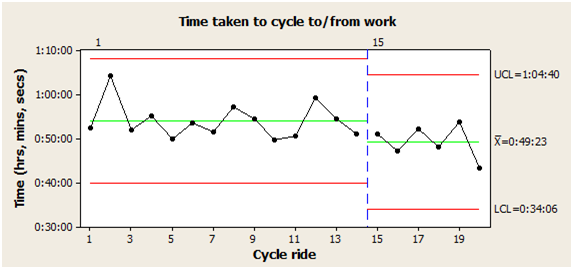
* Note: A control chart is the name for the type of graph used to study how a metric changes over time. The data is plotted in time order. Lines are added for the average, upper and lower control limits – where these are worked out from the data…but don’t worry about ‘how’ – these statistics can be worked out by an appropriate computer application (e.g. Minitab) in the hands of someone ‘in the know’.

Here’s a control chart showing the time it takes me to cycle to or from work:
Cycle time control chart

The second big point is that these capability control charts should be in the hands of those who perform the work. There’s little point in them being hidden within some managerial report!

Here’s what Jeffrey Liker says about how Toyota use visual management:

Every metric that matters…is presented visually for everyone who is involved in meeting the goal [purpose] to see. A key reason…is that it clarifies expectations, determines accountability for all the parties involved and gives them the ability to track their progress and measure their self-development.

[Making these metrics highly visible] is not to control behaviour, as is common in many companies, but primarily to give employees a transparent and understandable way to measure their progress.

Put simply: if the people doing the work can see what is actually happening, they are then in a place to use their brains and think about why this is so, what they could experiment with and whether these changes improved things or not* ….and on and on.

* Looking back at my ‘cycling to work’ control chart: I made a change to my method at cycle ride number 15 and (with the caveat that I need more data to conclude) the control chart shows me whether my change in method made things better, worse or caused no improvement. I cannot tell this from a binary comparison with averages, up/down arrows and traffic lights.

It should by now be clear that a capability measure is about the system, and NOT about the supposed ‘performance’ of individual operators within.

To summarise:

In bringing the above together, John Seddon applies 3 tests to determine whether something is a good measure. These tests are:

  1. Does it relate to purpose? (i.e. what matters to the customer);
  2. Does it help in understanding and improving performance? (i.e. does it reveal how the work works? To do this, it must be a measure over time, showing the variation inherent within the system, and it must be devoid of targets);
  3. Is it integrated with the work? (i.e. in the hands of the people who do the work so that they can develop knowledge and hence improve).

If it passes these three tests then you truly have a useful Capability Measure!

As luck would have it: One of my favourite bloggers, ‘Think Purpose’, released a similar ‘measurement’ post just after I had written the above. It includes a couple of very useful pictures that should compliment my commentary. It’s called A managers guide to good and bad measures – you could print them out and put them on your wall 🙂

A clarification: I’m happy with the use of the word ‘target’ if it is combined with the word ‘condition’. A reminder that a target condition (per the work of Mike Rother) is a description of the desired future state (how a process should operate, intended normal pattern of operation). It is NOT a numeric activity target or deadline. I explain about this in my earlier post called…but why?

So why can’t we do that?!

tesla-factoryI don’t know about you but ever since I was a kid I have loved watching short videos of manufacturing plants and staring in wonder at how the products we take for granted actually get made! It all seems so futuristic and alien.

Here’s a short (4 mins) yet amazing video showing the mind-boggling production of TESLA Model S cars over in Fremont, California.

What do you notice? Here’s what I see:

  • a large, high volume manufacturing plant;
  • an ultra clean and tidy environment;
  • ordered, smooth flow through specialised process steps;
  • consistency of operation and velocity;
  • substantial mechanisation & automation;
  • calm and assured humans working alongside the machines;
  • …with a high quality product coming out the end.

Sounds fantastic, I’ll have some of that!

…so why is it that service organisations don’t seem to get anywhere near the awesomeness that is modern day manufacturing?

Here’s the answer…..because they try to copy manufacturing!

“Hey, that doesn’t make sense…”

Surely (I hear you say) if manufacturing is sooo advanced from the times of Henry Ford and through Taiichi Ohno’s Toyota Production System, then service organisations should be studying what they have done and applying it to their world?

And, indeed, that is what many (most) service organisations have done. But, in doing so, they have spectacularly missed a crucial point: Service is different to manufacturing and therefore they have been ‘solving the wrong problem’.

Here’s a fundamental John Seddon quote with regards to service:

“Service differs from manufacturing. There is inherently more variety in customer demand….Whilst the Toyota method was developed to solve the problem of how to produce vehicles at the rate of customer demand, in service organisations the problem is how to design the system to absorb variety.”

Going back to the TESLA factory, notice how each car being made is essentially the same. Now I know that there is some variety – different colours, different engines, different trim levels – but it is basically the same (modular) product. I also know that Taiichi Ohno’s Toyota Production System brilliantly worked out methods to deliver this limited variety within the one production process (as opposed to requiring separate lines).

Much of manufacturing has adopted the mantra of ‘specialise, standardise, centralise and then automate’….but this is just about the opposite of what would be good for a customer requiring their very specific needs to be met for a service.

Let’s carry on with the car example but move on down the process to the service end – the selling, distribution and servicing of the car.

Let’s assume that TESLA’s competitor, TRAGIC, has applied the manufacturing mantra to their car service processes.

TRAGIC has created a centralised and highly automated ‘contact centre’ and separate ‘service centre’, both of which are broken up into highly specialised teams with standardised processes.

  • you will be directed to a website on which it is nigh on impossible to find out what you need to know, let alone a way of contacting a human being for a conversation;
  • …assuming you do find a contact number, you will then be punished by a multi-layered IVR that doesn’t have an option that meets your specific need;
  • you will have a standardised ‘scripted’ conversation with someone who doesn’t seem to be allowed to help you with your actual needs…but who can transfer you to [insert name of another department here];
  • you will then be passed around a number of specialised departments as they all ‘pass the parcel’;
  • you will be allocated to a ‘back office’ work queue and will have to repeat everything you have said so far to whomever is allocated your ‘ticket’…and they will likely disagree with whatever the person before them said to you along the lines of “oh no, I only do this” or “no, they don’t know what they are talking about, we can’t do that for you”;
  • you will talk with people who have a standard time slot allocated to you (or at least an ‘average handling time’ target), who will ask you standardised questions, categorise you according to limited drop-down boxes in their computer and then allocate you to defined ‘solutions’;
  • you will be confused as to who is actually dealing with you (or who even cares);
  • you will spend time and effort chasing up what is happening;
  • you will be provided with a standardised solution which either doesn’t meet (or only partially meets) your needs;
  • ….you will be forced through the whole sorry process again (and perhaps again) as you struggle to get your actual need resolved.

The Point:

In service, the customer comes in ‘customer shaped’. Our job is to design the system so that it can absorb their variety, not frustrate it.

Beware the manufacturing mantra of ‘specialise, standardise, centralise and then automate’.

Toyota and automation: I know that the TESLA factory looks like it’s been taken over by intelligent robots…but don’t get too carried away with automation in manufacturing. It’s worth noting that:

  • Studies have shown Toyota factories to be significantly more efficient than their competitors despite being less automated;
  • Toyota is wary of ‘over automation’ and has been reported to be reducing/ removing some automation in preference to human beings carrying out the work.

Their rationale? Putting to one side the enormous cost of developing, buying, installing and maintaining robotics, a robot simply does what it is programmed to do. Contrast this with a human that can think about the process they are performing and continually look for ways to improve it.

This can be the difference between static and dynamic processes…but of course this is only relevant if the human is in an environment that motivates them to continually improve what they do.

Talk-back radio

talkback-radio-2So I’m driving home from work in my car and I turn the radio on.

Damn, it’s one of those talk-back radio shows. You know the ones: the radio presenter seeds the show with a couple of emotive topics that are bound to wind up some sections of the population (those ‘for’ and those ‘against’) such that they are goaded into ringing in to robustly ‘tell us their view’.

I’m just about to change radio station when my subconscious tells me “no Steve, you should try to listen for a while.” And so my hand drops away from the controls and I settle in.

Things start okay. The presenter puts forward a clear articulation of a topic that we would obviously care about and invites people to call in to ‘assist him with the (supposedly) important task of unravelling the greyness within’. He waits a bit for the phone lines to warm up and then, yee-haw, we are off!

He takes call after call. I’m starting to get wound up by them…I’m not totally sure why, but I persevere.

Until, finally, one of the callers opens up with the following revealing words…and yes, this is the very first thing that came out of the caller’s mouth:

“I don’t know much about it but what I think is….”

Wow, I thought, that phrase just about says it all: “I don’t know much about it, but what I think is…” If you don’t know much about it then what makes your thinking credible, let alone relevant?

A common talk-back topic is on some current and major court case, often involving a horrendous crime. People love to ring in to tell the host whether the accused is guilty and whether they should be hung, drawn and quartered…and I always want to stop the radio show, get on the phone and ask the caller:

Q: “Were you in court?” A: “Erm, no.”

Q: “Have you seen the evidence?” A: “No. I haven’t”

Q: “Have you read the full set of court transcripts?” A: “That’s also a no.”

Q: “Do you understand the necessary law/ science/ statistics? Or have you had this suitably explained to you?” A: “Mmm, not really…well actually, not at all.”

“…but I have listened to lots of opinions!”

There’s a reason for a court case taking time, with huge files of documents and a jury who have to take time out from their daily lives to listen for days on end. The victim, society and the accused need a proper decision based on the facts, not on opinions.

Unfortunately, a clamour of ill informed opinions cause people (like politicians) to take knee-jerk actions that may very well do more harm than good.

Spot the link:

“Okay, Steve, interesting (sort of)…but what’s this got to do with our organisation and improving it?”

Well, there are two aspects to this…and both come back to getting knowledge and avoiding opinions. That’s the link. So here goes:

Understanding:

If you want to understand a system (let’s say a process) you have to study it – in detail and over time. If you are asked a question about it, you should only answer if you know….and if you don’t (which is absolutely fine), well you had better get back to the Gemba* and look some more….but please don’t guess, or rely on what you think might be the answer based on hearsay.

(* Japanese word meaning the place where the work is done)

And, to be clear, this ‘getting knowledge’ thing is a very natural iterative process. You think you know – you find out that you don’t – so you learn more…meaning that, again, you think you know…and on and on. This means that you continually understand your system at a deeper and deeper level and are more able to meaningfully and continuously improve it.

Ask yourselves this: How many times have you been in a meeting/ workshop, a question has been asked and either you or someone else has replied “I believe/ think the answer is…” and the meeting carries on under the assumption that this is correct?

Well, in my experience, this ‘answering with an opinion’ happens all the time.

But, stop, what damage could this be doing? This is a classic case of ‘going fast to go slow’ rather than ‘going slow to go fast’.

Example coaching conversation:

Improver:     “…so then the agent does [xyz] with it”

Coach:     “How do you know this?”

Improver:     “I’m pretty sure that this is what happens, based on talking to a few people about it.”

Coach:     “Have you seen the agent doing this?”

Improver:     “Well, no, but it makes sense that this is what they do with it.

Coach:    “This could be what happens but it would a good idea if you observed this yourself. Then, you can understand if this is correct, can see if there is actually more to it, and can gain an understanding of ‘why’ it’s like this.”

.….next meeting:

Improver:    “I watched what they actually do and I talked to them about it…and, erm, in fact they throw it in the bin because….”

As you can see from this example it was far more important to stop the conversation and go to the Gemba to truly learn than it was to ‘use a plausible answer’ to complete the conversation.

What would be even better than stopping a workshop to go and find out? Don’t start with a workshop! Start at the Gemba and ask questions whilst you are there…and when you come away and think about it and have some more questions…well, go back.

Taiichi Ohno was renowned for his method of developing managers. He would have them regularly stand at the production line (you may have heard of his ‘chalk circles’) and observe it. He would then come along and ask them what they had learned…and he would likely walk away if they simply came up with opinions.

Voting:

Okay, on to the 2nd and highly related point.

So you are in a workshop; a discussion has been had; there isn’t a clear way forward but there appear to be options on the table…so the meeting chair says “let’s vote on it.”

Now, there are quite a few voting ‘tools’ out there that help you carry out the desired task of voting* and therefore this becomes a very easy (and even, dare I say, rousing) activity to perform. Some of you might be familiar with them (such as ‘fist to five’ or ‘multi-voting’).

But if the question requires knowledge to be answered, voting is NOT appropriate.

“If the [necessary] knowledge is not common, it is very hard to do the right thing, especially as, in any consensus-building exercise, knowledge has no greater weight than opinion.” (John Seddon)

i.e. the trouble with voting is that knowledge and opinion appear to be equal. This is clearly madness. Imagine one person has knowledge and nine merely have their opinions – what chance has the knowledge got? Rather than voting, the need is to take the time to find out who (if anyone) has knowledge and listen to them.

Note: Voting can also work against variety, aiming at ‘an answer’ rather than realising that, perhaps, there should be many (see A Service Revolution).

Right, voting warning given…so when is voting okay? Well, if you want a group to democratically decide something and such democracy is relevant (“should we stop for a break now or later” or “is the room temperature okay”) then, great, use a voting tool.

(* Voting is a great example of where a tool can be easily misused. You should understand what a tool is for and whether it is applicable for your situation before you pick it up. Should you use a saw to hammer in a nail? And if you do, what damage might you do and what might the quality of the outcome be?)

In summary:

I suppose that it would be pretty rare for you to hear someone at work actually say “I don’t know much about it but what I think is….” but is this often the underlying truth?

So:

  • Try not to rely on opinions yourself: Always go (back) to the Gemba and find out the facts;
  • If you hear others doing it: Politely ask them some pertinent questions about how they arrived at their opinion…you can skilfully move them to want to find out the actual facts for themselves.

And finally:

  • By all means vote on whether the group is going to, say, have a toilet break but, for anything more than this, please seek out, recognise and suitably respect the difference between knowledge and opinion.

“The greatest enemy of knowledge is not ignorance; it is the illusion of knowledge.” (Daniel J. Boorstin)

Does anyone else get wound up by Talk-back radio….or is this what it’s actually for 🙂

It’s NOT about the nail!

It not about the nailSo there’s a fabulous (yet very short) YouTube skit called ‘It’s NOT about the nail’.

Many of you will have watched it…and if you haven’t then please watch it now before reading on – you won’t get this post if you don’t.

And I bet that those of you who have seen it before will want to watch it again (and again).

(though please see my ‘PC police’ note at the bottom 🙂 )

So, why am I using this clip? What’s the link?

Well it struck me that this is a brilliant systems analogy!

Let me explain:

Let’s assume that the woman is an organisation and the man is outside it, looking in.

The script might go something like this…

The organisation: “It’s just, there’s all this pressure you know. And sometimes it feels like it’s right up on me…and I can just feel it, like literally feel it, in my head and it’s relentless…and I don’t know if it’s going to stop, I mean that’s the thing that scares me the most…is that I don’t know if its ever going to stop!”

[Turns to show the outside world the reality of the situation]

Outside:     “…yeah…well…you do have…a ‘command and control’ management system.”

The organisation:     “It’s not about the management system!”

Outside:     “Are you sure? Because, I mean, I’ll bet that if we got that out of there…”

The organisation:     “Stop trying to fix it!”

Outside:     “No, I’m not trying to ‘fix it’…I’m just pointing out that maybe the management system is causing….”

The organisation:     “You always do this! You always try to fix things when all I really need is for you to listen!”

Outside:     “yeah…see…I don’t think that is what you need. I think what you need is to get the ‘command and control’ out…

The organisation: “See! You’re not even listening now!”

Outside:     “Okay, fine! I will listen. Fine.”

[Pause]

The organisation:     “…it’s just, sometimes it’s like…there’s this achy…I don’t know what it is. I’m not sleeping very well at all…and all my workers are disempowered and disengaged. I mean all of them.”

[Pause. Searching looks between the two]

Outside:     “That sounds…erm…really…hard.”

The organisation:     “It is! Thank you 🙂 

[Pause. Reach forward to reconcile….]

The organisation:     “Owch!”

Outside:     “Oh come on! If you would just…”

The organisation:    “DON’T!!!…”

[(usually) The end, unfortunately]

But let’s not stop there and just cope with the nail….

…to the point:

To successfully and meaningfully change a system towards its purpose, you need to look from the outside-in. You cannot achieve this looking from the inside-out.

Deming was very clear on this point: “The prevailing style of management must undergo transformation. A system cannot understand itself. The transformation requires a view from outside.”

Seddon wrote “When managers learn to take a systems view, starting outside-in (that is, from the customer’s rather than the organisation’s point of view), they can see the waste caused by the current organisation design, the opportunities for improvement and the means to realise them. Taking a systems view always provides a compelling case for change and it leads managers to see the value of designing and managing work in a different way…

…but this better way represents a challenge to current management conventions. Measures and roles need to change to make the systems solution work. You have to be prepared to change the system…”

In a similar vein Einstein is credited with the saying We cannot solve our problems with the same thinking we used when we created them.”

A catch:

Gosh, it sounds so simple….let’s just look from the outside-in shall we? But, unfortunately, it isn’t that simple.

Here’s Stafford Beer with why not:

“…a new idea is not only beyond the comprehension of the existing system, the existing system finds it threatening to its own status quo…the existing system does not know what will happen if the new idea is embraced.

The innovator fails to work through the systematic consequences of the new idea. The establishment cannot…and has no motivation to do so…it was not its own idea…the onus is on the innovator…[but] the establishment controls the resources that the adventurous idea needs…”

Blimey, that’s a bit depressing isn’t it!…which is an opportune moment to remind you of my earlier ‘Germ theory of management’ post.

You/I/we won’t succeed by trying to push the idea onto the system. We need to make ‘it’ curious and want to pull the idea at the rate that understanding, acceptance and desire emerges.

So it IS about the nail! …Oh never mind.

(if you watch the YouTube clip again, I expect you will find it hard not to mentally overlay the above script onto it now! I know I do.)

Comment for the ‘Political-Correctness’ police: I ‘get’ that the clip is stereotypical about the differences between men and women…I ‘get’ that men will likely find it funnier than women…but, come on, it is very funny.

Okay, okay…I am more than happy to post an equally funny clip (to address the gender balance) that sends up men…here’s a good one: ‘Man flu’

What do germs have to do with modern management?

5248_1651_2006-021If a hugely important message is so different to how people currently believe and behave, how do we best help people ‘get it’ and, even better, passionately ‘jump ship’?

I’d like to use an excellent ‘germ theory’ analogy, written about by Myron Tribus (see credit at bottom of this post).

Imagine it is the year 1869

Louis Pasteur has recently demonstrated that fermentation is caused by organisms which are carried in the air. Joseph Lister has applied Pasteur’s work and experimented with the first antiseptic and found that it worked to prevent infection after surgery.

Between them (and others), they have opened up a whole new theory – the germ theory of disease.

However, their contemporaries, the doctors administering to their patients have no understanding of this knowledge. Worse, current practises contaminate patients with virtually every action taken. Surgeons routinely operate with unwashed instruments and unwashed hands and then ‘sew death into the wound’ with unsterilised needles and unsterilised thread. Some people recover, some stay the same, but many die. In each case, some rationale (from what is currently believed) can be used to explain the outcome.

Today we cringe at the actions of these doctors…but at that time the medical world believed in a totally different (Miasma) theory and, as such, the practising doctors were constrained by this thinking. These professionals knew no better – they were prisoners to the state of knowledge of their profession, to the current way of thinking and were under pressure to conform, to follow ‘best practise’. They could not apply what they did not know or believe.

So, going back to the year 1869…the American civil war has recently ended. Imagine you are a young researcher in an American medical school and you have learned about these incredibly important new European developments in germ theory. The spread of such knowledge is rather slower than it is today (there’s no internet, no email).

You want to spread the new germ theory knowledge and the importance of sterilisation! You’ve been invited to speak in front of a group of distinguished doctors. They have achieved their fame from heroic work as surgeons in the field during the war (they are very good at sawing limbs off!)…but your underlying message to them is that they have been killing their patients.

So your task is to persuade them to forget what they have been taught, to abandon the wisdom they thought they had gained through many years of experience and to rebuild their understanding around a new theory…but think about this:

  • they have a very nice life based on what they have been doing (respect and prestige in their community, a nice house, some fine horses and a few servants);
  • you are effectively telling them that they are (currently) a menace…that they are dangerous!
  • …what about their reputation if this ‘gets out’?

How do you go about winning them over? Do you think they will be glad to hear you?

Let’s apply this analogy to management

Here’s the preface to W. Edwards Deming’s important book ‘The New Economics’:

“This book is for people who are living under the tyranny of the prevailing [command and control] style of management…Most people imagine that the present style of management has always existed, and is a fixture. Actually it is a modern invention – a prison created by the way people interact.”

Deming’s book (and his famous lectures) goes on to explain that what is considered as ‘best practise’ in management is in fact not…and that, instead, it is doing much harm and there is a better way….which sounds rather familiar to trying to educate doctors about germs in the late 1800s.

Now there are successful companies (think Japan for starters, and many forward thinking companies) and hugely respected educators (Ackoff, Scholtes, Womack & Jones, Seddon,….) around the world that have taken on and advanced Deming’s work. Deming is for management what Pasteur and Lister were for medicine.

But Deming’s message is some mouthful for the successful ‘command and control’ Executive to take!

In the same way that the doctors wouldn’t have liked to hear the “you are killing your patients” message, neither would an executive who has ‘got to the top’ using their knowledge and understanding of the traditional ‘command and control’ management system.

So what reactions should we expect from the 1869 doctors and today’s ‘command and control’ executives to a new way of thinking? Well, that depends on how the message is delivered!

One way will result in denial, the other curiosity (by some) to learn more.

Rational vs. Normative change

So what actually happened? Well, the doctors fought tooth and nail against the idea of having a sterile environment. “What, stop to wash my hands…don’t be silly. I have important things to do!”

But, consider this. Those doctors who were curious leapt ahead…those who wouldn’t change eventually became ridiculed, sidelined and even ruined. It took time…but the new theory eventually won out.

So back to delivering that message…here’s a comparison of two intervention methods:

  • Intervention Method 1: Rational change – This is the idea that you can use logical arguments to rationalise the proposed change (you explain, they listen)…but, if you do this, they will always map what you are saying onto their current world view (which is the very thing you are trying to change!) and then they will defend their current thinking since they know no better – this results in denial. You won’t get any traction here!

  • Intervention Method 2: Normative change – This is where you get them curious to look for themselves, to study their system (stand back, observe, collect information, consider) and thereby open their eyes to that which they could not see. Then, and only then, will they be ready to change. This change in thinking (unlearning and relearning) is achieved through experiential learning – people don’t deny what they see.

So, the task is to get ‘command and control’ leaders to become curious and then help them study their system, to open their eyes to what is actually happening….and then work with them to experiment towards a new way of management.

There are a couple of obvious ways to begin this study:

  • Demand: Take them to where the demand comes in (a branch, a contact centre, the mail) and get them to listen to/ observe demand. Get them to classify this as value or failure demand… get them thinking about what they ‘see’;

  • Flow: Get them to follow some units of value demand all the way through the current system, from when the demand first arose (from the customer’s point of view) all the way to when the customer achieved a satisfactory closure (to them) to their actual needs. Get them to identify the value work, seeing everything else as waste…get them thinking about what they ‘see’.

…now they should be curious to think about the why, why, why.

“Okay Steve, we get the ‘germ theory’ example….but what’s your supposedly missing management theory?”

Well, actually, it’s not just one missing theory – there are four!! I’ve put an introductory table at the bottom of this post if you are curious 🙂

Deming aptly referred to the understanding of these four theories, and their inter-relationships, as ‘profound knowledge’. Obviously, my simple (rational) writing about these can’t change anything much…but it might help you when studying your system.

So who’s this post actually written for?

If you are reading this, are part of the system and already ‘see’ some or all of the new way, then it is to explain to you that rational change is unlikely to work…so try to go down the normative change track with your leaders.

If you are a leader who is responsible for the system, then this post is merely to make you curious. I cannot rationally convince you that there is a far better way than your existing ‘command and control’ management system but I can help you study and learn for yourself.

…and finally, on a positive note…

Not everything that the doctors, or ‘command and control’ managers did was wrong. They did what they could with what they knew and they were sincere in their efforts to do the right things.

Four missing theories from command-and-control management:

The theory of:

Meaning…: Which will show the madness of:
A system When we break up the system into competitive components, we destroy value of unknown magnitude.

What matters most is how the components fit, not how they act taken separately.

An unclear purpose, vertical hierarchical silo’d thinking, continual reorganisations, cascaded personal objectives, and the rating & ranking of peoples’ performance;

Failure demand and waste

Variation There is natural variation in everything: we need to understand the difference between a signal and noise.

Targets are ‘outside’ the system and cause dysfunctional behaviour.

Binary comparisons, targets, traffic lights and tampering.
Human Psychology Understanding people and why they behave as they do (particularly in respect of motivation, relationships and trust). The use of extrinsic motivators, such as competitive awards and incentives (and a misunderstanding of money);

Management by fear and compliance; Treating people as the same, an obsession with ’empowerment’ and the missed opportunity of developing people

Knowledge True learning and development occurs through experimentation (e.g. PDSA) – from a theory that is properly tested and then reflected upon…leading to true and sustainable improvement.

Benchmarking and implementing solutions rather than experimentation; saying something is ‘an experiment’ when it’s not; a focus on results rather than their causes; Speeches and workshops rather than Gemba walking.

After thought: ‘Germ theory’ is but one example of a scientific theory that could have been used as the analogy in this post. In generic terms, ‘old knowledge’ hangs around for a while in spite of our efforts…but it does eventually die out, allowing us to move forward.

Credits:

  • The analogy comes from Myron Tribus: ‘The Germ theory of management’ (1992), SPC Press
  • The intervention thinking comes from an enlightening email exchange with John Seddon

Image: I had some fun looking for an appropriate image to go with this post. I came across some gruesome pictures of 19th century (unsterilised) amputations but, given that some of you might not appreciate seeing this, I limited myself to just showing you a 19th century surgeon’s instrument kit…and those of you that want to can let your imagination run riot 🙂

A breakthrough!…but is it all that it seems?

The word Breakthrough breaking through glass to symbolize discovSo, over the last few days a number of people have sent me links to this recent business article on Stuff: Accenture ditches annual performance reviews. Thanks for that, you know who you are 🙂

In summary:

  • Accenture, one of the largest professional services organisations in the world has decided to radically change its people processes: getting rid of the annual performance review
  • They aren’t the first ‘big beast’ to do something like this:
    • Deloitte (THE biggest professional services organisation in the world) went public in a similar vein last March. An April 2015 HBR article called Reinventing performance management explains where they are going;
    • I understand that the likes of Microsoft, Expedia and Adobe dropped most or all of the performance review process a couple of years ago;
    • Our very own NZ organisation, Telecom (or is that Spark?!), appeared to be heading down a similar path back in 2013 , though this would appear to me to have been driven by cost rather than the science of psychology:

Telecom [will] stop using online forms to appraise staff performance, reverting to a “far lighter” system of one-on-ones and “adult-to-adult conversations” on regular four-to-eight week cycles, he [Simon Moutter, CEO] said.

The “forms and processes” associated with performance appraisal had impeded Telecom, he said.”When we hit ‘appraisal season’, the company nearly grinds to a halt with the bureaucracy.”

Caveat: Looking at this 2015 Spark site, I’m not sure whether they successfully ‘broke away’ from the past…the picture at the bottom looks remarkably familiar!

A reminder: I have written quite a bit on the subject of performance review. In particular see An exercise in futility.

Ironic

What I find highly ironic about professional services firms eulogising about their new found wisdom is that they have large ‘human capital’ consulting arms that have been selling their wares for decades (I know, I used to work alongside them)…and what have they been earning millions of $ on? Yep, advising on implementing supposedly highly researched incentives schemes and performance review programmes….you know, the ones that they have now decided aren’t so great.

Taking a look, for example, at Deloitte’s website, I can deduce that they see a huge opportunity in presenting themselves as (what professional service organisations love to call themselves) ‘thought leaders’ to sell their new-found performance management brilliance (the next Silver Bullet) to all the other organisations out there.

A Fudge?

I have read the Deloitte HBR article (referenced above) and I see their ‘answer’ as a likely fudge.

They talk a lot about the wasteful time and effort expended in the current annual appraisal system. They talk about it not actually deriving valid results (being hugely biased by who is making the judgement). Yet their answer (when boiled down to its essence) is to merely make it simpler – a sort of ‘reboot’. It would appear that they are still asking questions about a person to rate them, which will determine a reward.

You could point to their strap line of “Replace ‘rank and yank’ with coaching and development” and, yes, I can get behind that BUT:

  • they haven’t once talked about the system and its monumental effect on what a person can (or cannot) achieve; and
  • they appear to be clinging to the idea of motivating an individual’s performance through contingent rewards, and judging them accordingly.

I can see that the games people understandably play will simply mutate, yet remain.

“Tell me how you will measure me and I will [show] you how I will behave” (Goldratt).

Going back to Alfie Kohn’s work:

  • First you need to remove contingent rewards;
  • Second, you need to re-evaluate the performance review process (change from judgement to feedback);and
  • Then you can create the conditions for authentic motivation.

A reminder of why judgement and rewards do not belong anywhere near helping people develop:

“If your parent or teacher or manager is sitting in judgement of what you do, and if that judgement will determine whether good things or bad things happen to you, this cannot help but warp your relationship with that person.

You will not be working collaboratively in order to learn or grow; you will be trying to get him or her to approve of what you are doing so that you can get the goodies.

A powerful inducement has been created to conceal problems, to present yourself as infinitely competent, and to spend your energies trying to impress (or flatter) the person with power.” (Kohn)

“Mind the gap”

Many an organisation might read about* what the likes of Accenture are doing and conclude that, clearly, they need to copy them.

But a reminder of the dangers of copying: Yes, look at what others are doing and, yes, be curious as to why…BUT you need to work it out for yourselves – you need to ‘get’ why it is the right thing to do and then adapt it accordingly. Otherwise you can expect one great big mess.

(* A particular quote from the Accenture article which I found of interest: “Employees that do best in performance management systems tend to be the employees that are the most narcissistic and self-promoting” We should be seriously questioning if this is actually what we want.)

“Nothing to see here”

Whilst a part of me is very pleased to see the big beasts ‘coming out’ (more or less) against the performance review process:

  • I’m unmoved (being polite) by their commissioning/ invoking of seemingly new and brilliant research that arrived at their ‘new insights’.

Why? Well, there’s nothing new here. Go back to Alfie Kohn’s brilliant book ‘Punished by Rewards’ to see the body of research from many decades ago. Go back to Deming’s 4 day lectures that he gave to thousands between 1981 and 1993 (that’s more than 30 years ago!!):

Deming’s Deadly disease number 3: Evaluation of performance, merit rating, or annual review

“In practise, annual ratings are a disease, annihilating long term planning, demolishing teamwork, nourishing rivalry and politics, leaving people bitter, crushed, bruised, battered, desolate, despondent, unfit for work for weeks after receipt of rating, unable to comprehend why they are inferior…sending companies down the tube.”

…go back even further to what Deming and the Japanese were doing from the 1950s.

During this time, the majority of large corporations have been pushing in, and constantly justifying, the exact opposite of where they have arrived at now.

Now, to be clear, I think it is really great that there appears to be a movement against the ridiculous performance review process BUT:

  • I’m not convinced that they fully ‘get it’ in respect of human psychology; and
  • I think it is disingenuous, arrogant (or maybe ignorant) of any organisation that does not (outwardly) recognise that what they have just ‘discovered’ has been there, loud and clear, in front of their eyes all the time.

Enough rope to hang ourselves

NooseIf you pick up a shiny new thing, perhaps a tool or methodology but don’t have a true understanding of the underlying thinking….then you’ve probably just found yourself with enough rope to hang yourself.

Note: I don’t put myself above being at risk of suffering this condition 🙂

Take John Seddon’s failure demand concept, which is explained in this earlier ‘marbles’ post. Once you’ve (re)read it, you will see that the failure demand concept is REALLY easy to understand and potentially incredibly powerful. In fact, it causes ‘light bulb’ insight moments.

But wait, don’t rush off just yet. Why do we get the failure demand?

Oh, too late, someone’s rushed off…

John Seddon uses the example of a senior civil servant in the UK Government finding out about the failure demand concept and (using their existing command-and-control mentality):

  • a) mandating that local authorities will, from now on, collect and report (to central government) on failure demand using a standardised method; and then, once this was in place
  • b) setting targets to reduce it, likely putting in place ‘performance incentives’ for successful reduction…which then require the judging of people’s performance .

So, what do you think would happen?

Well…

  • Step a) causes under-reporting of failure demand. People start off very cautious and don’t like exposing it to a command-and-control hierarchy that jumps to blame and usually then goes on to dictate ‘solutions’;
  • Step b) causes the reporting of only the failure demand that they believe can be reduced or removed within their control….so that they can then show great success against the set target and gain the rewards on offer;
    • …which hides the most important cross-departmental failures;
    • …and means departments throw work over the fence to other silo’s (moving rather than removing the problems) and arguing between each other as to who is claiming what benefits;
    • …which leads to the ‘centre’ (policy dictators) to introduce controls and auditing of the results to catch ‘cheaters’ (which requires new work, requiring resource…which is waste)

Therefore the data collected is incomplete and distorted whilst the initiative looks really successful, paying out incentives for things that could easily be achieved anyway. Yet the system hasn’t changed, much of the failure demand remains hidden and much energy (and money) has been spent in wasteful activity.

Looking at this, what is the knowledge that was missing?

They didn’t stop and think to study why the failure demand was occurring. They jumped to use their existing management thinking in the hope of quickly ‘solving’ it.

A huge caveat: To remove waste, you need to understand its causes”.

“Treating improvement as merely process improvement is folly; if the system conditions that caused the waste are not removed, any improvements will be marginal and unsustainable.” (John Seddon)

If they had studied their system, they would have seen the effects caused by:

If they understood their system, according to its purpose (from the customer’s point of view) and then designed it to allow the people within it to understand its capability (NO targets) and then collaborate across its components (No contingent rewards) to experiment with improvements….then they can successfully identify and remove failure demand…with no need for the waste of monitoring.

Moving on to waste:

Many organisations do the same ‘enough rope’ trick when it comes to waste.

They are taken through Taiichi Ohno’s 7 types of waste, with the 8th waste of untapped human potential added for good measure.

Each waste is explained, with examples, and some really good ‘class room’ understanding is achieved. Some of the more tricky waste concepts (like inspection and transport) take a bit of time to cement into place….but people ‘get it’.

…and so they are off, with their ‘waste spectacles’ donned, looking for waste.

But it goes awry when objectives (with targets) get set around waste reduction, and rewards are tied to achieving this. Management become waylaid with the categorising and reporting on the waste. They have now entered the same ‘existing management thinking’ game as is described above.

To be clear, Ohno didn’t want waste to be classified and reported, he wanted it to be removed. His reason for setting out 7 types was only to assist in spotting it….it is waste to spend your time categorising and reporting on waste!!

What you actually need to do is understand the root cause: why is the waste occurring…and this is far deeper than the process. It usually comes down to the current management thinking (which is rooted in management’s beliefs and behaviours).

Then, and only then, can you actually remove the waste.

Here’s a John Seddon quote that is worth taking some time to ponder:

“Fads and fashions usually erupt with a fanfare, enjoy a period of prominence, and then fade away to be supplanted by another. They are typically simple to understand, prescriptive and falsely encouraging – promising more than they can deliver. Most importantly, fads and fashions are always based on a plausible idea that fits with…management’s current theories and narratives – otherwise they wouldn’t take off.”

Don’t let failure demand and waste become ‘fads’ – they are not. They are very real things which drastically harm an organisation’s ability to meet its customer purpose…but we need to go deeper and understand the why, why, why.

People and relationships

!cid_image003_png@01D0AE76Relax, don’t worry about the title: I will be limiting this post to ‘work relationships’…and I don’t mean ‘relationships at work’.

Peter Scholtes wrote that, to understand people, we need to understand relationships. In particular, leading people requires the establishment and nurturing of personal relationships on a daily basis and the encouragement of others to do the same.

He sets out some characteristics of what he calls a good, old-fashioned one-to-one, face-to-face, first name to first name personal relationship”:

  • You listen to each other. You are able to talk to each other;
  • Each respects the other and knows how to show this respect; and
  • Each knows the other well enough to know their vulnerabilities and cares enough to avoid them.

Now, relationships are hugely important between manager and employee. Unfortunately, these relationships in most organisations are patronising and paternalistic.

The psychiatrist Dr Eric Berne (1910 – 1970) set out three ‘ego states’ – postures that we assume in relation to each other. These are:

  • Parent: from nurturing and supportive through to judgmental and controlling;
  • Adult: from realistic, logical, rationale through to affectless; and
  • Child: from playful and creative through to rebellious and spiteful.

Command and Control management systems necessitate ‘management’ to assume a parent ego state, which often ends up causing the employee to adopt a child-like ego state in reaction. The words ‘boss’ and ‘subordinate’ (both of which I dislike) fit this parent – child relationship narrative.

In reality, we are all adults at work. It just happens that we are employed to play different roles – from helping customers through to running a business division.

It is each leader’s choice as to the ego state they adopt…and therefore the likely ego state that their employees will take in response.

As an example: I find it odd when a manager verbalises to ‘their’ employee that what they are about to say to them is a ‘coaching moment’ (i.e. “…so listen up and take note!”) – how much closer could you get to a parent – child presumption by the manager? It’s akin to what my youngest son refers to as “getting a lecture” from me.

To be clear, I am most certainly NOT saying that I can’t be coached (I clearly can)….but:

  • A coachee needs to a) have a personal goal and b) a desire to be coached towards it. You can’t ‘coach’ without these two requisites;
  • A leader can equally (and often) be coached by employees, but only if they have their mind opened to be so; and
  • Pointing out to someone that ‘this is a coaching moment’ is patronising and presumptuous and demonstrates an (often sub-conscious) intent to enforce a superior (‘alpha’)/ inferior relationship signal…and it generally breaks point 1, so it isn’t actually coaching.

Right, coaching rant over, back to it….

Leaders need to recognise that we are all people (organistic systems), with our own separate purposes (just like them). The need is to establish adult-adult relationships, in which no one sets themselves out as being ‘above’ or ‘better’ than anyone else. If an organisation’s leaders succeed in this then they will have created a hugely powerful environment.

So, moving on to trust:

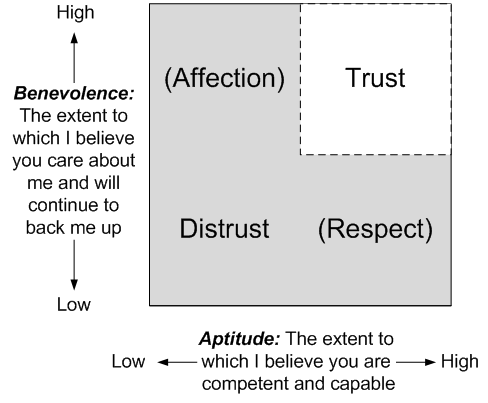
Healthy relationships require trust. Here’s an interesting figure from Scholtes showing the two converging beliefs that need to coexist for one person to trust another:

!cid_image002_png@01D0AE76

I find this figure illuminating. It makes me see that (and understand why) I have had some managers that I have respected and some that I have had (professional) affection for…but trust is much rarer.

Scholtes writes that “When I believe you are competent and that you care about me, I will trust you. Competency alone or caring by itself will not engender trust. Both are necessary.”

A couple of comments on trust:

  • I doubt it can be over emphasised that trust is in the eye of the beholder! ‘You’ can say that you care about me and that you know what you are doing but only ‘I’ decide whether I believe this…and I will be looking closely (and constantly) at your actions, not taking your word for it;
  • Some command and control managers have the view that employees need to earn their trust…this is the wrong way round! If someone wants to lead, they have to earn the trust of those that they would like to follow them.

KITA management (aka the picture at the top):

Now, onto the idea of KITA management: the term ‘KITA’ was coined by the psychologist and Professor of management, Frederick Herzberg (1923 – 2000)*. It stands for Kick-in-the-(pants)…he was too polite to write what the A actually stood for.

Herzberg wrote about positive KITA (carrots) and negative KITA (sticks)…and here’s why it isn’t motivation:

“If I kick my dog (from the front or the back), he will move. And when I want him to move again, what must I do? I must kick him again…” (Herzberg)

The related problem with KITA thinking is that it locks manager and employee in a highly unhealthy parent-child relationship. Further, when rewards are competitive (which they usually are in some way) KITA thinking creates winners and losers and adversarial relationships among those who should be colleagues.

* Note: Herzberg wrote the classic 1968 article “One More Time, How Do You Motivate Employees?” This is one of the most requested HBR articles of all time and has sold well over 1 million copies.

…and finally:

I’d like to share with you some wise words written by Alfie Kohn under the self-explanatory title ‘Rewards rupture relationships’

“We need to understand what the process of rewarding does to the interaction between the giver and receiver:

If your parent or teacher or manager is sitting in judgement of what you do, and if that judgement will determine whether good things or bad things happen to you, this cannot help but warp your relationship with that person.

You will not be working collaboratively in order to learn or grow; you will be trying to get him or her to approve of what you are doing so that you can get the goodies.

A powerful inducement has been created [through the regular judgement and resulting outcomes] to conceal problems, to present yourself as infinitely competent, and to spend your energies trying to impress (or flatter) the person with power….

… people are less likely to ask for help when the person to whom they would normally turn wields carrots and sticks. Needless to say, if people do not ask for help when they need it, performance suffers on virtually any kind of task.”

…and, in so writing, Alfie eloquently uncovers the damage caused by rewards and the stunting effect they have on the ability of an organisation, and its people, to improve.

The positive bit: It would be great if all of us worked really hard to attain an adult-adult relationship footing…realised when this had been broken by our words and deeds …and, through humility and dialogue, worked even harder to bring it back again.

An apology: I have a rule that a post should only cover one thing…and this one doesn’t appear to! It’s a bit of a journey from relationships, through leadership, coaching, trust, motivation and ending at rewards, which brings it full circle back to what rewards do to relationships.

In fact the topics in this journey do all belong together, under the competency of ‘Understanding people and why they behave as they do’. My intent was to show how they are all so tied up together so I hope you don’t mind me bending my rules 🙂

Outstanding!

Hello-My-Name-is-SlackerWhen I discuss my posts on performance appraisal and contingent rewards with people I get a lot of great understanding and support…but there’s always one question that pops up: “but then how will you deal with the slackers?”

Putting to one side whether our management instruments actually ‘deal with the slackers’ at the present, I find this an understandable response from within a command-and-control management system.

I usually find myself responding with:

“…and why do you think they are ‘slacking’*…do you think they want to perform an unfulfilling job all day long? Do you think this is how they started out when they got the job?”

(* if indeed they are ‘slacking’…our activity measures may present a different story than reality)

I then usually get: “yeah, but there will always be some people who take the p1ss!”

This uncovers a pretty hollow view of people. I’m not criticising people for thinking this …it’s more a recognition of the likely environments that people have had to endure through our working lives.

I would respond with a Deming quote to ponder:

“Anyone that enjoys his work is a pleasure to work with.”

  • You and I want to enjoy our work…and the environment that we work within will have a monumental influence on this;
  • I absolutely ‘get’ that there will almost always be a small % of people that sit outside the normal bell curve…but should we be designing our management system for the 5% or the 95%?
    • Do we tar everyone with the 5% brush?
    • Do we effectively yet compassionately deal with this 5% now?
    • Does it make sense that people ‘decay’ to being seen in this 5% bracket?

Regarding dead wood: “Why do we hire live wood and kill it?”

Kohn puts a deliberate order to his suggested actions (see the bottom of the ‘Exercise in Futility‘ post) and he most certainly doesn’t stop at removing contingent rewards and stopping performance appraisals…this is actually the point at which the real (and interesting) work can start to be done, with the process performers on collaboration, content and choice.

Okay, so you still think you’ve got a slacker:

If we are to consider the ‘slacker’ accusation, we also need to consider the other side of this coin, the supposed ‘talent’. Together, we can call these ‘outstanding performers’ where, as Scholtes explains:

We need to “use ‘outstanding’ in the statistical sense, not in the psychological sense.

Statistically*, ‘outstanding’ refers to something occurring outside the current capabilities of the system.”and therefore it makes it worth investigating as to what is happening and why.

* Note: There is variety in everything. We should not be tampering when there is nothing special about this variety. So ‘John’ achieved more than ‘Bob’ this week…big deal, we would expect differences…but is it significant, and is it consistently so?

Scholtes provides the following guidelines for our response to outstanding performance:

First: Determine for certain if they are truly outstanding:

  • Does (quality) data (properly) substantiate this ‘outstanding’ performance?
  • Does this data cover a sufficient timescale to indicate consistent performance at this lower or higher level?
  • Is there consensus among the outstanding performers’ peers (from observation, not gut reaction or rumours)

If the answer is ‘No’, it’s not actually outstanding!

If the answers to the above are all ‘Yes’ then:

Second: Investigate to discover what is behind this occurrence (using data!):

If the person is ‘positive’ outstanding, do they (for example):

  • use better methods which can be taught to others?
  • put in more hours?
  • have a wider range of skills?
  • have more experience?
  • have more native talent?

If the person is ‘negative’ outstanding, do they (for example):

  • need to learn a better method?
  • need to pick up speed?
  • need coaching or mentoring for a while?
  • lack the basic requisites for the job?
  • are they going through a difficult period?

And, depending on the explanation:

Third: Formulate an appropriate response:

For ‘positive’ outstanding:

  • teach methods to others;
  • provide higher pay* to recognise their change in market value (* but NOT contingent!)
  • provide more latitude in job definition

For ‘negative’ outstanding:

  • coaching, mentoring, training
  • provide greater structure for a while
  • get counselling and support
  • find a more appropriate position
  • Finally, sensitive and fair dismissal

If you take the last response, you still have a systems problem – you need to deal with how you ended up with this scenario.

Seddon deals with the issue of an individual’s supposed poor performance (and it being considered a ‘people problem’) in a similar vein to Scholtes. Put simply, there’s a whole host of questions that need to be asked about the system in which the individual operates before you can fairly arrive at the conclusion that the problem is with the individual.

The categories of questions, in order, are:

  • Is it an information problem? (do they know purpose, capability, flow?)
  • Is it a method problem? (waste? system conditions such as structures, policies, measurement, IT?)
  • Are extrinsic motivators the problem? (i.e. distractions from intrinsic motivation)
  • Is it a knowledge problem? (necessary knowledge to do the job?)
  • Is it a selection problem? (necessary attributes to do the job?)

All of the above are the responsibility of management to resolve.

  • Finally, is it a willingness problem?

Then, and only then can you conclude that you probably have the wrong person for the job.

“95% of the reasons for failure to meet customer expectations are related to deficiencies in the system…rather than the employee…

…the role of management is to change the system rather than badgering individuals to do better.” (Deming)

It’s very easy for a manager to blame a person. It’s a lot harder for them to work out what the systemic cause is. One of these approaches can improve the system, the other cannot.

A final Deming quote to ponder:

Question from ‘Management’: [what you are saying] “implies the abolition of the annual merit rating system [performance appraisals] and of management by [cascaded] objectives….but what will we do instead?”

Deming’s response: “Try leadership.”

A Service Revolution!

RevolutionService is different to manufacturing…and this difference is gob-smackingly important for a service organisation to understand if it is to truly move towards its (stated) customer purpose.

I was recently passed a link to a Malcolm Gladwell TED talk by a colleague and whilst watching it I thought…

“Nice! This is a simple tie-in to the incredibly important concept of variety in customer demand.”

So here’s the link to the very watchable talk (18 mins): Choice, happiness and spaghetti

Here’s the key points from the talk:

  • that Howard Moskowitz (a psychophysicist) had his ‘aha moment’ that “they had been looking for the perfect pickle…but they should have been looking for the perfect pickles“;  
  • the false assumption that the way to find out about what people want is to ask them….leading to years of fruitless and misleading focus groups. The truth is that:
    • people commonly don’t actually know, or cannot (and even will not) express, what they want; and
    • they will be constrained by what they currently know. No customer asked for an automobile. We have horses: what could be better.” (Deming)  
  • the importance of horizontal rather than hierarchical thinking about customer demand: we thought that customer demand was hierarchical (from cheap up to expensive products or services). Instead, there are only different kinds of products and services that suit different kinds of people;
  • that, instead of looking for one way to treat all of us, we now understand the importance of variability;
  • when we pursue universal truths [one standardised product/ service/ way of doing things], we aren’t just making an error, we are actually doing our customers a massive disservice;
  • We need to embrace the diversity of human beings

Hang on a minute….

So, I started off this post by saying that service is different to manufacturing but Gladwell uses lots of examples of physical products in his TED talk to make his point about the importance of customer variety (cola, pickle, spaghetti sauce, coffee,)…“make your mind up Steve!”

Well, this is a nice segue to explain about two types of variation, and how incredibly important this understanding should be to a service organisation (or the service part of any value stream).

These two types of variety are:

  • Customer-introduced (i.e. within their demand); and
  • Internally created within the process (regarding flow)

To go back to Gladwell’s spaghetti sauce: Different consumers like different sauces (this is variety in demand) but, once they have determined which variety of sauce they like, they then expect each jar they buy to be the same week in, week out (i.e. minimal variation in the process that creates that sauce).

So, whilst we definitely want to reduce and remove variation in the quality of the process, we should not remove the ability of the process to provide a suitably varied experience and outcome. Rather, it is the opposite – we should be trying to cater for this variety.

In fact, variety in service is MUCH bigger than Gladwell’s product examples:

One of my earlier posts set out five categories of variety in customer demand, as identified by Professor Frances Frei (see The Spice of Life).

Now, whilst it might be useful to categorise service variation (purely to help you ‘see’), the bigger point is that the customer sets the nominal value – the specific value of a service to them.

“The customer comes in customer shaped

…there is virtually infinite variety in people….and that variety can change for a given person depending on, say, time of day/ external influences/ mood….

Standardisation is NOT the answer…in fact, it is often the problem:

There are legions of service organisations that have hired manufacturing improvement experts (or people who have read books about them) to ‘standardise, specialise, centralise and automate’ because they say “this is the solution”.

Examples at attempts to standardise the customer include:

  • using IVRs to standardise customers into categories (“press 1, then press 3…”);
  • using call scripts to standardise the content of customer conversations;
  • using average handling times to standardise the length of a conversation;
  • using ‘box ticking’ forms to standardise customer information collection;
  • using ‘black and white’ rules above common sense, when dealing with a customer’s needs;
  • forcing customers down one path (e.g. you can only pay by direct debit, you can only interact online, you can only use these suppliers, …….and on and on).
  • …..

Interestingly, if you read the list above with your ‘I am a customer’ hat on, you will likely recall many instances where you have tried interacting with a service organisation and one or many of the above attempts at standardising you and your demand has seriously frustrated you!

This leads to much failure demand, waste (and cost) but with little value delivered (as written about in an earlier post).

Clarification: this isn’t to say that technology cannot assist or that there is no place for any standards. It’s making the point that the starting point should be that:

“….in service organisations, the problem is how to design the system to absorb variety” [and not frustrate it]. (Seddon)

Our starting point always seems to be ‘efficiency’ and a focus on activity cost. Perverse as it may seem, a focus on activity cost often has the unintended consequence of increasing total cost (though this is not visible to a silo’d organisation and is nigh on impossible for them to measure).

If we standardise, say, a site visit (the activity) such that it can’t absorb the variety in the customer’s demand…then don’t be surprised that:

  • there is failure demand from the customer when they complain and/or disagree with the outcome of the visit;
  • there is much ‘expert’ time spent reviewing this complaint;
  • there are yet more site visits required to resolve the problems;
  • there is lots more paperwork/ computer inputting/ workflow management required;
  • there is much confusion created by all this extra work (who did what when, who authorised what change from the standard, who is explaining all this jumble to the customer?); and
  • trust has been lost with the customer who now questions everything we do

The most important point to note is that “cost is in flow, not in activity”

So why the title of this post?

Well, the above is quite different thinking to where ‘command and control’ service organisations have been going. A revolution if you will.

Put simply, if we understand the variety in our customer demand and try to design our system to absorb (rather than frustrate) it we will go a long way towards our customer purpose…with the likely side effect of doing so for less cost.

“Managing value [for the customer] drives out cost….Focussing on cost paradoxically adds cost and harms value.” (Seddon)