“Why is your proposed change so profound?”

knot-systemMy recent serialised post titled “Your Money or your Life!” proposed that every ‘large corporate’* should make a meaningful change…that would be for the good of all.

Wow, that would be great!

* Where ‘large corporate’ is short form for ‘controlled by free-floating short-term thinking shareholders’.

I got thinking (as is often the case after pressing the ‘publish’ button) about readers thinking:

“Erm, okay – interesting perspective –  but why is the suggested change supposedly so profound?”

…and this caused me to question whether I had got the ‘this is a potential game changer!’ point across.

Note: What follows is relevant when considering ANY proposed change, not just the contents of my last post!

And so to a ‘systems thinking’ explanation:

First, a definition:

“A system is an interconnected set of elements that is coherently organised in a way that achieves something.

If you look at that definition closely for a minute, you can see that a system must consist of three kinds of things: elements, interconnections, and a function or purpose1.” (Donella Meadows)

Going back to an organisation (yours, mine,…wherever) as a system to ponder:

  • The Elements are pretty obvious – they include the people, the products and services offered, the physical buildings and resources, lots of intangible pieces (distinct departments, teams within) and so on…;

  • The Interconnections are the “the relationships that hold the elements together” e. g. the physical flows of work, the business policies and guidelines, external laws and regulations, the communications (including the gossip!), and flows of information (signals that go to decision or action points…which may or may not trigger reactions);

  • The Purpose of a system, whilst essential, is often hard to see (even if you think you know what it is!):

 “The best way to deduce the system’s purpose is to watch for a while to see how the system behaves…Purposes are deduced from behaviour, not from rhetoric or stated goals.”

 What you see may be very different to what you are told.

…and so, if you want to change an organisational system, presumably through a desire to improve (and even transform) it, then you have three “kinds of things” to play with.

Taking each ‘kind of thing’ in turn:

Elements

 “Changing elements usually has the least effect on the system.”

Using rugby and the All Blacks to illustrate the point: The coaches can change one or two players but, if they keep everything else the same, then not too much will change.

Now, sure, some elements may be very important (perhaps the introduction of a brilliant goal kicker) but, even then, the worth of such a change is hugely constrained by the rest of the system.

You might change ALL the elements (e.g. players) but if you keep the interconnections (such as the game plan, methods of communication, information sharing, the environment of trust and respect…) and purpose the same, then very little change may occur.
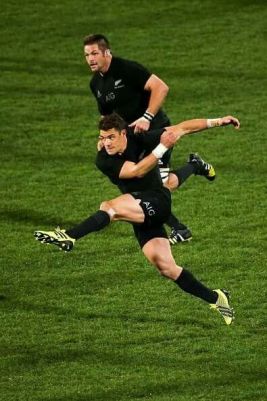
dan-and-richieA positive example of this phenomenon: The All Blacks won the rugby World Cup in 2011 and 2015, making them the first team ever to achieve ‘back-to-back’ rugby World Cups.  They did this with a core of extremely influential world-class players3who then promptly retired!

The world rugby media wondered how the All Blacks would rebuild, given the apparently gaping holes these players would leave. Many a pundit envisioned dark days ahead.

And yet a few weeks ago (on 22nd Oct 2016), despite introducing many new players, the All Blacks broke the world record for the number of consecutive international games won against ‘Tier one’ rugby nations (18 games). In short, rather than going backwards, they have ‘kicked on’ to even higher levels.

Their purpose and interconnections have clearly been shown to be stronger than the elements (e.g. players).

To the world of work: and organisational ‘restructures’. If you re-jig your hierarchical structure, changing the departments and faces within, but keep the methods of interconnection (the management system) and the underlying purpose the same (whether profit or political ideology), then not much has really changed.

“A system generally goes on being itself, changing only slowly if at all, even with complete substitution of its elements – as long as its interconnections and purposes remain intact.”

Further, you may have convinced yourself that your problems were ‘because of’ individuals…but consider that you may have ‘cut out’ the symptom and not the cause. If you don’t learn from this then you can expect another (costly) restructure in maybe 12 months time…and again…and again.

Interconnections

 “Changing interconnections in a system can change it dramatically.”
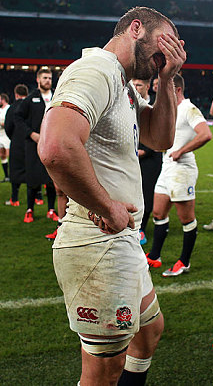
chris-robshawSo, staying with rugby, let’s move to the English national team.  In contrast to the All Blacks, they have had two terrible World Cups.

In 2011: they travelled to New Zealand and were awful (I know – I watched them!) They were heavily criticised for their attitude, and off field behaviour – they acted as if they were on an all expenses paid holiday…and, in the end, they were! The coach (Martin Johnson) resigned.

In 2015: they had home advantage – hopes were high. The whole of England was supporting them…but they exited the competition at the pool stages – the first time in their history. The coach (Stuart Lancaster) resigned.

So how has 2016 gone? Well, they’ve played 9, won 9…which includes:

  • achieving the Grand Slam (which they haven’t done for 13 years);
  • a 3-0 tour whitewash of Australia (a rare achievement); and
  • rising to be ranked 2nd in the World (from 8th)…just behind those mighty All Blacks.

So what’s changed? Well, England appointed a new manager (Eddie Jones)…but he has stuck with the core of previous players (those elements).

Instead of wholesale changing of the elements, he’s changed the interconnections – how they work together – resulting in players that had become labelled as ‘bad boys’, ‘past their best’ and ‘donkeys’4 being reborn, putting in controlled, consistent and herculean performances.

We don’t yet know whether the change will be long lasting…but it has most definitely been profound.

Back to the world of work: Perhaps the best known modern(ish) example of keeping the elements but changing the interconnections has to be NUMMI:

General Motor’s Fremont car plant was one of the worst performing plants in the whole industry, with high costs, low quality and terrible worker relations. GM closed the plant in 1982.

Toyota, wanting to start production in America, struck a joint-venture agreement with GM and the Fremont plant reopened as NUMMI in 1985. They rehired 85% of the original workforce (who still belonged to the Union – considered by GM as a serious problem). After taking 100s of the workers over to Japan to experience totally different thinking (involving a high degree of meaningful worker interacting), these learning’s were put into practise and the factory went on to produce the lowest cost, highest quality cars within its first year!

“Toyota took a bunch of [apparent] F Players, retrained them, put them into a great system, and magically they became superstars.” (Pfeffer and Sutton)

In short: Changing from a command-and-control management system to one that better understands systems and people will be dramatic.

Purpose

“A change in purpose changes a system profoundly, even if every element and interconnection remains the same.”

So, to switch from rugby to football: There’s an annual knockout competition in English Football, known as ‘The FA cup’. First played in 1871, it is the oldest football competition in the world. There is something rather magical about it because, given that it is open to any eligible club down to level 10 of the English football league system, it allows amateur minnows to mix it with the millionaire mega-stars…and, every now and then, create an upset – a minnow becomes a giant killer!

I searched for a game between a low-league minnow and a 1st division giant…and came up with Wrexham vs. Arsenal back in 19925. Both appeared to have had the same purpose – to win the game – but I suggest that their true purposes were rather different (and not so obviously stated).

Arsenal’s stars were probably trying to keep themselves injury free, to focus on other important matters – win their league (the 1st division) and perhaps get into their respective national sides (it was European Cup year)….and maybe avoid the embarrassment of defeat.

wrexham

In contrast, every man in the Wrexham team was aiming to become a legend!

Wrexham won 2 – 1. The crowd went nuts!

But here’s an interesting point: Wrexham, the giant killing minnow, went back to their low-league competition the following weekend and drew 0 – 0 at home with Maidstone United. Maidstone who? Exactly! The same players and staff, same coaching system, same methods of communications…different purpose!

This example, I hope, serves to illustrate the point that a (true) change in purpose will be profound, even whilst retaining the same elements and interconnections.

To the world of work: Even better than a transient change in purpose (like Wrexham’s), would be a permanent one!

…and so we finally come to that ‘profound point’ from my recent serialised post: long-term profit sharing. Bringing ‘Live Money’ into an organisation permanently changes its purpose, for the good of all…which would lead to experimentation with new interconnections…which would reinvigorate the elements (or at least naturally sort through those that fit vs. those that wish to pursue something else).

All in all – a profound change to the system. It would be…well…‘Transformed’.

To close: So, what if your ‘leader‘ changes?

Let’s say your organisation hires a new CEO – an element, but a central one. Everyone’s chattering about this ‘big change’…but will it change much?

The answer is “it depends”.

It will depend upon whether the leader understands systems and people (through education and experience, or perhaps instinctively)…because:

  • if the new leader goes on to change interconnections and, even better, the (actual) purpose then transformational change will likely occur; but
  • if that leaders attempts change merely through changing the elements (new people, new departments, a new IT system, some new products and brands….) then not much will actually change.

Changing the interconnections relates to the management system.

Changing the purpose relates to why the organisation exists, and for whom.

…and I hope I don’t need to say that a fancy new ‘purpose statement’ doesn’t, of itself, change a thing!

Footnote:

1. The word ‘Function’ is generally used for non-human systems and ‘Purpose’ for human systems.

2. Quote source: All quotes (unless otherwise stated) are taken from the excellent book ‘Thinking in Systems’ written by the late Donella Meadows (a giant to add at some point).

3. All Black players that retired after 2015 rugby World Cup:

  • Richie McCaw (148 caps): Regarded by many as the greatest ever rugby player, Most capped rugby player of all time, 3x World Rugby Player of the Year….and his accolades go on and on;
  • Dan Carter (112 caps): Regarded by many as the greatest ever no. 10 (fly half) player, Highest international test points scorer of all time (1,598), 3x World Rugby Player of the Year…and on and on;
  • Ma’a Nonu (103 caps) and Conrad Smith (94 caps). Most successful mid-field pairing;
  • …and other great players: Kevin Mealamu (132 caps), Tony Woodcock (118 caps)

4. England players: If you are a rugby fan then I’m referring to the likes of Dylan Hartley (‘bad boy’), Chris Robshaw (‘has been’) and James Haskell (‘donkey’). Sorry chaps…but this is what you had seemingly become!

5. FA Cup Giant Killing Context: Wrexham came last in League 4 the year before (i.e. came 92nd out of all the 92 league 1 – 4 clubs). At the complete opposite end of the spectrum, Arsenal won League 1 (i.e. came 1st out of these 92 clubs).

6. Explaining the main post Image: The system is made up of ropes (elements), knots (interconnections) and purpose (what it is intended to achieve)….which may be to look pretty or to hold a heavy load.

7. Clarification: This post is NOT saying that purpose is the only lever you should focus on. It is merely explaining the likely impact of working on each type of lever. We should be working on improving all three ‘kinds of things’ and, being a system, they are all related!

Chapter 5: Avoiding Armageddon!

Yep, it’s the last chapter! Phew, I hope you are still with me after Chapter 4…hello, is there anyone out there???

I said that I would end with “…and we all lived happily ever after” but there’s a few people who stand in the way of this.

Let’s get personal – Hot Potato time

hot-potatoSo everything I’ve written so far may resonate with you…and yet you will likely reply that nothing will change because those in control have no interest in doing so…and so I need to write a couple of personal messages:
  • to existing free-floating shareholders; and
  • to ‘large corporate’ CEOs;

I totally accept that there will be no real change unless both of these parties understand, need and want it.

A personal message to all you existing free-floating shareholders out there:

Okay, so cast your mind back to the opening of Chapter 1.

I held out Henry Ford as someone with something important to say…but I also noted that he had a huge amount of luck – he was on the right side of a technological disruption.

This is the time to inform (or remind) you that there are loads of technological (and related business model) disruptions happening right now:

  • In transportation: autonomous vehicles that will disrupt taxis, haulage, public transport…
  • In power: electrical generation (such as solar) and storage (such as batteries) that will disrupt the incumbent fossil fuel industry and its distribution networks…
  • In finance: I’m only just feeling around the crypto-currency stuff (I confess to being a bit of a laggard!)…but I can see that the effect will likely be huge;
  • In production: such that people can 3D print their own products to their own specifications as and when they want;
  • ….and all the financial service knock-on effects of the above:
    • On banking (e.g. less cars on the road = less car loans)
    • On insurance (e.g. drastically less accidents = no need for car insurance)
    • On currencies and share trading
  • …and probably loads more game changers that I don’t know about and/ or don’t understand (I haven’t even mentioned the rather trendy ‘internet of things’!);
  • …and yet more that none of us yet know about but could be around the corner.

Now, for a nimble start-up with a true purpose, the above is exciting. Indeed, they are the ones driving it.

But for a traditional, large, shareholder-owned incumbent, this is the stuff of nightmares!!!!

Such an organisation finds it almost impossible to change even though (and this is the interesting bit) it can and does see it coming – it’s as if its feet are stuck in cement blocks at the start of a 100 metre race. Worse, they waste loads of time and money flailing around trying to move (perhaps via ‘innovation’ programmes1)…but don’t really get anywhere.

In short: If you are a shareholder in such a company, you’d better wake up soon…’cos Henry Ford’s modern day equivalents are coming at ya! Your horse doesn’t stand a chance.

If you think “nah, none of the disruptions affect my investments in companies” then remember that many periphery industries were also devastated when the horse carked it.

“Hang on – aren’t many of these technological disruptions coming from large corporations?!”

steve-jobsYes, they are…but what form do these typically take? And did they start off from such a ‘large corporate’ state?
Well, they are usually led by a seriously driven founder (and likely lead investor), who toiled for years, because their personal purpose was clear from the start…and it wasn’t to make millions – this was the result from their success.

We can name:

  • Steve Jobs2 at Apple (and previously NeXT and Pixar)
  • Jeff Bezo at Amazon
  • Larry Page at Google
  • Elon Musk at Tesla, SpaceX, SolarCity (and previously Zip2 and PayPal)
  • and, of course, Richard Branson3 and his Virgin Group
  • …and there are no doubt loads more ‘seriously driven founders’ you could put forward.

(Please note that I’m not holding any of them out as great leaders – that’s a totally different matter.)

“Quick – grab a seriously driven founder!”

Every traditional ‘large corporate’ would just LOVE to employ a seriously driven founder…but it doesn’t work like that – they are doing their own thing…and perhaps sold their company to you!

You can’t fake being a seriously driven founder – you either are or you aren’t.

But wait, the large corporates that you invest in employ thousands of really capable people who, whilst they may not have the desire to ‘go it alone’, would be really happy to give of their all for a really great company that they co-own with you, through sharing in its success.

This is to match the right model to the system type.

At the moment, Management may be:

  • giving lectures on “you need to be innovative or else we’ll die”; and
  • putting huge effort into attempts to kick-start this (such as by setting up worker clubs)

…but change the paradigm and they may be hugely surprised4 at who starts talking to who…about what…who then informally club together to take it further…who enlist the help of others to do a little experiment…and uncover/ solve/ create something no-one else had…and, wow, that result could just be amazing!

To close this shareholder message: Your Dead money is useful, important and appreciated but, for your own good, it needs suitably diluting with Live money. This is in your interest – do you want your investments to be worthless or priceless?

And to all you Investment Fund Managers out there: You spend your days passing around shares in such ‘large corporates’. If the above is even slightly close to what is happening out there in your world, then I present you with the following analogy:

You are essentially playing Russian roulette, passing the gun around with your fellow fund managers until it goes off in the hands of whoever happens to be holding it.

How about swapping to play games with companies that have a lot better odds!

A personal message to CEOs out there:

fat-catIf the common man might label you as a ‘fat-cat CEO’ and you are responsible for a floating shareholder-owned company then I’d like to ‘speak to you’ about your situation:


  • You’ve done well for yourself; you’ve risen to the top. You are financially secure, in fact ‘set up for life’;
  • You probably spend much of your time telling your employees about the importance of purpose, and about matching their personal purpose with the stated purpose of your organisation;
  • So, what about your personal purpose?5 Are you here on earth ‘just for the money’?
  • Or would you like to be known (and remembered) for creating and sustaining a truly awesome organisation, for the good of society?

If it’s no longer ‘for the money’ (because, frankly, you’ve got that box ticked) then I’d ask that you ponder this post, perhaps share it with your board, and have a discussion about how you could change (I mean ‘improve’) the ownership structure of your company for the good of all…and that includes your current shareholders.

Personally, I love what Handelsbanken has done. But I recognise that there are many ways to ‘skin a cat’ (there’s that cat again!)

I hear what you say but…

If you ‘get’ what’s written in this post but don’t want to change your world, then at least know that employees of floating shareholder-owned organisations distinguish that it is really about the profit…and many (most?) of them see the constant blowing of your ‘purpose trumpet’ as convenient propaganda i.e. not the rallying cry that you might imagine. Sad, but true.

A ‘half arsed’ attempt:

Now, it’s possible that you’ve taken this all in, can see some industry or societal ‘movement’ towards profit sharing, and feel pressure building to be seen to be doing something.

So to a warning: Don’t play profit sharing ‘dress up’ (i.e. pretending that you are doing it but then hiding behind complex scheme rules and playing accounting games). Your people will see right through it and you will be the same as, and likely worse off than, before (minus the costs of your failed propaganda exercise).

Only do it if you actually WANT to share the success of the organisation with the people who make it possible…and this will only be because you’ve truly understood the situation, the opportunity, and the immense and sustainable potential.

A thought to finish:

henry-ford-quote

…so, don’t think about the profit! Focus on the service…but change something with regards to your ownership structure so that you (and everyone else) can!

…and with that:

  • We all lived happily ever after (that’s nice 🙂 ); or
  • Armagedon!!! (bugger)

If you’ve got to the end…yes, this is it! – nice one, top banana, brilliant. Thanks for staying with me!

I don’t pretend that I’ve solved ANYTHING…but I’ve definitely ‘got a lot off my chest’ 🙂 . I also hope that I’ve helped you in some way. Perhaps not yet…but with what might come.

Normal ‘single issue’ blog posts will resume from next week….and now to go and lie down.

Footnotes:

1. On efforts to ‘get your people innovative’: You should know that incentives and innovation don’t go well together! Alfie Kohn writes eloquently to explain why research repeatedly shows that “Rewards discourage risk taking”:

“the risks we want people to take – being willing to explore new possibilities… – are minimised by the presence of rewards. An extrinsic orientation, for example, makes people less likely to challenge themselves. Instead, they are apt to choose the easiest possible tasks to do, since this maximises the chance of getting the reward and getting it quickly.”

And, just in case you think incentives and profit sharing are the same thing, here’s an earlier post that explains why they are polar opposites.

2. Steve Jobs:

“I was worth over a million dollars when I was 23. And over ten million dollars when I was 24, and over a hundred million dollars when I was 25. And you know, it wasn’t that important, because I never did it for the money. I think money is a wonderful thing, because it enables you to do things. It enables you to invest in ideas that don’t have a short-term payback. At that time in my life, it was not the most important thing. The most important thing was the company, the people, the products we were making. And what we were going to enable people to do with these products. So I didn’t think about the money a great deal. I never sold any stock [shares]. I just believed that the company would do very well over the long term.”

3. Richard Branson:

“My interest in life comes from setting myself huge, apparently unachievable challenges and trying to rise above them … from the perspective of wanting to live life to the full, I felt that I had to attempt it.”

4. Doing something about it: I find it really interesting that the talk around me in my workplace is all about the disruptions out there (i.e. people know about, and are interested in them)…but there’s little real passion to do something about it (i.e. actions rather than merely talking about it) because we’re all placed in our hierarchy with our cascaded objectives and incentive/merit mechanisms.

Take those crypto-currencies. I’m sure that there’s something really important within…but I’m not leaping about to DO SOMETHING. I’ve got ‘concrete feet’ just like many (most? all?) those around me.

Is this me being lazy? Is this me being some sort of organisational traitor? No, these are the behaviours that the current system creates.

5. Your personal purpose: Looking at Maslow’s hierarchy of needs (see nice piccie below), I’d ask you to reflect that you (as a highly paid executive) are in the wonderful position to choose whether you move up the scale – to esteem and, ultimately, self-actualisation.

More Money won’t get you there!

maslows-hierarchy-of-needs

Money is necessary for the bottom two levels of the scale (also referred to by Frederick Herzberg as ‘hygiene factors’), and might assist with the middle (though can you really buy friends?)…but, once these levels are in place, money has little (if anything) to do with the top.

Conversely, continuing to adopt a (potentially subconscious) position, and take actions, towards more ‘money’ will prevent you getting there…which can lead to unhappiness and (at the end) a sense of huge disappointment through wasted opportunities.

Reflect on how many seriously driven founders, not knowing what to do with their wealth and often becoming very unhappy, turn to philanthropy.

You can create an amazing organisation (and gain colossal satisfaction) by creating the necessary environment for all the people who work there…and this will require you to be courageous and think totally differently.


Chapter 4: What possible ‘defences’ exist against the harm of ‘Money Power’?

So I’ve:

  • set out Ford’s explanation of Dead vs. Live money (Chapter 1);
  • ‘shot at’ organisations that claim they get this –as in “see, here’s my purpose!” (Chapter 2);
  • explained why shareholders are probably the last people you’d want as guardians for an organisation’s successful longevity; and
  • put forward a logic as to why executives behave as they do (including the recent Mylan example to consider) (Chapter 3).

light-bulb…and at this point you may reasonably ask “so what can be done about this situation?”
Thankfully not everywhere is the same…and we can look around for ideas.

Ha-Joon Chang writes that “most rich countries outside the Anglo-American world have tried to reduce the influence of free-floating shareholders and maintain (or even create) a group of long-term stakeholders (including some shareholders) through various formal or informal means.”

These include:

  • government ownership (either direct or indirect) of a sizeable share to act as stable shareholders (examples in France, Germany, Korea);
  • differential voting rights for different classes of shares e.g. for founders and their families to retain significant control (Sweden);
  • formal representation by the workers on the company supervisory board (Germany);
  • minimising influence of floating shareholders through cross-shareholdings amongst friendly companies (Japan)

“Being heavily influenced, if not totally controlled, by longer-term stakeholders, companies in these countries do not as easily sack workers, squeeze suppliers, neglect investment and use profits for dividends and share buybacks…all this means that in the long run they may be more viable…

Running companies in the interests of floating shareholders is not only inequitable but also inefficient, not just for the national economy but also for the company itself.”

(Of course, I should reflect that there are lots of other ownership models ‘out there’, such as State Owned Enterprises, Mutuals and Co-operatives…and I have read many a good-news story about what can be achieved with the latter.

If you already have one of these ownership models, please stay as you are! What follows is aimed squarely at the Dead Money corporations).

Exploring the employee option:

proft-sharing-quoteI’m a big fan of the ‘employees as long-term owners’ method.

Now, many a ‘large corporate’ would respond that their people can buy shares in their company and, further, that they encourage this by administering some form of ‘employee share buying scheme’.

So how’s this different to share ownership through profit sharing (as in the Oktogonen Foundation)?

Well, if we consider a typical ‘employee share buying scheme’:

  • You are asking employees to put up their own money as risk, rather than rewarding them for their ‘blood, sweat and tears’;
  • Only a limited number of employees will buy shares (for a variety of reasons – the most obvious being their level of affluence and their attitude to risk);
  • The minority that do buy a small ‘side salad’ of shares have simply been added to the vast pool of floating shareholders…worried about short-term profits and dividends.

In contrast:

The power in ‘share ownership through profit sharing’ is that EVERYBODY in the organisation becomes an owner, and thereby connected with the same aim.

The power in setting up a foundation specifically for this purpose is that the employees as a GROUP obtain a significant voice, creating representation on the board.

The power in defining a long-term method of payment (say, at pensionable age) is that employees (past and present) care deeply about the LONG TERM success of the organisation…which will produce a genuine focus on the CUSTOMER (and society).

Now these words might cause the following reaction from existing shareholders and executives: “Whoa…I don’t like the sound of ‘worker power’ – this is Trade Unionism by the back door…and look at where that always ends up!”

Here’s why it is the exact opposite:

The birth, and historic basis, of the Trade Union movement was to protect the workers from the power of the owners. In response to Trade Union power, the owners would regularly claim that the employees were ‘biting the hand that feeds them’…and thus a hugely adversarial battle became the norm1 (usually with the customer, and consequently the organisation, suffering in the cross fire).

But, rather than employee ownership through profit sharing stoking the ‘worker – owner’ flames, it actually dissolves the problem! Everyone is pointing in the same direction.

Even better, a foundational base is set to enable the business to become so much more efficient and effective because all those commanding and controlling ‘management instruments of torture’ can be torn down – that would be incentives and Performance Management2 for a start!

….just think how easy it would become to engage with the workers – or should we call them ‘long term guardians’ now?

“Just close your eyes and imagine…”

imagineI have often found myself in company presentations with management eulogising about the next ‘cost cutting’ initiative. A usual candidate is the travel and expenses budget (and the associated rules to be complied with)…and they always use the same logic:

“Imagine it as your own money!”

Ponder upon this for a minute: management ‘get’ that it isn’t our money, and that this will alter how we think about it…but they want us to play a game of ‘pretend’. Hmmm – they’re missing something there.

But what if THEY (management) altered their thinking such that it IS the employees’ money. They can dispense with those silly games, and potentially all those wasteful cost cutting initiatives. Imagine that!

“But it’s not their money!!”

Now, there may be a backlash of comments from shareholders with a view that the company would be giving away their money.

Some thoughts on this:

  • The organisation doesn’t need to raise capital to do this! It just needs to STOP the offering, and paying, of contingent rewards. There’s plenty of money right there;
  • For those shareholders that don’t realise this…there is loads of cost spent in administering the performance management/ incentives lark…and a great deal of harm caused that is unmeasurable! This is no longer required;
  • But, fundamentally, a long term ownership interest (Live Money) will change the way that employees think…for the good of the customer and therefore the organisation…and, as a result, to the benefit of those that invest.

A start to the journey

silver-bullet‘Necessary but not sufficient’: I’d like to be clear that, whilst profit sharing could be game changing, it’s not a silver bullet….but it is a hugely sound foundation from which the right type of business can be successfully built and sustained.

It can act as a catalyst for all those things that you’ve been saying, but not been able to do. Why? Well, because it fundamentally changes the employee – company relationship.

It brings Live Money onto the scene and, if done well, brings Service Power back to the fore.

(Note: I’ve written this whole serialised post because – after many years of pondering – I came to the conclusion that you can understand and passionately want to change your ‘culture’ BUT you won’t (meaningfully or sustainable) achieve this if you don’t address your ownership structure…and this relates to Money Power).

To close: A comment on the current ‘side show’

The current ‘large corporates’ hymn is all about diversity….and that this will ensure the future of an organisation – all those different people, with all those different perspectives and ideas! What’s not to like?!

Now, I’m all for diversity. I believe in respect, equality and fairness for all.

However, you can be as diverse as you like, but if you don’t change the system (of management and ownership) then you’ll simply get more of the same.

To repeat my regular John Seddon quote (I have it ringing in my head most days!):

“People’s behaviour is a product of their system. It is only by changing [the system] that we can expect a change in behaviour.”

Or, to a Deming pearl of wisdom: “A bad system will beat a good person every time”

Stop trying to change people and, instead, perform a paradigm3 shift so that they change for themselves.

I should add that the diversity thing will be so much easier to achieve when all employees want to collaborate together (profit sharing) rather than competing with each other for ratings, rankings and contingent rewards. i.e. If you really want diversity, and what it can offer, then change the system first.


Okay, so I’ve argued that employee ownership through long-term profit sharing is a bloody good way to go…but there’s a few people that I really need to convince first. That would be a) the existing shareholders and b) the CEO. And that is the subject of my next, and final, chapter 🙂

Update: Link forwards to Chapter 5

Footnotes:

1. Owners vs. Unions: As usual, Henry had something useful to say on the matter:

“Business does not exist to earn money for the capitalist or for the wage-earner. The narrow capitalist and the narrow trades unionist have exactly the same view of business – they differ only on who is to have the loot.” (Ford)

2. On the merit system (i.e the rating and rewarding of people’s performance): Here’s a nice Deming exchange in a Q & A part of one of his famous lectures:

Question from the audience: “What do you propose to replace the merit system with?”

Deming: “Replace it? What, you want something to destroy people better than that does?!

Replacement means another method to do the same thing. [Do] you know of anything more effective in the destruction of people?

Question rephrased: “But is there any way to change the merit system?”

Deming: “Change it? Abolish it! Look at what it’s done to us.”

3. Paradigm: I usually hate using the ‘p’ word – it seems so ‘management consultancy’ to me…but in this case it is spot on!

4. So…what if you don’t (yet) want Live Money: If you don’t want to do the profit sharing thing (even though you’ll be seriously missing out) then STILL GET RID OF THE INCENTIVES!

Chapter 3: Can executives change the ‘shareholder value’ machine?

So Chapter 1 explained Henry Ford’s philosophy, only for Chapter 2 to give modern ‘large corporations’ (including their executives and short-term shareholders) a bit of a slap around. You might reasonably ask whether executives can actually do anything about this, for the good of the organisation. That’s the subject of this chapter:

shareholder-value-machineSo let’s say that you are an executive of a shareholder-owned corporation. Who are you legally answerable to, and therefore in whose interests must you act?
This is the subject of another superb book, ‘The Corporation’ (2005) written by Joel Bakan. Here’s what he has to say about this:

“Corporations are created by law and imbued with purpose by law. Law dictates what their directors and managers can do, what they cannot do and what they must do. And, at least in…industrialised countries, as created by law…it compels executives to prioritise the interests of their companies and shareholders above all others and forbids them from being socially responsible – at least genuinely so.”

Bakan cites company law as establishing the principle that directors have a legal duty to put shareholders interests above all others1.

Now the last line of the Bakan quote might seem strange because ‘don’t all those companies provide us with corporate social and environmental responsibility statements?’ (i.e. on their websites and in a prominent position within their annual reports)

Bakan goes on to explain the apparent conflict:

“There is, however, one instance when corporate social responsibility can be tolerated – when it is insincere. The executive who treats social and environmental values as means to maximise shareholder wealth – not as an ends in themselves – commits no wrong.”

Now, this is pretty disturbing stuff! You might come back at me and say “but other laws and regulations will stop ‘em!” Mmm, it would be nice if that were so:

“For a company, compliance with law, like everything else, is a matter of [weighing up the] costs and benefits.”

Simply having laws and regulations isn’t going to protect the public. If the costs of meeting the ‘rules’ becomes exorbitant, the company will consider the legal and reputational costs of breaking (or ‘manipulating’) them as against the benefits to be derived….a small oil spill here, a dodgy tax deal there, with a sprinkling of marketing propaganda to cover up or divert attentions elsewhere.

[Quick side note: I recently watched the 1st Trump: Clinton debate and ‘the Donald’ referred to such logic as ‘smart business’…and why America needs him. Nice…not!]

Further, Bakan defines the concept of corporate externalisation:

“The corporation…is deliberately programmed, indeed legally compelled, to externalise costs without regard for the harm it may cause to people, communities and the natural environment. Every cost it can unload onto someone else is a benefit to itself, a direct route to profit.”

This illuminates the gulf between Dead Money power and the public good.

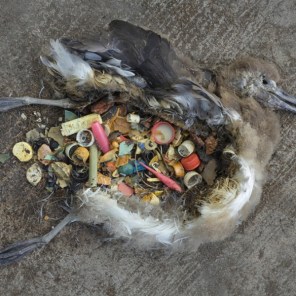
plastic-birdTake the really simple example of packaging for food and other consumables. Sure, the supermarket pays for the costs of the plastic…but they happily externalise the cost of dealing with this packaging once the item has been bought. “What do you mean it got into the sea and is killing stuff? Not our problem anymore!”

Are the big supermarkets bothered about this? Not really…but they become so if, and only when, we make it in their interests to be bothered…and you can be sure that, if they then make any improvements, their Public Relations (PR) machine will crow long and hard about how they are ‘making our world a better place’.

This is looking for good news out of what you are being forced to do, rather than doing the right things in the first place.

And beware of that supposed ‘good news’. The wonderful stuff (that they say) they are now doing, might not be so wonderful. I’ve just watched another episode of ‘Hugh’s war on waste’ and am appalled at big coffee’s2 attitude to coffee cups – they are perfectly comfortable with us all thinking that they are recyclable when they know that they aren’t. Nothing to see here – move along!

Now, I think that you and I know that we could dig up literally hundreds, if not thousands, of case studies over the years showing the harm caused to organisations and society by Dead Money…but let’s keep it real simple and just look at one that’s been in the media recently3:

Example: Mylan and the Epipen

epipenLet’s have a look at the drug company Mylan and their 2007 purchase of Epipen (an auto-injector of adrenaline, to counter an anaphylaxis reaction). The product had been around for many years and was making modest revenues of US$200m.
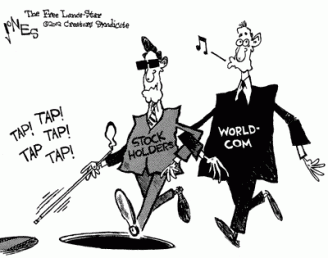
So here’s what Mylan came up with:

  • let’s strongly market it to concerned parents (so they feel morally compelled to buy more pens – for home, for school, for camp….);
  • let’s get laws passed that increase demand;
  • let’s get labelling rules changed that allow it to be marketed more widely;
  • let’s work hard on hindering competitors from bringing their substitute products to market
  • …let’s do whatever to push and protect this product.

And so, between 2008 – 2015: Mylan increased prices 400% (to US$600 for a twin-pack), sales rose to US$1 billion and the product margin went from 9% to 55%.

(Note: those price increases are the exact opposite of Ford’s success4)

But what of the customer (the public)? Well, as is often the case, the really needy people are the ones that suffer. Many parents of allergic children can no longer afford the best product (or the rising health insurance premiums). They have no choice but to take alternative actions, like:

  • carrying expired Epipens and hoping the drug still works; or
  • reverting to the old fashioned method of regular syringes, by paying a doctor to fill them with the drug…costing about $20… and hoping that it is administered correctly when the time comes.

Even officials in many states are training their medical technicians to use the old ‘regular syringes’ method so as to save hundreds of thousands of $ from their budgets.

…and, finally the dam burst: the story got out, with mainstream and social media waging war on Mylan’s CEO, Heather Bresch.

So, did Bresch do anything wrong? Who says? The shareholders had been ecstatic with her actions…at least until ‘we’ found out.

Has Bresch taken some steps to address the mess? Hell yes!…but only to defuse, protect and then, no doubt rebuild. Nothing has fundamentally changed. She might be ‘shamed’ into resigning (not looking likely)…but I hazard a guess that if this occurred:

  • her salary cheque (and share options) will likely comfort her;
  • there will be many job offers from other companies wanting to benefit from her ‘corporate acumen’; and
  • Mylan will look for, and easily find, a replacement CEO in her image.

So, where’s that much vaunted ‘purpose’ in all this? If you want to have a read about Mylan, their Mission and their Values then have a look here. The following words from Mylan’s website give me a lump in my throat, and tears in my eyes:

Doing what’s right is sacred to us. We behave responsibly, even when nobody’s looking.”

It reminds me of a rather nice Jon Stewart quote:

“If you don’t stick to your values when they’re being tested, they’re not values; they’re hobbies.”

If you were wondering about the insincerity part of Bakan’s quote above then I hope the Epipen example assists. Mylan’s demonstrable purpose is money, not its customers (the public).

It’s worth noting that Mylan’s short-termism has laid itself bare to disruption by those who (are seen to) champion the customer. I expect competing products to do well from this media saga, and new products to emerge.

We shall see how this affects Mylan…but they have clearly lost a great deal of trust from the public.

As an important side note: How many of Mylan’s employees do you think now love working for them vs. how many are embarrassed to say so? And what effect might this have?

The unholy alliance:

unholy-allianceThere is of course a further (and huge) problem implied within the above: Those short-term thinking shareholders have formed an unholy alliance with those they employ as their agents – the directors and executives. By which I am referring to share option incentives.
This isn’t new stuff – and I often reflect that not much in human history is!

Here’s what Henry Ford had to say about the stock [share] market nearly 100 years ago:

“The most common error of confusing money and business comes about through the operation of the stock market. And especially through regarding the prices on the exchange as the ‘barometer of business’. People are led to conclude that business is good if there is lively gambling upwards in stocks, and bad if the gamblers happen to be forcing stock prices down.

The stock market as such has nothing to do with business. It has nothing to do with the quality of the article…nothing to do with the output…it does not even increase or decrease the amount of capital used in the business. It is just a little show on the side.”

…and, to the highly problematic part:

“The state of the stock market may make a deal of difference to the officers and directors of a company if they are dabbling in the stocks and trying to make money out of the securities of the company instead of out of its service.

It’s interesting that Henry saw this point clearly so long ago. I wonder what he’d say to the size and nature of the modern share option incentive packages! This has become a modern ‘large corporate’ virus5, attacking at the heart of the (supposed) customer purpose.

To close:

So, we have:

  • A problem of dead money usurping purpose;
  • An ownership model that favours short-termism over doing the right things for the long term success of the business; and to cap it all…
  • Directors and Executives ‘bought’ by those short-term shareholders to keep it this way.

Many an executive could throw their hands up in the air and cry “I know…but what can I do?!”

In Chapter 4, I’ll put forward some alternative thinking – for ways to alter the ownership model and thus change the foundation for the good of all (including the shareholders).

Update: Link forwards to Chapter 4

Footnotes:

1. Shareholders as King: If you want to really delve into: the detail on the ‘shareholder primacy’ issue; recent attempts to move to an ‘enlightened shareholder value’ concept; and the conclusion that little has really changed then here’s an in-depth paper that does that.

2. ‘Big Coffee’: Hugh investigated the (misleading) words and (contradictory) actions of Starbucks, Costa Coffee and Cafe Nero in the UK.

3. Wells Fargo: I had already written Mylan as the case study when I saw the Wells Fargo fraud come out in the media…I could have added this case, but I expect that you’ve got the point – lots and lots of big corporations focused on dead money power, not service power for the public.

If you don’t know about, but would like to read up on the Wells Fargo case, then here’s a link.

4. Price: Henry Ford constantly sought ways to reduce his costs and pass these savings onto his customers (the public) by reducing the price of his cars. The price of a Model T ford dropped from $850 when it was introduced, to $260. (Source for price info.)

5. That ‘Unholy Alliance’: Just in case you were wondering (and this note is mainly for the benefit of shareholders), studies have examined the link between the introduction of executive incentive (i.e. share) packages and shareholder value – and it hasn’t exactly worked out well for the shareholders! A book to read here would be ‘Fixing the game’ by Roger Martin.

A recent study of 1,500 large corporations by Raghavendru Rau (Finance Professor at Judge Business School) found that:

“shares in firms that paid their CEOs in the top 10% of incentive pay [i.e. with high executive ‘incentive’ packages] typically saw their share price decline – and they fared considerably worse than the shares of companies in the bottom 10% [ i.e. with no or little executive incentive packages]”

Chapter 2: “That’s what WE do!”

Okay, so to recap, in Chapter 1 I took you back 100 years to consider the visionary Henry Ford and his foundational philosophies. I know he wasn’t a saint, I know he didn’t ‘solve the worlds problems’ and I know that he was lucky to be the right side of a technological disruption…but there’s bucket loads to learn from him.

what-peple-say-and-doThe ending of Chapter 1 was about Money power and, in particular, the idea of Dead Money provided by professional financiers – people focused on profit.
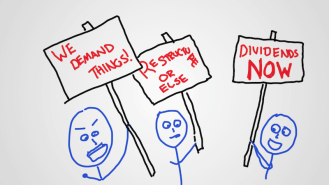
Now, I can almost hear any and every ‘large corporate’ executive, after reading Ford’s words, shouting back that “yes, yes, YES” – they understand ALL of this…they don’t run the business solely for profit…and this is why they have a rather wonderful Purpose Statement!1

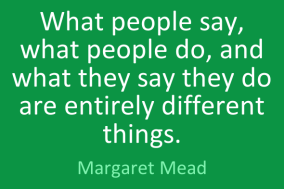
To those ‘large corporate’ executives that would protest that they are ‘at one’ with Henry, I would reply with Stafford Beer’s acronym POSIWID, which stands for ‘The Purpose Of the System Is What It Does’.

To better explain this point I will borrow from my earlier post on this point:

“There’s a BIG difference in what we might like the purpose of our (organisational) system to be and what it actually is!

You can say that the purpose of the system is [XYZ] until you are blue in the face but, if this isn’t what it actually delivers, then by point of fact it ISN’T its (current) purpose.”

Every time I hear the ‘purpose’ words and then see the conflicting profit actions, I have to go and have a lie down.

Ford’s words are profound2 and agreeably fit with what has subsequently been written/said by all those giants I referred to in my earlier post ‘Oxygen isn’t what life is about’.

Here’s the summary from this post:

  • “You can state a purpose….but you’ve got to actually live it to move towards it;
  • An organisation’s purpose should NOT be ‘profit’, even though this outcome is necessary for the system and those that finance it;
  • If you think it’s the other way around i.e. that you need to state a purpose so as to chase profit, then you are likely to fall a long way short of what you could achieve…and will put your long term survival at serious risk;
  • A focus on short term profits and results for the market will likely destroy unknown and unknowable value.

For those of you who think ‘what a load of hippy liberal rubbish, of course it’s all about the shareholder’, here’s a really nice quote to consider from Sam Walton (founder of Wal-Mart):

“There is only one boss. The customer. And he can fire everybody in the company from the chairman on down, simply by spending his money somewhere else.”

…how would those shareholders feel if their investment became worthless?”

i.e. Purpose is above profit…and you can’t just say this – it has to be so.

We seem to have a problem with understanding the ‘purpose isn’t profit’ thing.

So, what’s the difficulty here? Why can’t we fix this? What might be the cause?

And so to Corporations

shareholder-demandsIf you’ve not read it then I heartily recommend a well written book by Ha-Joon Chang (Economics Professor at Cambridge) called ’23 Things they don’t tell you about Capitalism’3.
‘Thing 2’ is that “Companies should not be run in the interest of their owners”.

Now this will likely confuse most people, provoking responses like “…but isn’t this a building block of capitalism?”

And yes, in Ha-Joon Chang’s words, here’s what we are told:

  • “Shareholders own companies. Therefore, companies should be run in their interests. It is not simply a moral argument…;
  • Shareholders’ incomes vary according to the company’s performance, giving them the greatest incentive to ensure the company performs well…;
  • If the company goes bankrupt, the shareholders lose everything, whereas other ‘stakeholders’ get at least something. Thus, shareholders bear the risk that others involved do not.”

Okay, that looks pretty cut and dry in favour of the shareholders – so what is he on about?!

…but here’s what they don’t tell us:

  • “Shareholders,…as the most mobile of the ‘stakeholders’, often care the least about the long-term future of the company;
    • On mobility: whilst shareholders can sell their shares in the blink of an eye, the other stakeholders (customers, employees, suppliers and even the lending banks) have far higher barriers to untangling themselves
  • Consequently, shareholders, especially but not exclusively the smaller ones, prefer corporate strategies that:
    • maximise short-term profits, usually at the cost of long-term investments; and
    • maximise the dividends [and share buy backs] from those profits, which even further weakens the long-term prospects of the company by reducing the amount of retained profit that can be used for re-investment.

 Running the company for the shareholders often reduces its long-term growth potential.”

This could just as easily be Ford talking about ‘Dead money’!

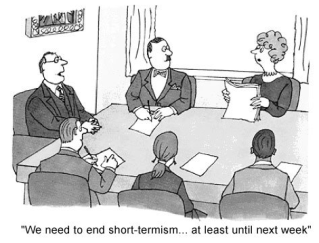
short-termismHa-Joon Chang goes on to tear apart the 1980s principle of ‘shareholder value maximisation’ (I won’t reproduce his critique here…but it is well worth reading4).
He concludes that “[shareholders] ease of exit is exactly what makes [them] unreliable guardians of a company’s long-term future.”

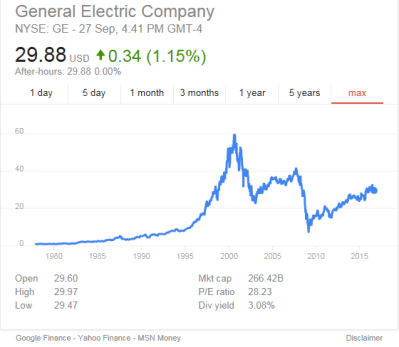
Jack Welch (then CEO of General Electric) was the darling of the ‘shareholder value maximisation’ ideology…and it seemed to work really well for the large corporations…until it all inevitably came crashing down5.

Welch, many years later, reflected in an interview with a financial journalist that:

Shareholder value is the dumbest idea in the world…

…Shareholder value is a result, not a strategy… your main constituencies are your employees, your customers and your products.”

…and, whilst it’s good that I can use this quote here, I find it convenient (to put it mildly) that Welch utters these words after he has extracted his $$$ millions from the corporation he pillaged and the ‘Guru Management’ books he sold…and now earns yet more $ from the reflective books telling us it was such a dumb idea!

“So are you trying to argue that we shouldn’t have limited liability companies?!”

llc-pros-and-consNo, I’m not.

They have been rather useful to our societies in enabling large, risky and capital intensive ventures that, whilst important, wouldn’t have happened without risk sharing – e.g. large-scale industries such as the railways.

Prior to their existence, a business person had to risk everything (including the shirt on their back) in order to carry out business…and if they failed then it was off to debtors prison.

The idea of a limited liability company was invented back in sixteenth century Europe (known as a joint stock company back then)…but, due to constraints imposed upon them, they didn’t come into general usage until the mid nineteenth century.

So why might society have wanted those constraints? Well, they didn’t trust them! Even Adam Smith, often referred to as ‘the father of economics’, said the following:

“directors of [limited liability] companies…being the managers rather of other people’s money than of their own, it cannot well be expected that they would watch over it with the same anxious vigilance with which the partners in [their own business] frequently watch over their own.”

So, the idea of limited liability? – Yep, this is definitely of use to society.

But the idea of purely dead money in a business, or even of it being the master? – No, this is not healthy, for the business, for society or (for that matter) those free floating shareholders caught holding the dead money when the music for the ‘short-termism’ pass-the-parcel game stops.

The music stops when the business fundamentals bite…and they always do.

What about those businesses that buy businesses that buy businesses?!

fish-eating-fish-eating-fishDon’t they need barrow loads of private financier’s money?
…and so back to a lovely Henry Ford quote to close out this chapter:

“What seems to be a big business may be created overnight by buying up a large number of small businesses.

The result may be big business, or again, it may be just a museum of business, showing how many curious things may be bought with money.

 [True] Big business is not money power: it is service power.”

Many a big corporate has used dead money to pursue a strategy of mergers and acquisitions…and has often destroyed so much value in the process….and, after licking its wounds (and perhaps the convenient ‘retirement’ of those involved) has repeated the same mistakes, again and again.

A business becomes successful because of service power, not because it took actions that merely made it big.

The point is that ‘big is not beautiful’, service is beautiful…which will likely lead to a growing business. Cause and effect.


So…this chapter considered the likely protests from ‘large corporate’ executives that they are doing exactly as Henry implored…and why it’s really not as simple as that. In fact, if we look at the idea of ‘shareholder value maximisation’ then Henry’s definition of Dead Money appears to fit oh-so-well.

This is all very interesting…but what if this is just how it has to be! Chapter 3 will consider whether executives can do anything about this, for the good of the organisation.

Update: Link forwards to Chapter 3

Footnotes:

1. I reflect that Simon Sinek’s excellent TED talk covering ‘Starting with Why’ has done extremely well in making its way around the world.

2. If you are a manager lecturing people as follows:

“We are here to make money and to [meet our purpose], in that order!…because if we don’t make money, we can’t [meet our purpose]”

…then PLEASE re-read and really think about what Ford (and the others) are saying.

Your ‘money comes first’ lecture is a classic case of ‘the tail wagging the dog’.

3. Anti-capitalism? Just in case you think Ha-Joon Chang, and perhaps I, a Communist, here’s a few lines from his concluding chapter:

“My criticism is of free-market capitalism, and not all kinds of capitalism….There are different ways to organise capitalism. Free-market capitalism is only one of them – and not a very good one at that…..so, capitalism, yes, but we need to end our love affair with unrestrained free-market capitalism, which has served humanity so poorly, and install a better-regulated variety.”

He goes on to set out eight principles to have in mind in redesigning our economic system.

4. Shareholder value maximisation: If you don’t want to buy Ha-Joon Chang’s book (it’s bloody good!) but do want to delve a little deeper in respect of “the dumbest idea in the world” then here’s a Forbes article that does similar.

5. General Electric: They became infamous during Welch’s tenure as masters of ‘legal earnings manipulation’ so that they always hit their earnings projections…and this was over a period of decades!

However, their underlying business didn’t look so hot when the pressure came on in the two crashes of the 2000s. Their share price (see graph below) tanked from $41 in Oct 2007 to $7 in March 2009.

ge-share-price-chart


Chapter 1: A long time ago in a land far, far away…

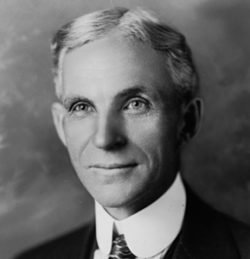
henry-ford…well, about 100 years ago in America…there was a visionary man who led society through a monumental technological disruption – his name was Henry Ford – and he and his organisation changed the world through his desire to ‘democratise the automobile’.
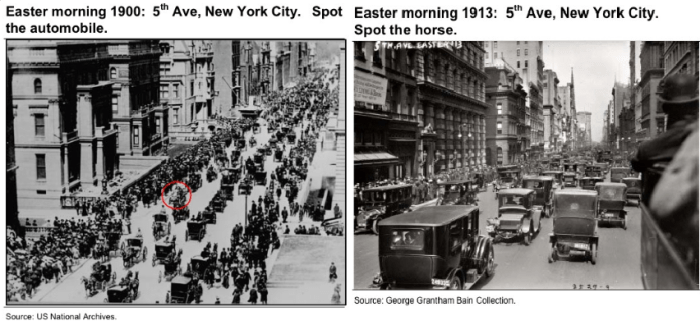
His success in putting the internal combustion engine on wheels devastated the ‘technology’ it replaced – the horse – and its many related industries (stables, horse feed and bedding, saddleries and tack shops, blacksmiths and farriers,….) although, on the plus side, it dissolved the huge problem of ever increasing amounts of horse manure pilling up on city streets!

We talk about modern technological disruptions, like the mobile phone or internet, happening quickly (in years) but we should reflect that profound technological shifts can occur pretty swiftly, whatever the age.

I imagine that once one ape invented the spear, then the rest changed ‘technology’ quicker than you can say “I wonder what those long pointy things are that I can see hurtling through the air towards us?”

The change from the horse to the car was pretty dramatic too:

horses-and-cars

Okay, so Henry Ford was on the right side of a technological disruption…but, whilst this was necessary, it was much more than luck that made the Ford Motor Co. such a success2.

So what were Henry’s core philosophies, and what ‘gems’ might we learn from him in this modern time of technological disruptions? These were his foundations:

  • ‘Service power’;
  • The ‘Wage motive’; and
  • ‘Money power’.

Service Power:

gandhi-quoteHenry was fanatically clear that a business is only there because of the people that buy its products and services. Without them it wouldn’t exist and, as such, the customer (the public, society) is the point. Full Stop!
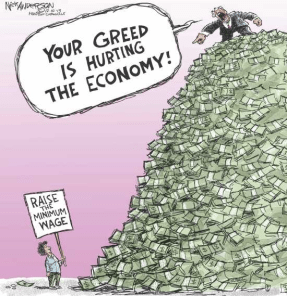
“Since the public makes a business, the primary obligation of business is to the public.”

(He nicely clarified that “Those who work for and with the business are part of this public.”)

This is so much more than the trendy “customer centric” mantra, in which we are usually shown a lovely circle with the customer conveniently arranged in the middle BUT, and this is the problem, all the other ‘conventional thinking’ management orthodoxy is retained around the outside3.

And to make it absolutely concrete in your mind as to what Ford really meant, he explained as follows:

“The true course of business is to follow the fortunes and pursue the service of those who had faith in it from the beginning – the public.

  • If there is any saving in manufacturing cost, let it go to the public;
  • If there is any increase in profits, let it be shared with the public in lowered prices;
  • If there is any improvement [in the quality of the service] let it be made without question, for whatever the capital cost, it was first the public that supplied the capital.

That is the true course for good business to steer, and it is good business, for there is no better partnership a business can enter than a partnership of service with the people.

It is far safer, far more durable and more profitable than partnership with a money power.”

Everything Ford did was with the customer at heart i.e could he provide the public with a cheaper car and yet also make it better than the ones he made yesterday? If he could do this, he knew that customer demand would continue to rise and profitability would be the least of his worries. ‘Customer, customer, customer’ provides growth and profitability – THAT WAY AROUND.

To make it cheaper and better for the customer, Henry was obsessed with constantly studying, experimenting and improving the process – through fanatical cleanliness and maintenance, ever deeper removal of waste (transportation, movement, scrap…), re-use of anything and everything, in-sourcing wherever possible, constant technological breakthroughs, decentralisation to where the work should be…and so on4.

And Henry didn’t just think about his automobile customers, he thought about the whole system (society) because he realised that it was all really one and the same thing. This led him into all sorts of interesting ventures that supported, and enabled, the core purpose.

In short: THE foundational ‘thing’ that made the Ford Motor Co. such a huge success was that Henry truly believed that his master was the public.

The Wage Motive:

your-greed-is-hurting-the-economyAnd so we move from customers to employees (the worker).
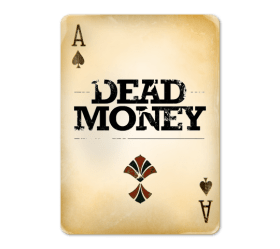
The ‘wage motive’ was Henry’s phrase for his philosophy that “one’s own employees ought to be one’s own best customers.” If the workers truly prosper then they will love, buy and advocate for the products (e.g. cars) they make…which will create an ever-improving product, a superb reputation and expanding customer demand…which enables the workers to prosper – and off we go round the circle.

He goes on to write that “If an employer does not share prosperity with those who make him prosperous, then pretty soon there will be no prosperity to share.”

Now, Henry was no Saint – he was a man of his times – but he wanted to do the right thing. Significantly, he learned from his early worker experiences and saw that the best, and only logical approach, was for his system to work with, and for, the worker, not against them.

He paid them high wages (far higher than they could receive elsewhere), provided regular employment (replacing the uncertainty of casual labour with steady work), reduced the standard working week to 8 hours for 5 days, insisted that Sunday was a day off for all, and provided them with excellent working and living conditions. Any worker that wanted more than manual repetitive work was given the chance to better themselves through training and increased responsibilities.

And finally, given that Turkeys don’t vote for Christmas, he was very clear that improvement was about bettering people and not about getting rid of people:

“Nobody with us ever thinks about improvement lessening the number of jobs, for we all know that exactly the contrary happens. We know that these improvements will lessen costs and therefore widen markets and make more jobs at higher wages.”

In fact, Henry got rid of (incentive driven) piece-work and created a profit sharing arrangement in the form of share ownership (more on this in Chapter 4)

Money Power:

And last, but nodead-moneyt least, to money. Over to Henry:

“There’s nothing to be said against the financier – the man who really understands the management of money and its place in life….but it is very different with the professional financier, who finances for the sake of financing and what he can get out of it in money, without a thought of the welfare of the people…

[Moneys] proper place [is] as one of the cogs in the wheel, not the wheel itself…

This is not to say that money and profits are not necessary in business. Business must be run at a profit, else it will die. But when anyone attempts to run a business solely for profit…then also the business must die, for it no longer has a reason for existence….

A business cannot serve both the public and the money power.

Money put into business as a lien on its assets is Dead money, its main purpose becomes the production of payments for the owners of that money. The service of the public [will] be secondary. If quality of goods jeopardizes these payments, then the quality is cut down. If full service cuts into the payments, then service is cut down. This kind of money does not serve business. It seeks to make business serve it.

Live money goes into the business to work and to share with the business. It is there to be used. It shares whatever losses there may be. It is asset to the last penny and never a liability.

Live money in a business is usually accompanied by the active labour of the man or men who put it there. Dead money is a sucker-plant….

Business that exists to feed profits to people who are not engaged, and never will be engaged in it, stands on a false basis.…Profits of business are due:

  • first, to the business itself as a serviceable instrument of humanity [i.e. to constantly improve the service to its customers], and then
  • to the people whose labour and contributions of energy make the business a going concern [i.e. its employees]…

The true course of business is to follow the fortunes and pursue the service of those who had faith in it from the beginning – the public…

The best defence any people can have against their control by mere money is a business system that is strong and healthy through rendering wholesome service to the community.


…and so I (and Henry) have set the scene as to what this ‘story’ is all about – customers, employees and money…and in particular, how do large floating (i.e. short-term thinking) shareholder owned organisations ‘fit’…and most importantly, (how) can their structure be altered to provide a foundation for a long term win/win/win for all?.

Update: Link backwards to Introduction and forwards to Chapter 2

Footnotes:

1. All of Henry Ford’s quotes above come from his 1926 book ‘Today and Tomorrow’.

2. Ford Success: Just in case you doubt this success (and accepting that money is a poor measure) Forbes estimates that, in today’s money, Henry Ford was worth around US$200 Billion….more than double anyone alive today.

3. Note to self: I’ve still got to write the post that slaughters the ‘Balanced Scorecard’ sacred cow! It’s been on my ‘to do’ list for far too long because other stuff keeps on popping up every day.

4. Toyota: If you’re a follower of Taiichi Ohno and, upon reading the above, think “Hang on, didn’t Toyota invent all that stuff?!”, here’s a rather nice quote to reflect upon:

“I met Taiichi Ohno on a Japanese study mission. When bombarded with questions from our group on what inspired his thinking, he just laughed and said he learned it all from Henry Ford’s book.” (Norman Bodek)

Introduction: “Your Money or your Life!”

What if there was aadam-ant big, hairy, gnarly beast of a thing…how would you go about tackling it?

Well, probably rather carefully!

How about thoughtfully, bit-by-bit….raising ideas, not solutions.

My posts normally focus on a particular point. Sure, they are all linked together in one glorious philosophical mess…but they (hopefully) stand on their own.

This time it’s different. I have (what I believe to be) an important story to tell and a message to create curiosity…but I’m conscious that you probably don’t want to read a book!

So, I aim to take you on a journey by breaking the ‘adventure’ down into interesting ‘Chapters’, and release a chapter per day until we are done.

There are 5 chapters:

  • starting with “A long time ago…”; and
  • ending with “…and we all lived happily ever after”.

Well, I doubt the Disney ending (I should probably add an alternative ‘Armageddon’ finale) but I definitely aim to reach a conclusion, that is of use to society.

“But what’s it going to be about?!”

If you read the end of my last post then I hinted that this story will hurtle towards ‘large corporates’ owned by floating (i.e. short-term thinking) shareholders.

Is this ‘story’ relevant to you? Probably!

  • you may work in such an organisation (or do so in the future);
  • you will likely have investments or pension funds that own shares in them (even if you don’t realise this or don’t think about this much);
  • we are nearly all customers of such organisations; and
  • we are all affected by them!

Now then, are we sitting comfortably? Good, then tomorrow I shall begin.

Update: Link forwards to Chapter 1

Footnotes:

1. “Your Money or Your Life!”: the title of the post refers to the folklore words uttered by a Highwayman as he holds up a stagecoach. He (or, if you are a Blackadder Series 3 fan, ‘She’) is asking you whether you’d prefer to hand over your money or lose your life.

  • If you hand over the money in the short term then you can go on to long term success; however
  • If you attempt to protect the money, then you die. Nice.

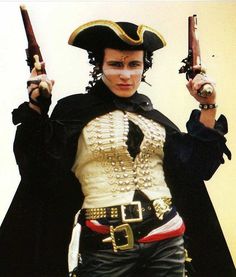
…and I hope those of you from the 1980s enjoy the Adam ‘the highwayman’ Ant pop. culture image.

2. A word of encouragement: If you are thinking “oh no, he’s writing a long one again!” then ooops, sorry. It’s just that this subject matter really needs to cover a few bases.

I am invoking the following quote in my defence:

“Make everything as simple as possible, but no simpler.” (attributed to Einstein)

I promise that I won’t make a habit out of it (it takes far too much out of me!) and normal service will resume just as soon as I’ve got over the effort of this one 🙂

Depths of ‘Transformation’

butterflyI’ve been meaning to write this post for 2 years! It feels good to finally ‘get it out of my head’ and onto the page.

It’s about that lovely ‘Transformation’ word.

Before I go on, I’ll repeat a definition from an earlier post:

Transformation: In an organisational context, a process of profound and radical change that orients an organisation in a new direction and takes it to an entirely different level of effectiveness….transformation implies a basic change of character and little or no resemblance with the past configuration or structure.” (businessdictionary.com)

To repeat the key phrase: An entirely different level of effectiveness! …and, just in case you missed it, the word is effectiveness, not efficiency.

I’m going to outline 3 levels of (supposed) transformation and I’ll do this by borrowing the bones of an idea from Mike Rother’s excellent ‘Toyota Kata’ book and extend it with a large dose of my own ‘poetic license’.

Level 1 Transformation: ‘On the surface’

iceburgSo, picture the scene: It’s the late 1970s. Your organisation desperately wants to improve and, on looking around for someone achieving brilliant results, you spot the awesome Toyota (or such like1).

You go on a Toyota factory visit. You are amazed at what you see and excitedly ask them how they do it.

You easily observe (‘on the surface’) lots of obvious methods and tools…and so you grab evidence of how these are carried out – e.g. some template forms, and the instructions that go with them. You also take lots of pictures of their (visual management) walls to show all this working in situ.

You run back home, hand out the methods and tools and mandate that, from now on, this is what we are doing.

toolboxYou helpfully provide training and (so called) ‘coaching’…and you put in place ‘governance’ to ensure it’s working. You roll it all up together and you give it a funky title…like your Quality Toolbox. Nice.

So what happens?

Well, yep, those tools and methods sure are ‘shiny new’ and easily applied. There’s an initial buzz, probably because of senior management focus…and pressure to prove the comedy ‘Return on Investment’ (ROI) calculation that had to be set out in the short-term thinking ‘will you pay for our factory trip?’ business case.

But the initial effects fall away. Anything achieved was a one-off, or of limited and low level benefit. The changes aren’t sustained – with a slide back to the old state. People start to misuse the tools and methods, and do much damage rather than good. There is a brief and ugly fight with the ‘methods and tools’ compliance police but disillusionment sets in and the early good work becomes discredited and abandoned (just like the last silver bullet…and the one before that…)

Timely reminder: “A fool with a tool is still a fool” (Grady Booch)

Note: This ‘on the surface’ transformation attempt has been likened to organisations going over to Japan in the late 1970s and early 1980s and coming home to fanatically ‘do Total Quality Management’ (TQM)…and then quietly dropping it a few years later. Sure, some organisations sustained it but most didn’t.

Level 2 Transformation: ‘Under the skin’

skinSo it’s now the 1990s. The methods and tools that came out of the initial Toyota factory visit weren’t sustained but the pressure is still on (and mounting) to transform your organisation…and your management can’t help noticing that Toyota are still doing amazing!

“Perhaps we didn’t look hard enough or close enough or long enough…perhaps we should go back and have a look ‘under the skin’.”

…and so you go for another factory visit (once you’ve been given permission following another well written story business case 🙂 ).

This time you take real care – studying ‘at the gemba’ for weeks, asking questions, watching activities, understanding the nature of changes being made to the system before you.

“Eureka! There’s something underneath those methods and tools! We can see that there’s an underlying logic that we missed last time round…oooh, we could codify them into a set of principles!

And here’s basically what you arrive at:

0. Everything should belong to, or support, a value stream (a horizontal flow from customer need, through to its satisfaction)

…and for each value stream we should:

1. Specify value, where this is through the eyes of the customer; then

2. Identify all the actions performed within the value stream, and expose and remove the obvious waste; then

3. Create flow by understanding and removing the barriers; then

4. Establish pull by producing only what is needed, when requested; and finally

5. The ‘golden nugget’: we should continually strive for perfection because this is a never-ending journey

Wow, that was profound – your factory tour team now need to give it a name!

And so, after a fun focus group, a young member of your team called John2 shouts out “It needs less of everything to create a given amount of value, so let’s call it ‘Lean’.”

Whoop, whoop, he’s only gone and cracked it!

You run back home to tell everyone about the wonders of ‘Lean’. You hand out books, provide training courses, coaching and mentoring and you slot all those wonderful tools and methods nicely into their place…neat…this is going to be great!

So what happens?

Well, everyone absolutely LOVES the principles. They make sooo much sense. They particularly liked playing with Lego in the training sessions to demo flow, pull, kanban and ‘stop the line’ thinking.

But after a while (and some short-term gains) you realise that there’s a huge tension building. No one can make those darn principles work because they continually clash with existing management practises.

Your senior management employ a gaggle of so-called Lean coaches to try to change the people at the bottom whilst they carry on at the top as before!

Your ‘Lean Office’ has become an island of coaches doing great work with the people but unable to turn the tide. Coaching conversations end with responses like:

“Yes, I can see that would be the right thing to do for the value stream…but that’s not what my objectives, performance rating and bonus is based on…or what my manager above me would support…so I’ll stick to soul-destroying fighting within my silo. Sorry about that 😦

This culminates in huge frustration; a revolving door of broken coaches; and many a good employee finding a better organisation to work for. If you ran an employee survey at this point, the results would make for ugly reading – you’ve created a complete divide between worker reality and management ‘cloud cuckoo land’.

Oh, and that lean word? Well it became capitalised! LEAN…as if it were a thing. You’ve all forgotten that it was just a label thought up by John in a focus group merely to describe what the factory visit team saw.

Pause for reflection: Taiichi Ohno is considered to be the father of the Toyota Production System (TPS) but he didn’t want it to be written down3 (codified) because he wanted it to remain dynamic.

And as for that name:“Ohno did not call his innovation ‘lean’ – he didn’t want to call it anything. He could, perhaps foresee the folly of a label.” (John Seddon)

Caution: …and if you did this ‘under the skin’ (supposed) transformation within a service organisation, you may find (if you properly stood back to look at it!) that you’d totally f@ck$d it up!

Credit: The ‘Level 2’ principles jotted down above are the core of the 1996 book ‘Lean Thinking’ by Womack and Jones….which they wrote following their research in Japan. They explicitly set out 5 principles, with a foundational one implied (hence why I’ve labelled it as ‘principle nought’).

Level 3 Transformation: ‘In the DNA’

dna…and so to the 2000s. The pressure to change your organisation is relentless – the corporate world is ‘suffering’ from seemingly constant technological disruption…but Toyota continues to be somehow different.
You pluck up the courage and ask for a sabbatical for 6 months – you want to find the meaning of life…well, perhaps not that deep…but you sure as hell want to know what Toyota have got that you don’t…and to work this out, you are going to have to go in deep – to their DNA.

Toyota are happy to see you again. But, rather than repeating what you did on the last two trips, you come straight out with it:

“Okay, you’ve shown me your tools and methods…you’ve let me uncover your principles…and I know that these aren’t the answer! What are you hiding from me?! Come on, I get it, it’s a competitive world out there but PLEASE let me in on your secret.”

The Toyota managers are perplexed. They don’t know what else they can do. They are adamant that they aren’t hiding anything from you.

…and so, rather than go straight back home empty handed, you ask if you can work with Toyota to experience what day-to-day work is actually like. They humbly agree to your request.

And six months later your mind has been totally blown!

You really get it….no, REALLY GET IT!

You couldn’t see the wood for the trees but now it’s as obvious as can be.

It’s all about the environment created by management’s actions, which come from their beliefs and behaviours about human beings: about society, about customers…and, most profoundly, about employees.

This is invisible on a factory visit! But it’s still there. It’s simply ‘in the DNA’.

Sure, you could provide a list of attributes as to what this looks like…but management can’t just do them, they have to believe in them – in fact, ‘be’ them!

Further, there’s nothing to be ‘implemented’ because it can’t be!

Everything flows from management’s beliefs and behaviours: It’s from these that Toyota creates new principles, methods and tools all the time…and throws out old ones that are no longer appropriate. Their systems thinking and human thinking is solid and profound, whilst their method is dynamic and agile.

…and the realisation sinks in: No wonder Toyota are happy to open their door to anyone. The thing that makes them great can’t be copied. It has to be lived and breathed…and nurtured from the shop floor all the way up. Oh sh1t!

…and so to your new headache: you totally ‘get it’ but how on earth do you change your organisational system – now that is THE nut to crack. That would be transformational!

Reflection time:

So ‘On the surface’, ‘Under the skin’ or ‘In the DNA’: What level of transformation are you playing at?

…if you are at level 1 or 2 then it’s not actually transformation.

…if you are truly at level 3, then here’s the final mind blowing bit – it is self-sustaining.


To close: I have been asking myself a HUGE question for a fair while now: Can management’s beliefs and behaviours change within a large floating (i.e. short-term thinking) shareholder owned organisation.  I’m nearly there with writing down my thoughts. Watch this space…

Footnotes:

1. Just Toyota? I use Toyota in this story since everyone knows who they are…and visits to their factories is precisely what happened regularly over the last several decades. But it isn’t just Toyota.

Your own ‘Toyota’ factory visit could be to another great organisation…and it needn’t be a factory making products – it could be a service organisation. Handelsbanken would be a great financial services example.

Though beware, there aren’t that many ‘true Toyotas’ out there. And perhaps none that have sustained it for so long.

2. ‘John’: He’s even called John in the true story – John Krafcik, a young researcher on Womack’s MIT research team…and those were his words back in 1987 (as recalled by Womack) to give birth to the Lean label.

3. Writing it down: Ohno finally relented when he retired in 1978 and wrote a book on TPS.

4. Clarification: I think a great deal of Lean Thinking, but not a lot about ‘LEAN’ – the implementation movement. I respect Womack and Jones, and their writings…but I note that my favourite Womack book is ‘Gemba Walks’ written about a decade after ‘Lean Thinking’ in which he humbly reflects that it was about far more than the tools and the principles. It was really about the management system (or, in my words, the DNA).

People don’t change their minds!

hugh-title-pictureSo a manager stands on a stage and lectures a group of people (or is that ‘thrusts hero opinions upon them’?) about how they should behave at work, and what ‘check box’ traits they should be looking for in others.

Within the bluster is a seemingly bizarre sentence stated as fact: That people don’t actually change their minds.

Is this true? How about some excellent examples of where you might agree:

  • a ‘Boris Johnson-loving’ Brexiteer at loggerheads with a ‘Yes to Europe’ standard bearer;
  • a Trump ‘nut’ arguing with a Hillary ‘supporter’;
  • a French secularist quarrelling with a Burkini wearer;
  • [name any other issue around the world and find people from opposing camps]

…what do you expect will be achieved by holding a ‘debate’ between these two sides?

Well, the best case scenario is that they retain their current views…but the worst case is that their positions will become firmer, their views more militant, and their mindsets become less respectful of (those that have now firmly become) their ‘opponents’1.

(Why) don’t we change our minds?

I recall reading an article that said a similar ‘people don’t change their mind’ thing…so I searched around the inter-web to see what I could find. Now, there are plenty of articles out there with headlines like ‘Why people don’t change their minds – even when faced with the facts’ so, yep, I was getting warm in my search…

…and after digging, reading, and a bit more digging, I find that there are two parts to it:

  1. Why do we form the opinions that we do?; and then
  2. Why do we cling on to them so tenaciously?

Now, many brilliant books have been written on the 1st part, covering all the weird and wonderful irrationality going on inside the human brain so I won’t attempt to summarise them here. If you want to ‘see for yourself’ then pick one of these up2 and have a read – they can be very entertaining!

But let’s go to the 2nd point: why do we cling on to these views once formed?

Here are a couple of explanations given:

Self-affirmation theory: individuals are driven to protect their self-integrity.

Hence, once you’ve decided something (especially if you make this public) then you are into ‘protection’ territory.

Cultural-cognition theory: the tendency of individuals to conform their beliefs about disputed matters of fact…to values that define their cultural identities (i.e. with the view of the groups with which we most strongly identify).

The key to this is the presence of doubt in respect of facts. If there’s no real dispute about something (e.g. that it’s currently raining outside) then there’s no challenge of values.

The doubt point is important, and was called out within research conclusions from this field of study3:

“…doubt turns people into stronger advocates…this effect is stronger if someone’s identity is threatened, if the belief is important to them, and if they think that others will listen. It all fits with a pattern of behaviour where people evangelise to strengthen their own faltering beliefs.”

…and the following is worth reading a couple of times and pondering:

 “The present research also offers a warning to anyone on the receiving end of an advocacy attempt. Although it is natural to assume that a persistent and enthusiastic advocate of a belief is brimming with confidence, the advocacy might in fact signal that the individual is boiling over with doubt.”

So back to that lecture:

What struck me about being told the ‘we don’t change our minds’ statement is that it questioned the whole basis of the lecture being dealt out to the group of people listening. If people don’t change their minds then why lecture them on your opinions? (i.e. attempting power/coercive or rational change)…you’ve just implied that there’s no point!

Now, I’d like to suggest an obvious flaw in the presenter’s logic about change.

Yes, people may be devoted to their (currently held) beliefs but they (including you and I) demonstrably do sometimes change their minds…and perhaps it is worth considering the massively important question: What was it that got them to change their minds?

Enter that lovely idea of normative change – true change arising through experiential learning.

I’ll describe a rather nice example:

I was watching a TV programme recently presented by Hugh Fearnley-Whittingstall (River Cottage chef).

Hugh is a favourite eco-warrior of mine and his programme was all about the amount of waste within our daily lives…and a call to action to do something about it.

hugh-binsHugh picked an ‘average’ street in a Manchester suburb and joined the bin (garbage) men and their truck, on the weekly rubbish collection. He then ‘went through their bins’ back at the waste processing plant, gathering together what he found – mounds of discarded clothes, wasted food, unwanted electrical goods….and so on.

Now, Hugh looked into lots of different waste angles during his programme…but I want to focus on one of these, which makes the relevant point for this post:

Of particular note was the amount of metal, plastic and glass that had been thrown into the general rubbish bin – i.e. unsorted and therefore due for landfill or incineration – even though everyone in the street had been provided with recycling bins and instructions on what should and shouldn’t be put in them.

Why weren’t people separating their recyclable waste from the rest?

recyclingA great question!

So, where would be a good place to investigate?

Well, with someone who utterly refuses to separate their waste because they “don’t believe in it”. Can you see where this is going…

You may be able to influence those already on the cusp of change but if you want to appreciate the real problem then, however uncomfortable this might be, you need to find and work with a ‘true disbeliever’.

Hugh asked around the street and found the perfect person to ask: A young women, perhaps in her 20s, with (what us old farts might think as) an ‘attitude’ on life and what it owes her (I’m sure she’s a great person 🙂 ).

…and so Hugh sat down for a cup of tea and a chat with her about recycling…BUT, the important bit, here’s how he did it:

He observed her environment and then, from asking some non-judgemental questions about her behaviours, he listened to what she believed….and when she said something of particular note, rather than pointing out the counter-logic he simply checked that he had fully understood her belief – perhaps with a further clarifying question and/or repeating it back to her to confirm.

Importantly, he never sneered or scoffed at her responses (which would have been a direct challenge to her self-integrity) – he politely listened and showed a genuine interest in what she thought.

…and she came out with the classics:

  • “Why should I be wasting my time separating stuff, it’s not my problem – it’s ‘theirs’ to sort out”;
  • “There’s no point in separating the plastic, metal and glass from the rest because they all go straight to the landfill anyway”;
  • “Even if they don’t go straight to landfill [i.e. they go somewhere to be processed], nothing actually of worth is done with the materials that they separate out”; and
  • “It’s just a waste of time.”

I hope you can see that, if this is what someone believes, you can tell them till you are ‘blue in the face’ that this isn’t the case, and even tell them why…but where would this get you?

Even more interesting is that if ‘I’ believe the opposite of her recycling statements, how do I know that I’m right? Perhaps she’s right!

…and so we can see that we have arrived at that point – two people holding opposing views. Arguing about it (even by producing supposed ‘facts’) isn’t going to be productive. This is no different to telling a Trump ‘nut’ why they should be a Hilary ‘supporter’.

So, given the ‘people don’t change their mind’ narrative, is this the end? Should Hugh ‘pack up and go home’? Of course not…

Hugh has nicely set up a potential dose of normative learning. He’s found out what she believes, so he now knows what experiences to provide her with…and given his genuine interest in what she has to say, he has established the necessary level of trust to take things further.

He therefore gets her acceptance to go along (with a whole group from her neighbourhood – spot the cultural identity bit!) to see the recycling plant. Importantly, he goes with them to show that he, just as much as they, needs to experience it – he could be wrong too!4

The visit

hugh-waste-visitSo they start at the beginning: a manual sorting line with workers at a conveyor belt removing all the things that the recycling plant can’t (currently) process. Eeeew – no one said it was going to be pretty!
Learning number 1: Seeing what waste the current process can and can’t cope with.

They move on to see an awesome magnet sucking the iron-containing metal off the moving line. Cool!

Next, the line goes over big crushing teeth – gravity bounces the glass over them and smashes it into little bits which fall through the gaps…but the plastic and aluminium glides over the teeth. Glass separated – Awesome!

After that, another magnet gets to work on the aluminium – but this is different than earlier because it repels it off the line. Groovy!

And the impressive finale: the remaining plastic goes over a conveyor belt ‘cliff’ containing sophisticated cameras. These cameras can ‘see’ the types of plastic, which then rapidly trigger lasers to shoot certain plastics in differing directions.  Amazing!

And so to the end, to see big cubes of metal, glass, aluminium and different plastics stacked to the ceiling.

Learning number 2: Our waste can be, and is, separated into types.

Hugh’s group of observers are really impressed. What a ride!

Except for that young women – our disbeliever. Yes, she thought it was really cool technology and all that…but “I still don’t believe anything gets done with it.”

But Hugh’s not done – he takes them to a display where he has gathered together examples of what each recycled material goes on to become, from clothes through to bike frames. She picks out a really cool branded jacket, puts it on…and it fits. She loves it…she wants it…Hugh tells her that it was made from a bundle of recycled plastic…and, yes, she can have it.

Learning’s number 3 and 4: Something is done with the recycled materials…and I like the result, so it’s not a waste of time!

People don’t change – really?

Well, you’ve guessed it, through the power of television Hugh goes back to see our disbeliever in her daily life some time later and she is happily sorting her rubbish into what can and can’t be recycled.

Let’s go back to the top: if Hugh had ‘given her a lecture’, then she wouldn’t have changed. Worse, her efforts at arguing back would have made her more militant – she would have justified herself!

Clarification:

I accept that there is likely to be a small percentage of people who, even after what might appear to be compelling experiential evidence, might not change their mind…but I believe that there are far fewer people like this than we might imagine.

The experiences required to alter our thinking will likely differ for each of us…and this comes back to the need to understand each of our underlying beliefs and behaviours if we are to effect meaningful change.

Further, some people might need several doses and a longer time period for the normative medicine to take effect on them. We each process our thoughts in some quite bizarre ways. It’s not a ‘one size fits all’ operation….but that’s because we are all different…which is a great thing.

Caveat:

And, of course, “It is difficult to get a man to understand something when his salary depends on not understanding it.” (Upton Sinclair)

So, back to the world of work

lecture“But that normative stuff will take far too long! We’ve only got time for a lecture.”
Hahaha…and look where all those lectures are getting you!

Such a response reminds me of a wonderful quote:

“Managers will try anything easy that doesn’t work before they will try anything hard that does” (Womack)

And to those of us trying to move our organisations from ‘command and control’ to a better place, we can ‘tell them’ about the effects of cascaded objectives, targets, ratings, rewards etc…but don’t expect change from this.

We need them to see reality for themselves.

You may find that you can’t just take managers ‘to the gemba’ (the place where the work is done) BUT:

  • you can talk with, and observe, them to find out what they believe; and
  • you can look for learning opportunities as and when situations arise

i.e. bide your time, look for the instance…and then engineer a chance for experiential learning…and keep doing this until they start to question their own beliefs.

A nice quote that fits with this: “Only describe, don’t explain” (Ludwig Wittgenstein)

i.e. show them what is actually happening, but let them ponder and explain it for themselves….but provide them with help along the way.

To close:

So, do people change their mind? Of course they do…but not because you told them to!

And therefore, given all of the above, have I changed your mind? Of course not! I’ve merely explained something to you. You would need to go out and discover normative change for yourself….but I might have made you curious to do so 🙂

Footnotes:

1. Debates: This is why the media just love the debate format. It does little for humanity, but a lot for ratings.

2. Irrationality: The first such book I read was called ‘Irrationality’, written by the late Stuart Sutherland (Professor of Psychology) – a good read. The last one I read was ‘Thinking, Fast and Slow’ by Daniel Kahneman.

3. Research: David Gal and Derek Rucker, North-western University referred to within this 2010 MINNPOST article

4. Could Hugh have been wrong? I realise that this is ‘Television’ and Hugh will have done his homework first (i.e. been to the recycling plant and seen for himself).

5. Note to councils around the world: If you really want people to recycle, and do so really well, then you need to show them (including me!) what happens….and every time that you make a step-change improvement in the capability of your process, you need to inform us of this and show us.

Are you a lady?

Thatcher“Power is like being a lady….If you have to tell people you are, [then] you aren’t” (Margaret Thatcher)

Now, love her or loath her2, Thatcher’s words make an insightful point.

And this point is the same for the rather overdone ‘leader’ word.

So, to a definition:

Leadership: The action of leading a group of people or an organization, or the ability to do this” (Oxford Dictionary)

Calling yourself a leader

I wish people in hierarchical positions would stop shouting about ‘being a leader’…that they are ‘leading people’…and all the other ‘leadership’ presumptions.

As I wrote some time ago, you are only truly a leader if people choose to follow you, for themselves.

(Anything else is only really compliance, through fear or perhaps indifference)

Personally, whilst I’m totally fine with Executives, Directors, Managers etc. (i.e. people with the titles) taking time to understand about leadership, I’d rather they never ‘told me’ that they were leading me.

Stick with the title that you’ve been given…and then ‘we’ (the people) will decide whether to follow based on your actions (as opposed to words) and abilities (rather than your assertions).

Conversely, ‘we’ (the people) may come together and try to lead an organisation to a place where the titled people aren’t, or haven’t yet been, heading. In which case, it would be worth those with the titles sitting up and taking note (rather than attempting to shut it down) – perhaps there’s something important within!

This post ISN’T written in any way to belittle or put down people who would like to lead ‘us’ to some better place.

It ISN’T to be disrespectful to the people currently with the titles – I ‘get’ that organisations need some form of structure.

In fact, it’s the opposite, it’s to say that many (most?) people crave to be genuinely led somewhere great…and this is only likely to happen if those put into positions of power ‘get over’ the leader word…and act as one of the people.

Here’s a rather humbling quote that turns the ‘I am your leader’ boast on its head:

“Go to the people. Live with them. Learn from them. Start with what they know. Build with what they have. But with the best leaders, when the work is done, the task accomplished, the people will say ‘we have done this ourselves’. ” (Lao-Tsu)

Leading is a potential outcome of what you do (actions) and how you behave (abilities), not a badge you can demand or procure.

Irony

I wrestled with using the quote at the top. It brilliantly suggests that “if you have to say you are leader, then you’re not” but I find myself wishing that it hadn’t been Thatcher who said it. She was given the label ‘The Iron Lady’…which was then used to lampoon her leadership style1.

This got me thinking: Why am I uncomfortable about this irony? Well, using a quote from Margaret Thatcher and Lao-Tsu on the same page rather grates with me.

So, was Thatcher a leader in the sense that I use above? – well, yes, there were lots of people that wanted to follow her.

Was she a leader for the whole country? – absolutely not. Due to the vagaries of the UK’s ‘first past the post’ voting system, she used her power to take the country to a place where the majority of people didn’t want to go3…with millions suffering in the process…and, arguably, generations (still) suffering from the outcome of her economic ideology…but that’s just me being political 🙂 .

What about the power word and its relationship with leadership?

Power: the ability to produce intended effects” (Bertrand Russell)

I reflect that power and leadership do not occupy the exact same space:

  • You may be successful in leading a group of people (because they are following), but you do not have 100% power over them (they can cease to follow if they so choose); and
  • You may have power far wider than the group following you, through what the group is achieving. The likes of Hitler had huge power, propped up by a band of fanatical followers.

…perhaps the secret to meaningful and sustainable leadership is to closely match the sphere of leadership and power. Any major imbalance has the potential for overthrow from within or disruption from outside.

Footnotes:

1.‘Spitting Image’ Iron Lady humour:

Margaret Thatcher is treating her Cabinet (team of Ministers) to a meal at a restaurant:

Waitress: Would you like to order, sir?

Thatcher: Yes. I will have the steak.

Waitress: How would you like it?

Thatcher: Oh, raw, please.

Waitress: And what about the Vegetables?

Thatcher: Oh, they’ll [The Cabinet] have the same as me!

2. Thatcher was the Prime Minister of the UK between 1979 – 1990 (my teenage years).

I’ll ‘nail my colours to the mast’ and say that I wasn’t a fan of Thatcher (I’m being polite)…but I recognise that many people were.

3. Thatcher’s Conservative Party won the 1979, 1983 and 1987 UK General Elections with 44%, 42% and 42% of the 76%, 73% and 75% turnout respectively (source: Wikipedia pages on each of these elections)

Put the other way (and with a little bit of maths): 67%, 69% and 68% of the eligible voting population didn’t vote for her but felt the effects of her power.

Now, you can chide the people that didn’t turn out, but you can’t say that they wanted to follow her.