Falling into that trap!

BearTrap_01.jpga203455b-ef09-4c5a-be36-5fe7351fd23fLargeSo I cycle to work when I can. It’s approx. 22km from one side of the city of Christchurch to the other, right through the middle. I (usually) enjoy it immensely.

I upgraded my cycle computer a few months back to a fancy new GPS one. It’s got this cool screen that tells me lots of information. I can also download each cycle ride’s data onto my computer to analyse later – perfect for a geek!

I’d been using this computer for a few weeks and was starting to get an understanding of my average km/ hour for each trip. Sometimes I could get it into the 27 km/hour range, other times I could only manage 23 km/hour….and before all you MAMILs* out there guffaw thinking “how slow?!” the average speed takes into account stopping at lots of junctions (traffic lights, roundabouts, road works) and crossing busy traffic….not that I’m saying that I am fast.

(* MAMIL: middle-aged men in Lycra…and I must confess to being a member of)

Further, the computer tells me my average km/ hour at the bottom of the screen as I cycle. I can see it going up and down throughout the journey. If I stop at a junction I can see it plunge rapidly whilst I am sat idle and then if I cycle on a long flat straight I see it slowly rise back up again.

Now, I fell into the trap! I began to get distracted by the average km/ hour reading as I cycled. Without consciously thinking about it I set myself a target of completing each ride at an average of 25 km/hour or higher. The fact that I was doing this only dawned on me the other day after I performed a dodgy manoeuvre in my obsession to keep my average above the target… my sudden sense of mortality put me into a reflective mood.

Here’s what I reflected on:

What had I become?

  • I had started to look at the average km/ hour reading all the time and obsess about it dropping below the magical 25;
  • If I was stopped at traffic lights, I watched the average km/hour reading sink before my eyes. I was then in a mad hurry to get off so as to get that average back up again as quickly as possible:
    • which meant that I was trashing my legs and blowing them out too early in the ride…
    • which put me at huge risk of pulling a muscle/ injuring a joint whilst piling on the pressure to get back above that target…
    • which meant that I didn’t cycle the next day because I couldn’t!
  • If I was ‘on the cusp’ of the target and coming up to a junction then I was starting to do dangerous things in order to keep going, like running orange lights or crossing lanes in between cars;
  • Even more bizarrely, I had unconsciously started to cheat!
    • I had changed my behaviour to only turning on the computer after I had got going from my house because the few seconds getting up to speed from rest might count!
    • If my average was 25.0 as I got to work I would turn the computer off before I came to a rest…so that it couldn’t drop down to 24.9 as I slowed…because that would have meant failure!
  • Conversely, if I was well above the target (let’s say because I had a good tail wind or I had been really lucky with the light sequences), then I was pretty happy and relaxed…no need to push since I was ahead. I could have gone faster.

Reading the above, you may think me to be a bit of a nutter! Did I really do those things? Well, yes, I did…and I can honestly say that the 25 km/ hour target that I had set myself was to blame.

Now for those of you who have been on one of my courses or who have read the majority of posts on this blog, you will likely have a good laugh at me – “he bangs on about the evils of targets all the time!”

So, getting away from my target:

What is my actual purpose in cycling to work?

On reflection I came up with the following:

“To safely cycle to work so that I get fitter and I use the car less.”

Three things come out of this purpose:

  • Fitter: I wanted to get better at it
  • Use the car less: I needed to be able to cycle consistently, day after day
  • Safely: there’s no point in getting killed or badly injured cycling!

This clarity of purpose has helped me drastically change the way I cycle!

Thinking about variation within the system:

In this case, the system is the cycling to/from work and the conditions I encounter in doing so. One cycle ride is a single ‘unit of production’. I should be thinking about the capability of the system (about how all units go through it), not about a single unit.

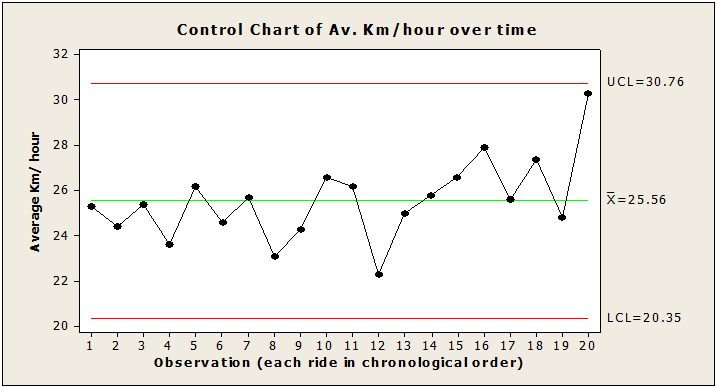
Here’s a control chart showing the variation in the last 20 of my rides:
bike control chart

The control chart enables you to visualise what a table of data can’t…that my riding is stable. It shows the meaninglessness of the target and variance analysis.

The following are the more obvious causes of variation:

  • Head wind or tail wind (makes a huge difference!);
  • Wet or dry weather;
  • Heavy or light traffic;
  • Whether the traffic light sequences are with me or not;
  • …and so on

Some special causes might be:

  • An accident;
  • Road works

…although if you live in Christchurch you will know that there’s nothing special about road works !!!

You can see that it would be bizarre for me to achieve the same average km/ hour every day. Going back to that target: Some days it will be impossible for me to hit the 25, other days it will be really easy…and that’s without me changing anything about my riding.

Note: Looking back at the control chart, you might think that you detect an improvement from around ride 15 onwards. In fact, it was at around ride 15 that I had my ‘I’ve fallen into the target trap’ epiphany….so, yes, there could be something in that. However, you should also know that whilst ride 20 looks fantastic (it was), I had a massive Nor’ Wester wind behind me literally pushing me along.

What can I experiment with to increase my capability?

The first thing I need to do is STOP LOOKING at the average km/hour as I cycle. Then I can consider what I can change about my cycling for every ride.

Since ride 15 I’ve begun to experiment with:

  • Junctions: looking well ahead and adjusting my pace to time myself through them so that I reduce the need to slow down/ stop
  • Pedalling: trying to pedal more smoothly and efficiently
  • Crossing lanes: improving my balance when looking behind me so that I can safely do this whilst retaining my speed with the traffic
  • ….and so on.

Each of these changes will lead to small improvements on every ride, no matter what the conditions are. It’s not about the current unit, it’s about every unit.

Results?

Well, it’s too early to draw valid conclusions (I need more data), and it’s a never ending journey of improvement BUT I can say that I am cycling more often (because I didn’t wreck my legs the day before) and I’m having far less ‘that car’s a bit too close for comfort’ moments.

So what’s the point?

Targets cause dysfunctional behaviour. As Simon Guilfoyle makes clear:

“As a ‘method’ [Setting a target] is rubbish because it disregards the capability of the system and natural variation. … It assumes that the system knows the target is there and will respond to it (it doesn’t and it won’t!) It ignores the fact that the greatest opportunity for improving performance lies in making systemic adjustments rather than berating, comparing, or otherwise trying to ‘motivate’ the workers to achieve the target.”

‘No targets’ doesn’t mean ‘no measurement’! In fact, it’s quite the reverse. It means actually studying meaningful measures (i.e. against purpose) over time (via a control chart), understanding the capability of the system and therefore truly understanding whether it is improving, staying the same or getting worse.

Do you have targets? So what dysfunctional behaviours do they cause, moving us away from purpose?


POSIWID

download (1)Professor Stafford Beer wrote that “the purpose of a system is what it does.” which is often stated by its acronym of POSIWID.

This is looking at systems via a kind of backwards logic. (See my earlier ‘harmony or cacophony’ post if you’d like to look at them going forward first!)

Another quote might help:

“Every system is perfectly designed to achieve the results it gets.” (Don Berwick)

Okay, so let’s see if these examples exercise your mind a bit:

 Example: Supposed purpose: (unintended?) Reality:
School (Teacher) Help our children grow into well rounded individuals capable of sustaining themselves in the world Train our children to pass tests on a specified curriculum and go up the ‘league tables’.
Parliament (Politician) Help deliver a better life for the electorate Get elected next time round/ get set up for a nice life ‘after’ politics.
Police Help keep us safe Meet targets for resolving reported crime and completing paperwork.
Call centre Satisfy the callers actual need (however long this takes) Deal with callers as ‘efficiently’ as possible (‘average handling times’).
…etc

In Stafford Beer’s words:

“The purpose of a system is what it does. This is a basic dictum. It stands for bald fact, which makes a better starting point in seeking understanding than the familiar attributions of good intention, prejudices about expectations, moral judgment, or sheer ignorance of circumstances.”

So, what’s the point? There’s a BIG difference in what we might like the purpose of our (organisational) system to be and what it actually is!

You can say that the purpose of the system is [XYZ] until you are blue in the face but, if this isn’t what it actually delivers, then by point of fact it ISN’T its (current) purpose.

How should we use POSIWID to assist us?

POSIWID is used to counter the belief that the purpose of the system can be understood purely from the intentions of those that design, operate or promote it. Complex systems (which organisations certainly are) are not controllable by simple notions of management. Interventions in complex systems can only be properly understood by observing their true effect on system behaviour.

This means:

  • listening to and observing demand*, particularly failure demand;
  • finding out:
    • what the system is currently capable of (using measures, NOT targets); and
    • how it actually works – get facts, don’t rely on opinions….which fits in perfectly with going to the Gemba; and
  • taking a scientific (open minded!) approach to interventions….which must avoid shonky experiments!

* a big part of the purpose of your system (at whatever level you define this) is to deal with the current demands coming into it….whatever they may be.

A final point on Management’s intent and Management controls

If we look above the value streams and observe an organisation’s management system, we are likely to see leaders saying wonderful things about respecting, empowering and supporting the process performers….yet people who work within a ‘command and control’ environment experience a set of management controls (cascaded personal objectives , numeric activity targets , contingent rewards , and performance appraisals ) that contradict and constrain these ideals.

“No matter what you say your values and beliefs are, the mechanisms of control define what your culture really believes about who can be trusted with what. [The desired management system] won’t work if you pay lip service to it.” (Mark Rosenthal)  

Note: Stafford Beer (1926 – 2002) was a theorist, consultant and professor and founder of the field of Management Cybernetics. He is another giant who, sadly, is no longer with us.

Scrap the ‘100 day plan’

Blank desktop calendarI’m sick of leaders coming into new roles with the ink already dry on their ‘100 day plans’. I’m sick of the conventional view that such an up-front and detailed plan is “critical for success”…success of what?

Throw that plan in the bin!

  • Who are you to know what the hell actually needs doing, by whom, and by when?
  • Even if some of your plan is vaguely logical (for the system and its purpose), how is your ‘commanding and controlling’ going to help the people accept your proposed changes and, even more importantly, learn for themselves so that an environment of improvement is sustained?

Instead, go to the Gemba, study the system with a truly open mind (and open eyes and ears) and get knowledge.

In this way you will get to understand:

  • The true purpose of the system, from the customer’s point of view;
  • The nature and frequencies of demands being placed upon it (including failure demands);
  • The current capability of the system (including the variation within) against its purpose;
  • How the work flows (or not!);
  • The system conditions that cause the above to be so; and most importantly…the underlying cause…
  • The current management thinking that makes the above the way it is.

Now, you can properly appreciate how the current management system constrains the system from achieving its purpose.

Now, you are in a position to help the people see, accept and make the necessary changes themselves that will truly and sustainably improve the system against its purpose….and meaningfully measure the effects.

Now, you can help the people experiment and learn, to make ongoing long term sustainable improvements rather than carry out knee-jerk ‘activities’ on a plan.

I can hear management’s riposte now: “We can’t take the time to do that! We’ve got to get results now!”

A reminder of the quote:

“Vision without action is a daydream. Action without vision is a nightmare.”

Taking actions does not equate to transformation. Your 100 day plans become ongoing nightmares!

A true but comedy illustration: I met a guy who had just come into a role. He had his 100 day plan (that he had presented at his interview and which had secured him the job). I asked him whether he had met his team yet. His reply? “Oh no, not yet, that’s not until day 21 on the plan.” 

Harmony or cacophony

One more time…what is a system?

In the wonderful YouTube clip called ‘If Russ Ackoff had given a TED talk’ (from way back in 1994), we get a really clear explanation about what a system is and, more importantly, why this matters!

A recap from W. Edwards Deming:

“A system is a network of interdependent components that work together to try to accomplish the aim [purpose] of the system.”

“If the various components of an organisation are all optimised, the organisation will not be. If the whole is optimised, the components will not be.”

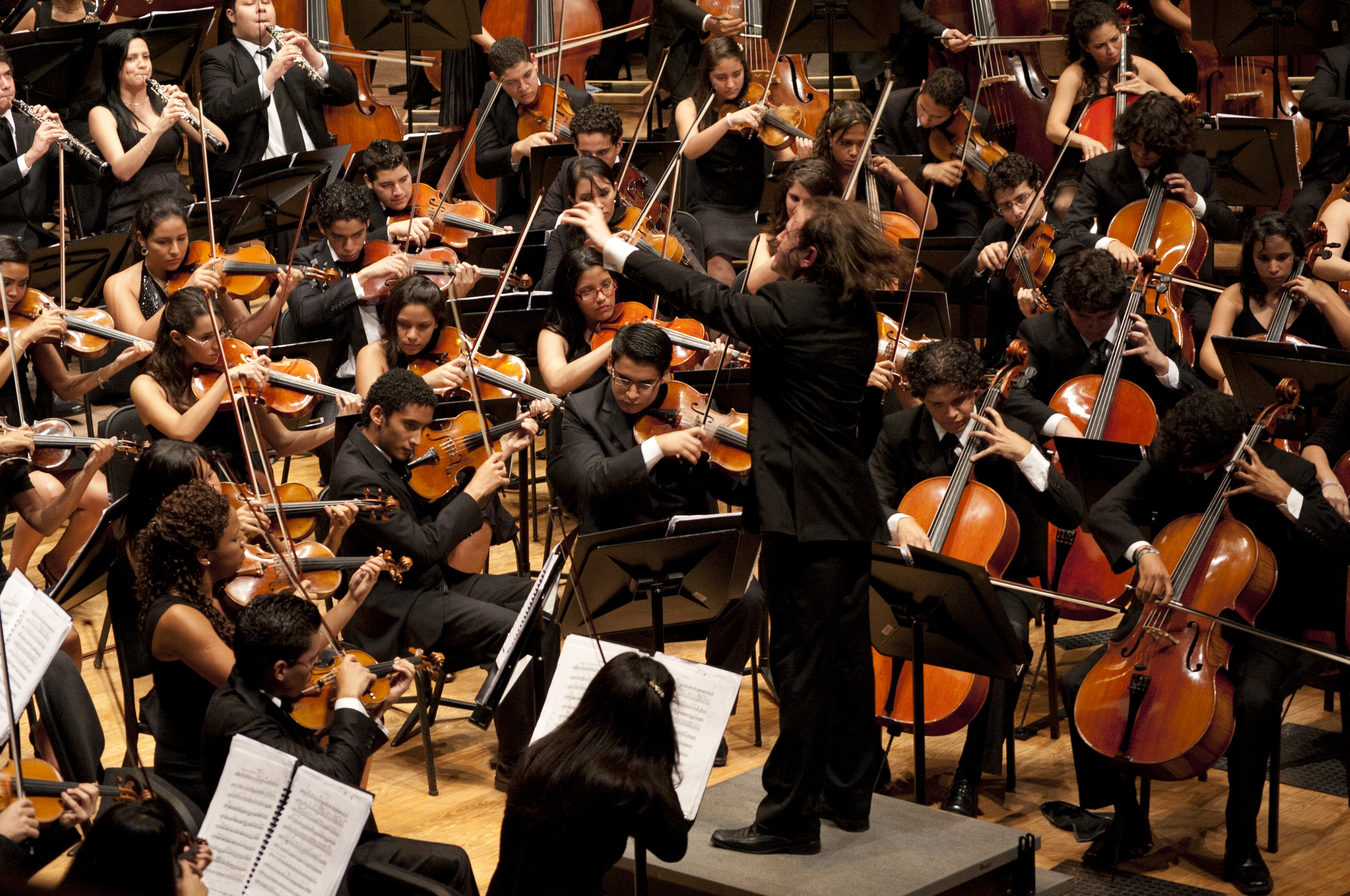
Dr Deming used to use the example of an orchestra to illustrate this point.

DSC_1637

  • A fine orchestra (the system) is highly interdependent;
  • The musicians (the components) are not there to stand out to the listener in a ‘look at me and what I can do’ manner…can you imagine the outcome of performance incentives – each musician being rewarded for playing faster and louder than the others! Such incentives are the source of cacophony that destroys value;
  • The musicians are there to support each other, to achieve the harmony that comes from the interaction of their specialised instruments adhering to the same fundamental rhythm, towards the same aim;
  • They are usually not ‘the best’ players in the country. They work as a team under the leadership of the conductor.

Another way of looking at this is that someone focused on the ‘efficiency’ of the orchestra would find them very inefficient – some of them are just sitting there waiting, tapping their feet! If the efficiency specialist would have their way, all the musicians would be playing all their instruments all the time!

Note that Deming considered a business to be even more interdependent than an orchestra and that, without real teamwork across the components, chaos is rampant.

It has been said that command-and-control companies get ordinary results after extensively searching, and fighting, for the limited supply of extra-ordinary people (what was coined as ‘the war for talent’ by McKinsey) whilst the likes of Toyota (and other ‘Systems thinking’ organisations) consistently obtain extraordinary results from ordinary people.

The point is that it is about optimising the system, not its components…and, to do this, we need to understand the obstacles that our current management system puts in the way and replace them with something better!

Everybody’s talking about it…

5366I am amazed (amused?) about how often ‘Purpose’ (or other such words) is being put forward at the moment as THE thing, and from just about every management thinker/ business article I am coming across.

Examples are:

  • John Seddon’s ‘Purpose, from the customer’s point of view’
  • Simon Sinek’s ‘Start with why’ to inspire others
  • Clayton Christensen’s ‘Job to be done’… the higher purpose – the human need you are trying to fulfil
  • Aaron Dignan’s ‘Purpose as the no. 1 element’ of an organisation’s operating model, with everything else (process, product, people) nested within

 …and on and on

I am absolutely sold that it should be all about purpose…and I would expect that you are as well…but why does this obvious point need to be said?

Note that the aim of the system (which, to be clear, “should always relate to a better life for everyone”) was THE starting point for W. Edwards Deming i.e. there is nothing really new in this…and the fact that it is being constantly re-stated and re-framed suggests that we don’t properly understand the underlying point!

Are we stating the obvious (again) and then just paying it lip service? What does it actually mean to be focused on purpose?

I went looking for the purpose statement of the company I work for when I was writing a course recently and was really pleased to come across a crisp, clear and (to me) totally relevant purpose statement on our intranet.

It set out the purpose of our two primary value streams. It’s worth reflecting that it doesn’t talk about the method or the results…just why we are here:

  • it’s not about selling things or retaining business;
  • it’s not about market share or size;
  • it’s not about leakage, efficiency ratios or returns on investment
  • it’s not about awards, bonuses and other carrot dangling;
  • it’s not about the rating and ranking of our people;
  • it’s not actually about customer advocacy scores…though some valid (and undistorted) capability measures of satisfaction levels would provide an indication as to how we are doing against our purpose in the eyes of the customer.

If an organisation has a purpose, but is struggling to move towards it, then we might question why this is so. Note that a command-and-control management system replaces the actual purpose of ‘serve customer’ (as generically written) with the de facto purpose of ‘make targets’…which end ups clashing with/ defeating the actual purpose.

I believe that I would struggle to find the well-written purpose statement being actively/ obviously used within the business: to manage our two primary value streams, to guide and challenge our decisions, to measure our capability against.

Instead, I see a lot that is used to command-and-control the method within. We shouldn’t have to re-state our purpose, we shouldn’t have to chase new ways of saying the same thing….our purpose should be within our DNA!

We need our management system to enable our people to be motivated by this purpose, not frustrate them.

Command-and control constrains. Being truly focused on purpose liberates method!

As a final thought, you might ask ‘so what if a business is clear on its purpose and has a management system that allows people to continuously work towards it…what about me?!’

To tie organisational purpose back to us as human beings, note that Victor Frankl wrote in his classic book ‘Man’s search for meaning’:

“The greatest need of the human being is for a sense of meaning and purpose in life”

If an organisation states its purpose clearly (a good start) but then pays it lip service, it is missing out on the phenomenal potential of providing its people with meaning in their work….imagine what could be achieved if all your people (and you) wanted to come to work, not for the money, but for themselves!

What you see depends upon your perspective.

uh___perspective__by_paper_flowersIf you go on a site visit to see another organisation, let’s say because you want to see if you can ‘borrow’ someone else’s brilliant ideas, be very mindful of the effect of your own constrained thinking on what you will see!

“…Everything we see is a perspective, not the truth.” (Marcus Aurelius)


Examples:

The Operations Manager: If you go to see a manufacturing plant, see that it is really clean and tidy, notice that they use a technique (and related tools) called ‘5S’…you could come back to your own plant and tell everyone to ‘do 5S’.

…but you would have missed the point as to how that manufacturing plant arrived at their current reality. They will likely have engaged everybody in the factory as part of a deeper ‘Lean/ Systems Thinking’ management system. They will have an environment in which ‘5S’ is relevant to them and can thrive.

It is likely that your top-down mandate to ‘do 5S’ won’t be embraced and you, the ‘command-and-controller’ will say “it didn’t work here”…and will go looking somewhere else for another ‘brilliant idea’ to impose.

The Healthcare Executive: If you go to see a hospital looking for ‘best practise’, see that some of the best surgeons use ‘checklists’…you could purchase a pack of ‘expert designed’ checklists from a consultant and mandate their use by all your surgeons.

….but you would have missed the point that the checklists (or any other effective yet dynamic ‘standardised work’) were designed and owned by the people who were using them because they believed that they were a meaningful counter-measure to meaningful problems.

It is likely that your surgeons won’t accept your imposed checklists…and you will attempt to implement controls to enforce their use, leading to extra costs and much worker- management resentment.


Note that the American car manufacturers AND Toyoda (now Toyota) went to see Henry Ford’s revolutionary ‘River Rouge’ production plant at about the same time as each other (the 1920s)…but they were looking at the same thing through very different eyes and came out with very different observations (e.g. economies of scale vs. flow)…and the rest is history!

The best way to make meaningful and sustainable improvements is to always start from the perspective of the customer, see the customer’s value stream as a system, understand its purpose and provide an environment in which all the process performers and managers are intrinsically motivated to continually improve this system towards its purpose. And, to be clear, this (in part) requires the removal of any and all management instruments that do the opposite.

Whilst it might be useful to see what others are doing, perhaps to spark ideas, this shouldn’t be your starting point and neither should it be the end point. You should know what you are trying to achieve before you look, and you should (meaningfully) experiment before you implement.

Two quotes that apply here:

On tools: “A fool with a tool is still a fool” (Grady Booch); and

On environment: “People’s behaviour is a product of their system. It is only by changing [the system] that we can expect a change in behaviour.” (John Seddon)