It’s NOT about the nail!

It not about the nailSo there’s a fabulous (yet very short) YouTube skit called ‘It’s NOT about the nail’.

Many of you will have watched it…and if you haven’t then please watch it now before reading on – you won’t get this post if you don’t.

And I bet that those of you who have seen it before will want to watch it again (and again).

(though please see my ‘PC police’ note at the bottom 🙂 )

So, why am I using this clip? What’s the link?

Well it struck me that this is a brilliant systems analogy!

Let me explain:

Let’s assume that the woman is an organisation and the man is outside it, looking in.

The script might go something like this…

The organisation: “It’s just, there’s all this pressure you know. And sometimes it feels like it’s right up on me…and I can just feel it, like literally feel it, in my head and it’s relentless…and I don’t know if it’s going to stop, I mean that’s the thing that scares me the most…is that I don’t know if its ever going to stop!”

[Turns to show the outside world the reality of the situation]

Outside:     “…yeah…well…you do have…a ‘command and control’ management system.”

The organisation:     “It’s not about the management system!”

Outside:     “Are you sure? Because, I mean, I’ll bet that if we got that out of there…”

The organisation:     “Stop trying to fix it!”

Outside:     “No, I’m not trying to ‘fix it’…I’m just pointing out that maybe the management system is causing….”

The organisation:     “You always do this! You always try to fix things when all I really need is for you to listen!”

Outside:     “yeah…see…I don’t think that is what you need. I think what you need is to get the ‘command and control’ out…

The organisation: “See! You’re not even listening now!”

Outside:     “Okay, fine! I will listen. Fine.”

[Pause]

The organisation:     “…it’s just, sometimes it’s like…there’s this achy…I don’t know what it is. I’m not sleeping very well at all…and all my workers are disempowered and disengaged. I mean all of them.”

[Pause. Searching looks between the two]

Outside:     “That sounds…erm…really…hard.”

The organisation:     “It is! Thank you 🙂 

[Pause. Reach forward to reconcile….]

The organisation:     “Owch!”

Outside:     “Oh come on! If you would just…”

The organisation:    “DON’T!!!…”

[(usually) The end, unfortunately]

But let’s not stop there and just cope with the nail….

…to the point:

To successfully and meaningfully change a system towards its purpose, you need to look from the outside-in. You cannot achieve this looking from the inside-out.

Deming was very clear on this point: “The prevailing style of management must undergo transformation. A system cannot understand itself. The transformation requires a view from outside.”

Seddon wrote “When managers learn to take a systems view, starting outside-in (that is, from the customer’s rather than the organisation’s point of view), they can see the waste caused by the current organisation design, the opportunities for improvement and the means to realise them. Taking a systems view always provides a compelling case for change and it leads managers to see the value of designing and managing work in a different way…

…but this better way represents a challenge to current management conventions. Measures and roles need to change to make the systems solution work. You have to be prepared to change the system…”

In a similar vein Einstein is credited with the saying We cannot solve our problems with the same thinking we used when we created them.”

A catch:

Gosh, it sounds so simple….let’s just look from the outside-in shall we? But, unfortunately, it isn’t that simple.

Here’s Stafford Beer with why not:

“…a new idea is not only beyond the comprehension of the existing system, the existing system finds it threatening to its own status quo…the existing system does not know what will happen if the new idea is embraced.

The innovator fails to work through the systematic consequences of the new idea. The establishment cannot…and has no motivation to do so…it was not its own idea…the onus is on the innovator…[but] the establishment controls the resources that the adventurous idea needs…”

Blimey, that’s a bit depressing isn’t it!…which is an opportune moment to remind you of my earlier ‘Germ theory of management’ post.

You/I/we won’t succeed by trying to push the idea onto the system. We need to make ‘it’ curious and want to pull the idea at the rate that understanding, acceptance and desire emerges.

So it IS about the nail! …Oh never mind.

(if you watch the YouTube clip again, I expect you will find it hard not to mentally overlay the above script onto it now! I know I do.)

Comment for the ‘Political-Correctness’ police: I ‘get’ that the clip is stereotypical about the differences between men and women…I ‘get’ that men will likely find it funnier than women…but, come on, it is very funny.

Okay, okay…I am more than happy to post an equally funny clip (to address the gender balance) that sends up men…here’s a good one: ‘Man flu’

What do germs have to do with modern management?

5248_1651_2006-021If a hugely important message is so different to how people currently believe and behave, how do we best help people ‘get it’ and, even better, passionately ‘jump ship’?

I’d like to use an excellent ‘germ theory’ analogy, written about by Myron Tribus (see credit at bottom of this post).

Imagine it is the year 1869

Louis Pasteur has recently demonstrated that fermentation is caused by organisms which are carried in the air. Joseph Lister has applied Pasteur’s work and experimented with the first antiseptic and found that it worked to prevent infection after surgery.

Between them (and others), they have opened up a whole new theory – the germ theory of disease.

However, their contemporaries, the doctors administering to their patients have no understanding of this knowledge. Worse, current practises contaminate patients with virtually every action taken. Surgeons routinely operate with unwashed instruments and unwashed hands and then ‘sew death into the wound’ with unsterilised needles and unsterilised thread. Some people recover, some stay the same, but many die. In each case, some rationale (from what is currently believed) can be used to explain the outcome.

Today we cringe at the actions of these doctors…but at that time the medical world believed in a totally different (Miasma) theory and, as such, the practising doctors were constrained by this thinking. These professionals knew no better – they were prisoners to the state of knowledge of their profession, to the current way of thinking and were under pressure to conform, to follow ‘best practise’. They could not apply what they did not know or believe.

So, going back to the year 1869…the American civil war has recently ended. Imagine you are a young researcher in an American medical school and you have learned about these incredibly important new European developments in germ theory. The spread of such knowledge is rather slower than it is today (there’s no internet, no email).

You want to spread the new germ theory knowledge and the importance of sterilisation! You’ve been invited to speak in front of a group of distinguished doctors. They have achieved their fame from heroic work as surgeons in the field during the war (they are very good at sawing limbs off!)…but your underlying message to them is that they have been killing their patients.

So your task is to persuade them to forget what they have been taught, to abandon the wisdom they thought they had gained through many years of experience and to rebuild their understanding around a new theory…but think about this:

  • they have a very nice life based on what they have been doing (respect and prestige in their community, a nice house, some fine horses and a few servants);
  • you are effectively telling them that they are (currently) a menace…that they are dangerous!
  • …what about their reputation if this ‘gets out’?

How do you go about winning them over? Do you think they will be glad to hear you?

Let’s apply this analogy to management

Here’s the preface to W. Edwards Deming’s important book ‘The New Economics’:

“This book is for people who are living under the tyranny of the prevailing [command and control] style of management…Most people imagine that the present style of management has always existed, and is a fixture. Actually it is a modern invention – a prison created by the way people interact.”

Deming’s book (and his famous lectures) goes on to explain that what is considered as ‘best practise’ in management is in fact not…and that, instead, it is doing much harm and there is a better way….which sounds rather familiar to trying to educate doctors about germs in the late 1800s.

Now there are successful companies (think Japan for starters, and many forward thinking companies) and hugely respected educators (Ackoff, Scholtes, Womack & Jones, Seddon,….) around the world that have taken on and advanced Deming’s work. Deming is for management what Pasteur and Lister were for medicine.

But Deming’s message is some mouthful for the successful ‘command and control’ Executive to take!

In the same way that the doctors wouldn’t have liked to hear the “you are killing your patients” message, neither would an executive who has ‘got to the top’ using their knowledge and understanding of the traditional ‘command and control’ management system.

So what reactions should we expect from the 1869 doctors and today’s ‘command and control’ executives to a new way of thinking? Well, that depends on how the message is delivered!

One way will result in denial, the other curiosity (by some) to learn more.

Rational vs. Normative change

So what actually happened? Well, the doctors fought tooth and nail against the idea of having a sterile environment. “What, stop to wash my hands…don’t be silly. I have important things to do!”

But, consider this. Those doctors who were curious leapt ahead…those who wouldn’t change eventually became ridiculed, sidelined and even ruined. It took time…but the new theory eventually won out.

So back to delivering that message…here’s a comparison of two intervention methods:

  • Intervention Method 1: Rational change – This is the idea that you can use logical arguments to rationalise the proposed change (you explain, they listen)…but, if you do this, they will always map what you are saying onto their current world view (which is the very thing you are trying to change!) and then they will defend their current thinking since they know no better – this results in denial. You won’t get any traction here!

  • Intervention Method 2: Normative change – This is where you get them curious to look for themselves, to study their system (stand back, observe, collect information, consider) and thereby open their eyes to that which they could not see. Then, and only then, will they be ready to change. This change in thinking (unlearning and relearning) is achieved through experiential learning – people don’t deny what they see.

So, the task is to get ‘command and control’ leaders to become curious and then help them study their system, to open their eyes to what is actually happening….and then work with them to experiment towards a new way of management.

There are a couple of obvious ways to begin this study:

  • Demand: Take them to where the demand comes in (a branch, a contact centre, the mail) and get them to listen to/ observe demand. Get them to classify this as value or failure demand… get them thinking about what they ‘see’;

  • Flow: Get them to follow some units of value demand all the way through the current system, from when the demand first arose (from the customer’s point of view) all the way to when the customer achieved a satisfactory closure (to them) to their actual needs. Get them to identify the value work, seeing everything else as waste…get them thinking about what they ‘see’.

…now they should be curious to think about the why, why, why.

“Okay Steve, we get the ‘germ theory’ example….but what’s your supposedly missing management theory?”

Well, actually, it’s not just one missing theory – there are four!! I’ve put an introductory table at the bottom of this post if you are curious 🙂

Deming aptly referred to the understanding of these four theories, and their inter-relationships, as ‘profound knowledge’. Obviously, my simple (rational) writing about these can’t change anything much…but it might help you when studying your system.

So who’s this post actually written for?

If you are reading this, are part of the system and already ‘see’ some or all of the new way, then it is to explain to you that rational change is unlikely to work…so try to go down the normative change track with your leaders.

If you are a leader who is responsible for the system, then this post is merely to make you curious. I cannot rationally convince you that there is a far better way than your existing ‘command and control’ management system but I can help you study and learn for yourself.

…and finally, on a positive note…

Not everything that the doctors, or ‘command and control’ managers did was wrong. They did what they could with what they knew and they were sincere in their efforts to do the right things.

Four missing theories from command-and-control management:

The theory of:

Meaning…: Which will show the madness of:
A system When we break up the system into competitive components, we destroy value of unknown magnitude.

What matters most is how the components fit, not how they act taken separately.

An unclear purpose, vertical hierarchical silo’d thinking, continual reorganisations, cascaded personal objectives, and the rating & ranking of peoples’ performance;

Failure demand and waste

Variation There is natural variation in everything: we need to understand the difference between a signal and noise.

Targets are ‘outside’ the system and cause dysfunctional behaviour.

Binary comparisons, targets, traffic lights and tampering.
Human Psychology Understanding people and why they behave as they do (particularly in respect of motivation, relationships and trust). The use of extrinsic motivators, such as competitive awards and incentives (and a misunderstanding of money);

Management by fear and compliance; Treating people as the same, an obsession with ’empowerment’ and the missed opportunity of developing people

Knowledge True learning and development occurs through experimentation (e.g. PDSA) – from a theory that is properly tested and then reflected upon…leading to true and sustainable improvement.

Benchmarking and implementing solutions rather than experimentation; saying something is ‘an experiment’ when it’s not; a focus on results rather than their causes; Speeches and workshops rather than Gemba walking.

After thought: ‘Germ theory’ is but one example of a scientific theory that could have been used as the analogy in this post. In generic terms, ‘old knowledge’ hangs around for a while in spite of our efforts…but it does eventually die out, allowing us to move forward.

Credits:

  • The analogy comes from Myron Tribus: ‘The Germ theory of management’ (1992), SPC Press
  • The intervention thinking comes from an enlightening email exchange with John Seddon

Image: I had some fun looking for an appropriate image to go with this post. I came across some gruesome pictures of 19th century (unsterilised) amputations but, given that some of you might not appreciate seeing this, I limited myself to just showing you a 19th century surgeon’s instrument kit…and those of you that want to can let your imagination run riot 🙂

A breakthrough!…but is it all that it seems?

The word Breakthrough breaking through glass to symbolize discovSo, over the last few days a number of people have sent me links to this recent business article on Stuff: Accenture ditches annual performance reviews. Thanks for that, you know who you are 🙂

In summary:

  • Accenture, one of the largest professional services organisations in the world has decided to radically change its people processes: getting rid of the annual performance review
  • They aren’t the first ‘big beast’ to do something like this:
    • Deloitte (THE biggest professional services organisation in the world) went public in a similar vein last March. An April 2015 HBR article called Reinventing performance management explains where they are going;
    • I understand that the likes of Microsoft, Expedia and Adobe dropped most or all of the performance review process a couple of years ago;
    • Our very own NZ organisation, Telecom (or is that Spark?!), appeared to be heading down a similar path back in 2013 , though this would appear to me to have been driven by cost rather than the science of psychology:

Telecom [will] stop using online forms to appraise staff performance, reverting to a “far lighter” system of one-on-ones and “adult-to-adult conversations” on regular four-to-eight week cycles, he [Simon Moutter, CEO] said.

The “forms and processes” associated with performance appraisal had impeded Telecom, he said.”When we hit ‘appraisal season’, the company nearly grinds to a halt with the bureaucracy.”

Caveat: Looking at this 2015 Spark site, I’m not sure whether they successfully ‘broke away’ from the past…the picture at the bottom looks remarkably familiar!

A reminder: I have written quite a bit on the subject of performance review. In particular see An exercise in futility.

Ironic

What I find highly ironic about professional services firms eulogising about their new found wisdom is that they have large ‘human capital’ consulting arms that have been selling their wares for decades (I know, I used to work alongside them)…and what have they been earning millions of $ on? Yep, advising on implementing supposedly highly researched incentives schemes and performance review programmes….you know, the ones that they have now decided aren’t so great.

Taking a look, for example, at Deloitte’s website, I can deduce that they see a huge opportunity in presenting themselves as (what professional service organisations love to call themselves) ‘thought leaders’ to sell their new-found performance management brilliance (the next Silver Bullet) to all the other organisations out there.

A Fudge?

I have read the Deloitte HBR article (referenced above) and I see their ‘answer’ as a likely fudge.

They talk a lot about the wasteful time and effort expended in the current annual appraisal system. They talk about it not actually deriving valid results (being hugely biased by who is making the judgement). Yet their answer (when boiled down to its essence) is to merely make it simpler – a sort of ‘reboot’. It would appear that they are still asking questions about a person to rate them, which will determine a reward.

You could point to their strap line of “Replace ‘rank and yank’ with coaching and development” and, yes, I can get behind that BUT:

  • they haven’t once talked about the system and its monumental effect on what a person can (or cannot) achieve; and
  • they appear to be clinging to the idea of motivating an individual’s performance through contingent rewards, and judging them accordingly.

I can see that the games people understandably play will simply mutate, yet remain.

“Tell me how you will measure me and I will [show] you how I will behave” (Goldratt).

Going back to Alfie Kohn’s work:

  • First you need to remove contingent rewards;
  • Second, you need to re-evaluate the performance review process (change from judgement to feedback);and
  • Then you can create the conditions for authentic motivation.

A reminder of why judgement and rewards do not belong anywhere near helping people develop:

“If your parent or teacher or manager is sitting in judgement of what you do, and if that judgement will determine whether good things or bad things happen to you, this cannot help but warp your relationship with that person.

You will not be working collaboratively in order to learn or grow; you will be trying to get him or her to approve of what you are doing so that you can get the goodies.

A powerful inducement has been created to conceal problems, to present yourself as infinitely competent, and to spend your energies trying to impress (or flatter) the person with power.” (Kohn)

“Mind the gap”

Many an organisation might read about* what the likes of Accenture are doing and conclude that, clearly, they need to copy them.

But a reminder of the dangers of copying: Yes, look at what others are doing and, yes, be curious as to why…BUT you need to work it out for yourselves – you need to ‘get’ why it is the right thing to do and then adapt it accordingly. Otherwise you can expect one great big mess.

(* A particular quote from the Accenture article which I found of interest: “Employees that do best in performance management systems tend to be the employees that are the most narcissistic and self-promoting” We should be seriously questioning if this is actually what we want.)

“Nothing to see here”

Whilst a part of me is very pleased to see the big beasts ‘coming out’ (more or less) against the performance review process:

  • I’m unmoved (being polite) by their commissioning/ invoking of seemingly new and brilliant research that arrived at their ‘new insights’.

Why? Well, there’s nothing new here. Go back to Alfie Kohn’s brilliant book ‘Punished by Rewards’ to see the body of research from many decades ago. Go back to Deming’s 4 day lectures that he gave to thousands between 1981 and 1993 (that’s more than 30 years ago!!):

Deming’s Deadly disease number 3: Evaluation of performance, merit rating, or annual review

“In practise, annual ratings are a disease, annihilating long term planning, demolishing teamwork, nourishing rivalry and politics, leaving people bitter, crushed, bruised, battered, desolate, despondent, unfit for work for weeks after receipt of rating, unable to comprehend why they are inferior…sending companies down the tube.”

…go back even further to what Deming and the Japanese were doing from the 1950s.

During this time, the majority of large corporations have been pushing in, and constantly justifying, the exact opposite of where they have arrived at now.

Now, to be clear, I think it is really great that there appears to be a movement against the ridiculous performance review process BUT:

  • I’m not convinced that they fully ‘get it’ in respect of human psychology; and
  • I think it is disingenuous, arrogant (or maybe ignorant) of any organisation that does not (outwardly) recognise that what they have just ‘discovered’ has been there, loud and clear, in front of their eyes all the time.

Outstanding!

Hello-My-Name-is-SlackerWhen I discuss my posts on performance appraisal and contingent rewards with people I get a lot of great understanding and support…but there’s always one question that pops up: “but then how will you deal with the slackers?”

Putting to one side whether our management instruments actually ‘deal with the slackers’ at the present, I find this an understandable response from within a command-and-control management system.

I usually find myself responding with:

“…and why do you think they are ‘slacking’*…do you think they want to perform an unfulfilling job all day long? Do you think this is how they started out when they got the job?”

(* if indeed they are ‘slacking’…our activity measures may present a different story than reality)

I then usually get: “yeah, but there will always be some people who take the p1ss!”

This uncovers a pretty hollow view of people. I’m not criticising people for thinking this …it’s more a recognition of the likely environments that people have had to endure through our working lives.

I would respond with a Deming quote to ponder:

“Anyone that enjoys his work is a pleasure to work with.”

  • You and I want to enjoy our work…and the environment that we work within will have a monumental influence on this;
  • I absolutely ‘get’ that there will almost always be a small % of people that sit outside the normal bell curve…but should we be designing our management system for the 5% or the 95%?
    • Do we tar everyone with the 5% brush?
    • Do we effectively yet compassionately deal with this 5% now?
    • Does it make sense that people ‘decay’ to being seen in this 5% bracket?

Regarding dead wood: “Why do we hire live wood and kill it?”

Kohn puts a deliberate order to his suggested actions (see the bottom of the ‘Exercise in Futility‘ post) and he most certainly doesn’t stop at removing contingent rewards and stopping performance appraisals…this is actually the point at which the real (and interesting) work can start to be done, with the process performers on collaboration, content and choice.

Okay, so you still think you’ve got a slacker:

If we are to consider the ‘slacker’ accusation, we also need to consider the other side of this coin, the supposed ‘talent’. Together, we can call these ‘outstanding performers’ where, as Scholtes explains:

We need to “use ‘outstanding’ in the statistical sense, not in the psychological sense.

Statistically*, ‘outstanding’ refers to something occurring outside the current capabilities of the system.”and therefore it makes it worth investigating as to what is happening and why.

* Note: There is variety in everything. We should not be tampering when there is nothing special about this variety. So ‘John’ achieved more than ‘Bob’ this week…big deal, we would expect differences…but is it significant, and is it consistently so?

Scholtes provides the following guidelines for our response to outstanding performance:

First: Determine for certain if they are truly outstanding:

  • Does (quality) data (properly) substantiate this ‘outstanding’ performance?
  • Does this data cover a sufficient timescale to indicate consistent performance at this lower or higher level?
  • Is there consensus among the outstanding performers’ peers (from observation, not gut reaction or rumours)

If the answer is ‘No’, it’s not actually outstanding!

If the answers to the above are all ‘Yes’ then:

Second: Investigate to discover what is behind this occurrence (using data!):

If the person is ‘positive’ outstanding, do they (for example):

  • use better methods which can be taught to others?
  • put in more hours?
  • have a wider range of skills?
  • have more experience?
  • have more native talent?

If the person is ‘negative’ outstanding, do they (for example):

  • need to learn a better method?
  • need to pick up speed?
  • need coaching or mentoring for a while?
  • lack the basic requisites for the job?
  • are they going through a difficult period?

And, depending on the explanation:

Third: Formulate an appropriate response:

For ‘positive’ outstanding:

  • teach methods to others;
  • provide higher pay* to recognise their change in market value (* but NOT contingent!)
  • provide more latitude in job definition

For ‘negative’ outstanding:

  • coaching, mentoring, training
  • provide greater structure for a while
  • get counselling and support
  • find a more appropriate position
  • Finally, sensitive and fair dismissal

If you take the last response, you still have a systems problem – you need to deal with how you ended up with this scenario.

Seddon deals with the issue of an individual’s supposed poor performance (and it being considered a ‘people problem’) in a similar vein to Scholtes. Put simply, there’s a whole host of questions that need to be asked about the system in which the individual operates before you can fairly arrive at the conclusion that the problem is with the individual.

The categories of questions, in order, are:

  • Is it an information problem? (do they know purpose, capability, flow?)
  • Is it a method problem? (waste? system conditions such as structures, policies, measurement, IT?)
  • Are extrinsic motivators the problem? (i.e. distractions from intrinsic motivation)
  • Is it a knowledge problem? (necessary knowledge to do the job?)
  • Is it a selection problem? (necessary attributes to do the job?)

All of the above are the responsibility of management to resolve.

  • Finally, is it a willingness problem?

Then, and only then can you conclude that you probably have the wrong person for the job.

“95% of the reasons for failure to meet customer expectations are related to deficiencies in the system…rather than the employee…

…the role of management is to change the system rather than badgering individuals to do better.” (Deming)

It’s very easy for a manager to blame a person. It’s a lot harder for them to work out what the systemic cause is. One of these approaches can improve the system, the other cannot.

A final Deming quote to ponder:

Question from ‘Management’: [what you are saying] “implies the abolition of the annual merit rating system [performance appraisals] and of management by [cascaded] objectives….but what will we do instead?”

Deming’s response: “Try leadership.”

A Service Revolution!

RevolutionService is different to manufacturing…and this difference is gob-smackingly important for a service organisation to understand if it is to truly move towards its (stated) customer purpose.

I was recently passed a link to a Malcolm Gladwell TED talk by a colleague and whilst watching it I thought…

“Nice! This is a simple tie-in to the incredibly important concept of variety in customer demand.”

So here’s the link to the very watchable talk (18 mins): Choice, happiness and spaghetti

Here’s the key points from the talk:

  • that Howard Moskowitz (a psychophysicist) had his ‘aha moment’ that “they had been looking for the perfect pickle…but they should have been looking for the perfect pickles“;  
  • the false assumption that the way to find out about what people want is to ask them….leading to years of fruitless and misleading focus groups. The truth is that:
    • people commonly don’t actually know, or cannot (and even will not) express, what they want; and
    • they will be constrained by what they currently know. No customer asked for an automobile. We have horses: what could be better.” (Deming)  
  • the importance of horizontal rather than hierarchical thinking about customer demand: we thought that customer demand was hierarchical (from cheap up to expensive products or services). Instead, there are only different kinds of products and services that suit different kinds of people;
  • that, instead of looking for one way to treat all of us, we now understand the importance of variability;
  • when we pursue universal truths [one standardised product/ service/ way of doing things], we aren’t just making an error, we are actually doing our customers a massive disservice;
  • We need to embrace the diversity of human beings

Hang on a minute….

So, I started off this post by saying that service is different to manufacturing but Gladwell uses lots of examples of physical products in his TED talk to make his point about the importance of customer variety (cola, pickle, spaghetti sauce, coffee,)…“make your mind up Steve!”

Well, this is a nice segue to explain about two types of variation, and how incredibly important this understanding should be to a service organisation (or the service part of any value stream).

These two types of variety are:

  • Customer-introduced (i.e. within their demand); and
  • Internally created within the process (regarding flow)

To go back to Gladwell’s spaghetti sauce: Different consumers like different sauces (this is variety in demand) but, once they have determined which variety of sauce they like, they then expect each jar they buy to be the same week in, week out (i.e. minimal variation in the process that creates that sauce).

So, whilst we definitely want to reduce and remove variation in the quality of the process, we should not remove the ability of the process to provide a suitably varied experience and outcome. Rather, it is the opposite – we should be trying to cater for this variety.

In fact, variety in service is MUCH bigger than Gladwell’s product examples:

One of my earlier posts set out five categories of variety in customer demand, as identified by Professor Frances Frei (see The Spice of Life).

Now, whilst it might be useful to categorise service variation (purely to help you ‘see’), the bigger point is that the customer sets the nominal value – the specific value of a service to them.

“The customer comes in customer shaped

…there is virtually infinite variety in people….and that variety can change for a given person depending on, say, time of day/ external influences/ mood….

Standardisation is NOT the answer…in fact, it is often the problem:

There are legions of service organisations that have hired manufacturing improvement experts (or people who have read books about them) to ‘standardise, specialise, centralise and automate’ because they say “this is the solution”.

Examples at attempts to standardise the customer include:

  • using IVRs to standardise customers into categories (“press 1, then press 3…”);
  • using call scripts to standardise the content of customer conversations;
  • using average handling times to standardise the length of a conversation;
  • using ‘box ticking’ forms to standardise customer information collection;
  • using ‘black and white’ rules above common sense, when dealing with a customer’s needs;
  • forcing customers down one path (e.g. you can only pay by direct debit, you can only interact online, you can only use these suppliers, …….and on and on).
  • …..

Interestingly, if you read the list above with your ‘I am a customer’ hat on, you will likely recall many instances where you have tried interacting with a service organisation and one or many of the above attempts at standardising you and your demand has seriously frustrated you!

This leads to much failure demand, waste (and cost) but with little value delivered (as written about in an earlier post).

Clarification: this isn’t to say that technology cannot assist or that there is no place for any standards. It’s making the point that the starting point should be that:

“….in service organisations, the problem is how to design the system to absorb variety” [and not frustrate it]. (Seddon)

Our starting point always seems to be ‘efficiency’ and a focus on activity cost. Perverse as it may seem, a focus on activity cost often has the unintended consequence of increasing total cost (though this is not visible to a silo’d organisation and is nigh on impossible for them to measure).

If we standardise, say, a site visit (the activity) such that it can’t absorb the variety in the customer’s demand…then don’t be surprised that:

  • there is failure demand from the customer when they complain and/or disagree with the outcome of the visit;
  • there is much ‘expert’ time spent reviewing this complaint;
  • there are yet more site visits required to resolve the problems;
  • there is lots more paperwork/ computer inputting/ workflow management required;
  • there is much confusion created by all this extra work (who did what when, who authorised what change from the standard, who is explaining all this jumble to the customer?); and
  • trust has been lost with the customer who now questions everything we do

The most important point to note is that “cost is in flow, not in activity”

So why the title of this post?

Well, the above is quite different thinking to where ‘command and control’ service organisations have been going. A revolution if you will.

Put simply, if we understand the variety in our customer demand and try to design our system to absorb (rather than frustrate) it we will go a long way towards our customer purpose…with the likely side effect of doing so for less cost.

“Managing value [for the customer] drives out cost….Focussing on cost paradoxically adds cost and harms value.” (Seddon)

Tampering

FunnelAny of you reading this who have been on my Systems Thinking course will have had the fun of being involved in Dr Deming’s famous red bead experiment.

This post is about Dr Deming’s other (not quite so famous but equally important) Funnel experiment. The experiment teaches about the harm caused by ‘Management by Results’ (MBR) …where this occurs through tampering.

Here’s the experiment set up:

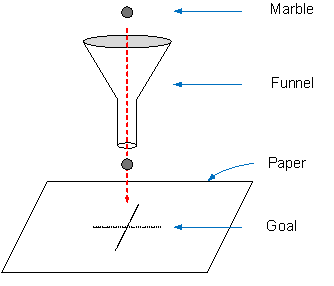
Funnel experiment set upWe have a flat horizontal surface (let’s say a table) with a piece of paper placed on top of it. We also have a kitchen funnel (like we would use to decant a liquid from one bottle to another), and a marble that we will drop through the funnel towards the paper below.

Let’s assume that the funnel is held upright in some sort of stand, say 50cm above the piece of paper.

Now we mark a cross in the middle of the piece of paper.

Goal: to hit the cross with the marble by dropping it through the funnel.

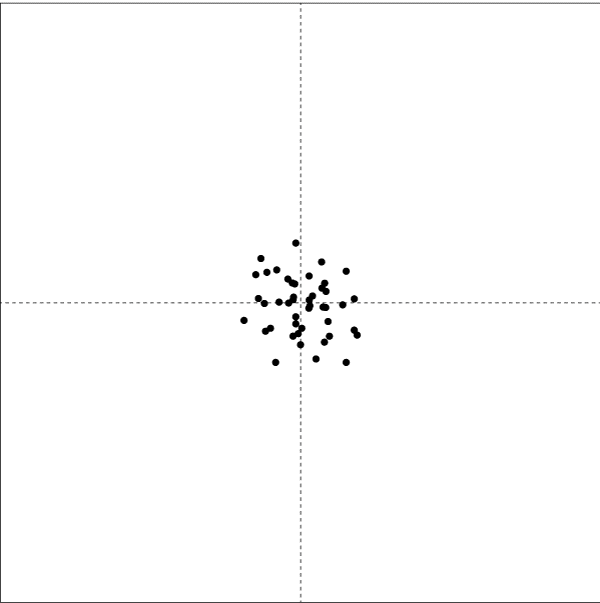
Round 1: We position the funnel over the cross and then drop the marble through the funnel 50 times. For each marble drop, we mark the spot on the paper where it hits.

We are likely to see something like this on the paper (looking from above):

nelsons-funnel-stable

Remember, we simply dropped 50 marbles without attempting to make any changes in-between drops and the paper shows the system to be stable. However, note that there is variation as to where the marble landed. It continually landed near the cross (with probably a few direct hits) but there was variation.

Round 2: So this time, we think that by adjusting the position of the funnel between each marble drop, we can ensure that the marble hits the cross on the next drop!

So we drop the 1st marble, note where it lands as compared to the cross and then move the funnel to compensate for this error. i.e.

  • if the marble landed 1 cm to the left (west) of the cross, we move the funnel 1cm to the right (east) of its current position….because this ‘fine tuning’ will make the next drop hit the cross, right?;
  • if this 2nd marble lands 2cm below (south of) its new position, then we move the funnel 2cm north from where it is currently positioned;
  • ….and so on, iteratively moving the funnel

So, what happens after we use this approach with our 50 marbles, iteratively adjusting the funnel’s position after each drop?

Well, it’s somewhat disappointing!

nelsons-funnel-adjust-to-target-1

Our attempts at compensation have made the variation increase drastically (experiments show by approx. 40%). We’ve made things much worse.

Clearly our ’round 2′ method of compensating didn’t work as we wished. Is there another way of compensating and therefore getting better at hitting the cross?

Round 3: The new idea is to do the opposite of the last idea! This time, we will move the funnel directly over where the last marble landed and keep doing this for the 50 drops.

Oh dear, the marble is moving away from the cross and will eventually move off the table and (as Deming put it) all the way “off to the Milky Way”.

nelsons-funnel-drift-1

Perhaps using the last marble drop as a guide isn’t a good idea!

Conclusions: So which method was best?

  • Round 1 was clearly the best.
  • Round’s 2 and 3 are examples of tampering (though in different ways). They show the effects of tweaking a process based on the ongoing results of that process…it will simply increase the variation and the chances of failures.

So, what should we do? To actually improve a process requires an understanding of the sources of the variation…and then the performance of controlled experiments to identify process improvements.

For our Funnel system we could experiment with:

  • lowering the funnel;
  • decreasing the size of the funnel hole;
  • strengthening the stand holding the funnel to make it more stable;
  • …performing the process in a vacuum 🙂

All of these proposed improvements involve changing the system rather than merely tampering with it based on previous results.

So what?

Now all of the above looks like good fun…I’m already thinking about borrowing a funnel…but it seems an awful long way from our working lives. So let’s explain why in fact it’s not…

Taking the production/ selling of something, let’s say a sandwich shop as an example:

  • you sold 10 sandwiches on Monday, so you make 10 for Tuesday..
  • you only sold 2 sandwiches on Tuesday, so you throw 8 in the bin (not fresh anymore) and you only make 2 sandwiches for Wednesday….
  • you have 6 customers on Wednesday, so you sell the 2 sandwiches you made, have 4 disappointed would-be-customers but make 6 sandwiches for Thursday…
  • …and so on. You can expect to have major stock problems and a lot of unhappy customers!
  • it would be much better to make a set number of sandwiches each day, collect information about demand variation over a sensible period of time and then adjust your system accordingly.

The sandwiches are a very simple example of any process. What about taking a call centre as an example:

  • There will be a great deal of natural variation in customer calls throughout a day (with a number of causes, categorised and explained in this earlier ‘Spice of Life’ post)…so the number of ‘calls waiting’ will constantly fluctuate, though likely between predictable bounds. No surprises there.
  • …let’s assume that Bob’s job is to constantly monitor the current ‘calls waiting’…
  • …it gets to a point where Bob thinks the number of calls waiting is high…so he sends out an urgent request for everyone to drop what else they are doing and get on the phones…and they all rush to do so…
  • ….so the number of ‘calls waiting’ now drops really low and even disappears…excellent. Now Bob sends out a screen pop-up message along the lines of “panic over, people who missed out on their breaks can go now”
  • ….so the number of ‘calls waiting’ now jumps up again…and the up-and-down cycle continues.
  • Bob has a really stressful job looking at the numbers and continually tampering (using the ’round 2′ method) in a hopeless attempt to exactly match supply to demand.
  • A better way would be to increase our understanding of the system by studying demand (its types and frequencies) and amending its design based on what we learned. There might be:
    • loads of failure demand in there (which is a waste of capacity); and
    • frequency patterns within the different types of value demand

Clarification: Many of you working in contact centres may say “but Steve, of course we analyse incoming calls and look for patterns!” I would note that:

  • whilst you can, and should, look for predictable patterns in the data, I doubt that you can tell me how many calls you will get in the next 15 minutes and how long they will take. There will be variation and this is outside your control….does this make you tamper?
  • Nearly all contact centres simply see incoming calls as ‘work to do’ with an ‘average handling time’. Hardly any will analyse this demand. Can you tell me what types of value and failure demand you get, and their frequencies…and what conclusions you draw from this?

I’m not picking on contact centres – I simply use it as an example that we should all be able to understand. Tampering happens all over the place.

In general, managers often look at the results of the last hour/ day/ week/ month* and attempt to make adjustments accordingly, whether by congratulating or berating staff, moving people between queues, changing work quotas, knee-jerk reacting to defects and so on.

(* where the unit of time will depend on the nature of the transactional service being provided)

In fact, praising someone one week for a perceived outstanding result (likely against the lottery of a target that they had very little control over meeting) and then giving them a ‘talking to’ the next because their result was considered poor is tampering.

The point is to understand the system and the reasons for variation. Then (and only then) you can make meaningful changes instead of merely tampering.

Note: The ‘Round 3’ type of tampering is not as common as the ‘Round 2’ type…but it does happen. Consider the following cases of using the last example to inform the next:

  • Using the last board cut as a pattern for the next; or
  • Train the trainer: Mary trains John who trains Bob who trains Jess.

Both of these examples show that any variation from purpose will be retained and amplified as it is passed on, like a chain of whispers.

Credit: I’ve seen the funnel experiment performed a few times now but, rather than taking the laborious time to recreate it, I have borrowed the 3 marble drop pattern pictures used above from this website.

Note: For those aficionados amongst you, this post represents a slightly simplified version of Deming’s full funnel experiment. There is yet another tampering rule (which I have left out for the sake of brevity) …but, just so you know, it also doesn’t work. You can read all about the funnel experiment in Chapter 9 of Deming’s book ‘The New Economics’.

Have I got a deal for you!

usedcarsalesmanWhich industry are we really suspicious about, and is the butt of jokes around the world? How about the car salesman?

So why do you think we are so suspicious?

Here’s what we might experience:

  • A rather smooth operator who appears to ask you about what you want but, surprise surprise, “has exactly what you are after”…which, funnily enough, happens to be what he’s got in stock!
  • A personal business card handed over, encouraging you to give him a call whenever you want…but use his direct number: “remember me, my name’s Jim”;
  • Some desperate moves from Jim as you attempt to leave his car yard, saying things like “I can only offer you this fabulous deal today”;
  • …but when you have left the yard, multiple calls from Jim asking how you are getting on and saying that things have changed for the better…so come on by so that we can discuss “…and remember to ask for Jim”;
  • …and if you ring back for Jim but he isn’t available, his ‘colleague’ Bob gladly (yet slyly) takes over the deal, perhaps saying “nah, no need to tell Jim, I can handle it from here!”;
  • Strong attempts to ‘sell you some extras’ like finance, warranty, a tow bar and so on…even when you’ve made clear that you really don’t want them;
  • Assurances that “yes, don’t worry about it – everything works…and if, in the unlikely event you have a problem, just bring it back in and we’ll sort it”;
  • …and if you end up making a purchase, some strange ‘paperwork’ going on to make the deal look a certain way:
    • perhaps trying to bring it forward or put it back (end of the week/ month/ year);
    • perhaps trying to play around with how the figures look

….you might be able to add a whole heap more experiences to the above!

Actually, car salesmen are nothing compared to big financial services business. Let’s move across to the UK Financial sector and have a look at the carnage of the last few decades:

  • the 1988 – 1994 Personal Pension miss-selling scandal in which salespeople on commission persuaded vast numbers of people to trade in generous and safe(r) company pensions for riskier and costlier alternatives. The resultant compensation scheme forced on the industry involved the review of 1.7 million consumers, over 1 million compensation payouts and a total cost to the financial companies involved of £12 billion; (Source of figures here)

  • the 1990s and 2000’s Payment Protection Insurance (PPI) miss-selling scandal in which banks and other financial institutions offered sales incentives to increase the take up of payment protection insurance…which led to a range of miss-selling practises including: putting pressure on customers to buy it in order to secure a loan; failing to make it clear that it was optional; selling to people who were actually ineligible; and even adding it to a loan without the customers consent or knowledge. The resultant compensation scheme forced on the industry (spot the pattern?!) saw the ombudsman receiving “5,000 complaints a week” and payouts being made of more than £15 billion. (Source of figures here)

  • …and on and on (the Endowment Mortgage miss-selling scandal, the Credit Card Protection insurance miss-selling scandal….)

They all shared the same ‘miss-selling’ credentials

  • aggressive, ignorant or incompetent sales tactics,
  • a failure to appropriately advise customers, and
  • deliberate strategies to sell financial services that customers do not need;

So, what’s the common ingredient?

Well, that would be the offering of sales incentives (contingent rewards).

The point is that, if you offer sales incentives, you can virtually guarantee that you will cause dysfunctional behaviour that goes against your (stated) ‘customer’ purpose.

Remember that a valid purpose statement should say something about “helping people…” It does not say “sell what you can to them”. We need to remind ourselves about a system and that ‘sales’ is but one component of it.

If you offer sales incentives, you can expect the system to ‘bite back’ in the form of undesirable discounts and terms given, failure demands from customers contacting you again, cancellations, complaints, debt collection costs, returns and after service costs… all of which will be un-measurable back to your brilliant sales incentive scheme.

You can of course try to put in place ‘compliance’ controls to monitor all these ‘side effects’ but a) you won’t catch the majority of them and b) this is just an additional (and expensive) layer of costs, and waste.

The sobering thing about the UK financial service miss-selling scandals is that the eventual costs dwarfed the original supposed sales benefits! What a huge waste.

If you offer sales incentives, you can expect:

  • people to try to sell what they have in front of them, rather than what the customer wants, or actually needs;
  • a strong desire to ‘get the sale’ and ‘move on’ to the next ‘lead’ meaning that less care is taken explaining the product and what it is and isn’t;
  • ‘dodgy sales’ made, which should never have occurred (i.e. were inappropriate and/or were not desired)

If these incentives are to individuals, you can expect reduced co-operation between ‘colleagues’, who are now in competition for those elusive sales…even leading to sabotage.

Such competition will actually harm, and prevent those many sales that would have occurred because of co-operation between colleagues.

If these incentives are for particular products, you can expect other products to be ignored, and even denigrated in favour of chasing the reward…even if the non-incentivised product was what the customer actually needed.

If you add targets to achieve these incentives, you can expect games to be played:

  • if I am near my target in a given period, I’ll do some creative things to creep over the threshold (perhaps offering discounts and giving things away for free that I shouldn’t be);
  • if I have achieved this period’s target, I might try to defer a sale to my next period, which, again, may not be what the customer wants and clearly distorts information about demand.

And, given that the customer isn’t daft, they ‘feel’ the sales process as opposed to experiencing someone that actually cares about them…providing an awful experience and a massive (yet missed) hit in reputation.

There’s nothing ‘rocket science’ about the above. We all know and recognise it (it happens to us as customers and we hate it!)…yet many of us still work in management systems that think that sales incentives are a good idea.

An important clarification:

If you think that the bad practices described above are only carried out by a handful of ‘bad people’ then you don’t understand human psychology. In fact, the majority of people are having to play a ‘game of survival’ within their incentivised ‘meet target’ management regime and feeling pretty bad about it too…it certainly doesn’t meet their much talked about personal purposes. You’d have to be a pretty strong person to go against the system…and you might not last long in such an organisation if you do!

It’s not a case of ‘bad people’…it’s a case of ‘good people’ having to work in a ‘bad system’….which brings to mind Deming’s quote:

“A bad system will beat a good person every time.”

To close: Going back to our car salesmen opening, most dealers assume that they won’t shift cars without sales incentives. John Seddon, in his latest book ‘The Whitehall Effect’, refers to a Canadian auto dealership client that:

  • studied their system;
  • revealed the tricks used by the salespeople to make sales and gain the incentives; and then
  • understood the resultant negative impacts on the customer.

They removed sales incentives, set out a customer brochure describing all the industry sales tricks and promised that none applied here. Salespeople now co-operate with each other, customer trust improved, sales went up and long term customer relationships were forged.

The 8th, and greatest, waste

performance-potentialI expect many of you sometimes sit back from your desk, sigh, and think something along the lines of:

“Blimey (polite version 🙂 ), I’ve got so much more to offer this organisation…if only they knew!…if only they properly utilised my particular talents and motivations”.

Each of our talents and motivations will likely be very different to one another but they are incredibly valuable.

So, what might happen if you took this ‘my value is so wasted’ thought further, along the lines of:

“Hey, why don’t I actually say this the next time that I meet with my Manager!” (or is that Leader? We seem to be confused by these two words nowadays)

What do you think his/ her response would be?

This brings me to something which seems to be all pervasive within a hierarchical ‘command and control’ organisation…I expect that you would hear the following response:

“but you are responsible for your own development!”

I’ve heard this at a few organisations throughout my ‘career’ and it has always made me deeply uncomfortable…not because I don’t want to further myself (I absolutely do¸ always have and always will….but not necessarily in the ‘go up the greasy money-and-power pole’ way that might be implied).

It makes me deeply uncomfortable because this “it’s your responsibility” response:

  • is so lazy and convenient! It sidesteps the need for management to think about why the person feels this way and what is preventing the organisation (and its customers) from benefiting from their potential;
  • misunderstands, or worse, ignores the huge role of the management system in what an individual can achieve;
  • demonstrates an abdication of responsibility* by the management above as to their role in understanding and developing their people and in enabling them to thrive;

(* as in “Your development is not actually my problem! I might ‘throw you a few bones’ but take control of your own destiny…I did and look at me!”);

  • really means “impress me (the manager)”…where this is more about them than you.

Essentially, you have to do things that they want, rather than things that are in fact of value…and you certainly aren’t being encouraged to think for yourself, be bold, courageous and different.

The “it’s your responsibility” response completely bypasses the actual role of management – “to change the system rather than badgering individuals to do better” (Deming)

Curiously, the higher you succeed in climbing an organisation, I suspect the greater the risk of hubris and the belief that you got there almost 100% because of you! And therefore the most likely you are to want to deny the effects of the system on what you (as compared to others) were enabled to achieve.

Indeed, if you operate in a command-and-control organisation and are good at playing the necessary game, you may very well ‘go far’…but is this ‘game playing’ actually good for the organisation and, ultimately, towards its purpose? I think not.

The frustrating thing is that the command-and-control management system works very well for those at or near the top and any rational analysis of the waste caused by their management system is likely to be met with denial.

As a result, the only way that change is likely to occur is through those leaders studying the system, obtaining meaningful knowledge as to how it operates and working it out for themselves.

This doesn’t mean that it is hopeless for the rest of us: the more we help those same leaders look at the system and how it actually works then the more likely they are to ‘see’.

Note: The title of this post refers to Taiichi Ohno’s original ‘7 wastes’ and the fact that an 8th overarching waste has been added – that of the waste of untapped human potential.

This 8th waste will be huge within a command-and-control paradigm. 

People are people so why should it be?

6508-mouse…so we are stood around the visual management board, considering a problem:

There’s been lots of talking, but an impasse has been reached.

  • After a while a ‘quiet mouse’ of a person (almost imperceptibly) whispers something that is actually quite profound….but no one seems to have heard it;
  • The ‘fog horn’ person doesn’t realise that he did in fact subconsciously overhear this whisper and blurts out similar words, thinking that he’s just had an original thought;
  • “Wow”, everyone thinks, “that’s a great idea!”
  • ‘Quiet mouse’ shifts back a little and thinks “that’s basically what I just said”…but is too polite to point this out;
  • Then the ‘really awkward’ person says something which annoyingly (for ‘fog horn’), yet totally justifiably, questions the great idea;
  • The ‘comedian’ says something funny that removes the tension in the air between ‘fog horn’ and ‘really awkward’;
  • Which causes the ‘deep thought’ person to ponder ‘really awkward’s challenge and carefully suggest a logical revision to the idea;
  • To which ‘fog horn’ adds his support, ‘comedian’ makes a joke out of this …and the group unite on fleshing out what experiment they are going to run to test out the idea and then conclude.

So, who did well in this discussion? Who did ‘best’? Who deserves praise? And, assuming that the subsequent experiment shows that the great idea has legs, which one deserves an award! Hang on…why are we trying to create a competition out of this?!

In reality, the good idea needed each and every one of ‘quiet mouse’, ‘fog horn’, ‘really awkward’, ‘comedian’ and ‘deep thought’ and the combined skills and personalities that they bring to the table. Remove any of these from the mix and we might not have got anywhere.

Those of you with even a mild eye for detail may protest that I have well and truly butchered Dr Meredith Belbin’s ‘Team Roles’ (I don’t think his list includes ‘quiet mouse’)…this was semi-intentional. Whilst Belbin’s research is hugely important (and very interesting), we shouldn’t really need the actual list of researched people characteristics to conclude that everyone’s different!

If you were to study a group of people working together over a period of time, you would see how dynamic (and necessary) the interplays are….but you know this!

However, a ‘command and control’ organisation looks to:

  • single out people to praise for their ‘individual brilliance’; and
  • rate and rank people against a supposedly desirable personality type.

An organisation is a highly complex living (as opposed to mechanistic) system. We should be celebrating the differences within our people. We should want to encourage each of them to develop their own innate skills AND the ability to collaborate.

A reminder of Deming’s wonderful quote about people:

“a [true] manager of people understands that people are different from each other. He [or she] tries to create for everybody interest and challenge and joy in work. He tries to optimise the family background, education, skills, hopes and abilities of everyone. This is not ranking of people. It is, instead, recognition of differences between people, and an attempt to put everybody in position for development.”

So what’s the point?

The success of an organisation will be best achieved through respecting each and every person and who they are….and helping them become who they can be. It will be damaged most by competition and pushing people to be who they are not.

This needs a rethink of the ‘command and control’ management system that creates the environment that many (most) of us work within.

End note: Does the title of this post mean anything to you? A 1980s song lyric? (…or perhaps it’s just my youth)

An Exercise in Futility

Dalmatian-chasing-tail-006Now this post is a bit longer than normal, but I hope that the 1st quote grabs you and sucks you in…I reckon that once you start you won’t stop 

“Performance evaluation is an exercise in futility” (Scholtes)

Every organisation operating a ‘command and control’ management system uses the performance appraisal as a key tool in its arsenal.

The contention in this post is that one of the key steps in providing an environment that fosters a highly motivated and capable workforce is to scrap the performance appraisal system and replace it with something far better.

Problems with performance appraisals

Let’s first consider just some of the problems with actually carrying out what might be considered a valid performance appraisal of an individual – that’s you and me:

  • Appraiser Bias: Performance assessments tell us as much about the appraiser as the appraisee. It tells us how harsh a critic the manager is, how good a job he/she expects the employee to do, how well the two of them get along, what basic values they share and even whether their backgrounds are similar; 
  • Management performance: The quality of management has a huge influence. “any individual’s performance is, to a considerable extent, a function of how they are managed…so the manager is in part evaluating him/herself without appearing to do so.” (McGregor) 
  • Interdependence: None of us act alone. “Almost nothing is accomplished by an individual operating alone. Most work is obviously a collective effort. Yet even workers who seem quite independent depend on others for ideas, stimulation, feedback, moral support and administrative services.

When an individual makes some heroic effort and accomplishes an extraordinary task, often he or she can take the time to do that work only because others have filled in on the less heroic parts of the job. When someone is credited with a success, he or she is individually honoured [e.g. by money, award, public acclaim] for what was most likely the work of many.” (Scholtes)

  • The effects of the system: Deming used his famous red bead experiment to illustrate this point simply yet brilliantly. He explains that the performance of the employee is 95% governed by the system that they work within. The ranking of people is actually merely ranking the effect of the system on the people. 

“It is simply unfair to the extent that employees are held responsible for what are, in reality, systemic factors that are beyond their control.” (Kohn)  

  • A straight jacket: Appraisals ‘compare’ everyone against a uniform expectation (albeit per manager – see 1. above) rather than understand and embrace the reality that everyone is unique, with very different (often subtle) contributions to make.

Deming wrote the wonderful words that “a [true] manager of people understands that people are different from each other. He [or she] tries to create for everybody interest and challenge and joy in work. He tries to optimise the family background, education, skills, hopes and abilities of everyone. This is not ranking of people. It is, instead, recognition of differences between people, and an attempt to put everybody in position for development.”  

  • Ignoring variation: The work of each individual is characterised by variability…it will naturally fluctuate! You cannot be the same every minute of every day….if you were, you would be a machine! Further, the major causes of such variation are beyond the attributes of the individual. So should you be criticised or praised because of ups and downs in your supposed ‘performance’ outside of your control?

I could go on…but I fear that I would write a book!

The performance appraisal creates the illusion that management have indeed isolated and determined the performance of an individual. Worse still, it allows management to abdicate their responsibilities – they will simply meet the person each period, get the person to justify themselves (with evidence!) and then judge them….no need to actually get to understand who they are, what their dreams and aspirations are, and therefore discuss how they can help them become reality.

The effects of performance appraisals

Most organisations running performance appraisal systems will answer back in denial: “yes, we know all about the above and we have ‘continuously improved’ our process through much iteration so there’s no such problems here!”

I would contend that they may have succeeded in creating a (laborious, bureaucratic and wasteful) process that masks (i.e. disregards) the above, but they cannot remove them.

But, for the sake of argument, let’s just suppose they have….what about the effects of the performance appraisal:

[the system by which merit is appraised and rewarded is] “the most powerful inhibitor to quality and productivity in the Western world….it nourishes short-term performance, annihilates long-term planning, builds fear, demolishes teamwork, nourishes rivalry…and leaves people bitter.” (Deming)

“Even if performance appraisals were adequate to gauge how well people were doing their effects are usually so destructive that they shouldn’t be used anyway. Not only is the fact of interdependence in the workplace ignored, but people are discouraged from cooperating in the future.” (Kohn)

“Appraisals leave people bitter, bruised, despondent, dejected, feeling inferior, some severely depressed.” (Seddon)

What do people running performance appraisals say they are for?

Rather than simply looking for a new technique to continue with the old flawed logic, let’s consider why people are being evaluated.

Kohn notes four ‘defences’ as being used by those that contend performance appraisals are required. They say they are needed to:

  1. Determine how much each employee should be paid and/or who should receive various awards and incentives;
  2. Make employees perform better for fear of receiving a negative evaluation or in the hope of getting a positive one;
  3. Sort employees on the basis of how good a job they are doing so we know who to promote; and
  4. Provide feedback, discuss problems, and identify needs in order to help each employee do a better job.

Taking each of these in turn, and using some of my previous posts so that you and I can finish this post today!!…

Regarding 1: Please read the following posts already on the blog that debunk the use of contingent rewards: The Chasm and Money as pay

Regarding 2: Please read Oh no, not that old theory and Making a wrong thing righter that explain why ‘carrot and stick’ approaches to motivation are counter-productive.

Regarding 3: Please read Anointing heroes. Further, there is a whole post to be written on promotion (I’ll add it to my list!). It’s not a good reason to carry out performance appraisals.

Defences 1 – 3 are about doing things to people…which leaves 4 as the only one which could be about working with people….mmm, if we got rid of 1 -3 then this is sounding promising! Read on.

So what should we replace performance appraisals with?

Kohn suggests that, if the over-riding purpose is to foster improvement (for the individual, and for the organisation) then the following principles take shape:

  • A two-way conversation:
    • An opportunity to trade ideas and ask questions;
    • NOT a series of judgements about one person pronounced by another;
  • A continuous process, rather than a time bound event (e.g. annual, quarterly);
  • It never involves any sort of relative ranking or competition (no scoring!);
  • It is utterly divorced from decisions about compensation
    • “Providing feedback that employees can use to do a better job ought never to be confused or combined with controlling them by offering (or withholding) rewards.” (Kohn)
    • It is “foolish to have a manager serving in the self-conflicting role as a counsellor (helping someone improve performance) when, at the same time, he or she is presiding as judge over the same employee’s salary” (Meyer)

Essentially, Kohn is arguing for good old fashioned regular and meaningful conversations between employee and manager within an environment of openness and mutual trust. I’ll have some of that!

Scholtes takes this further: Performance appraisals focus on the wrong target! The true opportunities for improvement are in an organisation’s systems and processes, rather than individuals or groups. Instead of focusing on individuals, managers should be working with individuals to focus on the problems with the system.

It’s worth noting that an organisation taking the above seriously won’t be able to move to this highly desirable state overnight: Once the scoring, ranking, rating and rewarding has been stripped out, it will take a bit of time for managers to establish the trust of their employees.

On the plus side, the vast majority of managers will relish the removal of the hugely wasteful processes and painful conversations of the old way…and will really enjoy spending the newly created time actually helping their team.

What about the advice from all those expensive consultants?

You will find queues of expensive consultants who will tell you otherwise.

Scholtes notes that most ‘research’ on performance appraisals consists of opinion polls asking “which kind of performance appraisal do you prefer?” They are usually:

  • conducted by consulting companies selling their ‘Human Capital’ services;
  • filled out by HR managers who, as a group, are predisposed in favour of performance appraisal…no disrespect meant but it is, after all, a major part of their (current) job; and then
  • sent back out to the same group of HR managers in glossy consultancy report format along with a nicely worded proposal as to how the consultancy can help implement what they now claim to be ‘best practise’ and move them up some supposed ‘maturity curve’!

Scholtes notes “when biased people ask the opinions of biased people, the results cannot be described as research.” This quote is so relevant to many a ‘big consultancy’ report purporting to be ‘research’.

…and finally: what do the Japanese do?

A really nice story from John Seddon:

“I was asked to write an article exposing the problems with performance appraisals for a Sunday newspaper. I submitted my 1st draft.

  • The editor suggested I should provide balance by talking about what to do instead.
  • My response was that you don’t need to find an alternative to doing a bad thing – you should just stop doing it!
  • The editor said ‘ring your friends in Japan and find out what they do’.
  • …so I did.
  • I asked ‘what do you do about performance appraisal?’
  • The reply was ‘what is that?’
  • …I explained.
  • Japanese people tend to be too polite to laugh.”