 I was asked a question by a colleague1, and it prompted my memory to a wonderful Russell Ackoff talk from waaaay back….and, in trying to answer her question, I rewatched an old, somewhat grainy video…
…and it made me smile 🙂
Firstly, Russell was a brilliant man and a superb educator.
Secondly, the video records a rather historic project that shaped much of what we now take for granted in telecommunications.
But mainly, it clearly explains his concept of Idealised Design
Of note: Many people watching the video won’t have experienced what a telephone was like ‘in the old days’ so his explanations – e.g. of the move from a dial to a keypad of numbers – may seem ridiculous and ‘from the stone age’. I’ve deliberately used an image of a dial phone…to show what one of these looked like…but you’d need to have experienced it to know how cumbersome it was! Thankfully telephone numbers were much shorter ‘back then’.
Here’s the link to the video on Youtube: Idealized Design, Systems Thinking by Dr. Russell Ackoff. It’s just under half an hour long.
In a nutshell – what is idealised design?
In much of his work, Ackoff summarised the main concept of idealised design with a simple question:
“What would you do if you could do whatever you wanted to [in order to fulfil a system’s purpose]?”
Hence the title to this post.
The extra words I’ve added in brackets make clear Ackoff’s requirement to start with purpose, not problems.
There is a big difference between problem-solving and idealised design.
Problem solving merely focuses on removing ‘defects’ from the current system…but such an approach doesn’t challenge whether the system’s design is an effective means of fulfilling its purpose.
Idealised design involves imagining the system you would create today if you were free to start again. Rather than beginning with the problems in the current system, it starts by exploring what the system ought to be in order to fulfil its purpose, and then works to discover how such a design can be realised.
Ackoff placed two (and only two) constraints on any such design2:
- “Technological feasibility: the design must not incorporate any technology not currently known to be feasible. This does not preclude new uses of available technology3. It is intended to prevent the design from becoming a work of science fiction.”
Turning this around, it’s asking ‘what’s possible’, however radical that might (currently) seem, free from current structures, assumptions and ways of working.
2. “Operational viability: the organisation should be designed so as to be capable of surviving in the current environment, but it need not be implementable in the current environment.”
The main consideration here is usually that the design must be legal – i.e. meet current laws and regulations. There may also be economic, social and political realities to consider. However, what appears to be a constraint is often simply a feature of the current system, and therefore something to be challenged.
A caveat: Before jumping to ‘design’, Ackoff was very clear that the current system should be understood first. He called it ‘formulating the mess’ or a situational analysis.
In doing this, the aim should be to understand:
- how the system currently operates (with respect to its purpose);
- what is obstructing the system from progressing (towards its purpose); and
- what might happen if it carries on as it is, considering both:
- the internal (current plans, policies, projects etc.); and
- the external (the future environment)
Such an understanding enables a move ‘from’ merely identifying problems to fix ‘to’ understanding why the system exists as it does currently, so that it can be meaningfully and sustainably changed to a far more effective design.
On the word ‘ought’: You may have noticed the use of the word ‘ought’ in the title. Many people dislike this word and/or think that it is ‘ye olde English’ and needs replacing with ‘should’. However….its use is deliberate!
‘Should’ implies advice or recommendations e.g. actions to be taken
‘Ought’ is deeper – it speaks to purpose and principles. It invites reflection on what is worth striving towards.
My picture
I use a picture that brings much of this together…and covers other related stuff too. If I were talking with you, I would build the picture up and explain it along the way. However, with this being a blog article, I have to ‘assault your senses’ and provide the whole picture in one go. If you bear with me, I’ll attempt a piece-by-piece explanation below it:
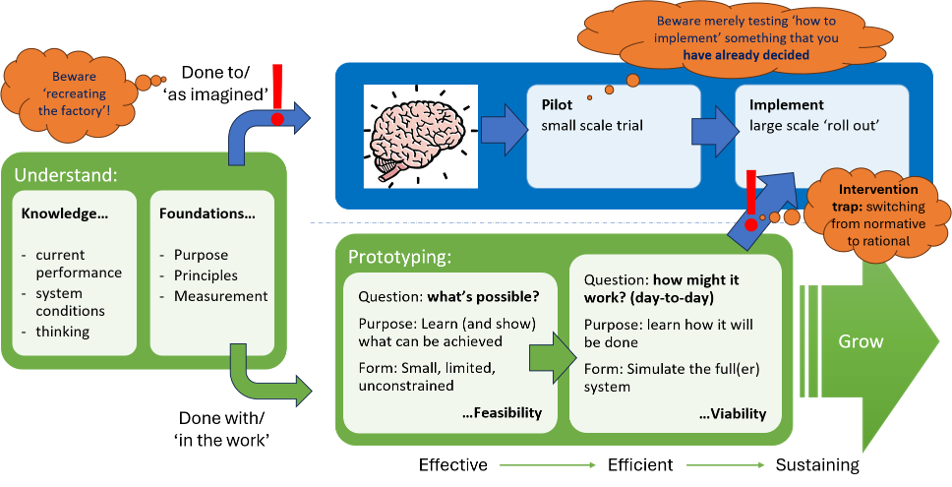
Starting on the left:
Understand the current (or, per Ackoff, ‘Formulating the mess’):
- get knowledge about the current performance of (whatever you are imagining as4) the system and most importantly why it is like this (ref. system conditions and thinking)
- be clear on the foundations for any design5: What is the (customer) purpose? What principles need to be strived for/ met? How would you measure against purpose and principles?
The diagram then contrasts two different horizontal routes out from this understanding:
Route 1) The conventional ‘done to’ (in blue), where ‘the brains in the centre’ attempt to apply the current management fads and fashions onto the work system, usually by way of a pilot6, and then a roll out.
I’ve previously written posts cautioning against this: e.g. Rolling, rolling, rolling… | Squire to the Giants
The diagram provides a couple of warnings:
- ‘Beware recreating the factory’ refers to a great quote by Robert M. Pirsig, reproduced in footnote 7
- ‘Beware merely testing how to implement your idea’ and, in so doing, presupposing the idea is a good one
Route 2) The systemic ‘done with/ in the work’ (in green), of prototyping with real people and real cases, to learn what works (effective) before learning how to grow this (efficient and then sustainable). You’ll see the feasible and viable steps as per Ackoff’s idealised design constraints.
The diagram then references a final (and sneaky) trap where, having done fantastic prototyping, ‘management’ (in a rush for results) switch tracks and attempt to roll out rather than grow their design.
Here’s a past post on the power of experiential learning: People don’t change their minds! | Squire to the Giants
In short, the people doing the work need to be involved in the learning about what works and why.
A summary:
- Start with purpose, not problems
- Many constraints aren’t really constraints
- The question isn’t a simple ‘what the system should do next’; it’s a constant ‘what the system ought to be’
Footnotes:
1. Thanks Kim for prompting the thought. It turns out that I just need a good prompt to make a post ‘fly off the page’….something I already knew…but really nice to have it happen again. It’s been a while.
2. Source: These quotes are taken from Ackoff’s ‘A brief guide to Interactive Planning and Idealised Design’ (2001)
3. Definition of a technology: I’m using the broad definition of ‘technology’ (and I think Ackoff is too), not just information and machine technology.
The Greek ‘tekhno’ meant skill. Nowadays we use the word ‘technique’ – which refers to a skill of any sort. There’s technique to cooking, origami, yoga… and, as such, all of these are ‘technical’. To do them well, you need ‘technique’, or skill.
‘Technology’ is a tool that embodies a technique. The ‘logy‘ bit is derived from the root ‘leg’, meaning to collect i.e. a technology is about ‘collecting’ (capturing/ harnessing) a skill.
4. What’s a system: A reminder that the concept of ‘a system’ is a sense-making device to help you and others explore aspects of the world, to better understand and hopefully move it in ‘better’ directions. If you want to understand this point better, then please read Section 3 of measurement-of-performance-education-document-version-1.1.pdf
5. Foundations: where purpose, principles and measurement against them are design-agnostic. i.e. you could try many different designs and assess them against these same foundations.
6. Pilot vs. Prototype: “Prototyping is about building to learn, about making something real enough to use in order to see what happens…the purpose of a prototype is the engagement, the learning, and the interaction it generates.
A prototype is not a pilot.
- In a pilot, a new idea is tested at small scale: it runs at arm’s length and then the results are analysed.
- Prototype is a verb: it is an active process – we are in there, observing, playing roles, taking apart and remaking.
A good prototype helps us to suspend our current reality for just long enough for something else to emerge. Some things work and others don’t. Sometimes something fails, but in the process we get our best insights.” [Hillary Cottam, Radical Help]
7. Quote: “If a factory is torn down but the rationality which produced it is left standing, then that rationality will simply produce another factory.
If a revolution destroys a government, but the systemic patterns of thought that produced the government are left intact, then those patterns will repeat themselves…
…There’s so much talk about the system. And so little understanding.” (Robert M. Pirsig)

