Tampering

FunnelAny of you reading this who have been on my Systems Thinking course will have had the fun of being involved in Dr Deming’s famous red bead experiment.

This post is about Dr Deming’s other (not quite so famous but equally important) Funnel experiment. The experiment teaches about the harm caused by ‘Management by Results’ (MBR) …where this occurs through tampering.

Here’s the experiment set up:
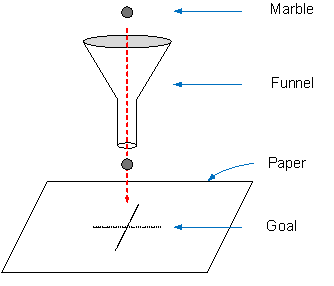
Funnel experiment set upWe have a flat horizontal surface (let’s say a table) with a piece of paper placed on top of it. We also have a kitchen funnel (like we would use to decant a liquid from one bottle to another), and a marble that we will drop through the funnel towards the paper below.

Let’s assume that the funnel is held upright in some sort of stand, say 50cm above the piece of paper.

Now we mark a cross in the middle of the piece of paper.

Goal: to hit the cross with the marble by dropping it through the funnel.

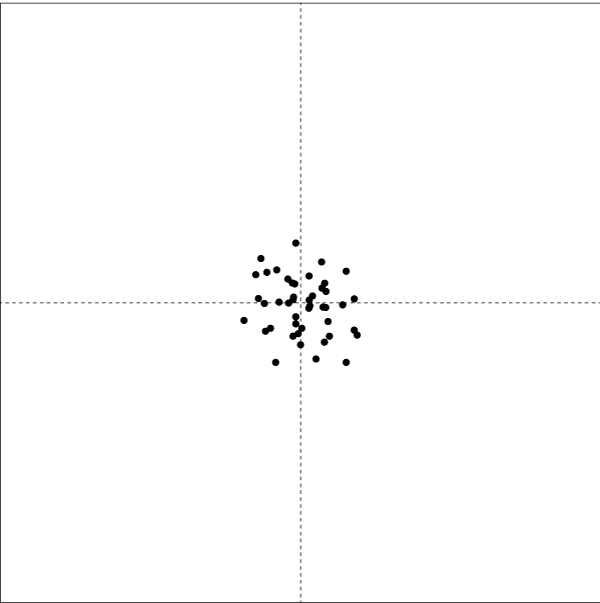
Round 1: We position the funnel over the cross and then drop the marble through the funnel 50 times. For each marble drop, we mark the spot on the paper where it hits.

We are likely to see something like this on the paper (looking from above):

nelsons-funnel-stable

Remember, we simply dropped 50 marbles without attempting to make any changes in-between drops and the paper shows the system to be stable. However, note that there is variation as to where the marble landed. It continually landed near the cross (with probably a few direct hits) but there was variation.

Round 2: So this time, we think that by adjusting the position of the funnel between each marble drop, we can ensure that the marble hits the cross on the next drop!

So we drop the 1st marble, note where it lands as compared to the cross and then move the funnel to compensate for this error. i.e.

  • if the marble landed 1 cm to the left (west) of the cross, we move the funnel 1cm to the right (east) of its current position….because this ‘fine tuning’ will make the next drop hit the cross, right?;
  • if this 2nd marble lands 2cm below (south of) its new position, then we move the funnel 2cm north from where it is currently positioned;
  • ….and so on, iteratively moving the funnel

So, what happens after we use this approach with our 50 marbles, iteratively adjusting the funnel’s position after each drop?

Well, it’s somewhat disappointing!
nelsons-funnel-adjust-to-target-1

Our attempts at compensation have made the variation increase drastically (experiments show by approx. 40%). We’ve made things much worse.

Clearly our ’round 2′ method of compensating didn’t work as we wished. Is there another way of compensating and therefore getting better at hitting the cross?

Round 3: The new idea is to do the opposite of the last idea! This time, we will move the funnel directly over where the last marble landed and keep doing this for the 50 drops.

Oh dear, the marble is moving away from the cross and will eventually move off the table and (as Deming put it) all the way “off to the Milky Way”.

nelsons-funnel-drift-1

Perhaps using the last marble drop as a guide isn’t a good idea!

Conclusions: So which method was best?

  • Round 1 was clearly the best.
  • Round’s 2 and 3 are examples of tampering (though in different ways). They show the effects of tweaking a process based on the ongoing results of that process…it will simply increase the variation and the chances of failures.

So, what should we do? To actually improve a process requires an understanding of the sources of the variation…and then the performance of controlled experiments to identify process improvements.

For our Funnel system we could experiment with:

  • lowering the funnel;
  • decreasing the size of the funnel hole;
  • strengthening the stand holding the funnel to make it more stable;
  • …performing the process in a vacuum 🙂

All of these proposed improvements involve changing the system rather than merely tampering with it based on previous results.

So what?

Now all of the above looks like good fun…I’m already thinking about borrowing a funnel…but it seems an awful long way from our working lives. So let’s explain why in fact it’s not…

Taking the production/ selling of something, let’s say a sandwich shop as an example:

  • you sold 10 sandwiches on Monday, so you make 10 for Tuesday..
  • you only sold 2 sandwiches on Tuesday, so you throw 8 in the bin (not fresh anymore) and you only make 2 sandwiches for Wednesday….
  • you have 6 customers on Wednesday, so you sell the 2 sandwiches you made, have 4 disappointed would-be-customers but make 6 sandwiches for Thursday…
  • …and so on. You can expect to have major stock problems and a lot of unhappy customers!
  • it would be much better to make a set number of sandwiches each day, collect information about demand variation over a sensible period of time and then adjust your system accordingly.

The sandwiches are a very simple example of any process. What about taking a call centre as an example:

  • There will be a great deal of natural variation in customer calls throughout a day (with a number of causes, categorised and explained in this earlier ‘Spice of Life’ post)…so the number of ‘calls waiting’ will constantly fluctuate, though likely between predictable bounds. No surprises there.
  • …let’s assume that Bob’s job is to constantly monitor the current ‘calls waiting’…
  • …it gets to a point where Bob thinks the number of calls waiting is high…so he sends out an urgent request for everyone to drop what else they are doing and get on the phones…and they all rush to do so…
  • ….so the number of ‘calls waiting’ now drops really low and even disappears…excellent. Now Bob sends out a screen pop-up message along the lines of “panic over, people who missed out on their breaks can go now”
  • ….so the number of ‘calls waiting’ now jumps up again…and the up-and-down cycle continues.
  • Bob has a really stressful job looking at the numbers and continually tampering (using the ’round 2′ method) in a hopeless attempt to exactly match supply to demand.
  • A better way would be to increase our understanding of the system by studying demand (its types and frequencies) and amending its design based on what we learned. There might be:
    • loads of failure demand in there (which is a waste of capacity); and
    • frequency patterns within the different types of value demand

Clarification: Many of you working in contact centres may say “but Steve, of course we analyse incoming calls and look for patterns!” I would note that:

  • whilst you can, and should, look for predictable patterns in the data, I doubt that you can tell me how many calls you will get in the next 15 minutes and how long they will take. There will be variation and this is outside your control….does this make you tamper?
  • Nearly all contact centres simply see incoming calls as ‘work to do’ with an ‘average handling time’. Hardly any will analyse this demand. Can you tell me what types of value and failure demand you get, and their frequencies…and what conclusions you draw from this?

I’m not picking on contact centres – I simply use it as an example that we should all be able to understand. Tampering happens all over the place.

In general, managers often look at the results of the last hour/ day/ week/ month* and attempt to make adjustments accordingly, whether by congratulating or berating staff, moving people between queues, changing work quotas, knee-jerk reacting to defects and so on.

(* where the unit of time will depend on the nature of the transactional service being provided)

In fact, praising someone one week for a perceived outstanding result (likely against the lottery of a target that they had very little control over meeting) and then giving them a ‘talking to’ the next because their result was considered poor is tampering.

The point is to understand the system and the reasons for variation. Then (and only then) you can make meaningful changes instead of merely tampering.

Note: The ‘Round 3’ type of tampering is not as common as the ‘Round 2’ type…but it does happen. Consider the following cases of using the last example to inform the next:

  • Using the last board cut as a pattern for the next; or
  • Train the trainer: Mary trains John who trains Bob who trains Jess.

Both of these examples show that any variation from purpose will be retained and amplified as it is passed on, like a chain of whispers.

Credit: I’ve seen the funnel experiment performed a few times now but, rather than taking the laborious time to recreate it, I have borrowed the 3 marble drop pattern pictures used above from this website.

Note: For those aficionados amongst you, this post represents a slightly simplified version of Deming’s full funnel experiment. There is yet another tampering rule (which I have left out for the sake of brevity) …but, just so you know, it also doesn’t work. You can read all about the funnel experiment in Chapter 9 of Deming’s book ‘The New Economics’.

How to have a successful journey

photo-winding-roadMike Rother, in his excellent book ‘Toyota Kata’, explains that ‘command and control’ organisations see the ‘implementing’ word as a very positive one but that their obsession with it actually impedes their progress and the development of their people.

To explain what is meant by an implementation versus a problem solving mode:

Implementation mode (‘Go fast to go slow’)

This mode can be characterised as:

  • The need for a clear and (usually overly) simple ‘solution’ up front arrived at by some expert(s) a la “we have the answer!”;

(where this answer is normally derived from copying what others have already done);

  • A detailed plan (the more lines on the Gantt chart, the better!) that sets out exactly what needs doing, when, and by whom to implement the answer;
  • A target date (along with some incentives), established to motivate (!) people to put on their ‘implementation’ blinkers…nothing must get in the way;
  • A finish line mentality – “we got it in!…now let’s move on to something else.”

…in reality:

  • The above requires the organisation to assume everything is ‘steady state’ (which includes ignoring the effects of the rest of the system on the component(s) in focus);
  • However, there is continual change both inside and outside the environment (which may or may not be noticed…and which is unlikely to be understood);
  • It is impossible for us to predict what will actually eventuate;
  • We spend vast sums of money trying to shoe horn our answer into this changing reality, often years after it was conceived;
  • There has been very little meaningful learning and development going on!

“Humans have a tendency to want certainty, and even to artificially create it, based on beliefs, when there is none. This is a point where we often get into trouble. If we believe the way ahead is set and clear, then we tend to blindly carry out a preconceived implementation plan rather than being sensitive to, learning from, and dealing adequately with what arises along the way. As a result, we do not reach the desired destination at all, despite our best intentions.” [Rother]

Problem solving mode (‘Go slow to go fast’):

There are three things we need to know with certainty (none of which is to know the answer up front!). These are:

  • Where we are (current condition);
  • Where we want to be (target condition); and
  • A method by which to manoeuvre through the unclear territory in-between

Some key points to make:

‘Where we are’ means that we really understand our current condition, which includes why we are like this (i.e. the system conditions and management behaviours that make it so).

‘Where we want to be’ doesn’t mean “we want to have implemented x”. That’s just the implementation mode by another name. It means clearly stating a target condition (our challenge towards purpose): how should the process operate i.e. can we describe this in terms of relevance to the customer and the process performers. This description can’t know how it is to be achieved….this will unfold via…

…the ‘method’ (experimentation), which IS clear. The experiments themselves will not become clear until we progress step-by-step through the obstacles within the unclear territory.

“True certainty and confidence does not lie in pre-conceived implementation steps or solutions, which may or may not work as intended, but in understanding the logic and method for how to proceed through unclear territory.” [Rother]

So what’s the point?

Too many ‘projects’ are merely the implementation of a new technology or ideology (that someone has been convinced they need) with:

  • a reverse-engineered ‘business case’ that attempts to justify what should be achieved from ‘putting it in’; and
  • a grand plan with supposedly certain time, scope and cost.

Such projects regularly fail, sometimes spectacularly and even if they ‘complete’ (whatever definition they use for this word), there has been little value added or learning achieved….in fact they often (usually) destroy value and repeat the same errors and pitfalls as the last project and the one before that.

Instead, we should adopt a mindset of:

  • being really clear on what we are trying to achieve (in respect of customer purpose); and then (and only then)
  • work our way towards this ideal through a series of steps:
    • learning as we go; and
    • deciding the next step (the how) as we learn, adapt and ‘see’

Okay, so I’ve ‘scratched the surface’ of the idea that a brilliant implementation plan is not the answer. For those that would like an excellent analogy to think about this, here’s a useful (and short) post: The difference between launching a rocket and driving a car.

We should know ‘before we leave the house’ what our intended destination is, why and how we would know how we are going towards it…and we should steer our way there (unconstrained) as we meet the unknown obstacles on the way.

There would be little point in claiming ‘completion’ because we had spent our quota of time, distance or cost if we hadn’t actually arrived!

Have I got a deal for you!

usedcarsalesmanWhich industry are we really suspicious about, and is the butt of jokes around the world? How about the car salesman?

So why do you think we are so suspicious?

Here’s what we might experience:

  • A rather smooth operator who appears to ask you about what you want but, surprise surprise, “has exactly what you are after”…which, funnily enough, happens to be what he’s got in stock!
  • A personal business card handed over, encouraging you to give him a call whenever you want…but use his direct number: “remember me, my name’s Jim”;
  • Some desperate moves from Jim as you attempt to leave his car yard, saying things like “I can only offer you this fabulous deal today”;
  • …but when you have left the yard, multiple calls from Jim asking how you are getting on and saying that things have changed for the better…so come on by so that we can discuss “…and remember to ask for Jim”;
  • …and if you ring back for Jim but he isn’t available, his ‘colleague’ Bob gladly (yet slyly) takes over the deal, perhaps saying “nah, no need to tell Jim, I can handle it from here!”;
  • Strong attempts to ‘sell you some extras’ like finance, warranty, a tow bar and so on…even when you’ve made clear that you really don’t want them;
  • Assurances that “yes, don’t worry about it – everything works…and if, in the unlikely event you have a problem, just bring it back in and we’ll sort it”;
  • …and if you end up making a purchase, some strange ‘paperwork’ going on to make the deal look a certain way:
    • perhaps trying to bring it forward or put it back (end of the week/ month/ year);
    • perhaps trying to play around with how the figures look

….you might be able to add a whole heap more experiences to the above!

Actually, car salesmen are nothing compared to big financial services business. Let’s move across to the UK Financial sector and have a look at the carnage of the last few decades:

  • the 1988 – 1994 Personal Pension miss-selling scandal in which salespeople on commission persuaded vast numbers of people to trade in generous and safe(r) company pensions for riskier and costlier alternatives. The resultant compensation scheme forced on the industry involved the review of 1.7 million consumers, over 1 million compensation payouts and a total cost to the financial companies involved of £12 billion; (Source of figures here)

  • the 1990s and 2000’s Payment Protection Insurance (PPI) miss-selling scandal in which banks and other financial institutions offered sales incentives to increase the take up of payment protection insurance…which led to a range of miss-selling practises including: putting pressure on customers to buy it in order to secure a loan; failing to make it clear that it was optional; selling to people who were actually ineligible; and even adding it to a loan without the customers consent or knowledge. The resultant compensation scheme forced on the industry (spot the pattern?!) saw the ombudsman receiving “5,000 complaints a week” and payouts being made of more than £15 billion. (Source of figures here)

  • …and on and on (the Endowment Mortgage miss-selling scandal, the Credit Card Protection insurance miss-selling scandal….)

They all shared the same ‘miss-selling’ credentials

  • aggressive, ignorant or incompetent sales tactics,
  • a failure to appropriately advise customers, and
  • deliberate strategies to sell financial services that customers do not need;

So, what’s the common ingredient?

Well, that would be the offering of sales incentives (contingent rewards).

The point is that, if you offer sales incentives, you can virtually guarantee that you will cause dysfunctional behaviour that goes against your (stated) ‘customer’ purpose.

Remember that a valid purpose statement should say something about “helping people…” It does not say “sell what you can to them”. We need to remind ourselves about a system and that ‘sales’ is but one component of it.

If you offer sales incentives, you can expect the system to ‘bite back’ in the form of undesirable discounts and terms given, failure demands from customers contacting you again, cancellations, complaints, debt collection costs, returns and after service costs… all of which will be un-measurable back to your brilliant sales incentive scheme.

You can of course try to put in place ‘compliance’ controls to monitor all these ‘side effects’ but a) you won’t catch the majority of them and b) this is just an additional (and expensive) layer of costs, and waste.

The sobering thing about the UK financial service miss-selling scandals is that the eventual costs dwarfed the original supposed sales benefits! What a huge waste.

If you offer sales incentives, you can expect:

  • people to try to sell what they have in front of them, rather than what the customer wants, or actually needs;
  • a strong desire to ‘get the sale’ and ‘move on’ to the next ‘lead’ meaning that less care is taken explaining the product and what it is and isn’t;
  • ‘dodgy sales’ made, which should never have occurred (i.e. were inappropriate and/or were not desired)

If these incentives are to individuals, you can expect reduced co-operation between ‘colleagues’, who are now in competition for those elusive sales…even leading to sabotage.

Such competition will actually harm, and prevent those many sales that would have occurred because of co-operation between colleagues.

If these incentives are for particular products, you can expect other products to be ignored, and even denigrated in favour of chasing the reward…even if the non-incentivised product was what the customer actually needed.

If you add targets to achieve these incentives, you can expect games to be played:

  • if I am near my target in a given period, I’ll do some creative things to creep over the threshold (perhaps offering discounts and giving things away for free that I shouldn’t be);
  • if I have achieved this period’s target, I might try to defer a sale to my next period, which, again, may not be what the customer wants and clearly distorts information about demand.

And, given that the customer isn’t daft, they ‘feel’ the sales process as opposed to experiencing someone that actually cares about them…providing an awful experience and a massive (yet missed) hit in reputation.

There’s nothing ‘rocket science’ about the above. We all know and recognise it (it happens to us as customers and we hate it!)…yet many of us still work in management systems that think that sales incentives are a good idea.

An important clarification:

If you think that the bad practices described above are only carried out by a handful of ‘bad people’ then you don’t understand human psychology. In fact, the majority of people are having to play a ‘game of survival’ within their incentivised ‘meet target’ management regime and feeling pretty bad about it too…it certainly doesn’t meet their much talked about personal purposes. You’d have to be a pretty strong person to go against the system…and you might not last long in such an organisation if you do!

It’s not a case of ‘bad people’…it’s a case of ‘good people’ having to work in a ‘bad system’….which brings to mind Deming’s quote:

“A bad system will beat a good person every time.”

To close: Going back to our car salesmen opening, most dealers assume that they won’t shift cars without sales incentives. John Seddon, in his latest book ‘The Whitehall Effect’, refers to a Canadian auto dealership client that:

  • studied their system;
  • revealed the tricks used by the salespeople to make sales and gain the incentives; and then
  • understood the resultant negative impacts on the customer.

They removed sales incentives, set out a customer brochure describing all the industry sales tricks and promised that none applied here. Salespeople now co-operate with each other, customer trust improved, sales went up and long term customer relationships were forged.

The Emperors Clothes

emperors_new_clothes_550There are some funny conversations going on around me at work at the moment. I can hear sentences starting with:

“Now, I don’t agree with it either BUT…; or

“Let’s just muddle through and see what we can come up with…; or

“Let’s try and make this a painless as possible…; or even

“Let’s just pretend to play the game…

What’s this all about? Well, it’s ‘end of year’ time at work and the performance review show is just ramping up. I can feel it all around me. The words quoted above are what I can hear from managers (appraisers) when talking with their teams (appraisees).

These bizarre yet established conversations aren’t new to this year. I hear them every year.

The children’s story ‘The Emperors Clothes’ springs to mind. Everybody knows something important but can’t bring themselves to tell the Emperor….so they carry on with the charade.

I feel like the little boy in the story who dared to say something….and here it is: An Exercise in Futility.


Of note: All these managers do want to talk to their teams but not through an annual judgement exercise.

Falling into that trap!

BearTrap_01.jpga203455b-ef09-4c5a-be36-5fe7351fd23fLargeSo I cycle to work when I can. It’s approx. 22km from one side of the city of Christchurch to the other, right through the middle. I (usually) enjoy it immensely.

I upgraded my cycle computer a few months back to a fancy new GPS one. It’s got this cool screen that tells me lots of information. I can also download each cycle ride’s data onto my computer to analyse later – perfect for a geek!

I’d been using this computer for a few weeks and was starting to get an understanding of my average km/ hour for each trip. Sometimes I could get it into the 27 km/hour range, other times I could only manage 23 km/hour….and before all you MAMILs* out there guffaw thinking “how slow?!” the average speed takes into account stopping at lots of junctions (traffic lights, roundabouts, road works) and crossing busy traffic….not that I’m saying that I am fast.

(* MAMIL: middle-aged men in Lycra…and I must confess to being a member of)

Further, the computer tells me my average km/ hour at the bottom of the screen as I cycle. I can see it going up and down throughout the journey. If I stop at a junction I can see it plunge rapidly whilst I am sat idle and then if I cycle on a long flat straight I see it slowly rise back up again.

Now, I fell into the trap! I began to get distracted by the average km/ hour reading as I cycled. Without consciously thinking about it I set myself a target of completing each ride at an average of 25 km/hour or higher. The fact that I was doing this only dawned on me the other day after I performed a dodgy manoeuvre in my obsession to keep my average above the target… my sudden sense of mortality put me into a reflective mood.

Here’s what I reflected on:

What had I become?

  • I had started to look at the average km/ hour reading all the time and obsess about it dropping below the magical 25;
  • If I was stopped at traffic lights, I watched the average km/hour reading sink before my eyes. I was then in a mad hurry to get off so as to get that average back up again as quickly as possible:
    • which meant that I was trashing my legs and blowing them out too early in the ride…
    • which put me at huge risk of pulling a muscle/ injuring a joint whilst piling on the pressure to get back above that target…
    • which meant that I didn’t cycle the next day because I couldn’t!
  • If I was ‘on the cusp’ of the target and coming up to a junction then I was starting to do dangerous things in order to keep going, like running orange lights or crossing lanes in between cars;
  • Even more bizarrely, I had unconsciously started to cheat!
    • I had changed my behaviour to only turning on the computer after I had got going from my house because the few seconds getting up to speed from rest might count!
    • If my average was 25.0 as I got to work I would turn the computer off before I came to a rest…so that it couldn’t drop down to 24.9 as I slowed…because that would have meant failure!
  • Conversely, if I was well above the target (let’s say because I had a good tail wind or I had been really lucky with the light sequences), then I was pretty happy and relaxed…no need to push since I was ahead. I could have gone faster.

Reading the above, you may think me to be a bit of a nutter! Did I really do those things? Well, yes, I did…and I can honestly say that the 25 km/ hour target that I had set myself was to blame.

Now for those of you who have been on one of my courses or who have read the majority of posts on this blog, you will likely have a good laugh at me – “he bangs on about the evils of targets all the time!”

So, getting away from my target:

What is my actual purpose in cycling to work?

On reflection I came up with the following:

“To safely cycle to work so that I get fitter and I use the car less.”

Three things come out of this purpose:

  • Fitter: I wanted to get better at it
  • Use the car less: I needed to be able to cycle consistently, day after day
  • Safely: there’s no point in getting killed or badly injured cycling!

This clarity of purpose has helped me drastically change the way I cycle!

Thinking about variation within the system:

In this case, the system is the cycling to/from work and the conditions I encounter in doing so. One cycle ride is a single ‘unit of production’. I should be thinking about the capability of the system (about how all units go through it), not about a single unit.

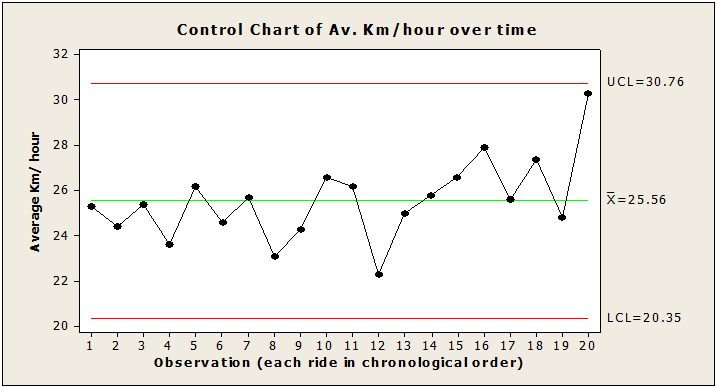
Here’s a control chart showing the variation in the last 20 of my rides:

bike control chart

The control chart enables you to visualise what a table of data can’t…that my riding is stable. It shows the meaninglessness of the target and variance analysis.

The following are the more obvious causes of variation:

  • Head wind or tail wind (makes a huge difference!);
  • Wet or dry weather;
  • Heavy or light traffic;
  • Whether the traffic light sequences are with me or not;
  • …and so on

Some special causes might be:

  • An accident;
  • Road works

…although if you live in Christchurch you will know that there’s nothing special about road works !!!

You can see that it would be bizarre for me to achieve the same average km/ hour every day. Going back to that target: Some days it will be impossible for me to hit the 25, other days it will be really easy…and that’s without me changing anything about my riding.

Note: Looking back at the control chart, you might think that you detect an improvement from around ride 15 onwards. In fact, it was at around ride 15 that I had my ‘I’ve fallen into the target trap’ epiphany….so, yes, there could be something in that. However, you should also know that whilst ride 20 looks fantastic (it was), I had a massive Nor’ Wester wind behind me literally pushing me along.

What can I experiment with to increase my capability?

The first thing I need to do is STOP LOOKING at the average km/hour as I cycle. Then I can consider what I can change about my cycling for every ride.

Since ride 15 I’ve begun to experiment with:

  • Junctions: looking well ahead and adjusting my pace to time myself through them so that I reduce the need to slow down/ stop
  • Pedalling: trying to pedal more smoothly and efficiently
  • Crossing lanes: improving my balance when looking behind me so that I can safely do this whilst retaining my speed with the traffic
  • ….and so on.

Each of these changes will lead to small improvements on every ride, no matter what the conditions are. It’s not about the current unit, it’s about every unit.

Results?

Well, it’s too early to draw valid conclusions (I need more data), and it’s a never ending journey of improvement BUT I can say that I am cycling more often (because I didn’t wreck my legs the day before) and I’m having far less ‘that car’s a bit too close for comfort’ moments.

So what’s the point?

Targets cause dysfunctional behaviour. As Simon Guilfoyle makes clear:

“As a ‘method’ [Setting a target] is rubbish because it disregards the capability of the system and natural variation. … It assumes that the system knows the target is there and will respond to it (it doesn’t and it won’t!) It ignores the fact that the greatest opportunity for improving performance lies in making systemic adjustments rather than berating, comparing, or otherwise trying to ‘motivate’ the workers to achieve the target.”

‘No targets’ doesn’t mean ‘no measurement’! In fact, it’s quite the reverse. It means actually studying meaningful measures (i.e. against purpose) over time (via a control chart), understanding the capability of the system and therefore truly understanding whether it is improving, staying the same or getting worse.

Do you have targets? So what dysfunctional behaviours do they cause, moving us away from purpose?

Chalk and Cheese

Chalk-and-CheeseLet’s compare two organisations (or departments within):

In one (let’s call it Cheese – I like cheese…it matures into a lovely outcome):

The senior manager is curious as to how to get the best out of the system, for the good of the customer. She has understood that, to achieve excellent results, the organisation must continually work on the causes of those results.

She questions her own learning’s to date, always looking to expand her knowledge and amend her ‘worldview’, seeks counsel from others* and (once suitably skilled) actively coaches the people that work within the system. She has the humility to realise that her role is to lead, not to know the answer.

* such counsel comes from meeting the process rather than a reliance on the  senior management team.

This mentality has become the way that all her managers now think and operate and, because of this, they have removed all ‘management instruments’ that get in the way of collaborative system-wide thinking.

They don’t believe that the ‘answers’ are out there, to be found and copied from other organisations or consultancies selling the ‘current best practise’.

Instead:

  • they identify measures that demonstrate the system’s capability at delivering value to their customers (making these transparent to all) and they monitor these measures over time to understand variation and any progress.
  • they constantly work to understand their current condition, set themselves challenges (target conditions) that, when achieved, would be good for their customers and then move towards these goals through experimentation and learning.

They accept that their path will be unclear…but they are clear on what they want to move towards, why and how they are truly doing.

And, because of the above:

  • everyone is engaged in a collaborative effort towards a clear purpose (for the customer);
  • there is transparency for all within the system;
  • there is mutual trust and respect across the system; and as result
  • there is a high degree of commitment and engagement….dare I say ‘a thriving culture’ in which people want to come to work

BUT: it’s not perfect, it’s often rather messy…but learning is like that.

In the other (Chalk – crumbly, disintegrates…not enjoyable to consume!)

The senior manager has come across some improvement methodologies and guru books and has issued a directive that these will be implemented across the organisation.

A corporate team is set up to drive each implementation. Energy is spent developing and deploying presentations, training, tools, templates and methods of working. There is an implementation plan with activities, milestones and metrics. Benefits are to be ‘realised’.

Tweaks are made to incorporate the programme into the existing management instruments: objectives, performance appraisals, rewards, awards.

‘Operations’ (the various teams within) are then expected to enthusiastically embrace and absorb the ‘shiny new thing’ (along with the other ones that are regularly handed down from the brains above) whilst continuing to deliver against silo’d targets.

The corporate team responsible for the initiative ‘lives and breathes it’ as if its implementation is the most important thing…no surprise since their rewards are based on this.

A regular reporting mechanism is put in place to demonstrate adoption. Operations do what they can to categorise their actions as ‘evidence’ of their successful compliance, thereby pleasing those above and ‘proving that it was a good idea’.

So what’s the point?

  1. It’s not about ‘implementing’ a methodology (or two), it’s about a complete change in thinking;
  1. It about changing your management system rather than manipulating it;
  1. You can’t separate Operations from those responsible for actually managing the improvement of the system. (You have to be very careful about setting up a separate corporate team i.e. why you are doing this and how this will actually be of value!);
  1. You don’t start with an answer, you don’t ‘implement’, you never complete…it is a never ending journey with a clear purpose and an open mind.
  1. If senior management don’t truly get this, then there’s work to do – they need to understand their system for what it really is.

If you want to understand the above at a deeper level, I would recommend reading (in increasing order of length and therefore time commitment):

  • the essay ‘Modern Management vs. Lean Management’ by Jim Womack in his book Gemba Walks;
  • the prologue to John Seddon’s book called ‘Freedom from Command and Control’;
  • the book called ‘Turn your ship around’ by David Marquet

The 8th, and greatest, waste

performance-potentialI expect many of you sometimes sit back from your desk, sigh, and think something along the lines of:

“Blimey (polite version 🙂 ), I’ve got so much more to offer this organisation…if only they knew!…if only they properly utilised my particular talents and motivations”.

Each of our talents and motivations will likely be very different to one another but they are incredibly valuable.

So, what might happen if you took this ‘my value is so wasted’ thought further, along the lines of:

“Hey, why don’t I actually say this the next time that I meet with my Manager!” (or is that Leader? We seem to be confused by these two words nowadays)

What do you think his/ her response would be?

This brings me to something which seems to be all pervasive within a hierarchical ‘command and control’ organisation…I expect that you would hear the following response:

“but you are responsible for your own development!”

I’ve heard this at a few organisations throughout my ‘career’ and it has always made me deeply uncomfortable…not because I don’t want to further myself (I absolutely do¸ always have and always will….but not necessarily in the ‘go up the greasy money-and-power pole’ way that might be implied).

It makes me deeply uncomfortable because this “it’s your responsibility” response:

  • is so lazy and convenient! It sidesteps the need for management to think about why the person feels this way and what is preventing the organisation (and its customers) from benefiting from their potential;
  • misunderstands, or worse, ignores the huge role of the management system in what an individual can achieve;
  • demonstrates an abdication of responsibility* by the management above as to their role in understanding and developing their people and in enabling them to thrive;

(* as in “Your development is not actually my problem! I might ‘throw you a few bones’ but take control of your own destiny…I did and look at me!”);

  • really means “impress me (the manager)”…where this is more about them than you.

Essentially, you have to do things that they want, rather than things that are in fact of value…and you certainly aren’t being encouraged to think for yourself, be bold, courageous and different.

The “it’s your responsibility” response completely bypasses the actual role of management – “to change the system rather than badgering individuals to do better” (Deming)

Curiously, the higher you succeed in climbing an organisation, I suspect the greater the risk of hubris and the belief that you got there almost 100% because of you! And therefore the most likely you are to want to deny the effects of the system on what you (as compared to others) were enabled to achieve.

Indeed, if you operate in a command-and-control organisation and are good at playing the necessary game, you may very well ‘go far’…but is this ‘game playing’ actually good for the organisation and, ultimately, towards its purpose? I think not.

The frustrating thing is that the command-and-control management system works very well for those at or near the top and any rational analysis of the waste caused by their management system is likely to be met with denial.

As a result, the only way that change is likely to occur is through those leaders studying the system, obtaining meaningful knowledge as to how it operates and working it out for themselves.

This doesn’t mean that it is hopeless for the rest of us: the more we help those same leaders look at the system and how it actually works then the more likely they are to ‘see’.

Note: The title of this post refers to Taiichi Ohno’s original ‘7 wastes’ and the fact that an 8th overarching waste has been added – that of the waste of untapped human potential.

This 8th waste will be huge within a command-and-control paradigm. 

Worse than useless

ChocTeapotI’ve recently got back from visiting family in the UK. Whilst there, I noticed things that had changed since I left 7 years ago. This post is about one particular change in service businesses that stood out to me.

During my visit I travelled the length and breadth of England, staying in hotels, eating in restaurants and buying items in shops – my credit card took a real hammering!

It struck me that many of these service businesses have put in place some very unhealthy practices around asking customers for feedback.

Let me explain with an example:

The hotel

We stayed a few nights in a (budget chain) hotel on the edge of London – nothing flash: A basic family room for four, breakfast included and parking for our hire car.

Overall the place was pretty good – well worth the price we had paid. However, during this stay there were the odd things that we noticed that could have been better. For instance:

  • The onsite parking was rather confusing: we had pre-paid on the internet but it wasn’t easy to show this. It took a few phone calls and some explaining to partially satisfy us that we weren’t going to get towed away for non-payment;
  • My boys complained to us that the sheets on the extra beds put into the room for them were cheap and scratchy…which they really didn’t like. I told them to ‘take a concrete pill’; and
  • The scrambled eggs at breakfast had clearly sat around at the buffet for far too long and had become a bit ‘plastic’, dare I say chewy.

At the end of our stay we went to reception to hand in our room key. A very nice chap behind reception thanked us for our stay and then told us that we would be receiving an email with a link to a survey asking us to rate our stay using scores from 1 – 10. He went on to quietly inform us (as if it was secretive information) that:

  • if we scored 9s or 10s then these counted as a positive for them;
  • if we scored 8s, these were neutral – no good to them; but
  • all scores of less than 8 would count against them. He gave us the clear impression that this would be in monetary terms (i.e. affecting their rating and therefore bonuses for this month)

Some very clever manager at head office (who had probably been to ‘management school’) had tied the collection of customer feedback with contingent rewards for the workers. Clearly a believer in the brilliance of extrinsic motivators.

Now, before I go any further, if you are a fan of contingent rewards you may cry out that the employee shouldn’t have told the customer about the scoring and its effects! But think about that for a minute – do you really expect your employees not to engage in the games that you are playing on them?

As Goldratt wrote: “Tell me how you will measure me, and I will [show] you how I will behave.”

Further, let’s just assume that the employee hadn’t told me about the scoring system: Management have shown no understanding of the variation in customer demand (one person’s 5 is another person’s 9) – meeting these targets is a lottery that the employee is, understandably, trying to influence in his favour by confiding in us.

So what do you think this scoring knowledge does to the customer, and for the company?

I can tell you three things it does to me:

  • First, given that I am a human being, it makes me feel a little bit sorry for the really nice chap behind reception who established a rapport with us and served us excellently. We understand that he probably has very little ability to improve our stay any further…and so we want to give him a good score, an 8 or 9 so that it doesn’t count against him*.

 But this isn’t what we really feel. I was thinking of a 6 or 7…along the lines of ‘it was all right but not mind-blowing’.

So the company collects distorted information telling it that it is doing better than it is…and will draw incorrect conclusions accordingly. 

  • Second, I also feel a bit used by the employee telling us about the scoring and the likely outcome. So I now think worse of the company for putting in place such a system which has ended up manipulating me. I almost feel dirty for being involved in this subterfuge!

 So I am now turned off this company for making me feel this way by their management practices. 

  • Third, I walk away without providing any verbal qualitative feedback on my stay.

So the people who need to know have gained no understanding of my three highly useful pieces of qualitative feedback (the parking, scratchy sheets and plastic eggs)

I can almost picture the confusion at the senior management team meeting where the CEO is asking his Executive team:

“But how can we be performing so poorly when our average customer feedback score at each of our hotels is 8.27?!”

In summary, the company:

  • has collected a score for my stay that is likely incorrect and misleading;
  • has annoyed me because I feel manipulated…which may lead me to look elsewhere next time (and tell my friends the same);

yet (most importantly)

  • the employees are totally blind as to what could have been better and hence cannot improve.

The customer feedback score is worse than useless!

The knowledge required to meaningfully improve is in each and every piece of qualitative customer feedback…it is not in a monthly average score.

* This behaviour has been reported in many other similar service situations. My hotel experience is but one example. Put in general terms: the employee quietly tells the customer that their feedback score will be ‘used on them’ by their company and pleads for the customer to be kind. As humans we can’t help but want to help them out yet also feel annoyed about this manipulation of us.

Just in case you hadn’t got the picture at the top: it is of a chocolate teapot…which is worse than useless…a bit like linking contingent rewards to customer feedback.

POSIWID

download (1)Professor Stafford Beer wrote that “the purpose of a system is what it does.” which is often stated by its acronym of POSIWID.

This is looking at systems via a kind of backwards logic. (See my earlier ‘harmony or cacophony’ post if you’d like to look at them going forward first!)

Another quote might help:

“Every system is perfectly designed to achieve the results it gets.” (Don Berwick)

Okay, so let’s see if these examples exercise your mind a bit:

 Example: Supposed purpose: (unintended?) Reality:
School (Teacher) Help our children grow into well rounded individuals capable of sustaining themselves in the world Train our children to pass tests on a specified curriculum and go up the ‘league tables’.
Parliament (Politician) Help deliver a better life for the electorate Get elected next time round/ get set up for a nice life ‘after’ politics.
Police Help keep us safe Meet targets for resolving reported crime and completing paperwork.
Call centre Satisfy the callers actual need (however long this takes) Deal with callers as ‘efficiently’ as possible (‘average handling times’).
…etc

In Stafford Beer’s words:

“The purpose of a system is what it does. This is a basic dictum. It stands for bald fact, which makes a better starting point in seeking understanding than the familiar attributions of good intention, prejudices about expectations, moral judgment, or sheer ignorance of circumstances.”

So, what’s the point? There’s a BIG difference in what we might like the purpose of our (organisational) system to be and what it actually is!

You can say that the purpose of the system is [XYZ] until you are blue in the face but, if this isn’t what it actually delivers, then by point of fact it ISN’T its (current) purpose.

How should we use POSIWID to assist us?

POSIWID is used to counter the belief that the purpose of the system can be understood purely from the intentions of those that design, operate or promote it. Complex systems (which organisations certainly are) are not controllable by simple notions of management. Interventions in complex systems can only be properly understood by observing their true effect on system behaviour.

This means:

  • listening to and observing demand*, particularly failure demand;
  • finding out:
    • what the system is currently capable of (using measures, NOT targets); and
    • how it actually works – get facts, don’t rely on opinions….which fits in perfectly with going to the Gemba; and
  • taking a scientific (open minded!) approach to interventions….which must avoid shonky experiments!

* a big part of the purpose of your system (at whatever level you define this) is to deal with the current demands coming into it….whatever they may be.

A final point on Management’s intent and Management controls

If we look above the value streams and observe an organisation’s management system, we are likely to see leaders saying wonderful things about respecting, empowering and supporting the process performers….yet people who work within a ‘command and control’ environment experience a set of management controls (cascaded personal objectives , numeric activity targets , contingent rewards , and performance appraisals ) that contradict and constrain these ideals.

“No matter what you say your values and beliefs are, the mechanisms of control define what your culture really believes about who can be trusted with what. [The desired management system] won’t work if you pay lip service to it.” (Mark Rosenthal)  

Note: Stafford Beer (1926 – 2002) was a theorist, consultant and professor and founder of the field of Management Cybernetics. He is another giant who, sadly, is no longer with us.

Blackmail

the-beatings-will-continueI’ve written about why cascaded personal objectives and contingent rewards aren’t a good idea.

Question: What’s the worst form of this practise?

Answer: A rigged game.

Now clearly, contingent rewards are set by those (hierarchically) above you so as to strongly encourage you to comply with their wishes. That’s the whole point. But we should be very clear that compliance should not be mistaken for motivation.

“Rewards and punishments induce compliance, and this they do very well…but if you want long term changes in behaviour…they are worse than useless – they are actually counter-productive.” (Alfie Kohn)

The rigged game explained:

Consider if the objectives being set and the carrots/ sticks on offer really mean the following:

Carrot: “We’ll pay you money for saying what we want you to say…which will then make us look good…and is effectively buying you.”

Or

Stick: “If you don’t act as we want, we will make sure that you will lose out and even be disciplined.”

If a politician did this, they would be hung out to dry!

There was an interesting article on Stuff recently regarding an Australian company (Cotton On) that could easily be accused of playing this rigged game. Here’s an extract of that article, referring to their HR department’s leaked* four page code:

Failure to portray “fun, entrepreneurial, keeping it real, family, ethical, engaged” behaviour was unacceptable, the Australian clothing chain said.

It could result in counselling, warnings or instant dismissal, according to the four-page code** which was leaked to Fairfax Australia newspaper The Age.

* you don’t have to be a brain surgeon to see why it was leaked…being told to have fun ‘or else’ is quite a message to stomach!

** the need for a four-page code speaks volumes about a lack of trust. (Does your organisation trust you?)

Surveys linked to rewards:

Another example of rigging would be if you ask people to fill in a survey and then link (some aspect of) their rewards to the results of that survey. You can’t say that the outcome of such a survey can be unbiased.

An organisation’s culture will not be understood from reviewing survey results that merely capture how people felt they were expected to answer. In fact, the reverse is the case – the results from such a survey will hide, distort and confuse… leading to ignorance of the true state of play and the wrong conclusions being drawn.

Attitudes:

I personally dislike the idea that an organisation thinks it needs to tell me what specific ‘attitudes’ I should be adopting at work. What is much worse (and moves towards the rigged game) is that I am then rated and rewarded according to their judgement as to how well I meet them! This is not far removed from the Cotton On example.

The only difference is that Cotton On were daft enough to spell out the ‘stick’ as opposed to concentrating on the ‘carrot’….but this misses the point that, in every carrot there is a hidden stick (that you can be denied the reward).

The crucial point:

Our behaviours are a result of the environment in which we find ourselves.

If you want me to be motivated, happy, collaborative, engaged, ‘real’ … [keep going with a long list of words in a dictionary that are blindingly obviously desirable!]…don’t tell me to BE these words…don’t blackmail me to SAY that I am these words….provide the environment such that I AM these words!

Oh, and the final crunch point: I (and most normal human beings) actually WANT to be motivated, happy, collaborative, engaged, ‘real’. I’d be weird if I didn’t. It’s down to the management system (which defines the environment that I work within) that determines whether I can be.

The above is perfectly reflected in the saying “the beatings will continue until morale improves”.

A clarification: I’m certainly not saying that attitude isn’t important. In fact, I think that ‘attitude’ is just about the most important thing there is for a human being!

Here’s one of my favourite quotes ever (I have it on my wall at home and at work):

“The longer I live, the more I realise the impact of attitude on life. Attitude to me is more important than facts. It is more important than the past, than education, than money, than circumstances, than failures, than success, than what other people think or say or do. It is more important than appearances, gift, or skill. It will make or break a company…a church…a home.

The remarkable thing is we have a choice every day regarding the attitude we will embrace for that day. We cannot change our past…we cannot change the fact that people will act in a certain way. We cannot change the inevitable. The only thing we can do is play on the string we have, and that is our attitude.

I am convinced that life is 10% what happens to me and 90% how I react to it. And so it is with you…we are in charge of our attitudes”. (Charles Swindoll).

It is this quote that often helps me write these (professionally provocative) posts. My attitude is that there’s not a lot of point in moaning about my environment. I choose to try to do something about it.