Blackmail

the-beatings-will-continueI’ve written about why cascaded personal objectives and contingent rewards aren’t a good idea.

Question: What’s the worst form of this practise?

Answer: A rigged game.

Now clearly, contingent rewards are set by those (hierarchically) above you so as to strongly encourage you to comply with their wishes. That’s the whole point. But we should be very clear that compliance should not be mistaken for motivation.

“Rewards and punishments induce compliance, and this they do very well…but if you want long term changes in behaviour…they are worse than useless – they are actually counter-productive.” (Alfie Kohn)

The rigged game explained:

Consider if the objectives being set and the carrots/ sticks on offer really mean the following:

Carrot: “We’ll pay you money for saying what we want you to say…which will then make us look good…and is effectively buying you.”

Or

Stick: “If you don’t act as we want, we will make sure that you will lose out and even be disciplined.”

If a politician did this, they would be hung out to dry!

There was an interesting article on Stuff recently regarding an Australian company (Cotton On) that could easily be accused of playing this rigged game. Here’s an extract of that article, referring to their HR department’s leaked* four page code:

Failure to portray “fun, entrepreneurial, keeping it real, family, ethical, engaged” behaviour was unacceptable, the Australian clothing chain said.

It could result in counselling, warnings or instant dismissal, according to the four-page code** which was leaked to Fairfax Australia newspaper The Age.

* you don’t have to be a brain surgeon to see why it was leaked…being told to have fun ‘or else’ is quite a message to stomach!

** the need for a four-page code speaks volumes about a lack of trust. (Does your organisation trust you?)

Surveys linked to rewards:

Another example of rigging would be if you ask people to fill in a survey and then link (some aspect of) their rewards to the results of that survey. You can’t say that the outcome of such a survey can be unbiased.

An organisation’s culture will not be understood from reviewing survey results that merely capture how people felt they were expected to answer. In fact, the reverse is the case – the results from such a survey will hide, distort and confuse… leading to ignorance of the true state of play and the wrong conclusions being drawn.

Attitudes:

I personally dislike the idea that an organisation thinks it needs to tell me what specific ‘attitudes’ I should be adopting at work. What is much worse (and moves towards the rigged game) is that I am then rated and rewarded according to their judgement as to how well I meet them! This is not far removed from the Cotton On example.

The only difference is that Cotton On were daft enough to spell out the ‘stick’ as opposed to concentrating on the ‘carrot’….but this misses the point that, in every carrot there is a hidden stick (that you can be denied the reward).

The crucial point:

Our behaviours are a result of the environment in which we find ourselves.

If you want me to be motivated, happy, collaborative, engaged, ‘real’ … [keep going with a long list of words in a dictionary that are blindingly obviously desirable!]…don’t tell me to BE these words…don’t blackmail me to SAY that I am these words….provide the environment such that I AM these words!

Oh, and the final crunch point: I (and most normal human beings) actually WANT to be motivated, happy, collaborative, engaged, ‘real’. I’d be weird if I didn’t. It’s down to the management system (which defines the environment that I work within) that determines whether I can be.

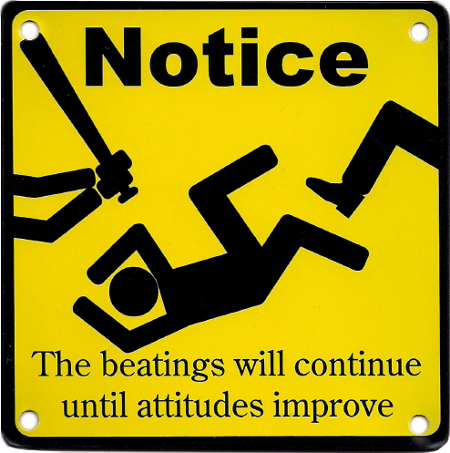
The above is perfectly reflected in the saying “the beatings will continue until morale improves”.

A clarification: I’m certainly not saying that attitude isn’t important. In fact, I think that ‘attitude’ is just about the most important thing there is for a human being!

Here’s one of my favourite quotes ever (I have it on my wall at home and at work):

“The longer I live, the more I realise the impact of attitude on life. Attitude to me is more important than facts. It is more important than the past, than education, than money, than circumstances, than failures, than success, than what other people think or say or do. It is more important than appearances, gift, or skill. It will make or break a company…a church…a home.

The remarkable thing is we have a choice every day regarding the attitude we will embrace for that day. We cannot change our past…we cannot change the fact that people will act in a certain way. We cannot change the inevitable. The only thing we can do is play on the string we have, and that is our attitude.

I am convinced that life is 10% what happens to me and 90% how I react to it. And so it is with you…we are in charge of our attitudes”. (Charles Swindoll).

It is this quote that often helps me write these (professionally provocative) posts. My attitude is that there’s not a lot of point in moaning about my environment. I choose to try to do something about it.

The Spice of Life

spices-442726_640Variety is the spice of life. If everything were the same it would be rather boring. Happily, there is natural variety in everything.

Let me use an example to explain:

I was thinking about this as I was walking the dog the other day. I use the same route, along the beach each day, and it takes me roughly the same time – about 30 minutes.

If I actually timed myself each and every day (and didn’t let this fact change my behaviour) then I would find that the walk might take me on average 30 minutes but it could range anywhere between, say, 26 and 37 minutes.

I think you would agree with me that it would be somewhat bizarre if it always took me, say, exactly 29 minutes and 41 seconds to walk the dog – that would just be weird!

You understand that there are all sorts of reasons as to why the time would vary slightly, such as:

  • how I am feeling (was it a late night last night?);
  • what the weather is doing, whether the tide is up or down, and even perhaps what season it is;
  • who I meet on the way and their desired level of interaction (i.e. they have some juicy gossip vs. they are in a hurry);
  • what the dog is interested in sniffing…which (I presume) depends on what other dogs have been passed recently;
  • if the dog needs to ‘down load’ or not and, if so, how long this will take today!
  • …and so on.

There are, likely, many thousands of little reasons that would cause variation. None of these have anything special about them – they are just the variables that exist within that process, the majority of which I have little or no control over.

Now, I might have timed myself as taking 30 mins. and 20 seconds yesterday, but taken only 29 mins. and 12 seconds today. Is this better? Have I improved? Against what purpose?

Here’s 3 weeks of imaginary dog walking data in a control chart:

Untitled

A few things to note:

  • You can now easily see the variation within and that it took between 26 and 37 minutes and, on average, 30 mins. Understanding of this variation is hidden until you visualise it;
  • The red lines refer to upper and lower control limits: they are mathematically worked out from the data…you don’t need to worry about how but they signify the range within the data. The important bit is that all of the times sit within these two red lines and this shows that my dog walking is ‘in control’ (stable) and therefore the time range that it will take tomorrow can be predicted with a high degree of confidence!*
  • If a particular walk had taken a time that sits outside of the two red lines, then I can say with a high degree of confidence that something ‘special’ happened – perhaps the dog had a limp, or I met up with a long lost friend or…..
  • Any movement within the two red lines is likely to just be noise and, as such, I shouldn’t be surprised about it at all. Anything outside of the red lines is what we would call a signal, in that it is likely that something quite different occurred.

* This is actually quite profound. It’s worth considering that I cannot predict if I just have a binary comparison (two pieces of data). Knowing that it took 30 mins 20 secs. yesterday and 29 mins 12 secs. today is what is referred to as driving by looking in the rear view mirror. It doesn’t help me look forward.

Back to the world of work

The above example can equally be applied to all our processes at work…yet we ignore this reality. In fact, worse than ignoring it, we act like this isn’t so! We seem to love making binary comparisons (e.g. this week vs. last week), deriving a supposed reason for the difference and then:

  • congratulating people for ‘improvements’; or
  • chastising people for ‘slipping backwards’ whilst coming up with supposed solutions to do something about it (which is in actual fact merely tampering)

So, hopefully you are happy with my walking the dog scenario….here’s a work-related example:

  • Bob, Jim and Jane have each been tasked with handling incoming calls*. They have each been given a daily target of handling 80 calls a day as a motivator!

(* you can substitute any sort of activity here instead of handling calls: such as sell something, make something, perform something….)

  • In reality there is so much about a call that the ‘call agent’ cannot control. Using Professor Frances Frei’s 5 types of service demand variation, we can see the following:
    • Arrival variability: when/ whether calls come in. If no calls are coming in at a point in time, the call agent can’t handle one!
    • Request variability: what the customer is asking for. This could be simple or complex to properly handle
    • Capability variability: how much the customer understands. Are they knowledgeable about their need or do they need a great deal explaining?
    • Effort variability: how much help the customer wants. Are they happy to do things for themselves, or do they want the call agent to do it all for them?
    • Subjective preference variability: different customers have different opinions on things e.g. are they happy just to accept the price or are they price sensitive and want the call agent to break it down into all its parts and explain the rationale for each?

Now, the above could cause a huge difference in call length and hence how many calls can be handled…but there’s not a great deal about the above that Bob, Jim and Jane can do much about – and nor should they try to!. It is pure chance (a lottery) as to which calls they are asked to handle.

As a result, we can expect natural variation as to the number of calls they can handle in a given day. If we were to plot it on a control chart we might see something very similar to the dog walking control chart….something like this:

Control chart 2

We can see that:

  • the process appears to be under control and that, assuming we don’t change the system, the predictable range of calls that a call agent can handle in a day is between 60 and 100;
  • it would be daft to congratulate, say, Bob one day for achieving 95 and then chastise him the next for ‘only’ achieving 77…yet this is what we usually do!

Targets are worse than useless

Let’s go back to that (motivational?!) target of 80 calls a day. From the diagram we can see that:

  • if I set the target at 60 or below then the call agents can almost guarantee that they will achieve it every day;
  • conversely, if I set the target at 100 or above, they will virtually never be able to achieve it;
  • finally, if I set the target anywhere between 60 or 100, it becomes a daily lottery as to whether they will achieve it or not.

….but, without this knowledge, we think that targets are doing important things.

What they actually do is cause our process performers to do things which go against the purpose of the system. I’ve written about the things people understandably do in an earlier post titled The trouble with targets.

What should we actually want?

We shouldn’t be pressuring our call agents (or any of our process performers) to achieve a target for each individual unit (or for an average of a group of units). We should be considering how we can change the system itself (e.g. the process) so that we shift and/or tighten the range of what it can achieve.

So, hopefully you now have an understanding of:

  • variation: that it is a natural occurrence…which we would do well to understand;
  • binary comparisons and that these can’t help us predict;
  • targets and why they are worse than useless; and
  • system, and why we should be trying to improve its capability (i.e. for all units going through it), rather than trying to force individual units through it quicker.

Once we understand the variation within our system we now have a useful measure (NOT target) to consider what our system is capable of, why this variation exists and whether any changes we make are in fact improvements.

Going back to Purpose

You might say to me “but Steve, you could set a target for your dog walks, say 30 mins, and you could do things to make it!”

I would say that, yes, I could and it would change my behaviours…but the crucial point is this: What is the purpose of the dog walk?

  • It isn’t to get it done in a certain time
  • It’s about me and the dog getting what we need out of it!

The same comparison can be said for a customer call: Our purpose should be to properly and fully assist that particular customer, not meet a target. We should expect much failure demand and rework to be created from behaviours caused by targets.

Do you understand the variation within your processes? Do you rely on binary comparisons and judge people accordingly? Do you understand the behaviours that your targets cause?

Appreciated

Toilet-engaged-sign-007So, here’s a short ‘thought for the day’ shared with me by Helen (thanks H):

“A person who feels appreciated will always do more than what is expected.” (Author unknown)

I think it’s a great quote that really sits with Systems Thinking and is worth pondering over.

…and before any managers think “wow, that’s cool, I had better run off and show lots of appreciation to people because then I’ll get better results…and hopefully instantly!”, let’s just put some qualifiers/ caveats around it:

  • There isn’t much that is more precious to a human being than feeling that we truly matter, that what we do is valuable and is valued;
  •  A worldwide study (cited in a 2012 HBR article) found that the single highest driver of engagement is whether workers feel that their managers are genuinely interested in their well-being. Less than 40% of workers felt this way;
  • Conversely, the feeling of being devalued* is incredibly toxic;

(* whether from negative comments/actions or, just as bad, neglect through presumption, inaction and a lack of care);

Appreciation has to be authentic! Any/all instruments used to extrinsically motive (e.g. contingent rewards) and judge people (performance appraisals) will seriously harm/ undermine management’s ability to show genuine appreciation.

The answer always seems to be…

images…empowerment! But what does that even mean?

As usual, I thought I’d better get myself on firm ground by looking the word up in the dictionary. Here’s what I get:

“Empower: Give (someone) the authority or power to do something.” (Oxford Dictionary)

And why aren’t ‘they’ (or, depending on your viewpoint, ‘we’) empowered in the first place? Here’s an eye-opening quote from John Seddon:

“Empowerment is a pre-occupation of command-and-control managers, who:

  • design systems that dis-empower people…;
  • …notice the problem and send people on ’empowerment’ programmes;
  • …and then put them back in a system that…”

i.e. it is a merry-go-round in which people’s hopes are raised (often offsite by a cool and groovy external training company) about the wonders of empowerment…and then they get plugged back into their old reality!

The instruments of a ‘command and control’ system dis-empower people. Leaders can ‘happy talk’* about empowerment and even provide training, tools and (worse) incentives to encourage empowerment….but, if the underlying management system remains the same, they are mostly wasting their time. (* if you’ve not heard this ‘happy talk’ phrase before I provide an explanation at the bottom of this post).

Saying ‘you are empowered’ and meaning it are two very different things:

Here’s a lovely quote I came across recently on a Lean Thinking blog that I follow:

Leader:     “I want my employees to feel empowered.”

Counsel:     “You realise empowerment means your employees start making decisions, right?”

Leader:     “Oh… I want them to feel empowered. I didn’t say I wanted them to be empowered.”

(Mardig Sheridan)

The main reason why people aren’t empowered is because of the environment they work within, not because they don’t want to be!

You can’t simply move to an empowered culture:

It’s easy (and usual) to want the result…but simply wanting it (as in ‘Stating the obvious’) doesn’t magically deliver it.

There are two risks for ‘leaders’ who have always told ‘their’ people what to do (via the likes of transformation programmes, change projects and cascaded personal objectives) when they tell everyone that they should feel empowered:

  • The leader stands back completely: this will create a void in which people won’t know what to do…which will end up with those same ‘leaders’ saying “well that didn’t work, I’d better take control again.”

OR

  • The leader continues to tell them what to do: creating a battle between leader and worker and much resentment and disbelief. And just to spell it out, you are telling them what to do by default if you simply say ‘no’ to everything they suggest or request permission to experiment with.

You can’t just say ‘you are empowered’ – you have to create the environment to make it happen! So how do we go about truly creating an environment in which people are genuinely empowered?

There’s a great book by David Marquet on this called ‘Turn your ship around’. It relates to his time as Captain of a US Navy Nuclear submarine. There’s also a really nice 10 min. animated version enabling you to quickly watch and get the gist. I recommend you watch it right now.

…so, what is needed is:

  • clarity of purpose (of the system in which the people operate), which
    • must be from the customers point of view; and
    • is NOT anything like ‘to implement xyz’ – that’s a dictated solution;
  • the building of your people’s competence;
    • which means far more than just knowing their basic job…it includes them understanding the system in which they operate and the likely effects of their decisions towards it purpose
  • the definition of capability measures (against purpose), and the ongoing transparency of this critical information to those operating the system; and
  • the removal of the barriers that define ‘the old way’ (most of my other posts explain what these are so I won’t repeat myself)

Leadership and empowerment

A reminder of three types of leaders:

“There are three kinds of leaders. Those that tell you what to do. Those that allow you to do what you want. And ‘Lean’ [Systems Thinking] leaders that come down to the work and help you figure it out.” (John Shook)

I hope you can see the cause and effect relationship between leadership and empowerment…it is only the 3rd style of leadership that is meaningful. This is true coaching through an ongoing back-and-forth dialogue between mentor and mentee.

It is only through true leadership (which includes trust, support and humility) that an organisation’s people can become empowered.

But isn’t it simply about hiring the right people?

A quote to finish on:

“Don’t bother trying to hire positive people only to give them crappy jobs and a line of bullshit about empowerment. If you are serious about reaping the benefits of an empowered workforce, make sure you are committed to providing good jobs, fair policies, and remarkable leadership, then go hire good folks and invite them to partner with you to continuously improve your workplace. (Bret L Simmons)

___________________________________________________________________________________________

‘Happy Talk’ (Pascal Dennis):

“I remember the first time I attended a leadership conference at [my organisation] about three years ago. I walked away from the event really frustrated with leadership because the messages they shared seemed so disconnected from the reality of the work I was doing each day.

You know the type of event: leaders standing up confidently in front of their peers throwing around buzz words and all the ‘right answers’. What Pascal Dennis refers to as ‘the happy talk’.

Basically we got told what we wanted to hear as opposed to what we really needed to hear. It’s a lot harder to talk about problems and deliver disturbing news than to talk about everything that is going great.” (DailyKaizen.org)

Scrap the ‘100 day plan’

Blank desktop calendarI’m sick of leaders coming into new roles with the ink already dry on their ‘100 day plans’. I’m sick of the conventional view that such an up-front and detailed plan is “critical for success”…success of what?

Throw that plan in the bin!

  • Who are you to know what the hell actually needs doing, by whom, and by when?
  • Even if some of your plan is vaguely logical (for the system and its purpose), how is your ‘commanding and controlling’ going to help the people accept your proposed changes and, even more importantly, learn for themselves so that an environment of improvement is sustained?

Instead, go to the Gemba, study the system with a truly open mind (and open eyes and ears) and get knowledge.

In this way you will get to understand:

  • The true purpose of the system, from the customer’s point of view;
  • The nature and frequencies of demands being placed upon it (including failure demands);
  • The current capability of the system (including the variation within) against its purpose;
  • How the work flows (or not!);
  • The system conditions that cause the above to be so; and most importantly…the underlying cause…
  • The current management thinking that makes the above the way it is.

Now, you can properly appreciate how the current management system constrains the system from achieving its purpose.

Now, you are in a position to help the people see, accept and make the necessary changes themselves that will truly and sustainably improve the system against its purpose….and meaningfully measure the effects.

Now, you can help the people experiment and learn, to make ongoing long term sustainable improvements rather than carry out knee-jerk ‘activities’ on a plan.

I can hear management’s riposte now: “We can’t take the time to do that! We’ve got to get results now!”

A reminder of the quote:

“Vision without action is a daydream. Action without vision is a nightmare.”

Taking actions does not equate to transformation. Your 100 day plans become ongoing nightmares!

A true but comedy illustration: I met a guy who had just come into a role. He had his 100 day plan (that he had presented at his interview and which had secured him the job). I asked him whether he had met his team yet. His reply? “Oh no, not yet, that’s not until day 21 on the plan.” 

Confusion over two words

element-of-confusion-teeThere are two words that are bandied about organisations, often interchangeably…but I think we need to take great care over their use.

These two words are ‘Manager’ and ‘Leader’.

Using the example of a sports team to explain:

  • the person installed as Captain may not be a leader i.e. if the Coach has got the wrong (wo)man for the job; however
  • many players may lead, despite not being bestowed with the role of Captain.

One is a hierarchical/ formal role granted from above, the other is natural.

You can be given the title of ‘Manager’ and this be a fact, whether people like it or not.

Conversely, you can’t give yourself the moniker of ‘Leader’ (or have this formally bestowed on you) if this is not so! You either lead or you don’t. People follow or they don’t.

You can become a leader by your words and deed. Equally, you can lose your leadership mojo. You aren’t really someone’s leader, just because you say so. Conversely, you may be leading (influencing) people without this being obvious to ‘Management’.

I am not suggesting that there isn’t a relationship between ‘Manager’ and ‘Leader’:

  • the formal position you are given (and, with this, the likely resources at your disposal) will impact the degree of influence that you can have; and
  • obvious leaders may very well be given formal management positions…but this doesn’t secure them as a leader going forwards.

All the more reason to understand the distinction between Management and Leadership.

Finally: It’s worth noting that being good at leading shouldn’t be mistaken for being a leader for good: Hitler, Stalin, Pol Pot etc. were clearly leaders! They inspired many people to dream, learn, do and become more….but not as we would consider towards a purpose that we would agree with.

Getting over the God Complex

infallible2I recently came across a superb (and highly relevant) TED talk by Tim Harford called ‘Trial, error and the God complex’. I humbly suggest that it is worth your while watching it – it (like most TED talks) is 18 mins. long.

(Note: For those of you who haven’t heard of Tim Harford, he is an economist and writes a great column in the (UK) Financial Times called ‘The Undercover Economist’. His columns have been drawn together into some really interesting books by the same name)

In the TED video, Tim tells us the story of how Archie Cochrane fought all his life against what he called ‘the God complex’, where the symptoms of this complex are:

“No matter how complicated the problem, you have an absolutely overwhelming belief that you are infallibly right in your solution.”

In fact we see people with the God complex around us all the time:

  • Our medical experts (Doctors)
  • Our economists
  • Our business leaders
  • Our politicians that we vote for
  • ….etc.
  • “people who, in the face of an incredibly complicated world, are nevertheless absolutely convinced that they understand the way that the world [as is relevant to them and what they want to achieve] works.”

Added to this, there is even a relatively new ‘business’ book genre out there that tells us we can all ‘fake it to make it’…which essentially encourages us to see if we can ‘catch’ the God complex because this will no doubt be good for us and our careers!

Tim nicely explains that the world is simply far too complicated for us to understand. It’s unbelievable how complicated the world has become…and is so far removed from the simple societies in which our brain evolved.

We find the God complex so tempting….we want to draw a few graphs (maybe a two-by-two matrix for those management consultants amongst us) and then say “yes, we get it, we understand how this all works!” BUT we don’t get it, and we never do!

This isn’t saying that we can’t solve complicated problems in a complicated world – we clearly can…but not by presuming we know the answer!

“The way we solve [complicated problems] is by humility: to abandon the God complex and to actually use a problem solving technique that works…and we have [such a] technique. You show me a successful complex system and I’ll show you a system that has evolved through trial and error.”

He goes on to give some excellent examples of trial and error* that have achieved great success (*which in my ‘Lean Thinking’ course we explain as the scientific method of experimentation). These successes couldn’t have been achieved by subscribing to the God complex, which would have meant finding an expert who allegedly had (or can work out) ‘the answer’.

“The moment you step back from the God complex and you say ‘let’s just try a bunch of stuff, let’s have a systematic way of determining what’s working and what’s not’, you can solve your problem”

Tim’s research (explained in his latest book) has concluded that the process of trial and error is far more common in successful institutions than we care to recognise. It is how they can be successful!

I love the bit where Tim basically says that, whilst lots of people say that his point (about experimentation) is blindingly obvious so “duh, nothing new there Tim”, he will only accept the ‘it’s obvious so no need to bang on about it’ critique when we change the way we educate our children, when our politicians change the platform that they campaign on (and how they act in office) and even more importantly, when we change the way that we vote accordingly.

I would add “…and our business leaders change the way that they ‘run’ our organisations”.

Tim’s message aligns perfectly with:

  • W Edwards Deming’s message of constant ‘Plan, Do, Study, Act’ cycles;
  • Taiichi Ohno’s message of going to the Gemba – studying the actual facts (evidence) rather than dealing in opinions;
  • Mike Rother’s message of setting a target condition (not a target) and experimenting through the obstacles to get there;
  • John Seddon’s message of understanding your system (study, get knowledge) before making any interventions;
  • …and on and on through the great System Thinking giants.

I love this quote:

“For every complex problem, there is a solution that is simple, neat and wrong.” (H L Mecken)

Finally, a couple of warnings:

  • Beware of shonky experiments , in which you are merely going through the motions of what you want to do anyway; and
  • If you offer rewards contingent on the success of an experiment then don’t expect unbiased results!

The only true experiment is one in which you are open minded as to the outcome…and you should remove any instruments that might put this in jeopardy.

(Credit: the cartoon is of ‘Captain Infallible’ taken from doctorinsan
o.com
)

A state of flow

rock_climb_will_mono-2I often talk about flow in the sense of how value flows through a value stream from a customer’s demand trigger through to its satisfaction.

However, this post is all about a different use of the word ‘flow’.

Professor Mihaly Csikszentmihalyi – I’m not going to pronounce that! – is world famous for his studies and writings on happiness and creativity. His seminal book ‘Flow: The psychology of optimal experience’ (1990) outlines his theory that people are happiest when they are in a state of flow.

If you are in a state of ‘flow’ then this means that you are completely absorbed by an activity and a situation…and you are so involved that nothing else matters. It’s what is often described as being ‘in the zone’.

It is the optimal state of intrinsic motivation and is something that we all experience at times, even to the point that you forget about time, food, self ego and so on. And, given this, you can see that it is an incredibly fulfilling and enjoyable state to be in.

It has been noted that this flow state is a functional mode of ‘being’ that eastern meditation masters have been pointing to for millennia.

An example:

“The mystique of rock climbing is climbing; you get to the top of a rock glad it’s over but really wish it would go on forever. The justification of climbing is climbing, like the justification of poetry is writing; you don’t conquer anything except things in yourself…. The act of writing justifies poetry. Climbing is the same: recognizing that you are in flow. The purpose of the flow is to keep on flowing, not looking for a peak or utopia but staying in the flow. It is not a moving up but a continuous flowing; you move up to keep the flow going. There is no possible reason for climbing except the climbing itself; it is a self-communication.” (Mihaly Csikszentmihalyi, Flow)

It just so happens that, having regularly climbed some years ago, I really ‘get’ his example…and even if you are afraid of heights but have been on a climbing wall once in your life I bet you weren’t thinking about much else whilst holding on!

Your flow examples will be different to mine – other activities often cited as examples are musicians lost in their music and painters becoming one with the process of painting i.e. they experience ‘the suspension of time’. Have a think about when you are totally in the zone and not thinking about the rest of the world.

So what?!

Now, I know I can’t spend all my days [climbing/….] (please substitute your personal flow activities in here) and that I need to earn money to live…but wouldn’t it be brilliant if I could regularly attain a state of flow in my work?!

Csikszentmihalyi suggests that flow occurs when there is neither anxiety nor boredom.

Anxiety occurs when the challenge of the moment exceeds our capabilities. Boredom occurs when we are capable of doing considerably more than the challenge presented to us.

Tying this in to Frederick Hertzberg’s theory of motivation: Anxiety and boredom are demotivating, flow is motivating.

A command-and-control management system is likely to:

  • dictate methods/ solutions/ activities to the workers;
  • set grand ‘implementation’ plans that seem massive and unachievable “given what we know about our reality!”;
  • focus on results, rather than constant iterative improvement;
  • set targets that may be impossible or out of our control (leading to anxiety) or
  • may be easily achieved (boredom)
    • “….though, if I get a bonus for achieving the easy target, I am unlikely to tell someone I am bored for fear of being given the impossible instead.”
  • use end-game language (such as ‘best practice’, ‘target operating model’, ‘solution’, ‘project completion’…) rather than focusing on the journey;
  • likely lock-in ‘the plan’ and focus much effort on forensic examination (and blame) of variance rather constant learning and adjustment.

…but, ultimately, provides an environment that constrains people’s ability to achieve flow in their work.

We can see that the Systems thinking ‘scientific method’ of:

  • constant/ never-ending:
  • experimentation;
  • by the workers/ management together;
  • to attain progressively more challenging target conditions;
  • which are meaningful to the customer

is most likely to provide workers and management with a state of enjoyable psychological flow where their skills, and the challenges they take on will constantly grow.

I love being in a state of flow…and I expect you do too.

Demand, demand everywhere…but not a drop of value to drink!

PhoneScream…so I contact a (world renowned) bank about opening an account, but it’s not a basic request:

The comedy begins:

  • I look up the bank’s internet site to find a number to ring for my specific need. I can’t find anything that fits. The best I find is a ‘contact us’ email form, so I fill it in, explaining my need and asking for the right contact number.
  • I get an email back providing me with a contact number and instructions as to which IVR selections to make when I ring it (‘press 2 for blah, then 1 for blah, then 3 for blah’).
  • I ring the number. The IVR is nothing like the instructions. I listen to the (long list of) options. None fit my need so I wait for someone to pick up.
  • I explain my need to the agent that picks up and am told that “oh no, we don’t deal with that. You need to speak with ‘abc’ department. Would you like me to pass you through to them?” I say that, yes, I surely would.
  • I am ‘cold passed’ to this 2nd queue and therefore have to wait in line and then re-explain my need to the agent. They say “No, they shouldn’t have passed you through to us. You need ‘xyz’ department. I’ll put you through.”
  • Once again, I am ‘cold passed’ through to a 3rd queue, wait in line and re-explain. They say “We don’t deal with that. You need to speak with ‘blah’ department”
  • I listen to the original bloody IVR again! I’m really annoyed now. I think about hanging up, but I really want to talk to someone about my need. I decide to wait.
  • I get another agent and explain about what has just happened to me…this took time and I was clearly exhibiting signs of annoyance (funny that!). I asked them to PLEASE listen to my actual need and spend time with me to figure out if they can assist and then who can. They say that they need to transfer me to someone who can help. I pleadingly ask them to ‘warm transfer’ me over to that person so that I don’t start the merry-go-round again!
  • I was cold transferred to another number!!! After waiting for an agent, guess what, they couldn’t help and would need to transfer me to…..I hung up.
  • I went back on to the website, found the ‘contact us’ email address and wrote what I shall describe as a ‘strong email’….I am yet to receive a response.

Now, whilst the above is (verging on) humorous for those not involved, sadly I bet most of you reading it have examples of similar ‘service’ experiences to have happened to you.

To summarise the above:

  • there was 1 ‘white marble’ of value demand, the actual need for which the bank is there for;
  • there were 6 ‘blue marbles’ of failure demand (so far!), each of which the bank had to handle*, as if it were a valid unit of production;
    • * for each unit of demand they had to: plan and roster staff; handle the queue; handle the call (welcome, understand need, action, closure); record in their systems; performance review the agent as to how the call was ‘handled’….etc
  • each silo within the bank experienced their vertical unit of activity and probably met each target they set themselves: call answering time, average handling time, call resolution rate….and probably celebrated their success, perhaps with some awards, even some contingent rewards! ;
  • the bank is oblivious to the horizontal flow that I experienced;
  • and, worst of all, my need remained unresolved!
    • simply and clearly explaining to me that they can’t do what I was asking (if this were the case) would have resolved my value demand.

To use a current buzz phrase, there is nothing ‘customer-centric’ about this experience.

Why does the bank have this problem?

Because it bought into the economies of scale mantra of ‘standardise, specialise, centralise.’

Because it believed that what has been seen/ heard about in manufacturing can simply be applied to service.

Because it bought into technology as an automator of service provision.

What does this cause?

Silo’d thinking, in which effort is put into the efficiency of each vertical activity…at the expense of the effectiveness of the horizontal flow of value, from customer demand through to its satisfaction.

Massive waste that is unseen (though paid for) by the business yet is acutely felt by the customer.

“Cost is in flow, not activity….economies come from flow, not scale.” (John Seddon)

“There is nothing so useless as doing efficiently that which should not be done at all.” (Peter Drucker)

Now you might laugh at this, and think “wow, daft bank!” but, before we dismiss this as not something that could happen to us, I could equally have written about a similar experience I had from ringing an internal helpline at the company I work for. I didn’t (and won’t) write about this internal example because the point is to think about the problem and its causes, not to get caught by the error of blame.

The reason for the madness is the system (and management’s beliefs and behaviours), not the people within it.

None of the ‘customer service agents’ will have enjoyed handling my units of demand – there was no satisfaction to be had in helping me with my need. Each will have been left hollow by their inability to assist…and then they will have moved on to their next call….safe in the knowledge that they cannot change their reality whilst they work within their ‘command and control’ paradigm.

People are people so why should it be?

6508-mouse…so we are stood around the visual management board, considering a problem:

There’s been lots of talking, but an impasse has been reached.

  • After a while a ‘quiet mouse’ of a person (almost imperceptibly) whispers something that is actually quite profound….but no one seems to have heard it;
  • The ‘fog horn’ person doesn’t realise that he did in fact subconsciously overhear this whisper and blurts out similar words, thinking that he’s just had an original thought;
  • “Wow”, everyone thinks, “that’s a great idea!”
  • ‘Quiet mouse’ shifts back a little and thinks “that’s basically what I just said”…but is too polite to point this out;
  • Then the ‘really awkward’ person says something which annoyingly (for ‘fog horn’), yet totally justifiably, questions the great idea;
  • The ‘comedian’ says something funny that removes the tension in the air between ‘fog horn’ and ‘really awkward’;
  • Which causes the ‘deep thought’ person to ponder ‘really awkward’s challenge and carefully suggest a logical revision to the idea;
  • To which ‘fog horn’ adds his support, ‘comedian’ makes a joke out of this …and the group unite on fleshing out what experiment they are going to run to test out the idea and then conclude.

So, who did well in this discussion? Who did ‘best’? Who deserves praise? And, assuming that the subsequent experiment shows that the great idea has legs, which one deserves an award! Hang on…why are we trying to create a competition out of this?!

In reality, the good idea needed each and every one of ‘quiet mouse’, ‘fog horn’, ‘really awkward’, ‘comedian’ and ‘deep thought’ and the combined skills and personalities that they bring to the table. Remove any of these from the mix and we might not have got anywhere.

Those of you with even a mild eye for detail may protest that I have well and truly butchered Dr Meredith Belbin’s ‘Team Roles’ (I don’t think his list includes ‘quiet mouse’)…this was semi-intentional. Whilst Belbin’s research is hugely important (and very interesting), we shouldn’t really need the actual list of researched people characteristics to conclude that everyone’s different!

If you were to study a group of people working together over a period of time, you would see how dynamic (and necessary) the interplays are….but you know this!

However, a ‘command and control’ organisation looks to:

  • single out people to praise for their ‘individual brilliance’; and
  • rate and rank people against a supposedly desirable personality type.

An organisation is a highly complex living (as opposed to mechanistic) system. We should be celebrating the differences within our people. We should want to encourage each of them to develop their own innate skills AND the ability to collaborate.

A reminder of Deming’s wonderful quote about people:

“a [true] manager of people understands that people are different from each other. He [or she] tries to create for everybody interest and challenge and joy in work. He tries to optimise the family background, education, skills, hopes and abilities of everyone. This is not ranking of people. It is, instead, recognition of differences between people, and an attempt to put everybody in position for development.”

So what’s the point?

The success of an organisation will be best achieved through respecting each and every person and who they are….and helping them become who they can be. It will be damaged most by competition and pushing people to be who they are not.

This needs a rethink of the ‘command and control’ management system that creates the environment that many (most) of us work within.

End note: Does the title of this post mean anything to you? A 1980s song lyric? (…or perhaps it’s just my youth)