Two parallel tracks

railway-track-leading-into-distanceI get a number of different reactions from people when I discuss organisational ‘systems thinking’ ideas with them. These range:

  • from “wow, that’s so right…but we are completely stuck in our current ‘command-and-control’ reality and surely can’t do anything about it!” ;
  • to “we need change and I can’t wait around for your theory to come to fruition – I’m going to accept things as they are and tinker at the edges as best I can…otherwise I will go mad with frustration!”.

To quote Russell Ackoff: the later response above is basically trying to make a “wrong thing righter” or, in effect, limit the damage.

However, I am very mindful that people can’t feast on ideas alone and that the point is to improve. All the theory in the world won’t help if we can’t apply it.

I have pondered this dilemma a lot and often…and came across (what is to me) a profound answer to this dilemma, as written by Alfie Kohn:

“When something is wrong with the present system, you move on two tracks at once.

  • You do what you can within the confines of the current structure, trying to minimise its harm.
  •  You also work with others to try to change that structure, conscious that nothing dramatic may happen for a very long time.

If we move exclusively on the latter track, such as by mobilising people to dismantle [the destructive instruments of the] system, we may not be doing enough to protect [our colleagues] from the destructive effects [of these instruments] with which they are going to be controlled in the meantime.

But – and this point can be more difficult to recognise – if we simply reconcile ourselves to the status quo and spend all our time getting our [colleagues] to accommodate themselves to it and play the game, then nothing will change and they will have to do the same with their [colleagues and on and on].

As someone once said, realism corrupts; absolute realism corrupts absolutely.”

So, we need to simultaneously travel along two tracks.

We need to accept that our progress along the (truly) transformational track of changing our management system will take time….but we MUST start and sustain this journey (i.e. not see it as an impossibility) whilst also doing what we can within our current daily realities. We can only do this if you and I continue to think, collaborate and learn….which, I suggest, may be intrinsically motivating for us and give us a clearer sense of purpose.

Meet the process

IvoryTowerAll rational ‘leaders’ appreciate that, rather than sitting in metaphorical ‘ivory towers’, they need to understand what actually happens in their business.

But how do many leaders go about this? I suggest that the following two techniques are the norm:

1. Hold a regular ‘road show’ in which the leaders present to ‘their people’ and, at the end, hold a Q&A session.

What usually follows are questions from the floor that are:

    • generalist in nature and which can be answered safely, politically with ‘happy talk’…and everyone appears content; or
    • highly specific and which need to be answered ‘off line’ because how could you expect your leader to be able to answer that on his/her feet…and no one is the wiser

Whilst such leaders may be great orators and the people may like what they hear….it becomes somewhat of a show divorced from reality.

2. Perform ‘tours’ of their facilities, usually starting with a (very carefully prepared) workshop presentation by that function’s management team, and then being introduced around the floor by the duty manager…along the lines of “Leader, this is your worker…worker, this is your leader…now have a polite chat as if he/she were the Queen”.

What usually follows is a discussion with a random set of workers who are conveniently at their posts that:

    • is full of pleasantries: “so how are things”…”very good thanks”….”that’s great to hear, keep up the good work”…and everyone is happy; or
    • is used by a ‘plucky worker’ as a golden opportunity to air a particular soap-box issue (which may have little relevance in terms of size and occurrence)…and management MUST now act immediately on that issue because the leader now ‘knows about it’ and has to be seen to be ‘listening to the workers’

How much of reality do the leaders actually get exposed to? How much ‘polishing’ is likely to be performed before a management presentation? How distorted (subdued, careful or biased) is the process performer’s voice likely to be?

…how is this really helping the customer receive a forever improving service?

I suggest that ‘leaders’ (whatever level in an organisation) switch their mentality from ‘meeting the people’ to ‘meeting the process’. This means:

  • listening to, and observing actual customer demand at the point it comes in; and
  • following actual units of demand through the value stream (not just a silo within!) until its successful conclusion.

Now, it should be obvious that to do this the leader has to meet the process performers along the way…but the purpose is totally different. Instead of focusing on a person, there is a joint focus (leader and process performers) on the unit of customer demand and how it is processed through the value stream – with its warts and all. This is likely to garner a level of trust with the process performers as and when they believe the leader is really interested in the process, not in judging them.

Meeting the process is often referred to as ‘Gemba walking’, where Gemba is the Japanese word for ‘the real place’ or place of action/ where the work gets done. A Gemba walk involves walking with a unit of customer demand, from its trigger all the way through to its resolution (to the customer’s satisfaction). In performing this, the leader will see the environment that their management system requires the people to work within and probably a great deal of waste along the way.

To be clear: A Gemba walk isn’t a one off thing…it is a management practice that is regularly performed. This regularity is hugely important:

  • one walk won’t uncover the variety that exists within customer demand, or the subsequent process;
  • establishing the trust of the process performers will come over time (as and when they believe in you); and
  • we want to see the process actually changing for the better as leader, management and process performers continue to make changes to improve their capability of meeting the customer’s true purpose.

The act of actually ‘meeting the process’ will ensure that the leader really gets what’s going on and what’s possible…and can ensure that the appropriate management system is put in place that ensures continual process improvement.

Footnote:

Here’s a link to a post that I subsequently wrote on how to ‘Gemba walk’: Gemba Walking: A ‘How to’ Guide

L.A.M.E

inv6153_2_forearm_crutchesHave you heard people state that they are “implementing Lean” or, perhaps if they are further on their journey, that they are “doing Lean”? If so, I contend that they don’t really understand ‘Lean’. It is not something that you can tick the box when you ‘get there’.

And, because of this, it is no surprise to me when I come across people with a jaundiced view of ‘Lean’ – their understanding of it is probably not what those who coined the ‘Lean’ label would have hoped. This is no fault of the beholder – they are not cynics, just people who are likely to have experienced (or been passed on war stories about) L.A.M.E.

And before you ask a ‘Lean consultant’ if they agree with the above, bear in mind that there are two types of (usually clever) consultants: a) those that are selling a methodology and a bunch of related tools and b) those that really ‘get it’…and even they are (understandably) trying to make a living.

As a reminder: the word ‘Lean’ was simply attached as a label to describe the system (i.e. the complete management philosophy, principles, and operational practices) that a team at MIT uncovered within the Japanese car industry (but particularly Toyota) through their research, which began as far back as 1977.

The ‘Lean’ label has been on a journey since it was first coined in 1987 – it has spawned an industry of its own. Of note, one of the foundational researchers, Jim Womack, has spent time reflecting on this journey and accepts that ‘the early years’ were somewhat unfortunately tools focused. He is trying to reset people’s thinking.

Reflect that Taiichi Ohno, often referred to as the father of the Toyota Production System (TPS), didn’t want to write it down because he insisted we shouldn’t codify method, fearing that it would become stale – being seen as ‘the answer’ rather than merely the current state of thinking, to be continually challenged and improved.

So, I hope you understand when I try to be very specific when I talk about ‘Lean Thinking‘…and perhaps even get a bit edgy/ pedantic when people switch to talking just about ‘Lean’. This is because the real value in what the MIT researchers uncovered (which, incidentally, was being clearly articulated by Deming, Ackoff and others) is that Toyota’s success is based on their management system: the way they think….which has enabled, and continues to enable them to consistently deliver increasing value to their customers, whilst providing secure yet engaging work for their employees…which then delivers excellent results.

You can’t pick up a ‘Toyota organisation’ kit off the shelf and implement it into your organisation. You have to understand why they are achieving and how this differs to you…and it’s all in the thinking!

Oh yes, so what’s L.A.M.E? This is (yet another) label as dreamt up by Mark Grabban, a Lean blogger in the health space. It stands for ‘Lean As Misguidedly Executed’. If you remain within a command-and-control management system, having ‘Lean’ ostensibly done to you then this is clearly L.A.M.E.

To end with a quote from a favourite blog of mine (Thinkpurpose):

Don’t call it anything: if it has a name, people (including you) will waste time arguing about what ‘it’ is and isn’t….

Call it something: otherwise nobody can ever talk about it!”

As Womack no doubt reflects on choosing to label what they learned from their research – you are damned if you do and damned if you don’t.

Well done team, keep up the good work!

His+name+is+quot+condescending+wonka+quot+_f82cc1640b48cb9aa9b6dfb08f676dd5If you are a ‘leader’, how many times have you said “well done team, keep up the good work!” How do you think this is taken by those receiving it? Do you think they need to be ‘told’ to do this (the keeping up of the good work)…will they stop if you don’t?

Conversely (putting yourself in the other person’s shoes), how many times have you had some senior person who you don’t really know use the “well done…” phrase (or similar) either in an email/intranet communication or whilst doing a ‘press the flesh’ floor walk….and how does this make you feel?

How about when something major is implemented after months, if not years of hard work – is there an ever increasing level to this “well done…” message as the senior manager, then GM, then Exec. say ostensibly the same thing?…and, underneath this, do you think ‘if only they knew the half of it!’

The people who you really appreciate comment from are those who you know really understand what you (personally) have been doing/ going through, what successes you have achieved and the obstacles you have battled through to get them.

…and the comments that are most useful are the highly specific ones.

Some thoughts on praise from a chapter within Alfie Kohn’s eye-opening book ‘Punished by Reward’:

Kohn explains that the available research (of which there is plenty) has identified a number of reasons as to why ‘praise’ may fail to boost achievement and, in fact may drag it down:

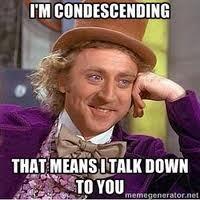
  1. Low ability: praising people’s efforts may create a feeling that you are being somewhat condescending as to their abilities…along the lines of ‘didn’t you do well !’
  2. Pressure: telling someone how good they are can increase the pressure they then feel to live up to the compliment
  3. Avoidance of risk: praise may set up unrealistic expectations of continued success, which leads people to avoid difficult tasks in order not to risk the possibility of failure (and then criticism)
  4. Reduces interest in the task itself: praise can be heard as an attempt to manipulate our behaviour (as in ‘keep up the good work’ basically saying ‘I want more of the same’). A good deal of research has shown that intrinsic motivation declines as a result of praise.

So, what does Kohn say we should do? He puts forward two general principles as the standards by which all praise should be measured:

  • Self determination: Are we helping the individual feel a sense of control over their life OR are we attempting to manipulate their behaviour by getting them to think about whether they have met our criteria?
  • Intrinsic Motivation: Are our comments creating the conditions for the person being praised to become more deeply involved in what they are doing OR are they turning the task into something they have to do to win our approval?

Taking these into more specifics, Kohn offers the following practical suggestions:

  1. Don’t praise people, only what people do (“that’s a really nice story” is better than “you’re such a good writer”)
  2. Make praise as specific as possible (“the twist at the end was completely unexpected” is better than “that’s a really nice story”)
  3. Avoid phony praise (praise is objectionable when it is clearly not a spontaneous expression but a deliberate strategy)
  4. Avoid praise that sets up a competition (don’t praise by comparing to someone else.)

Now, I’m not suggesting that senior management should stop showing their appreciation. Far from it! Instead, I am noting that people believe this to be genuine when they know that the comments: comes from someone who ‘really does understand’; are specific to the receiver and what they did; and are not rationed according to some rating and ranking mechanism.

…which ties in nicely with the need for management to meaningfully ‘Gemba walk’ often.

Bad digger driver or bad process?

5tonne_diggerOn Thursday 29th October 2014, a digger cut through a major gas pipe in the centre of Christchurch and a major evacuation ensued.

There was plenty of talk about this in the tea room at my work place the next day, about the major traffic jams and hassle it caused. The usual “I bet the digger driver gets it!” comment was made….and, possibly, he will. But, on reflection, do any of us think that the digger driver did it deliberately? I doubt it.

The Press article reporting the gas leak notes that the Fire Service representative said “a digger driver working in the area caused the widespread disruption”. Whilst maybe taken out of context, as the media delight in doing, it’s pretty emotive to single out the digger driver.

Much better, I would suggest, is that SCIRT (the infrastructure rebuild organisation) claimed responsibility, stated that they will be doing a full investigation and said “it is essential that we work out how this happened so it does not recur in future.” That’s a lot better, looking much wider than the person AND wanting to improve the process.

It is interesting to note that the reader’s comments section below the article is a mixture of blaming the digger driver, blaming SCIRT and conversely, trying to ‘cut them some slack’ by noting that the post-quake Christchurch environment is a somewhat tricky one to be operating within and it would be a miracle if no such defects occurred given the magnitude of the work being undertaken. I am often frustrated at how people jump to blame without being in possession of the facts.

Whilst this example of a defect causing pain for others is pretty major, we could (if we looked with our ‘blaming bad people’ radars turned on) find lots of examples at work in which you and I think badly of a person because of what we perceive they did, or did not do.

But, standing back, how many people turn up at work to deliberately do a poor job…conversely, how many people are doing their best given the environment they work within…and, perhaps most concerning, how many people have effectively turned their brains to their ‘low setting’ because of the system they have to work within?

So, whenever you find yourself blaming a person, try to stand back and think about the environment that they are working within. If you think about it, you are very likely to find many reasons as to why they acted as they did…and the harder you look, the more likely you are to consider the process could be improved.

Finally, if you think the process should be improved but believe it won’t be…I would ask you to reflect on why this is the case…perhaps the constraint is within the design of the ‘management system’ in which the workers have to operate.

As the Toyota saying goes “Be hard on the process, but soft on the operators.”

‘Management by results’…how does that work?!

cause_effect__1_1_5312The CEO of the company I work for recently shared a tweet with us summing up an insight she gained at a recent engagement she attended, which read as follows:

“Nick Farr-Jones dinner guest at conference key message focus on process not the scoreboard and you will get result.”

I like this tweet – the words, whilst short, are incredibly important for anyone wanting to make improvements. I thought it useful to dig into this a bit.

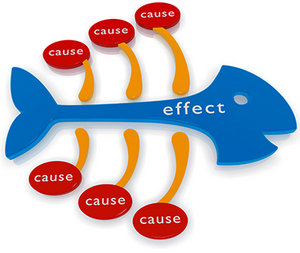
Dr W. Edwards Deming was very clear on this point! He set out the practise of ‘Management by results’ (e.g. focusing on a scoreboard of outcomes) as one of the diseases of a ‘modern organisation’ and, instead, proposed that we should spend our time and focus on understanding and improving the processes that produce the results i.e. the results are the outcome of something, and you can look at the outcome till you are blue in the face…but this won’t make it change!

“The outcome of management by results is more trouble, not less….Certainly we need good results, but management by results is not the way to get good results….It is important to work on the causes of the results – i.e. on the system. Costs are not causes: costs come from causes.” (Deming, The New Economics)

Professor John Seddon (think ‘Deming on steroids’ for Service organisations 🙂 ) takes this message on further. He notes that the measures used in most organisations are ‘lagging’ or ‘rear-view’ measures – they tell you what you did.

Seddon has a very clear view on measurement but at this time I want to simply put forward his thinking regarding the difference between operational and financial measures. He says that we should use:

  • Operational measures (such as demand for a service, and a processes capability to deliver against its purpose) to manage; and
  • Financial measures (revenues, costs) to keep the score.

We know that one affects the other but we can never know exactly how and it is waste to divert time and effort to try to do so.

Bringing this back to Nick Farr-Jones and Rugby: A rugby coach uses process measures to manage (e.g. passes complete, line-outs won, tackles made…) and the result quite literally as the score!

So Nick Farr-Jones, Deming and Seddon quite clearly agree with each other. If you work on the capability of a system/ value stream/ process to deliver against its purpose (as from the customer’s point of view) then the results will come.

Finally, you may be thinking ‘ah yes, this is where the balanced scorecard comes in’…there’s a post in there! Watch this space.

What you see depends upon your perspective.

uh___perspective__by_paper_flowersIf you go on a site visit to see another organisation, let’s say because you want to see if you can ‘borrow’ someone else’s brilliant ideas, be very mindful of the effect of your own constrained thinking on what you will see!

“…Everything we see is a perspective, not the truth.” (Marcus Aurelius)


Examples:

The Operations Manager: If you go to see a manufacturing plant, see that it is really clean and tidy, notice that they use a technique (and related tools) called ‘5S’…you could come back to your own plant and tell everyone to ‘do 5S’.

…but you would have missed the point as to how that manufacturing plant arrived at their current reality. They will likely have engaged everybody in the factory as part of a deeper ‘Lean/ Systems Thinking’ management system. They will have an environment in which ‘5S’ is relevant to them and can thrive.

It is likely that your top-down mandate to ‘do 5S’ won’t be embraced and you, the ‘command-and-controller’ will say “it didn’t work here”…and will go looking somewhere else for another ‘brilliant idea’ to impose.

The Healthcare Executive: If you go to see a hospital looking for ‘best practise’, see that some of the best surgeons use ‘checklists’…you could purchase a pack of ‘expert designed’ checklists from a consultant and mandate their use by all your surgeons.

….but you would have missed the point that the checklists (or any other effective yet dynamic ‘standardised work’) were designed and owned by the people who were using them because they believed that they were a meaningful counter-measure to meaningful problems.

It is likely that your surgeons won’t accept your imposed checklists…and you will attempt to implement controls to enforce their use, leading to extra costs and much worker- management resentment.


Note that the American car manufacturers AND Toyoda (now Toyota) went to see Henry Ford’s revolutionary ‘River Rouge’ production plant at about the same time as each other (the 1920s)…but they were looking at the same thing through very different eyes and came out with very different observations (e.g. economies of scale vs. flow)…and the rest is history!

The best way to make meaningful and sustainable improvements is to always start from the perspective of the customer, see the customer’s value stream as a system, understand its purpose and provide an environment in which all the process performers and managers are intrinsically motivated to continually improve this system towards its purpose. And, to be clear, this (in part) requires the removal of any and all management instruments that do the opposite.

Whilst it might be useful to see what others are doing, perhaps to spark ideas, this shouldn’t be your starting point and neither should it be the end point. You should know what you are trying to achieve before you look, and you should (meaningfully) experiment before you implement.

Two quotes that apply here:

On tools: “A fool with a tool is still a fool” (Grady Booch); and

On environment: “People’s behaviour is a product of their system. It is only by changing [the system] that we can expect a change in behaviour.” (John Seddon)