I’m right behind you…

man-309490_640How many times have you heard your hierarchical ‘superiors’* say “I’m right behind you” when you explain what you want to do/ are doing and ask for their support?

Is this where you want them?!

How many times have you said it to your ‘subordinates’*?

The following quote from Deming relates to management’s (obvious) stated desires to improve ‘their’ organisation:

It is not enough that top management commit themselves to quality and productivity. They must know what it is that they are committed to – that is, what they must do. These obligations cannot be delegated. Support is not enough: action is required…

…A quality program for an [organisation], launched by ceremonies with a speech by the [sponsor], raising of flags, beating of drums, badges, all with heavy applause, is a delusion and a snare.”

It’s not about support. In fact, as Deming’s last words above allude to, such support is often worse than none at all. It can create false expectations, cause misreporting and distortion, eventual disillusionment and witch hunts for ‘blame’…causing immeasurable damage.

I don’t want my ‘leader(s)’ behind me. In fact, I don’t want them in front of me, (heroically) telling me what to do. I want them with me, where we are working in partnership towards the purpose of the system.

But what about if ‘the leader’ is busy?

Well then, it can’t be that important then can it.

I love the words of William E Conway on this “…and if you can’t come, send nobody.”

Deming expanded on this by saying “In other words, if you don’t have time to do your job, there is not much that I can do for you.”

* …just in case you hadn’t worked it out: I hate the words ‘superiors’ and ‘subordinates’. I also hate the concept of a ‘boss’ and what it implies….I see all of us simply as people with roles to play within a system, for the overall good of our customers in respect of the purpose of the system. One of THE traits of a great leader is humility, such that people never feel like the leader thinks that they are anything more than them.

DUMB

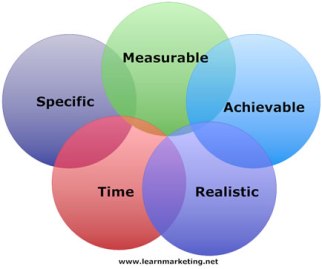
smartWe are all taught at an early age in our careers (i.e. ‘Management for dummies’) that we should cascade down S.M.A.R.T objectives. You will come across it as an idea that is so deeply rooted that it has been co-opted as ‘common sense’.

Sounds so good, it must be right, right?

Let’s just remind ourselves what SMART stands for:

  • Specific
  • Measurable
  • Achievable
  • Realistic
  • Time bound

Let’s then also remind ourselves about the definition of a system (taken from my earlier ‘Harmony or cacophony’ post):

“A system is a network of interdependent components that work together to try to accomplish the aim [purpose] of the system.” (W. Edwards Deming)

The cascaded objectives technique (known as Management by Objectives, or M.B.O) is used by ‘Command-and-control’ organisations in the mistaken belief that, if we all achieve our cascaded personal objectives, these will then all roll up to achieve the overall goal (whatever that actually is).

This misunderstands:

  • the over-riding need for all the parts (components) of a system to fit together; and
  • the damage caused by attempting to optimise the components…because this will harm the whole system.

A simple illustrative example (taken from Peter Scholtes’ superb book called ‘The Leaders Handbook’):

Let’s say that we run a delivery company – our system. Fred, Amy and Dave are our drivers – our people components. If we provide them each with SMART personal objectives cascaded down (and offer performance-based pay), we might assume that they will all be ‘motivated’ to achieve them and therefore, taken together, the purpose of the whole will be achieved. Sounds great – I’ll have some of that!

…but what should we expect?

  • Each driver might compete with the others to get the best, most reliable, largest-capacity truck;
  • Each driver might compete for the easiest delivery assignments;
  • Drivers might engage in ‘creative accounting’: such as trying to get one delivery counted as two; or unloading a delivery somewhere nearby where it can be made after hours so that they can go back to the warehouse to get more jobs;
  • If we have created a competition out of it (say, the getting of a desirable award) then we can expect to see little driver co-operation, more resentment and perhaps even subtle sabotage.

The above shows that the sum of the outcomes will not add up to what we intended for the whole system…and, in fact, will have caused much unmeasured (and likely immeasurable) damage!

This is a good point to bring out Eli Goldratt’s classic quote:

“Tell me how you will measure me and I will tell [show*] you how I will behave.”

* I prefer to use the word ‘show’ since most people won’t tell you! They know their actions aren’t good for the overall system (they aren’t stupid) and so don’t like telling you what daft practices the management system has ended up creating.

A critique of S.M.A.R.T:

“SMART doesn’t tell us how to determine what to measure, and it assumes knowledge – otherwise how do we know what is ‘achievable’ and ‘realistic’? It is only likely to promote the use of arbitrary measures that will sub-optimise the system.” (John Seddon)

If an individual (or ‘team’) is given a truly SMART objective then, by definition, it would have to have been set so that they could achieve it on their own….otherwise it would be unrealistic.

Therefore any interdependencies it has with the rest of the organisational system would have to have been removed…which, clearly, given the definition of a system means one of the following:

  • if all interdependencies had been successfully removed…then meeting the resultant SMART objective will be:
    • a very insignificant (and very possibly meaningless) achievement for the system; and/or
    • sub-optimal to the system (i.e. work against the good of the whole)

OR

  • if (most likely) it was in fact not possible to truly remove the interdependencies…despite what delicate and time consuming ‘word smith-ing’ was arrived at…then:
    • it will be a lottery (not really under the person’s control) as to whether it can be achieved; and/or
    • it will ‘clash’ with other components (and their supposedly SMART objectives) within the system

So where did the post title ‘D.U.M.B’ come from? Here’s a thought provoking quote from John Seddon:

“We should not allow a plausible acronym to fool us into believing that there is, within it, a reliable method.”

Consider     

  • SMART: Specific, Measurable, Achievable, Realistic, Time-bound

With

  • DUMB: Distorting, Undermining, Management-inspired, Blocking improvement

Does the fact that the acronym and its components ‘match’ make it any more worthy?

Cascaded personal objectives will either be ineffective, detrimental to the whole system or a lottery (outside of the person’s control) as to whether they can be achieved.

We need to move away from cascaded personal objectives and, instead:

  • see each horizontal value stream as a system, with customers and a related purpose;
  • provide those working within these systems with visible measures of the capability of the system as against its purpose; and
  • desist from attempting to judge individuals ‘performance’ and thereby allow and foster collaboration and a group desire to improve the system as a whole.

Harmony or cacophony

One more time…what is a system?

In the wonderful YouTube clip called ‘If Russ Ackoff had given a TED talk’ (from way back in 1994), we get a really clear explanation about what a system is and, more importantly, why this matters!

A recap from W. Edwards Deming:

“A system is a network of interdependent components that work together to try to accomplish the aim [purpose] of the system.”

“If the various components of an organisation are all optimised, the organisation will not be. If the whole is optimised, the components will not be.”

Dr Deming used to use the example of an orchestra to illustrate this point.

DSC_1637

  • A fine orchestra (the system) is highly interdependent;
  • The musicians (the components) are not there to stand out to the listener in a ‘look at me and what I can do’ manner…can you imagine the outcome of performance incentives – each musician being rewarded for playing faster and louder than the others! Such incentives are the source of cacophony that destroys value;
  • The musicians are there to support each other, to achieve the harmony that comes from the interaction of their specialised instruments adhering to the same fundamental rhythm, towards the same aim;
  • They are usually not ‘the best’ players in the country. They work as a team under the leadership of the conductor.

Another way of looking at this is that someone focused on the ‘efficiency’ of the orchestra would find them very inefficient – some of them are just sitting there waiting, tapping their feet! If the efficiency specialist would have their way, all the musicians would be playing all their instruments all the time!

Note that Deming considered a business to be even more interdependent than an orchestra and that, without real teamwork across the components, chaos is rampant.

It has been said that command-and-control companies get ordinary results after extensively searching, and fighting, for the limited supply of extra-ordinary people (what was coined as ‘the war for talent’ by McKinsey) whilst the likes of Toyota (and other ‘Systems thinking’ organisations) consistently obtain extraordinary results from ordinary people.

The point is that it is about optimising the system, not its components…and, to do this, we need to understand the obstacles that our current management system puts in the way and replace them with something better!

Anointing heroes

super-heroDr Deming’s red bead experiment simply yet brilliantly shows that, when we rate and rank people, we are mostly rating and ranking the effect of the system on the people.

“Apparent performance is actually attributable mostly to the system that the individual works in, not to the individual…the so-called merit system introduces conflict between people and destroys co-operation. Emphasis goes to achievement of rank, merit, not on the work…judging a person, putting them into slots, does not help them to do a better job.” (Deming)

To illustrate this point – compare two people performing two different roles:

  • If you give me a job (let’s say focused 100% on ‘improvement’) in which I can look good and am enabled to help people then, guess what, I’ll be their hero;
  • If you give me a job in which I have to ‘shovel the proverbial sh1t’ (let’s say as an over stretched ‘worker’ being asked to achieve the impossible) then, guess what, I will hardly be noticed….unless I’m not making my arbitrarily-set numerical activity targets…in which case I will be dealing with even more pain.

…who’s the real hero?!

I think anointing certain people as heroes because of what the system enabled them to achieve is a very unhealthy practise (for the supposed heroes’ and for the rest).

After explaining to a colleague how ‘the system’ has a huge influence over what someone can achieve, she made a really great ‘aha’ comment back to me:

It goes something like this:

“…that explains why I couldn’t work out whether that project manager working for me was any good!    

  • on one project he was superb: great communications, fantastic results on time/ within budget etc.
  • on another project he seemed terrible: nothing was going right, completely off track and seemingly no ability to do anything about it.

I now understand that I was judging him when, in fact, I should have been considering what the system was allowing him to achieve – the first project had a clear sponsor and much backing, the second project was an organisational orphan with difficult people and many historic issues, a virtual hospital pass!”

I am a mathematician at heart and Dr Deming used a wonderful formula to explain the above…bear with me:

  • Let x be the contribution of an individual
  • Let y(x) be the effect of the system on his/ her performance
  • Finally, let’s suppose we could measure the complete result of a person’s performance – a dubious idea in itself….but for the sake of this post, let’s suppose we have a number for his/ her apparent performance, such as 8 mistakes in the year or sales of $800,000.

Then we have the equation        x + y(x) = 8

(i.e. the individual’s contribution combined with what the system enabled him/ her to accomplish will determine the outcome s/he can achieve)

Deming goes on to explain

“To rate the individual we need to know x. Unfortunately, there are two unknowns and only one equation. Johnny in the sixth grade knows that no one can solve this equation for x.

Yet people that use the merit system think that they are solving it for x. They ignore the other term y(x), which is predominant.”

Now, a standard response to the above from people working in a command-and-control system is as follows:

“…but some people really are rubbish and/or lazy… and the above allows them to use the ‘it’s the system’ thing as an excuse!”

A couple of thoughts back:

  • If someone isn’t capable of performing the role they are being asked to perform, then:
    • are we failing to develop them into this role? or, if we’ve (truly) done what we can here;
    • have we incorrectly put them into this role?
  •  If someone hasn’t got any interest in their role, then:
    • has this been ‘beaten out of them’ by the system? (a very common reality) or, if not;
    • have we misunderstood or, worse, not (properly) considered what motivates this person?

Rating and ranking them ignores and hides the above. It tries to make it their problem….but who is responsible for the environment in which they work?

The difference between…

tree+bookA short and, hopefully, light hearted post for you:

For those of you who have been on an improvement course with me you will know that I start off by saying that it isn’t a training course, it is about education (with the same being true about this blog).

I use Deming’s quote of:

“We’re not here to learn skills; we’re here for education – to learn theory.”

If you are uncertain about the difference between training (learning skills) and education then I think Alfie Kohn (leading education psychologist) makes the distinction  really clear with the following:

“Would you want your kids to be provided with Sex Training or Sex Education?”

…I don’t think I need to say anymore to explain that!

‘Management by results’…how does that work?!

cause_effect__1_1_5312The CEO of the company I work for recently shared a tweet with us summing up an insight she gained at a recent engagement she attended, which read as follows:

“Nick Farr-Jones dinner guest at conference key message focus on process not the scoreboard and you will get result.”

I like this tweet – the words, whilst short, are incredibly important for anyone wanting to make improvements. I thought it useful to dig into this a bit.

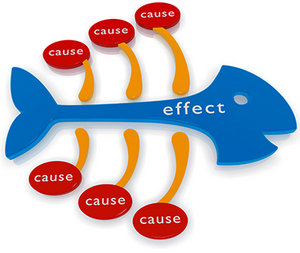
Dr W. Edwards Deming was very clear on this point! He set out the practise of ‘Management by results’ (e.g. focusing on a scoreboard of outcomes) as one of the diseases of a ‘modern organisation’ and, instead, proposed that we should spend our time and focus on understanding and improving the processes that produce the results i.e. the results are the outcome of something, and you can look at the outcome till you are blue in the face…but this won’t make it change!

“The outcome of management by results is more trouble, not less….Certainly we need good results, but management by results is not the way to get good results….It is important to work on the causes of the results – i.e. on the system. Costs are not causes: costs come from causes.” (Deming, The New Economics)

Professor John Seddon (think ‘Deming on steroids’ for Service organisations 🙂 ) takes this message on further. He notes that the measures used in most organisations are ‘lagging’ or ‘rear-view’ measures – they tell you what you did.

Seddon has a very clear view on measurement but at this time I want to simply put forward his thinking regarding the difference between operational and financial measures. He says that we should use:

  • Operational measures (such as demand for a service, and a processes capability to deliver against its purpose) to manage; and
  • Financial measures (revenues, costs) to keep the score.

We know that one affects the other but we can never know exactly how and it is waste to divert time and effort to try to do so.

Bringing this back to Nick Farr-Jones and Rugby: A rugby coach uses process measures to manage (e.g. passes complete, line-outs won, tackles made…) and the result quite literally as the score!

So Nick Farr-Jones, Deming and Seddon quite clearly agree with each other. If you work on the capability of a system/ value stream/ process to deliver against its purpose (as from the customer’s point of view) then the results will come.

Finally, you may be thinking ‘ah yes, this is where the balanced scorecard comes in’…there’s a post in there! Watch this space.